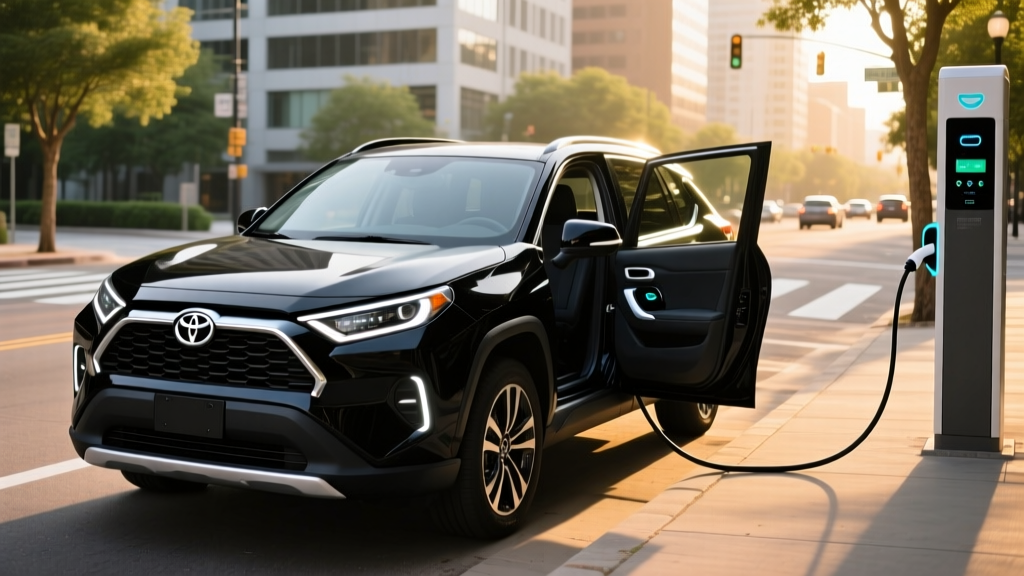
The Toyota RAV4 Hybrid has anchored the compact SUV segment for years, and for good reason: it delivers genuine fuel savings without requiring a plug, a charging routine, or any lifestyle change. For 2026, Toyota continues to offer the RAV4 Hybrid in multiple trims — all available in black exterior paint across Midnight Black Metallic and, on select trims, a blacked-out appearance package. Whether you're eyeing the conventional hybrid (HEV) or the plug-in RAV4 Prime (PHEV), this guide breaks down every number that matters: EPA MPG, real-world fuel economy, powertrain output, battery warranty, pricing, and tax-credit eligibility.
If you've been searching for a black Toyota RAV4 Hybrid and want to know whether the HEV or the Prime PHEV is the right call — or whether you should skip both for a full battery-electric vehicle — this is the spec-driven walkthrough you need.
HEV vs PHEV: Which RAV4 Hybrid Are You Actually Looking At?
Toyota sells two electrified RAV4 variants, and confusing them is the single most common buyer mistake. Here's the fundamental split:
RAV4 Hybrid (HEV) — Conventional Hybrid
How it works: A 2.5L four-cylinder engine pairs with electric motor-generators and a small (~1.6 kWh) nickel-metal hydride or lithium-ion battery. The battery charges through regenerative braking and the engine — you never plug it in.
Best for: Drivers who want better MPG with zero routine change. No charging cable, no outlet needed, no electric-only driving to manage.
RAV4 Prime (PHEV) — Plug-In Hybrid
How it works: A larger 18.1 kWh lithium-ion battery pack powers the vehicle for up to 42 miles on electricity alone (EPA estimate). Once depleted, it operates exactly like a conventional hybrid. You can plug it in to recharge — and should, to capture the efficiency benefit.
Best for: Drivers with home charging access and short commutes who want EV-like daily driving with a gas-engine safety net for road trips.
Both are available in black. The HEV is significantly more affordable and far more widely available at dealerships. The Prime commands a premium and has historically faced long waitlists.
Fuel Economy: EPA MPG and Real-World Numbers
Fuel economy is the core reason buyers choose the RAV4 Hybrid over the gas-only RAV4. Here's how the numbers stack up across the lineup, sourced from fueleconomy.gov:
| Model | City MPG | Highway MPG | Combined MPG | Electric-Only Range |
|---|---|---|---|---|
| 2026 RAV4 Hybrid (AWD) | 41 | 38 | 39 | N/A |
| 2026 RAV4 Hybrid (FWD LE) | 27 (gas base) | 35 (gas base) | 30 (gas base) | N/A |
| 2026 RAV4 Prime (PHEV, AWD) | 40 (hybrid mode) | 36 (hybrid mode) | 38 (hybrid mode) / 94 MPGe (EV mode) | 42 miles |
Real-World MPG: What Owners Actually Report
The EPA estimates above are standardized lab tests. In real-world driving, Toyota's hybrid system — which relies heavily on electric motor assist at low speeds — tends to exceed its EPA city rating in stop-and-go traffic. Many RAV4 Hybrid owners report 42-44 MPG in urban commuting. Highway driving at 75+ mph, however, often drops to 34-36 MPG, since the gasoline engine carries more of the load at sustained speed.
For the RAV4 Prime, the 42-mile electric-only range holds up well in mild weather (60-75°F). In cold conditions (below 30°F), expect that range to contract to roughly 32-36 miles as cabin heating and battery thermal management draw energy. Once the battery depletes, the Prime operates as a conventional hybrid at approximately 36-38 MPG combined.
Powertrain Specs: Horsepower, Engine, and Motors
| Specification | RAV4 Hybrid (HEV) | RAV4 Prime (PHEV) |
|---|---|---|
| Engine | 2.5L 4-cyl Dynamic Force | 2.5L 4-cyl Dynamic Force |
| Combined Net Horsepower | 219 hp | 302 hp |
| 0-60 mph | ~7.4 seconds | ~5.7 seconds |
| Drivetrain | AWD (electronic rear motor) | AWD (electronic rear motor) |
| Hybrid Battery Capacity | ~1.6 kWh (NiMH/Li-ion) | 18.1 kWh (Li-ion) |
| Towing Capacity | 1,750 lbs | 1,750 lbs |
The RAV4 Prime's 302 combined horsepower makes it the quickest RAV4 Toyota sells — quicker, in fact, than many turbocharged competitors in the segment. The HEV's 219 hp is adequate for daily driving and highway merging, though it won't feel sporty.
RAV4 Prime Charging: Plug-In Specs and Times
This section applies only to the RAV4 Prime (PHEV). The conventional RAV4 Hybrid does not plug in and has no charging port.
| Charging Method | Power | 0-100% Time | Notes |
|---|---|---|---|
| Level 1 (120V household outlet) | ~1.4 kW | ~12 hours | Included cable; overnight charge |
| Level 2 (240V, home or public) | ~3.3 kW (Prime onboard charger limit) | ~4.5 hours | J1772 connector |
| DC Fast Charge | Not supported | N/A | No CCS/CHAdeMO capability |
A key limitation: the RAV4 Prime's onboard charger maxes out at 3.3 kW, meaning even a 48-amp Level 2 home charger won't fill it any faster than a 16-amp unit. And there is no DC fast-charging capability — you won't find a CCS or CHAdeMO port on this vehicle. For a PHEV with an 18.1 kWh battery, this isn't a dealbreaker (the battery is small enough for overnight Level 1 or Level 2), but it's worth knowing before you invest in expensive charging equipment.
Pricing: 2026 RAV4 Hybrid and Prime MSRP
Below are approximate starting MSRPs for the 2026 model year. Black exterior paint (Midnight Black Metallic) is a no-cost color on most trims, though some appearance packages may carry a premium.
| Trim | Approx. MSRP | Powertrain |
|---|---|---|
| RAV4 Hybrid LE | ~$33,500 | HEV |
| RAV4 Hybrid XLE | ~$35,000 | HEV |
| RAV4 Hybrid XLE Premium | ~$37,500 | HEV |
| RAV4 Hybrid Limited | ~$40,500 | HEV |
| RAV4 Prime SE | ~$44,500 | PHEV |
| RAV4 Prime XSE | ~$48,000 | PHEV |
Federal Tax Credit Eligibility
The conventional RAV4 Hybrid (HEV) does not qualify for the federal §30D clean vehicle tax credit. That credit is reserved for plug-in electric vehicles with sufficient battery capacity and qualifying domestic battery sourcing.
The RAV4 Prime (PHEV) may qualify for up to $7,500 under §30D, but eligibility is not guaranteed for every buyer or every vehicle. Current IRS rules impose:
- Buyer income caps: Modified AGI must not exceed $150,000 (single), $225,000 (head of household), or $300,000 (joint).
- MSRP cap: The vehicle's MSRP must not exceed $80,000 for SUVs (the Prime clears this easily).
- Battery sourcing requirements: Critical minerals and battery components must meet phased-in domestic/F TA content thresholds. Toyota's supply chain for the Prime has historically partially met these requirements, but the qualifying credit amount (full $7,500, partial $3,750, or $0) can change as sourcing rules tighten.
- Point-of-sale transfer: As of 2024+, qualifying buyers can transfer the credit to the dealer at purchase for an immediate price reduction, rather than waiting for a tax refund.
Always verify current eligibility on IRS.gov or consult a tax professional before assuming the credit applies to your purchase.
Battery Warranty, Reliability, and Replacement Cost
Toyota Hybrid Battery Warranty
RAV4 Hybrid (HEV): 10 years / 150,000 miles (whichever comes first) on the hybrid battery, per Toyota's current Hybrid Battery Coverage policy.
RAV4 Prime (PHEV): 10 years / 150,000 miles on the traction battery pack, with a capacity retention guarantee (typically 70% or above during the warranty period).
Powertrain warranty: 5 years / 60,000 miles on both models.
How Long Do Toyota Hybrid Batteries Actually Last?
Toyota's hybrid battery track record is among the best in the industry. The Prius — which shares core hybrid-system architecture — routinely sees original batteries lasting 150,000-200,000+ miles. The RAV4 Hybrid's battery is smaller and less stressed than a full EV pack, and Toyota's hybrid system never deeply cycles it (the battery operates in a narrow state-of-charge window, typically 40-80%, which dramatically extends cycle life).
Real-world failure rates for Toyota hybrid batteries in the first 10 years are low. When replacement is needed out of warranty:
- RAV4 Hybrid (HEV): ~$3,000-$4,000 for a new OEM battery pack; refurbished units available for ~$1,500-$2,500.
- RAV4 Prime (PHEV): ~$6,000-$8,000+ for the larger 18.1 kWh pack, given its higher capacity and more complex thermal management.
For context, most owners will never pay for a hybrid battery replacement. The 10-year/150,000-mile warranty covers the vast majority of ownership, and many vehicles are traded before the battery reaches end-of-life.
Black Exterior: Trim Availability and Appearance Options
Midnight Black Metallic is a standard (no-cost) color across virtually every RAV4 Hybrid and RAV4 Prime trim. For buyers who want a fully blacked-out aesthetic, Toyota has offered appearance packages on select trims (such as black roof rails, black mirror caps, and black wheel accents) — availability varies by model year and trim. Check with your local dealer for the specific 2026 appearance package configuration, as Toyota adjusts these offerings annually.
One practical note: black paint shows swirl marks, dust, and water spots more readily than silver or white. If you're particular about appearance, budget for a ceramic coating or regular hand-wash maintenance.
Hybrid vs PHEV vs Full EV: Which Is Right for You?
Decision Framework
Choose the RAV4 Hybrid (HEV) if:
- You don't have access to home or workplace charging
- You want maximum MPG with zero behavioral change
- Your budget is under $40,000
- You drive a mix of city and highway and want consistent efficiency
Choose the RAV4 Prime (PHEV) if:
- You have a garage or driveway where you can install a Level 2 charger (or use a 120V outlet overnight)
- Your daily commute is under 40 miles round-trip (you'll rarely use gas)
- You want EV-like quietness for daily driving but need gas-engine range for road trips
- You can capture the §30D federal tax credit, narrowing the price gap with the HEV
Choose a full EV (like the Toyota bZ4X, Tesla Model Y, or Hyundai Ioniq 5) if:
- You have reliable home charging and your daily driving is under 250 miles
- You want zero tailpipe emissions and minimal maintenance (no oil changes, no engine)
- You're ready to plan around DC fast-charging for road trips
- You want to fully eliminate gasoline costs
Pros and Cons at a Glance
Pros
- 39 MPG combined (HEV) — among the best in the compact SUV class
- No plug-in required for the HEV; zero lifestyle change
- 10-year / 150,000-mile hybrid battery warranty
- Standard AWD on most trims (electronic rear motor)
- Toyota Safety Sense 2.5+ ADAS suite included on all trims
- Strong resale value and proven reliability record
- RAV4 Prime offers 302 hp and 42 miles of EV range
Cons
- HEV does not qualify for the federal §30D tax credit
- RAV4 Prime is expensive (~$44,500+) and often hard to find in stock
- Prime's 3.3 kW onboard charger limits Level 2 speed; no DC fast charging
- 1,750-lb towing capacity trails some turbocharged gas rivals
- Infotainment system functional but not class-leading in responsiveness
- Highway MPG drops to mid-30s at sustained 75+ mph speeds
Frequently Asked Questions
How many MPG does the black Toyota RAV4 Hybrid get?
The 2026 RAV4 Hybrid with AWD is EPA-rated at 41 city / 38 highway / 39 combined MPG. In real-world city driving, many owners report 42-44 MPG thanks to Toyota's hybrid system relying on electric motor assist at low speeds. Highway driving at higher speeds typically yields 34-36 MPG.
How far can the RAV4 Prime go on electric only?
The 2026 RAV4 Prime delivers an EPA-estimated 42 miles of electric-only range on a full charge. In cold weather (below 30°F), expect approximately 32-36 miles due to cabin heating demand and battery efficiency loss. Once the battery is depleted, it operates as a conventional hybrid at ~36-38 MPG.
Does the RAV4 Hybrid qualify for any tax credit?
The conventional RAV4 Hybrid (HEV) does not qualify for the federal §30D clean vehicle tax credit — it lacks a plug and sufficient battery capacity. The RAV4 Prime (PHEV) may qualify for up to $7,500 depending on your income, the vehicle's battery sourcing compliance, and current IRS rules. Check IRS.gov for the latest eligibility details.
Is the Toyota RAV4 Hybrid reliable, and what does battery replacement cost?
Toyota's hybrid system has a strong reliability record spanning two decades. The hybrid battery is covered by a 10-year / 150,000-mile warranty. Out-of-warranty replacement costs approximately $3,000-$4,000 for the HEV and $6,000-$8,000 for the Prime's larger pack. In practice, most Toyota hybrid batteries last 150,000-200,000+ miles, and many owners never face a replacement.
Do I need to plug in the RAV4 Hybrid?
No. The conventional RAV4 Hybrid (HEV) charges its small battery through regenerative braking and the gasoline engine. There is no plug, no charging port, and no electric-only range to manage. Only the RAV4 Prime (PHEV) has a charging port and benefits from being plugged in.
Is the RAV4 Prime worth the premium over the regular Hybrid?
It depends on your situation. If you can charge at home and your daily driving stays under 42 miles, the Prime lets you drive almost entirely on electricity — saving significantly on fuel. The 302 hp powertrain is also substantially quicker. However, the ~$10,000+ price premium over the HEV takes years of fuel savings to recoup unless you qualify for the full $7,500 federal tax credit, which narrows the gap considerably.