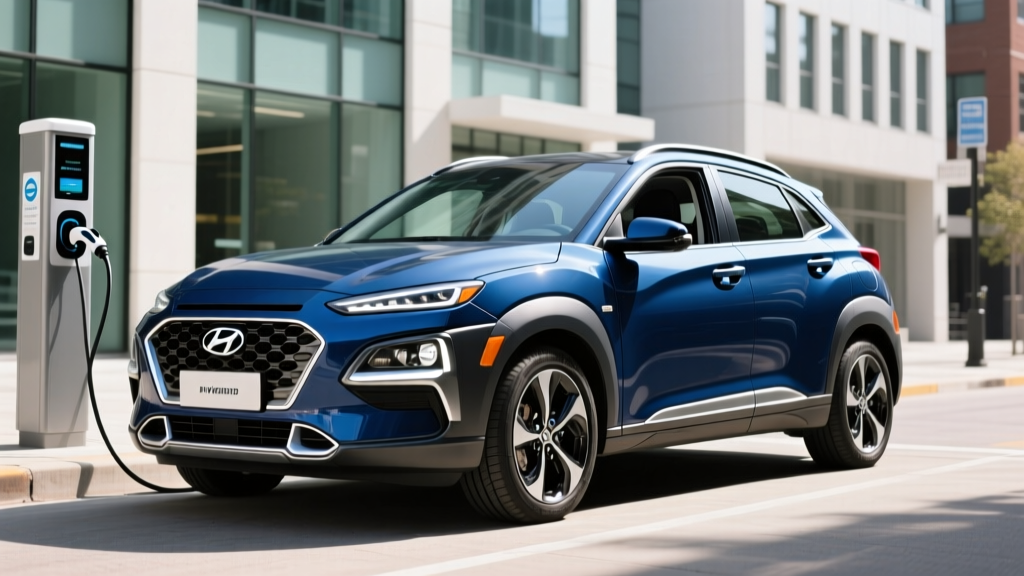
The 2024 Hyundai Kona Hybrid arrived as a complete redesign for Hyundai's compact crossover lineup, offering a conventional hybrid (HEV) powertrain alongside its gas-only and fully electric siblings. For buyers who want electrified efficiency without plugging in, the Kona Hybrid targets a specific sweet spot: crossover practicality, strong city MPG, and a sub-$30,000 starting price. But does its real-world fuel economy match the EPA sticker, and how does it stack up against a PHEV or full EV for your daily driving?
We've analyzed the 2024 Kona Hybrid's powertrain data, EPA ratings, ownership costs, and battery longevity to help you decide whether this HEV fits your garage — or whether you should look at a plug-in alternative.
HEV vs PHEV vs EV: Where the Kona Hybrid Fits
Before examining specs, it's critical to understand what the 2024 Hyundai Kona Hybrid is — and what it isn't. The Kona Hybrid is a conventional hybrid electric vehicle (HEV). It pairs a gasoline engine with a small electric motor and a compact battery that recharges through regenerative braking and engine power. You never plug it in.
This distinguishes it from two other electrified options:
| Feature | HEV (Kona Hybrid) | PHEV (e.g., Tucson PHEV) | BEV (e.g., Kona Electric) |
|---|---|---|---|
| Plug-in charging | No | Yes (Level 1/2) | Yes (Level 1/2/DC) |
| Electric-only range | ~1 mile at low speed | 25–33 miles typical | 200–300+ miles |
| Battery size | ~1.3 kWh | 13–18 kWh | 60–80+ kWh |
| Gasoline required | Yes | Yes | No |
| Federal tax credit (§30D) | No | Up to $7,500* | Up to $7,500* |
| Starting MSRP range | ~$28,000 | ~$37,000+ | ~$33,000+ |
*§30D credit eligibility depends on MSRP caps, buyer income limits, and battery-sourcing requirements. See IRS guidelines for current rules.
The Kona Hybrid is designed for buyers who want better fuel economy than a gas-only car but don't have reliable access to home or workplace charging. If you can plug in nightly, a PHEV or BEV will deliver lower running costs. If you can't, the HEV is the pragmatic choice.
EPA Fuel Economy & Real-World MPG
The 2024 Hyundai Kona Hybrid carries EPA ratings that vary slightly by trim and wheel size. Here's the official breakdown from fueleconomy.gov:
| Configuration | City MPG | Highway MPG | Combined MPG |
|---|---|---|---|
| Blue trim (16" wheels) | 51 | 45 | 48 |
| SEL / Limited (18" wheels) | 47 | 40 | 44 |
The Blue trim's 51 city / 48 combined rating makes it one of the most efficient non-plug-in crossovers on the market, rivaling the Toyota Prius in city driving despite offering more cargo room and a higher seating position.
Powertrain Specs: Engine, Motor & Combined Output
The 2024 Kona Hybrid uses Hyundai's Smartstream G1.6 hybrid powertrain, a setup shared with the Hyundai Elantra Hybrid and Kia Niro. Here's the full mechanical breakdown:
| Specification | Detail |
|---|---|
| Engine | 1.6L GDI 4-cylinder (104 hp / 109 lb-ft) |
| Electric motor | Permanent-magnet synchronous (32 kW / 43 hp / 125 lb-ft) |
| Combined system output | 140 hp / 195 lb-ft torque |
| Transmission | 6-speed dual-clutch automatic (DCT) |
| Drivetrain | Front-wheel drive (FWD only) |
| Hybrid battery | ~1.3 kWh lithium-ion polymer |
| 0–60 mph (est.) | ~9.0 seconds |
| Curb weight | ~3,200–3,350 lbs |
Hyundai's choice of a 6-speed DCT rather than a CVT gives the Kona Hybrid a more natural, stepped acceleration feel — a deliberate departure from the droning rubber-band sensation common in Toyota's hybrid system. The trade-off is slightly less seamless low-speed transitions, though Hyundai's tuning has largely smoothed this out for the 2024 redesign.
The 140 combined horsepower figure puts the Kona Hybrid in the adequate-but-not-quick category. Merging onto highways is confident enough, but this isn't a performance-oriented vehicle. Buyers prioritizing acceleration should look at the Kona's turbocharged 1.6T gas variant (190 hp) or the Kona Electric (201 hp, instant torque).
Battery Warranty, Longevity & Replacement Cost
Hybrid battery anxiety remains a top concern for first-time HEV buyers. Here's what Hyundai provides:
- Duration: 10 years / 100,000 miles (whichever comes first)
- Coverage: Defects and capacity loss below functional threshold
- Transferability: Warranty transfers to subsequent owners on 2024 models
- Hybrid system components: 10 yr / 100,000 mi (motor, inverter, DCT)
- Vehicle warranty: 5 yr / 60,000 mi bumper-to-bumper
The 1.3 kWh hybrid battery in the Kona HEV is far smaller and less stressed than a full EV battery pack. It cycles within a narrow state-of-charge window (roughly 40–80%), which dramatically reduces degradation. Hyundai's lithium-ion polymer cells have proven durable across the Ioniq and Niro platforms, with widespread owner reports of minimal capacity loss past 150,000 miles.
Replacement cost context: Should the hybrid battery fail outside warranty, a replacement typically runs $2,000–$3,500 including labor — substantially less than an EV traction battery ($8,000–$20,000+). Third-party refurbishers and hybrid battery specialists now offer reconditioned units for $1,200–$2,000. In practice, the vast majority of Hyundai hybrid batteries outlast the vehicle itself.
Pricing, Trims & Tax Credit Eligibility
The 2024 Hyundai Kona Hybrid is offered in three trims in the U.S. market:
| Trim | MSRP (incl. destination) | Key Features |
|---|---|---|
| Blue | ~$28,975 | 16" alloy wheels, 12.3" dual displays, wireless CarPlay/Android Auto, SmartSense ADAS suite |
| SEL Convenience | ~$31,475 | 18" wheels, heated seats, power liftgate, roof rails, Digital Key |
| Limited | ~$34,475 | Leather, ventilated front seats, Bose audio, HUD, Highway Driving Assist, sunroof |
The pricing gap between the Kona Hybrid and a comparable PHEV (like the Hyundai Tucson PHEV at ~$37,000+ before credit) is significant. Even after a potential $7,500 federal credit on a PHEV, the Kona Hybrid's lower purchase price and simpler powertrain mean lower upfront cost and fewer variables at tax time.
Driving Impressions & Practicality
The 2024 redesign gave the Kona a substantial size increase — roughly 6 inches longer than the prior generation — translating to meaningful gains in rear-seat legroom and cargo capacity. The hybrid variant offers approximately 25.5 cubic feet behind the rear seats and 63.7 cubic feet with the rear seats folded, competitive with the Subaru Crosstrek and Mazda CX-30.
On the road, the Kona Hybrid prioritizes comfort over sportiness. The suspension absorbs pavement imperfections well, and cabin noise is notably lower than the previous generation thanks to improved insulation and the engine's tendency to shut off at low speeds. The SmartSense ADAS suite (standard on all trims) includes forward collision-avoidance assist, lane-keeping assist, blind-spot monitoring, and rear cross-traffic alert. Higher trims add Highway Driving Assist, which combines adaptive cruise control with lane centering — a Level 2 system that still requires full driver attention.
One practical limitation: the Kona Hybrid is FWD-only. If you need all-wheel drive for snow or gravel, you'll need to look at the gas-only Kona AWD, the Tucson Hybrid AWD, or the Toyota RAV4 Hybrid (which offers standard AWD).
Who Should Buy the Kona Hybrid — And Who Shouldn't
- You want 45+ MPG combined without plugging in
- You lack home/workplace charging access
- You want a crossover ride height with car-like efficiency
- Your budget caps around $30,000–$34,000
- You mostly drive in city/suburban stop-and-go conditions
- You want Hyundai's 10-year hybrid battery warranty
- You have reliable home charging (a PHEV or BEV saves more per mile)
- You need AWD for snow/mountain driving
- You want brisk acceleration (0–60 in ~9 sec is leisurely)
- You tow anything (not rated for towing)
- You want electric-only commuting without gas
- You want the federal $7,500 tax credit
- Choose the Kona Hybrid over a gas car if: You drive 12,000+ miles/year in mixed city/highway conditions. At 48 combined MPG vs. ~30 MPG for the gas Kona, you'll save roughly $500–$700/year in fuel (at $3.50/gal), paying back the ~$2,000 hybrid premium in 3–4 years.
- Choose a PHEV over the Kona Hybrid if: You can charge at home and your daily commute is under 30 miles. A Tucson PHEV covers most commutes on electricity alone, with the gas engine as a road-trip backup.
- Choose a full EV over the Kona Hybrid if: You have Level 2 home charging, drive under 250 miles daily, and want the lowest per-mile cost (~$0.04/mile on electricity vs. ~$0.08/mile on hybrid gas).
Frequently Asked Questions
How many MPG does the 2024 Hyundai Kona Hybrid get?
The EPA rates the Kona Hybrid Blue trim at 51 city / 45 highway / 48 combined MPG. Higher trims with 18-inch wheels drop to 47 / 40 / 44 MPG. In real-world city driving, many owners report exceeding the city rating by 2–5 MPG thanks to regenerative braking. Highway driving at 75+ mph typically yields 38–42 MPG.
Does the Kona Hybrid need to be plugged in?
No. The Kona Hybrid is a conventional HEV. Its small 1.3 kWh battery recharges through regenerative braking and the gasoline engine. You fuel it like any other car — just with fewer stops at the pump.
Is the 2024 Kona Hybrid reliable?
Hyundai's hybrid powertrain has proven durable across the Ioniq, Elantra Hybrid, and Kia Niro platforms. The 1.6L Smartstream engine is naturally aspirated and mechanically simple, while the DCT has received software updates addressing earlier-generation roughness. The hybrid battery carries a 10-year / 100,000-mile warranty. Hyundai's brand reliability has climbed in J.D. Power and Consumer Reports rankings, though long-term data specific to the redesigned 2024 Kona Hybrid is still accumulating.
How much does a Kona Hybrid battery replacement cost?
Out-of-warranty hybrid battery replacement typically costs $2,000–$3,500 including labor. Refurbished or reconditioned units are available for $1,200–$2,000. In practice, Hyundai hybrid batteries rarely require replacement within the first 150,000 miles due to their narrow state-of-charge operating window and conservative thermal management.
Does the Kona Hybrid qualify for any tax credits?
The Kona Hybrid does not qualify for the federal §30D Clean Vehicle Credit, which is limited to plug-in vehicles (PHEVs and BEVs). Some states and local utilities offer modest rebates for conventional hybrids — check your state energy office or dealer for current programs. If the federal credit is important to you, consider a PHEV or BEV instead.
Does the Kona Hybrid come with AWD?
No. The 2024 Kona Hybrid is front-wheel drive only across all trims. If AWD is essential, consider the gas-only Kona (available with AWD), the Hyundai Tucson Hybrid AWD, or the Toyota RAV4 Hybrid (standard AWD).
How does the Kona Hybrid compare to the Toyota RAV4 Hybrid?
The RAV4 Hybrid is larger, offers standard AWD, and rates at 39–41 MPG combined. The Kona Hybrid is smaller but more efficient (44–48 combined) and starts at a lower price. If you need rear-seat space and all-weather capability, the RAV4 wins. If you prioritize maximum MPG in a compact footprint, the Kona Hybrid has the edge.
Sources: EPA fueleconomy.gov, Hyundai Newsroom, IRS §30D Clean Vehicle Credit, IIHS.