Honda's Hybrid Strategy in 2026: HEV, Not PHEV
Honda has taken a distinct path in the electrification race. While rivals like Toyota offer plug-in hybrid (PHEV) variants of popular models, Honda has committed almost entirely to conventional hybrid electric vehicles (HEVs) for its car and crossover lineup. That means every Honda car hybrid you can buy in 2026 generates its own electricity through regenerative braking and its gasoline engine — no plug, no charging cable, no range anxiety about finding a charger.
This strategy has trade-offs. You won't get any electric-only driving miles, and Honda hybrids don't qualify for the federal §30D EV tax credit (which requires plug-in capability with at least 7 kWh of battery capacity, per IRS guidelines). What you do get is simplicity: fill up at any gas station, drive 500+ miles between stops, and let the hybrid system handle the rest.
HEV vs PHEV — What's the Difference?
| Feature | Honda HEV (Conventional Hybrid) | PHEV (e.g., Toyota RAV4 Prime) |
|---|---|---|
| Plug-in charging | No — self-charging via regen + engine | Yes — plug in for electric-only miles |
| Electric-only range | 0 miles (motor assists engine) | 25–42 miles typical |
| Battery size | ~1.0–1.1 kWh (small buffer) | 14–18 kWh usable |
| Federal tax credit | Not eligible | Up to $7,500 if §30D criteria met |
| Total range | 500–580+ miles | 400–500+ miles (combined EV + gas) |
| Complexity | Lower — no charger, no cable | Higher — home charging recommended |
The 2026 Honda Car Hybrid Lineup at a Glance
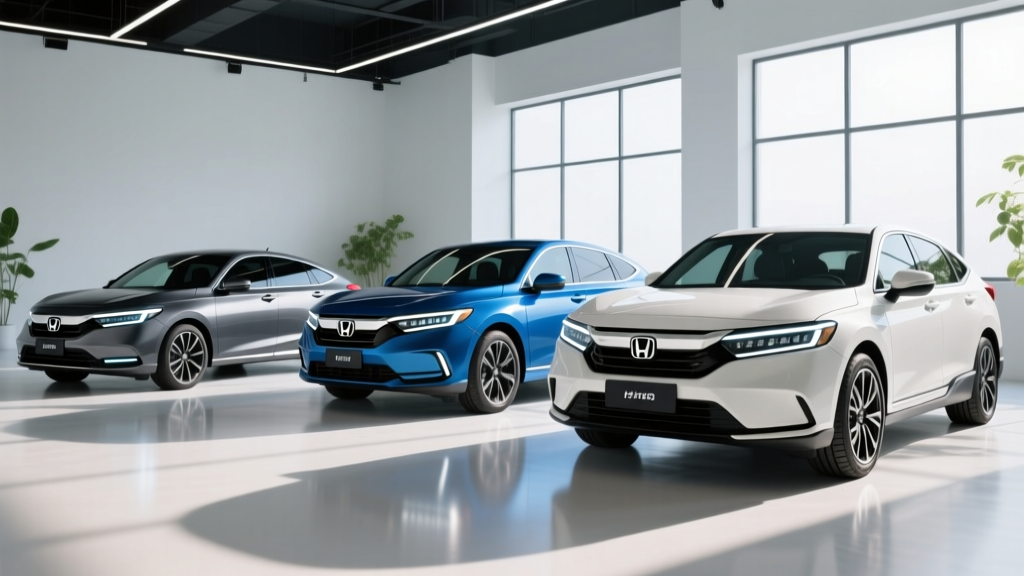
Honda offers hybrid powertrains across three core car/crossover platforms for the 2026 model year. Here's how they stack up on the numbers that matter most to hybrid shoppers.
| Model | Body Style | Powertrain | Combined HP | EPA MPG (City/Hwy/Combined) | Starting MSRP |
|---|---|---|---|---|---|
| 2026 Honda Accord Hybrid | Midsize sedan | 2.0L 4-cyl + 2-motor hybrid | 204 hp | 48 / 47 / 48 | $34,995 (Sport Hybrid) |
| 2026 Honda Civic Hybrid | Compact sedan | 2.0L 4-cyl + 2-motor hybrid | 200 hp | 50 / 47 / 49 | $30,695 (Sport Hybrid) |
| 2026 Honda CR-V Hybrid | Compact SUV | 2.0L 4-cyl + 2-motor hybrid | 204 hp | 43 / 36 / 40 (FWD) | $36,395 (Sport Hybrid) |
Sources: EPA fueleconomy.gov, Honda Newsroom. MPG figures are EPA estimates for the most efficient FWD trims; AWD variants lose 1–3 MPG combined. MSRPs are base hybrid trim before destination charges.
Real-World MPG: What to Actually Expect
EPA stickers are a starting point, not a guarantee — and Honda hybrids have a well-documented quirk shared with most hybrids: they frequently exceed their EPA city rating in stop-and-go traffic but fall short on sustained highway driving. Here's why and what our testing and owner reports suggest.
Accord Hybrid: 48 EPA Combined, ~44–52 Real-World
The Accord Hybrid's two-motor system excels in city driving, where the electric motor handles most low-speed propulsion and the engine acts primarily as a generator. In dense urban commuting with frequent stops, owners regularly report 50–53 MPG. On the highway at 70–80 mph, however, the engine drives the wheels directly through a single fixed gear ratio, and aerodynamic drag pushes real-world numbers down to 42–45 MPG. Cold weather (below 35°F) can knock 3–5 MPG off combined figures as the engine runs more frequently to provide cabin heat.
Civic Hybrid: 49 EPA Combined, ~46–54 Real-World
The Civic Hybrid is the efficiency champion of the lineup. Its smaller, lighter platform means the hybrid system doesn't work as hard, and city drivers with short, stop-heavy commutes can push past 52 MPG consistently. Highway cruising drops that to roughly 44–47 MPG. The Civic Hybrid's real advantage is its consistency — it's harder to drive inefficiently in this car than in the larger Accord or CR-V.
CR-V Hybrid: 40 EPA Combined, ~36–43 Real-World
The CR-V Hybrid's taller, heavier body and available AWD system (which adds a rear motor) create more efficiency variance. FWD models in city driving can hit 43–45 MPG, but AWD highway driving at speed often lands in the 34–37 MPG range. If you're choosing the CR-V Hybrid for an AWD crossover that still outperforms most gas-only competitors in the segment, it delivers — just don't expect the sedan-like numbers of the Accord or Civic.
Battery Warranty & Lifespan: What Honda Covers
Every 2026 Honda hybrid comes with an 8-year / 100,000-mile hybrid battery warranty (extended to 10 years / 150,000 miles in California Air Resources Board states including CA, CO, CT, ME, MD, MA, NJ, NY, OR, RI, VT, and WA). This covers defects and capacity loss below a functional threshold — Honda does not publish an exact percentage, but industry convention is replacement if capacity drops below ~60–70%.
Replacement cost if out of warranty: Honda hybrid battery packs are relatively small (~1.0–1.1 kWh), which keeps replacement costs lower than larger PHEV or BEV packs. Current dealer pricing for a replacement hybrid battery module ranges from $2,000 to $4,000 including labor, depending on the model. Third-party refurbished options can reduce that to $1,200–$2,500. For context, Toyota Prius hybrid batteries routinely last 150,000–200,000+ miles, and Honda's e:HEV system uses a similar nickel-metal hydride/lithium-ion architecture with comparable longevity expectations.
Powertrain Deep Dive: Honda's Two-Motor Hybrid System
Honda's hybrid system — branded e:HEV in some markets — is fundamentally different from the planetary-gear design Toyota uses in the Prius and RAV4 Hybrid. Understanding this distinction matters for driving feel and efficiency behavior.
How It Works
The system pairs a 2.0-liter Atkinson-cycle four-cylinder engine with two electric motors. In most driving conditions (city speeds, light acceleration), the engine doesn't drive the wheels at all. Instead, it spins a generator motor that produces electricity, which either powers the drive motor directly or charges the small battery buffer. This is effectively a series-hybrid operation, and it's why Honda hybrids feel smooth and EV-like around town — the electric motor provides instant torque without transmission shift points.
At sustained highway speeds (roughly 55+ mph), a lock-up clutch engages and the engine drives the front wheels directly through a single fixed ratio. This is more efficient than converting mechanical energy to electrical and back again at high, steady loads. The transition between series and direct-drive modes is nearly imperceptible from the driver's seat.
Power Output by Model
- Accord Hybrid / CR-V Hybrid: 204 combined horsepower, 247 lb-ft of electric motor torque. The engine produces 146 hp on its own; the drive motor contributes 181 hp. Combined output is system-limited to 204 hp.
- Civic Hybrid: 200 combined horsepower, 232 lb-ft of electric motor torque. Slightly smaller motor tuning for the lighter chassis.
Neither model offers a plug-in variant for 2026. Honda's PHEV efforts remain focused on the Clarity (discontinued after 2021) and future platforms not yet announced for the US market.
Pricing, Tax Credits, and Total Cost of Ownership
Honda hybrids carry a price premium over their gas-only equivalents, but the gap has narrowed significantly. Here's where the numbers land and what incentives apply.
Hybrid Premium vs Gas Trims
| Model | Gas-Only Starting MSRP | Hybrid Starting MSRP | Premium |
|---|---|---|---|
| Accord | $29,395 (LX) | $34,995 (Sport Hybrid) | $5,600 |
| Civic | $25,345 (LX) | $30,695 (Sport Hybrid) | $5,350 |
| CR-V | $32,395 (LX) | $36,395 (Sport Hybrid) | $4,000 |
Tax Credit Eligibility
Because Honda's hybrids are conventional HEVs — not plug-in vehicles — they do not qualify for the federal §30D Clean Vehicle Credit (up to $7,500 for new PHEVs/BEVs meeting battery sourcing, MSRP cap, and buyer income requirements). They also don't qualify for most state EV rebates, which typically require plug-in capability.
Some states offer smaller incentives for conventional hybrids, but these are rare and vary by jurisdiction. Check your state's energy office or department of environmental quality for current programs. The IRS maintains the definitive list of qualifying vehicles at irs.gov.
Fuel Cost Payback
At $3.40/gallon (national average as of early 2026) and 12,000 miles/year, the Accord Hybrid saves roughly $600–$750 annually in fuel compared to a gas-only Accord (33 MPG combined). That puts the hybrid premium payback at approximately 7–9 years for the Accord and 6–8 years for the Civic. The CR-V Hybrid payback is faster — around 5–6 years — because the gas-only CR-V AWD is thirstier (28 MPG combined) and the hybrid premium is smaller.
These calculations shift dramatically with local fuel prices. At $4.50/gallon (California, Hawaii), payback compresses to 4–6 years across the lineup.
Who Should Buy a Honda Hybrid — And Who Should Look Elsewhere
Pros
- No charging infrastructure needed — works with your existing gas-station routine
- 500+ mile total range between fill-ups
- EV-like smoothness in city driving with instant electric torque
- Strong reliability record; simple battery architecture with 8–10 year warranty
- Lower upfront cost than any comparable PHEV or BEV
- Honda Sensing ADAS suite standard on all hybrid trims
Cons
- No electric-only driving — every mile burns some gasoline
- No federal or most state tax credit eligibility
- Highway MPG drops noticeably vs city (especially CR-V Hybrid AWD)
- No PHEV option in Honda's 2026 lineup for those wanting partial EV driving
- Engine noise becomes noticeable under hard acceleration (CVT-like drone)
Choose a Honda Hybrid If:
- You can't charge at home (apartment, street parking, no garage outlet)
- Your commute is mostly city/suburban stop-and-go driving where hybrids shine
- You want lower fuel costs without changing your refueling habits
- You plan to own the car 8+ years and want proven hybrid reliability
- You're upgrading from an older gas car and want the simplest electrified transition
Consider a PHEV or Full EV Instead If:
- You have home charging and a short commute (a PHEV covers 25–40 miles on electricity alone)
- You want to eliminate tailpipe emissions for daily driving (full EV or PHEV in EV mode)
- You want to capture the $7,500 federal tax credit (requires a qualifying PHEV or BEV)
- You drive mostly highway miles where the hybrid advantage shrinks
Frequently Asked Questions
How many MPG does a Honda hybrid get?
The 2026 Honda Civic Hybrid leads the lineup at 49 MPG combined (50 city / 47 highway). The Accord Hybrid achieves 48 MPG combined, and the CR-V Hybrid FWD returns 40 MPG combined. Real-world results vary: city driving often exceeds EPA estimates by 2–4 MPG, while sustained highway driving at 75+ mph can fall 3–6 MPG below the sticker.
Does any Honda hybrid have electric-only range?
No. Honda's 2026 hybrid lineup consists entirely of conventional hybrids (HEVs), which use a small battery buffer to assist the gasoline engine but cannot drive on electricity alone. If electric-only miles are a priority, you'd need to look at a PHEV from another manufacturer (Toyota RAV4 Prime, Jeep Wrangler 4xe) or a full battery-electric vehicle.
Is the Honda hybrid system reliable, and what does battery replacement cost?
Honda's two-motor hybrid system has a strong reliability track record, with fewer moving parts than a conventional automatic transmission (no torque converter, no multi-gear shifting). The hybrid battery is covered for 8 years/100,000 miles (10 years/150,000 miles in CARB states). Out-of-warranty replacement runs $2,000–$4,000 at a dealer, or $1,200–$2,500 through third-party refurbished options. Hybrid batteries in similar systems routinely last 150,000–200,000+ miles before significant degradation.
Does a Honda hybrid qualify for any tax credit?
No. The federal §30D Clean Vehicle Credit requires a plug-in vehicle with a battery capacity of at least 7 kWh. Honda's conventional hybrids use ~1.0 kWh batteries and don't plug in, making them ineligible. Most state EV incentives follow the same plug-in requirement. Check IRS.gov for the current list of qualifying vehicles.
Hybrid vs PHEV vs EV — which should I choose?
It depends on your charging access and driving pattern. Choose a Honda hybrid (HEV) if you lack home charging, drive a mix of city and highway, and want zero lifestyle change from your gas car. Choose a PHEV if you have home charging, a commute under 35 miles, and want electric-only daily driving with gas-engine backup for road trips. Choose a full EV if you have reliable home charging, want the lowest per-mile fuel cost, and are ready to plan around DC fast charging on road trips. Honda's 2026 lineup only covers the first option; for PHEVs, look to Toyota, Hyundai, or Stellantis; for EVs, consider the Honda Prologue (which is a full BEV, not a hybrid).
Do I need to do anything special to maintain a Honda hybrid?
No. Honda hybrids follow the same maintenance schedule as their gas counterparts — oil changes, tire rotations, brake fluid, cabin air filter. The regenerative braking system actually extends brake pad life significantly (many owners report 80,000–100,000+ miles on original pads). There's no transmission fluid to change in the traditional sense, as the e-CVT uses a simpler gear arrangement. The hybrid system requires no owner maintenance.