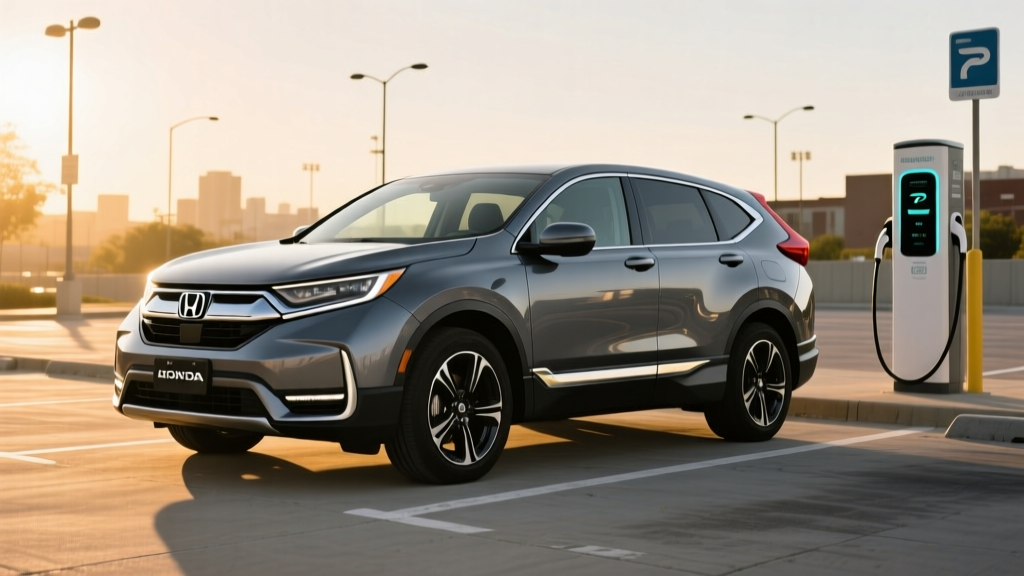
If you are researching the 2024 Honda CR-V Hybrid MPG, you likely already know the CR-V is America's best-selling compact SUV. But the hybrid variant is where Honda's efficiency engineering shines brightest. For 2024, the CR-V Hybrid returns with a refined two-motor system that delivers up to 40 MPG combined — a figure that holds up remarkably well in real-world driving, particularly in the city where hybrid systems do their best work.
This guide covers the full efficiency picture: EPA city/highway/combined figures, how the hybrid powertrain actually works, real-world MPG expectations, battery longevity, pricing, and whether the CR-V Hybrid is the right electrified choice for your garage — or whether a PHEV or full BEV might serve you better.
2024 Honda CR-V Hybrid MPG: The EPA Numbers
The 2024 Honda CR-V Hybrid is offered in three trims — Sport, Sport-L, and Sport Touring — and the EPA fuel economy figures differ slightly depending on whether you choose front-wheel drive (FWD) or all-wheel drive (AWD). Here is the complete breakdown from fueleconomy.gov:
| Trim / Drivetrain | City MPG | Highway MPG | Combined MPG |
|---|---|---|---|
| Sport FWD | 43 | 36 | 40 |
| Sport AWD | 40 | 34 | 37 |
| Sport-L FWD | 43 | 36 | 40 |
| Sport-L AWD | 40 | 34 | 37 |
| Sport Touring AWD (standard) | 40 | 34 | 37 |
The FWD Sport and Sport-L trims lead the lineup at 43 city / 36 highway / 40 combined. The city-dominant split is classic hybrid behavior: the electric motor handles low-speed acceleration, where gas engines are least efficient, while the engine takes over more at highway speeds. The AWD penalty is modest — a 3 MPG drop across the board — making it one of the least costly AWD upgrades in the compact SUV segment in terms of efficiency loss.
Real-World MPG vs. EPA: What Owners Actually See
EPA numbers are a baseline, not a guarantee. The 2024 CR-V Hybrid's real-world fuel economy depends heavily on your driving mix:
- City-dominant commuting (under 45 mph): Many owners report meeting or exceeding the 43 MPG city EPA figure. The hybrid system thrives in stop-and-go traffic, where regenerative braking recaptures energy and the engine shuts off frequently. Expect 40–45 MPG in heavy urban driving.
- Highway cruising (70–80 mph): Hybrids lose their advantage at sustained high speed. Expect 32–35 MPG at 75 mph, roughly matching or slightly below the EPA highway estimate. Aerodynamic drag dominates here, and the engine runs continuously.
- Mixed driving (50/50 city-highway): Most owners land between 36–40 MPG combined, aligning closely with EPA estimates for their drivetrain.
- Cold weather (below freezing): Expect a 10–15% reduction, bringing combined figures to roughly 34–36 MPG. The engine runs more to generate cabin heat and warm the catalytic converter.
Compared to the gas-only 2024 CR-V (rated at 29 city / 34 highway / 31 combined for FWD), the hybrid delivers a 9 MPG improvement in combined driving — roughly a 29% efficiency gain. Over 15,000 miles per year at $3.50/gallon, that translates to approximately $450–$500 in annual fuel savings.
How the CR-V Hybrid Powertrain Works
The 2024 CR-V Hybrid uses Honda's fourth-generation two-motor hybrid system, which operates quite differently from a traditional parallel hybrid like the older Toyota system. Here's what's under the hood:
| Specification | 2024 CR-V Hybrid |
|---|---|
| Engine | 2.0L Atkinson-cycle 4-cylinder |
| Engine Output | 145 hp / 138 lb-ft torque |
| Electric Motors | Two (one drive motor, one generator) |
| Drive Motor Output | 184 hp / 247 lb-ft torque |
| Combined System Output | 204 hp / 247 lb-ft torque |
| Transmission | e-CVT (no traditional gears) |
| 0–60 mph | ~7.6 seconds (AWD) |
| Drivetrain Options | FWD or AWD (AWD standard on Sport Touring) |
| Towing Capacity | 1,000 lbs |
The system primarily operates as a series hybrid at low and moderate speeds: the gas engine spins the generator motor, which produces electricity to power the drive motor. The engine does not directly drive the wheels in this mode. At highway speeds, a lock-up clutch engages, allowing the engine to drive the wheels directly for better efficiency — this is where it behaves like a parallel hybrid.
The result is seamless, electric-motor-dominant acceleration around town with the engine contributing its best efficiency at cruising speed. The 247 lb-ft of electric torque is available immediately, making the CR-V Hybrid feel notably more responsive than its gas-only counterpart, especially from a stop.
CR-V Hybrid vs. PHEV vs. Full EV: Which Fits You?
A common question: should you buy the CR-V Hybrid, wait for a plug-in version, or go full electric? Here's how to think about it:
Conventional Hybrid (HEV) — The 2024 CR-V Hybrid
- No plug required. The battery recharges via regenerative braking and the gas engine. You fuel it like any normal car.
- Battery size: ~1.06 kWh (small lithium-ion pack, used as a buffer — not for electric-only driving beyond very low-speed creep)
- Best for: Drivers without reliable home charging access, those who take frequent long road trips, or anyone who wants efficiency gains without changing fueling habits.
Plug-In Hybrid (PHEV) — Not Available for CR-V in the US
Honda does not currently sell a CR-V PHEV in the United States. The CR-V e:PHEV exists in China and Europe with a ~17 kWh battery and roughly 40+ miles of electric-only range, but it is not part of Honda's US lineup for 2024 or 2025. If you want a compact SUV PHEV in this price range, consider the Toyota RAV4 Prime (42 miles EV range, 94 MPGe) or the Hyundai Tucson PHEV (33 miles EV range).
Full Battery Electric (BEV)
If you have reliable Level 2 home charging and your daily driving is under 250 miles, a BEV like the Hyundai Ioniq 5, Tesla Model Y, or Ford Mustang Mach-E eliminates fuel stops entirely and offers lower per-mile energy costs. However, BEVs require a bigger upfront investment and more planning for road trips.
Choose a PHEV (RAV4 Prime, Tucson PHEV) if: You can charge at home and want 30–42 miles of electric-only commuting with a gas backup for road trips.
Choose a full EV if: You have Level 2 home charging, your daily commute is under 200 miles, and you want to eliminate gas entirely.
Pricing, Trims, and Tax Credit Eligibility
The 2024 Honda CR-V Hybrid is positioned as a value-oriented electrified SUV. Here's the MSRP breakdown by trim (including destination charge):
- Sport Hybrid FWD: $35,395
- Sport Hybrid AWD: $36,895
- Sport-L Hybrid FWD: $37,795
- Sport-L Hybrid AWD: $39,295
- Sport Touring Hybrid AWD: $42,195
Does the CR-V Hybrid Qualify for a Federal Tax Credit?
No. The conventional CR-V Hybrid (HEV) does not qualify for the federal §30D Clean Vehicle Credit. That credit — up to $7,500 — is reserved for plug-in electric vehicles (BEVs and PHEVs) that meet battery sourcing, critical minerals, MSRP caps, and buyer income requirements under current IRS rules.
Conventional hybrids are not eligible for any federal purchase incentive. Some states and municipalities offer small rebates for hybrids (typically $250–$500), but these vary widely. Check your state energy office or local utility for current programs.
Battery Warranty, Reliability, and Replacement Cost
Hybrid battery longevity is one of the most common concerns among first-time hybrid buyers. Here's what Honda covers:
- Hybrid battery (traction): 8 years / 100,000 miles (10 years / 150,000 miles in CARB states including CA, NY, MA, and others)
- Hybrid system components: 8 years / 100,000 miles
- Standard vehicle warranty: 3 years / 36,000 miles bumper-to-bumper; 5 years / 60,000 miles powertrain
The CR-V Hybrid's ~1 kWh battery pack is small and operates within a narrow state-of-charge window (roughly 40–80%), which significantly reduces degradation stress. Honda's hybrid batteries have proven durable: the company's earlier hybrid systems in the Accord Hybrid and Insight routinely exceeded 150,000 miles without battery replacement.
What Does Hybrid Battery Replacement Cost?
If the hybrid battery does fail outside of warranty — which is uncommon before 150,000+ miles — replacement costs for the CR-V Hybrid battery pack currently range from $2,000 to $4,000 including parts and labor. This is substantially less than a full EV battery replacement because the pack is small (~1 kWh vs. 60–100 kWh in a BEV). Refurbished and aftermarket options may reduce this cost further as the vehicle ages.
For context, the IIHS awarded the 2024 CR-V a Top Safety Pick rating, and Honda's hybrid powertrain has consistently scored above average in long-term reliability surveys from Consumer Reports and J.D. Power.
Who Should Buy the 2024 CR-V Hybrid?
Pros
- 40 MPG combined (FWD) with no plug-in required
- 204 hp and 247 lb-ft of electric torque — responsive acceleration
- Modest AWD efficiency penalty (only 3 MPG)
- 8-year/100,000-mile hybrid battery warranty
- Proven Honda reliability and strong resale value
- Spacious interior with 39.3 cu ft cargo behind rear seats
Cons
- No plug-in hybrid option available in the US
- Highway MPG drops to 34 (AWD) at sustained speed
- 1,000-lb towing limit (lower than gas CR-V's 1,500 lbs)
- No federal tax credit for conventional hybrids
- Road noise noticeable above 70 mph
- Sport Touring trim pushes past $42,000
The 2024 CR-V Hybrid is the right choice for buyers who want a practical, efficient compact SUV without the complexity of plug-in charging. If your daily routine includes a mix of city errands and highway commuting, the hybrid system works invisibly — you simply drive and refuel as normal, while burning 29% less gas than the non-hybrid CR-V.
It is not the right choice if you want electric-only driving for your commute (look at a PHEV) or if you want to eliminate gasoline entirely (consider a BEV). But for the vast majority of SUV buyers who aren't ready to plug in, the CR-V Hybrid delivers one of the best efficiency-to-utility ratios on the market.
Frequently Asked Questions
How many MPG does the 2024 Honda CR-V Hybrid get?
The EPA rates the 2024 CR-V Hybrid at 43 city / 36 highway / 40 combined for FWD trims, and 40 city / 34 highway / 37 combined for AWD trims. Real-world mixed driving typically yields 36–40 MPG.
Does the Honda CR-V Hybrid need to be plugged in?
No. The CR-V Hybrid is a conventional hybrid (HEV). Its small battery recharges automatically through regenerative braking and the gas engine. You never plug it in — you fuel it like a regular gasoline car.
Is there a plug-in hybrid (PHEV) version of the CR-V?
Not in the United States. Honda sells a CR-V e:PHEV in China and Europe, but it is not available in the US market. If you want a compact SUV PHEV, the Toyota RAV4 Prime and Hyundai Tucson PHEV are the closest alternatives.
How long will the CR-V Hybrid battery last?
Honda covers the hybrid battery for 8 years / 100,000 miles (10 years / 150,000 miles in CARB states). Based on Honda's track record with earlier hybrid models, the battery should last 150,000+ miles under normal driving conditions. Replacement costs $2,000–$4,000 if needed out of warranty.
Does the 2024 CR-V Hybrid qualify for a tax credit?
No federal tax credit is available for conventional hybrids under current IRS §30D rules. The federal credit applies only to plug-in vehicles (BEVs and PHEVs). Some state or utility rebates may apply — check your local programs.
Is the CR-V Hybrid slower than the gas version?
No. The hybrid produces 204 combined horsepower and 247 lb-ft of torque, compared to the gas CR-V's 190 hp and 179 lb-ft. The hybrid's electric torque delivery makes it feel quicker in city driving, though 0–60 times are similar at roughly 7.6 seconds.
How does the CR-V Hybrid compare to the Toyota RAV4 Hybrid?
The 2024 RAV4 Hybrid is rated at 41 city / 38 highway / 40 combined (AWD standard). The RAV4 Hybrid has a slight highway advantage, while the CR-V Hybrid offers a more refined interior, newer infotainment, and slightly more cargo space. Both are strong choices at roughly the same price point.