Quick Verdict: A Proven HEV That Still Delivers in 2026
The 2007 Toyota Highlander Hybrid V6 is a conventional hybrid electric vehicle (HEV) — not a plug-in. It pairs a 3.3-liter V6 with Toyota's Hybrid Synergy Drive system to deliver EPA-rated 26 MPG combined, a figure that still competes with many modern crossovers. Nearly two decades on, the Highlander Hybrid's reputation for durability and straightforward ownership makes it a compelling used-vehicle pick for buyers who want hybrid efficiency without plug-in complexity.
But at 19 years old, the central question for any 2026 buyer is the traction battery. We'll cover what to expect from MPG to battery replacement cost, and help you decide whether this first-generation hybrid SUV fits your needs versus a newer HEV, PHEV, or full BEV.
2007 Highlander Hybrid V6 Powertrain Specs
The 2007 Highlander Hybrid uses Toyota's second-generation Hybrid Synergy Drive. The 3.3L 3MZ-FE V6 produces 208 hp on its own, while two electric motor-generators (MG1 and MG2) work through a planetary-gear eCVT to yield a net system output of 270 hp. Power is routed to all four wheels via Toyota's E-Four system, which adds a rear-mounted electric motor for on-demand AWD without a mechanical driveshaft.
| Specification | Value |
|---|---|
| Engine | 3.3L V6 (3MZ-FE), 208 hp |
| Net System Horsepower | 270 hp |
| Transmission | eCVT (planetary gearset) |
| Drivetrain | E-Four AWD (electric rear motor) |
| Traction Battery | NiMH, ~6.5 kWh (sealed, non-pluggable) |
| EPA Fuel Economy | 26 MPG combined (see table below) |
| 0-60 mph | ~7.3 seconds (est.) |
| Curb Weight | ~4,330 lbs |
| Towing Capacity | 3,500 lbs |
| Original MSRP | $33,735 (Base) / $35,955 (Limited) |
Fuel Economy: EPA Ratings vs. Real-World MPG
The EPA rates the 2007 Toyota Highlander Hybrid V6 at 27 MPG city, 25 MPG highway, and 26 MPG combined, per fueleconomy.gov. These figures apply to the AWD configuration standard on all Hybrid trims.
| Driving Cycle | EPA MPG |
|---|---|
| City | 27 MPG |
| Highway | 25 MPG |
| Combined | 26 MPG |
Real-World Expectations in 2026
Toyota's Hybrid Synergy Drive system is particularly effective in stop-and-go traffic, where regenerative braking recaptures energy and the electric motor handles low-speed propulsion. Many owners report 28-30 MPG in city-heavy driving, exceeding the EPA city estimate. Highway-only driving at 75+ mph typically drops to 23-24 MPG due to the boxy aerodynamics and 4,300-lb curb weight.
At 19 years old, actual MPG will depend heavily on battery health. A degraded NiMH pack reduces the system's ability to assist the gasoline engine and capture regen energy. Expect a 2-4 MPG drop if the battery is significantly weakened but not yet failed. Replacing or reconditioning the pack (see below) typically restores fuel economy to near-original figures.
HEV vs. PHEV vs. EV: Where the 2007 Highlander Hybrid Fits
The 2007 Highlander Hybrid is a conventional hybrid (HEV). It cannot be plugged in. The NiMH battery charges exclusively through regenerative braking and the gasoline engine. There is no electric-only driving range beyond brief low-speed assist.
This is a critical distinction from plug-in hybrids (PHEVs) like the current Toyota RAV4 Prime or full battery-electric vehicles (BEVs) like the Tesla Model Y. Here's how the three electrified powertrain types compare for a buyer in 2026:
| Factor | HEV (e.g., '07 Highlander Hybrid) | PHEV (e.g., RAV4 Prime) | BEV (e.g., Model Y) |
|---|---|---|---|
| Plug-in required? | No | Yes, for EV range | Yes, always |
| Electric-only range | None (motor assist only) | 30-42 miles typical | 250-330+ miles |
| Home charging needed? | No | Recommended (Level 2) | Essential (Level 2) |
| Fuel/energy cost per mile | ~$0.12-$0.15 | ~$0.04 (EV) / $0.12 (gas) | ~$0.04-$0.06 |
| Used market entry price (2026) | $4,000-$8,000 | $25,000-$40,000 | $20,000-$45,000 |
| Federal tax credit (§30D) | Not eligible | Up to $7,500 (new only) | Up to $7,500 (new/used rules vary) |
| Maintenance complexity | Low (proven Toyota V6) | Moderate (dual systems) | Low (no engine/trans) |
Battery Life, Replacement Cost & Warranty Status
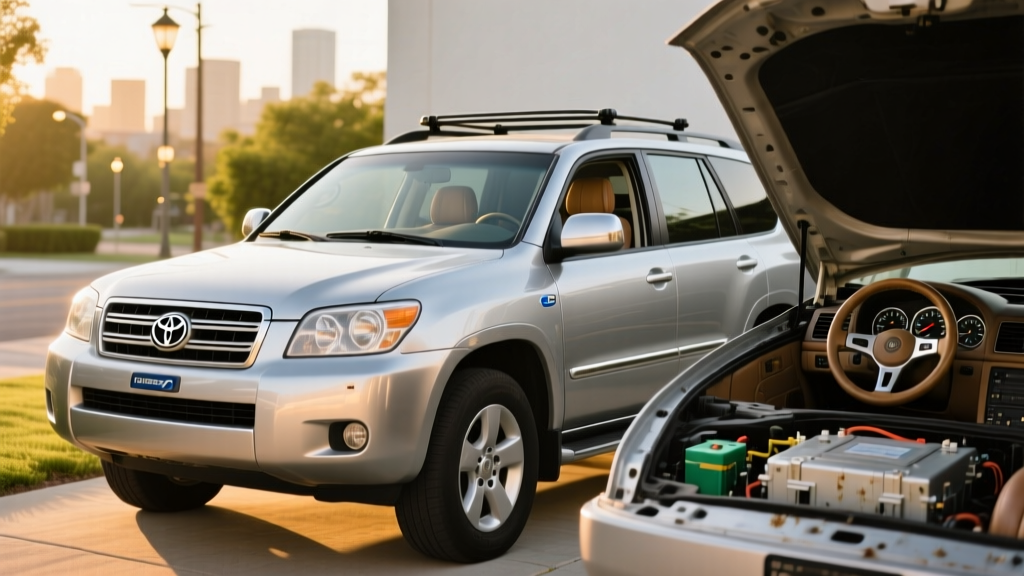
The 2007 Highlander Hybrid's NiMH traction battery was originally covered by Toyota's hybrid battery warranty: 8 years / 100,000 miles (10 years / 150,000 miles in CARB states including California, New York, Massachusetts, and others that adopted California emissions standards). In 2026, every original warranty has expired regardless of mileage.
How Long Does the Battery Last?
Toyota's NiMH packs in this generation typically last 150,000-200,000 miles before significant degradation triggers a check-engine light or noticeable fuel economy loss. Some units have exceeded 250,000 miles with proper thermal management (avoiding prolonged high-SoC storage in extreme heat). At the 2026 mark, most surviving examples are either on a replacement pack or approaching the need for one.
Battery Replacement Costs
| Option | Estimated Cost | Notes |
|---|---|---|
| New OEM Toyota pack | $3,000-$4,500 (installed) | Available through dealers; best longevity |
| Remanufactured pack | $1,800-$2,800 (installed) | Rebuilt with tested cells; 1-3 year warranty typical |
| Used/salvage pack | $600-$1,200 (plus install) | Risky — unknown remaining life; budget option |
| Individual module replacement | $400-$900 (specialist shops) | Replace only failed modules; requires cell-balancing expertise |
For a vehicle valued at $4,000-$8,000 in 2026, a full OEM replacement may approach the vehicle's worth. Many owners opt for remanufactured packs or individual module replacement to keep costs proportional. Independent hybrid specialists (not general mechanics) typically offer the best value for module-level repairs.
Reliability Track Record & Common Issues
The 2007 Highlander Hybrid benefits from Toyota's strongest era of build quality. The 3MZ-FE V6 is a timing-belt engine (not chain), so timing belt and water pump service every 90,000-100,000 miles is mandatory — a $600-$1,000 maintenance item that non-hybrid buyers might overlook.
Beyond the traction battery and timing belt, common age-related concerns include:
- Inverter coolant pump: The hybrid inverter has its own electric coolant pump. Failure can overheat the inverter ($1,500-$2,500 replacement). Listen for unusual whining from the engine bay.
- Brake actuator: The regenerative braking system uses an electro-hydraulic actuator. Replacement runs $1,200-$1,800 if it fails, though many units last 200k+ miles.
- 12V auxiliary battery: Located in the rear cargo area. Standard replacement; not the traction battery. A weak 12V can prevent the hybrid system from booting.
- Suspension components: Struts, bushings, and sway bar links at this age are standard wear items for any 4,300-lb SUV.
The eCVT transmission is a planetary gearset with no belts, clutches, or bands to wear. It is widely regarded as one of the most durable transmissions Toyota has ever produced, with failures being exceptionally rare when fluid is changed at recommended intervals.
Pricing & Tax Credit Eligibility in 2026
The 2007 Highlander Hybrid originally carried an MSRP of $33,735 for the base trim and $35,955 for the Limited. In 2026's used market, expect to pay:
- $4,000-$5,500 — High mileage (180k+), potential battery concerns, cosmetic wear
- $5,500-$7,000 — Moderate mileage (120k-180k), documented maintenance, healthy battery
- $7,000-$9,000 — Lower mileage (under 120k), excellent condition, recent battery replacement
Federal Tax Credit Status
The 2007 Toyota Highlander Hybrid does not qualify for the federal §30D new clean vehicle credit, which applies only to new vehicle purchases and has specific MSRP, income, and battery-sourcing requirements under current IRS rules. The used clean vehicle credit (up to $4,000 or 30% of sale price, whichever is less) under §25E applies only to vehicles with an MSRP under $25,000 when new — which excludes the Highlander Hybrid's original $33,735+ sticker.
Bottom line: No federal tax credits are available for this vehicle in 2026. Some states or local utilities may offer used-EV or hybrid incentives — check your state's energy office for current programs.
Who Should Buy the 2007 Highlander Hybrid?
✓ Good Fit
- Budget buyers needing AWD and 3-row seating under $8,000
- Apartment/condo dwellers with no charging access
- Commuters with heavy stop-and-go traffic (where HEVs shine)
- Toyota loyalists comfortable with basic DIY maintenance
- Second-car buyers wanting low running costs
✗ Look Elsewhere
- Buyers wanting EV-only commuting (consider a PHEV or BEV)
- Those seeking modern safety tech (no auto emergency braking, lane keep, etc.)
- Highway-dominant drivers over 20k miles/year (fuel savings diminish)
- Anyone unwilling to budget $2,000-$4,000 for potential battery work
- Buyers wanting Apple CarPlay, modern infotainment, or USB-C
2007 Highlander Hybrid vs. Modern Alternatives
If the 2007 Highlander Hybrid's age or battery risk gives you pause, consider these alternatives at different price points:
| Vehicle | Year Range | EPA Combined MPG | Typical Used Price | Key Advantage |
|---|---|---|---|---|
| Toyota Highlander Hybrid (2nd gen) | 2008-2013 | 25-26 MPG | $8,000-$14,000 | Updated styling, newer battery |
| Toyota RAV4 Hybrid | 2016-2019 | 32-34 MPG | $16,000-$24,000 | Better efficiency, modern safety |
| Lexus RX 450h | 2010-2015 | 29-30 MPG | $12,000-$20,000 | Premium interior, same powertrain DNA |
| Ford Escape Hybrid | 2010-2012 | 29-31 MPG | $5,000-$8,000 | Lower entry price, decent efficiency |
Frequently Asked Questions
How many MPG does the 2007 Toyota Highlander Hybrid V6 get?
The EPA rates it at 27 MPG city, 25 MPG highway, and 26 MPG combined. In real-world city-heavy driving, many owners achieve 28-30 MPG thanks to aggressive regenerative braking and electric motor assist at low speeds. Highway-only driving at 75+ mph typically yields 23-24 MPG.
Does the 2007 Highlander Hybrid need to be plugged in?
No. It is a conventional hybrid (HEV), not a plug-in hybrid (PHEV). The NiMH battery charges through regenerative braking and the gasoline engine. You fuel it like any other vehicle — there is no charging port.
How far can it drive on electric power alone?
The 2007 Highlander Hybrid cannot drive on electric power alone for any meaningful distance. The electric motor assists the V6 at low speeds and during acceleration, but the gasoline engine runs nearly continuously. This is fundamentally different from a PHEV, which offers 25-42 miles of electric-only range.
Is the 2007 Highlander Hybrid reliable, and what does a battery replacement cost?
Yes — the powertrain is among Toyota's most durable. The eCVT and 3MZ-FE V6 are proven to reach 250,000+ miles with proper maintenance. The main risk is the NiMH traction battery, which typically lasts 150,000-200,000 miles. Replacement costs range from $600 (used pack) to $4,500 (new OEM, installed), with remanufactured options around $2,000-$2,800.
Does it qualify for any federal tax credit?
No. The §30D new clean vehicle credit applies only to new purchases. The §25E used clean vehicle credit requires the vehicle's original MSRP to be under $25,000 — the 2007 Highlander Hybrid started at $33,735, so it is excluded. Check with your state energy office for any local hybrid incentives, and consult a tax professional regarding IRS rules.
What maintenance does the hybrid system require?
Beyond standard oil changes and the critical timing belt service (every 90k-100k miles), the hybrid system is largely maintenance-free. The inverter coolant should be checked and replaced per Toyota's schedule. The eCVT fluid should be drained and filled every 60,000-100,000 miles. No spark plugs, belts, or other hybrid-specific consumables require regular attention.
How does it compare to a modern hybrid or EV?
A 2025 Toyota RAV4 Hybrid achieves 39 MPG combined — roughly 50% better — and includes modern safety features like automatic emergency braking and lane-keeping assist. A BEV like the Tesla Model Y eliminates fuel costs entirely if you have home charging. However, both alternatives cost $20,000-$45,000 used, making the 2007 Highlander Hybrid a budget option for buyers who prioritize low entry price over peak efficiency and technology.