Quick Verdict: The 2024 Audi Q5 55 TFSI e in 60 Seconds
If you want premium-crossover luxury with a plug but aren't ready to commit to a full battery-electric vehicle, the 2024 Audi Q5 55 TFSI e S line is one of the most compelling plug-in hybrids (PHEVs) in its class. It pairs a turbocharged 2.0-liter four-cylinder with an electric motor for a combined 362 horsepower and 369 lb-ft of torque, wrapping it in Audi's signature interior quality and Quattro all-wheel drive. The trade-off? A modest 23-mile EPA electric-only range and no DC fast-charging capability — meaning this PHEV rewards owners who can charge at home or work every day.
| Spec | 2024 Audi Q5 55 TFSI e |
|---|---|
| Powertrain | 2.0L Turbo I4 + Electric Motor |
| Combined Output | 362 hp / 369 lb-ft |
| Battery (Usable) | 14.1 kWh (NMC lithium-ion) |
| EPA Electric Range | 23 miles |
| EPA MPGe (EV Mode) | 64 MPGe combined |
| EPA MPG (Gas-Only) | 26 combined (25 city / 28 hwy) |
| Total Combined Range | ~360 miles |
| Level 2 Charge Time (0–100%) | ~2.5 hours at 7.2 kW |
| DC Fast Charging | Not available |
| 0–60 mph | 5.0 seconds (est.) |
| Drivetrain | Quattro AWD |
| Base MSRP | $58,895 (Premium Plus S line) |
| Federal Tax Credit (§30D) | Up to $3,750 (see eligibility below) |
| Hybrid Battery Warranty | 8 years / 100,000 miles |
HEV vs. PHEV: What the Q5 Hybrid Actually Is
Before we go further, let's clear up a common point of confusion. The 2024 Audi Q5 hybrid sold in the United States is exclusively a plug-in hybrid electric vehicle (PHEV) — the Q5 55 TFSI e. Audi does not offer a conventional hybrid (HEV) version of the Q5 in the U.S. market for 2024.
| Feature | Conventional Hybrid (HEV) | Plug-In Hybrid (PHEV) |
|---|---|---|
| Plug-in charging required? | No — charges via regen and engine | Yes — plug in to access EV range |
| Electric-only range | 0–2 miles at low speed | 20–40+ miles typically |
| Battery size | 1–2 kWh | 10–25 kWh |
| Tax credit eligible? | No | Sometimes (§30D, up to $3,750–$7,500) |
| Example | Toyota RAV4 Hybrid | 2024 Audi Q5 55 TFSI e |
As a PHEV, the Q5 55 TFSI e can operate in pure electric mode for short commutes, then seamlessly transition to hybrid operation using its gasoline engine for longer trips. You never need to plug it in to drive — the engine will keep you going — but you'll miss the electric-only efficiency benefits if you don't charge regularly.
Fuel Economy: EPA Numbers vs. Real-World MPG
The EPA rates the 2024 Audi Q5 55 TFSI e at 64 MPGe combined when operating in electric-assisted mode. When the battery is depleted and the vehicle runs purely on gasoline, the rating drops to 26 MPG combined (25 city / 28 highway).
| Driving Mode | City | Highway | Combined |
|---|---|---|---|
| EV + Gas (Blended) | 64 MPGe | ||
| Gas-Only (Battery Depleted) | 25 MPG | 28 MPG | 26 MPG |
Real-World MPG: What to Actually Expect
EPA estimates are a starting point, not a guarantee. In real-world driving, PHEV fuel economy is heavily dependent on your charging habits:
- Daily commuters who charge every night: If your round-trip commute is under 23 miles, you may burn almost no gasoline during the week, achieving effective economy well above 64 MPGe.
- Highway-dominant drivers: Expect gas-only economy closer to 24–26 MPG at sustained 70+ mph speeds, where aerodynamic drag and the Q5's ~4,600-lb curb weight work against efficiency.
- Cold-weather impact: Below freezing, expect 15–25% reduction in electric-only range (roughly 17–19 miles instead of 23) as the battery's chemical efficiency drops and cabin heating draws power.
- Infrequent chargers: If you rarely plug in, the Q5 PHEV effectively becomes a heavy conventional hybrid. Expect 23–26 MPG — slightly worse than a purpose-built HEV like the Toyota RAV4 Hybrid (39 MPG combined) because of the added battery weight.
The bottom line: this PHEV rewards consistent charging. Without it, you're carrying 300+ pounds of battery you never use.
Electric-Only Range and Charging Details
The Q5 55 TFSI e carries a 14.1 kWh usable battery pack (17.9 kWh gross capacity), using NMC (nickel-manganese-cobalt) lithium-ion cells. The EPA rates it for 23 miles of electric-only range.
Charging Speeds and Times
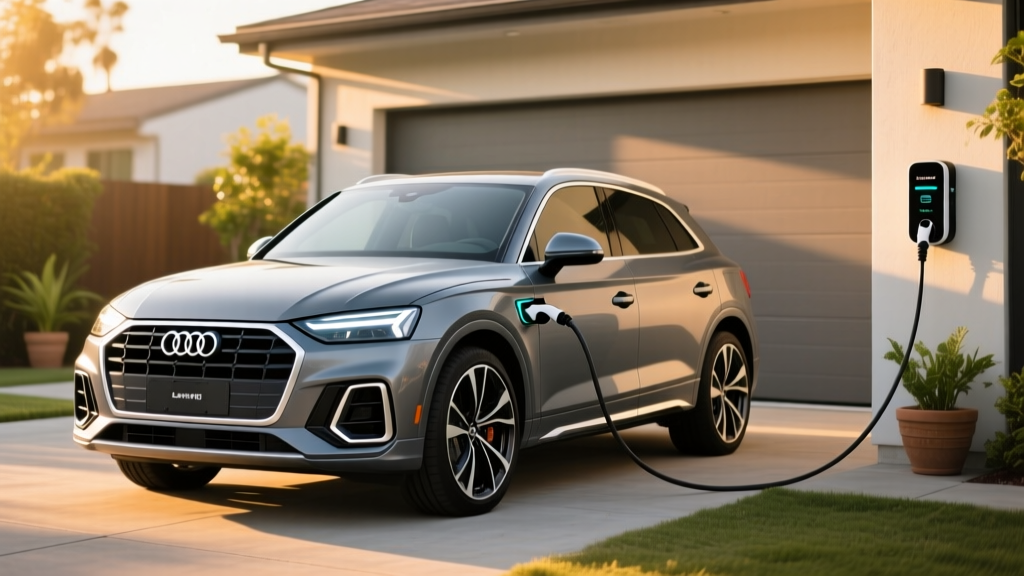
The Q5 PHEV is equipped with a 7.2 kW onboard charger and uses a standard J1772 connector for Level 2 AC charging. Critically, it does not support DC fast charging — a limitation common among PHEVs due to their smaller battery packs.
| Charging Method | Power | 0–100% Time | Connector |
|---|---|---|---|
| Level 1 (120V household) | ~1.4 kW | ~10–12 hours | J1772 |
| Level 2 (240V home/public) | 7.2 kW | ~2.5 hours | J1772 |
| DC Fast Charge | — | Not supported | — |
For most PHEV owners, a Level 2 home charger is the ideal setup. A full charge in roughly 2.5 hours means you can easily top off during the workday or overnight. Level 1 charging from a standard 120V outlet is feasible but slow — it will replenish the battery overnight but won't fully charge from empty in a typical 8-hour sleep window.
Powertrain Performance: 362 HP and Quattro AWD
The Q5 55 TFSI e combines a 2.0-liter turbocharged four-cylinder engine (261 hp on its own) with an electric motor integrated into the 7-speed S tronic dual-clutch transmission. Combined system output is 362 horsepower and 369 lb-ft of torque, making it the most powerful Q5 variant short of the SQ5.
Audi's Quattro all-wheel-drive system is standard, with the electric motor contributing to the front axle and the engine primarily driving the rear. The result is confident traction in all conditions and a 0–60 mph time of approximately 5.0 seconds — genuinely quick for a luxury SUV.
Driving modes let you prioritize electric-only operation (EV mode), blend gas and electric for maximum efficiency (Hybrid mode), or hold the battery charge for later use (Battery Hold mode). The Hold mode is particularly useful for highway commuters who want to save their electric range for city driving at their destination.
Pricing, Trims, and Federal Tax Credit Eligibility
The 2024 Audi Q5 55 TFSI e is offered in a single Premium Plus S line trim with an MSRP starting at $58,895 (including destination). Key standard features include:
- 14.1 kWh battery pack with electric motor
- Quattro AWD
- 12.3-inch Virtual Cockpit digital instrument cluster
- 10.1-inch MMI touchscreen with wireless Apple CarPlay/Android Auto
- Leather upholstery, heated front seats, panoramic sunroof
- Audi Pre Sense basic and rear safety systems
- Adaptive cruise control and lane-keeping assist
Federal Tax Credit: §30D Eligibility
- MSRP cap: SUVs must be under $80,000 MSRP — the Q5 PHEV qualifies at $58,895.
- Buyer income cap: Modified AGI must not exceed $150,000 (single) or $300,000 (joint).
- Battery sourcing: The credit amount depends on critical mineral and battery component requirements that shift annually. Check the latest IRS qualified vehicle list before purchasing.
- Point-of-sale transfer: As of 2024, eligible buyers can transfer the credit to the dealer at purchase for an immediate price reduction.
Always verify current eligibility with your tax professional and the IRS, as sourcing requirements and qualified model lists update periodically.
Battery Warranty, Reliability, and Long-Term Costs
Hybrid battery longevity is consistently a top concern for PHEV buyers. Audi covers the Q5 55 TFSI e's high-voltage battery under its hybrid component warranty:
Is the Q5 PHEV Reliable?
Audi's PHEV powertrain is based on the Volkswagen Group's well-established MLBevo platform, shared with the Porsche Cayenne E-Hybrid and other models. The 2.0L turbo engine is a proven design. However, the added complexity of a PHEV — two power sources, a larger battery, additional power electronics, and a more complex transmission — inherently introduces more potential failure points than a conventional gas vehicle or a full BEV.
Based on available owner data and industry reliability surveys, the Q5 PHEV's most common reported issues involve software glitches in the infotainment and energy management systems rather than powertrain failures. The high-voltage battery itself has proven durable, with most PHEV batteries across the industry retaining 85–95% capacity after 5 years of normal use.
Battery Replacement Cost
Out of warranty, a full high-voltage battery replacement for the Q5 PHEV is estimated at $8,000–$12,000 including parts and labor. However, complete battery failure is rare — individual cell modules can often be replaced for significantly less. For context, the vast majority of PHEV batteries outlast the vehicle's useful life, and degradation typically plateaus after the first 2–3 years.
Q5 PHEV vs. Full EV vs. Gas Q5: Which Fits You?
- Your daily commute is under 25 miles round-trip and you can charge at home
- You want electric commuting but need gas-engine flexibility for road trips
- You lack reliable public DC fast-charging access in your area
- You value premium interior quality and brand cachet
- You have home Level 2 charging and your daily driving is under 200 miles
- You want zero tailpipe emissions and minimal maintenance
- You're eligible for the full $7,500 federal tax credit
- You want access to DC fast charging for road trips
- You cannot install a home charger and have no workplace charging
- You want a lower purchase price ($44,995 starting MSRP)
- You drive mostly highway miles where PHEV electric range offers minimal benefit
- 362 hp makes it genuinely quick (5.0s 0–60)
- Premium interior with excellent build quality
- Quattro AWD standard for all-weather confidence
- 23-mile EV range covers most daily commutes
- No range anxiety — gas engine as backup
- Eligible for partial federal tax credit
- Only 23 miles of electric range (short for a PHEV)
- No DC fast charging
- Gas-only MPG (26 combined) is mediocre for a hybrid
- Heavy — 4,600+ lbs hurts highway efficiency
- Single trim limits option flexibility
- Cargo space reduced vs. gas Q5 due to battery
Ownership Costs: 5-Year Outlook
To understand the Q5 PHEV's value proposition, consider a 5-year ownership scenario assuming 12,000 miles/year, 70% of daily miles driven on electricity, and home charging at $0.14/kWh national average:
| Cost Category | Q5 55 TFSI e (PHEV) | Q5 45 TFSI (Gas) |
|---|---|---|
| Purchase Price (MSRP) | $58,895 | $44,995 |
| Est. Tax Credit | –$3,750 | $0 |
| 5-Year Fuel/Energy Cost | ~$5,800 | ~$10,200 |
| 5-Year Maintenance | ~$3,200 | ~$3,800 |
| 5-Year Insurance (est.) | ~$9,500 | ~$8,800 |
| 5-Year Depreciation (est.) | ~$22,000 | ~$18,000 |
| 5-Year Total Cost | ~$95,645 | ~$89,795 |
The PHEV commands a higher upfront cost but recoups some of it through lower fuel and maintenance expenses. The gap narrows further if you qualify for the full tax credit or have access to low-cost electricity. For high-mileage commuters who charge daily, the fuel savings become substantially more pronounced.
Frequently Asked Questions
How many MPG does the 2024 Audi Q5 hybrid get?
The EPA rates the Q5 55 TFSI e at 64 MPGe combined when using both electric and gas power. In gas-only mode with a depleted battery, it achieves 26 MPG combined (25 city / 28 highway). Real-world results depend heavily on how often you charge — daily chargers may rarely visit a gas station, while those who never plug in should expect 23–26 MPG.
How far can the Q5 PHEV go on electric only?
The EPA rates it for 23 miles of electric-only range. In real-world conditions with climate control and mixed driving, expect 18–20 miles. Cold weather (below freezing) reduces this to roughly 17–19 miles. This covers most daily commutes but falls short of PHEV leaders like the Toyota RAV4 Prime (42 miles).
Does the 2024 Audi Q5 hybrid qualify for a tax credit?
It may qualify for up to $3,750 under the IRS §30D federal tax credit, depending on battery sourcing requirements, your income level (under $150K single / $300K joint), and the vehicle's MSRP (under $80K for SUVs — which the Q5 meets). Always verify current eligibility on the fueleconomy.gov tax credit page and consult a tax professional before purchase.
Is the Q5 PHEV reliable, and what does battery replacement cost?
Audi's PHEV system is built on a proven platform shared with other VW Group vehicles. The high-voltage battery is warranted for 8 years / 100,000 miles at 70% capacity retention. Out-of-warranty replacement is estimated at $8,000–$12,000, though full battery failures are rare. Most PHEV batteries retain 85–95% capacity after 5 years of normal use.
Can the Q5 PHEV charge at a DC fast charger?
No. The 2024 Q5 55 TFSI e supports only AC charging — Level 1 (120V) and Level 2 (240V at up to 7.2 kW). A full Level 2 charge takes about 2.5 hours. This is standard for most PHEVs; DC fast charging is typically reserved for full battery-electric vehicles with larger battery packs.
Should I buy the Q5 PHEV or a full electric SUV?
If you have reliable home charging, drive under 200 miles daily, and want minimal maintenance, a full EV like the Audi Q8 e-tron (300+ mile range, DC fast charging, full $7,500 credit potential) is a stronger long-term bet. The Q5 PHEV is the right choice if you need gas-engine flexibility for frequent road trips, live in an area with sparse charging infrastructure, or simply want to dip a toe into electrified driving without full commitment.