Why the 2022 RAV4 Hybrid Still Sets the Efficiency Benchmark
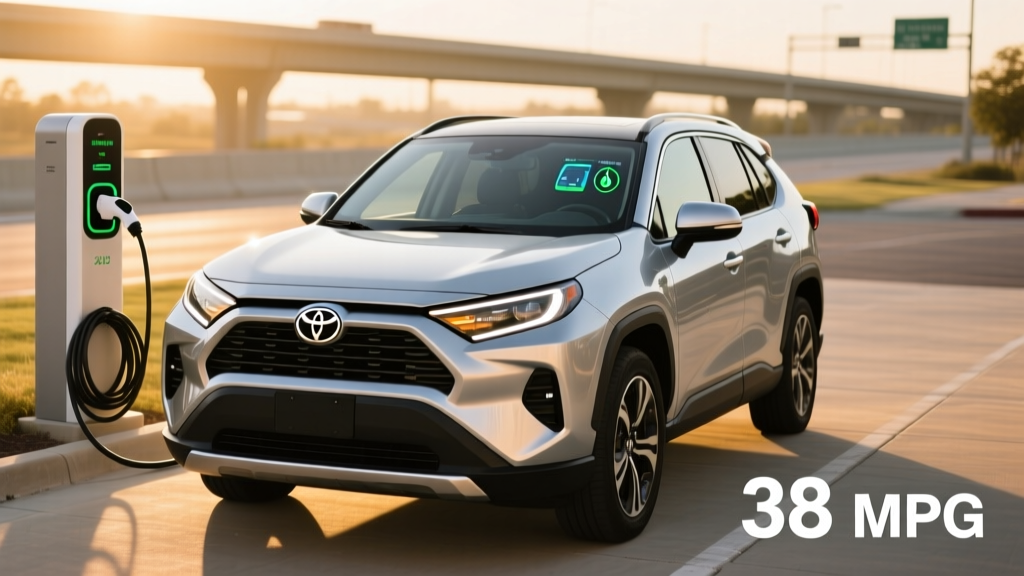
Three years after it left the showroom, the 2022 Toyota RAV4 Hybrid remains one of the most fuel-efficient compact SUVs money can buy — new or used. With an EPA-rated 40 MPG combined, standard all-wheel drive, and Toyota's proven hybrid synergy drive, it continues to attract buyers who want SUV practicality without the fuel bills. In this guide, we break down the exact 2022 RAV4 Hybrid MPG figures, how they hold up in real-world driving, and how the hybrid stacks up against its plug-in sibling (the RAV4 Prime) and full-electric alternatives in 2026.
2022 RAV4 Hybrid MPG: EPA Ratings and Real-World Results
The EPA rates the 2022 RAV4 Hybrid across all trims (LE, XLE, XLE Premium, SE, Woodland Edition, Limited) at identical fuel economy figures thanks to the shared powertrain:
| Driving Cycle | EPA MPG | Real-World Expectation |
|---|---|---|
| City | 41 MPG | 42–45 MPG (hybrids excel in stop-and-go) |
| Highway | 38 MPG | 34–37 MPG (aerodynamic drag at 70+ mph) |
| Combined | 40 MPG | 38–42 MPG depending on driving mix |
With a 14.5-gallon fuel tank, the 2022 RAV4 Hybrid delivers a theoretical range of roughly 580 miles per tank in combined driving, or 600+ miles in city-heavy commutes. That's fewer fuel stops and genuine road-trip flexibility without range anxiety.
Powertrain Specs: What Makes the RAV4 Hybrid Efficient
The 2022 RAV4 Hybrid uses Toyota's fourth-generation Hybrid Synergy Drive, pairing a 2.5-liter Atkinson-cycle four-cylinder engine with two electric motor-generators and an electronically controlled CVT (eCVT). All-wheel drive is standard across every trim via a dedicated rear-axle electric motor (AWD-i).
| Component | Specification |
|---|---|
| Engine | 2.5L 4-cyl Atkinson cycle (176 hp / 163 lb-ft) |
| Front Electric Motor | 88 kW (118 hp) |
| Rear Electric Motor (AWD-i) | 40 kW (54 hp) |
| Combined System Output | 219 hp |
| Hybrid Battery | 1.6 kWh nickel-metal hydride (NiMH), sealed |
| Transmission | eCVT (planetary gearset, no belt) |
| 0–60 mph | 7.4 seconds (MotorTrend tested) |
| Drivetrain | AWD-i (standard, all trims) |
The 1.6 kWh battery pack is small by EV standards — and that's the point. It's a self-charging system: the gasoline engine and regenerative braking continuously replenish it. You never plug in a conventional RAV4 Hybrid. The battery simply acts as an energy buffer, allowing the engine to shut off at stops and assist during acceleration, which is where the efficiency gains come from.
HEV vs PHEV: RAV4 Hybrid vs RAV4 Prime (2022)
Toyota also sold the RAV4 Prime (a plug-in hybrid) alongside the standard hybrid in 2022. The two look nearly identical but serve very different use cases. Here's how they compare:
| Attribute | RAV4 Hybrid (HEV) | RAV4 Prime (PHEV) |
|---|---|---|
| Powertrain Type | Conventional hybrid — no plug | Plug-in hybrid — charges via outlet |
| Combined System HP | 219 hp | 302 hp |
| EPA Combined MPG (gas) | 40 MPG | 38 MPG (charge-sustaining) |
| EPA MPGe (electric mode) | N/A | 94 MPGe |
| Electric-Only Range | None (EV assist only) | 42 miles EPA |
| Total Range (gas + electric) | ~580 miles | ~600 miles |
| Battery Capacity | 1.6 kWh (NiMH) | 18.1 kWh (lithium-ion) |
| Charging (Level 1, 120V) | N/A | ~12 hours (full) |
| Charging (Level 2, 240V) | N/A | ~4.5 hours (full) |
| DC Fast Charging | N/A | Not supported |
| 0–60 mph | 7.4 sec | 5.7 sec |
| Starting MSRP (2022) | $29,075 (LE) | $39,800 (SE) |
| Federal Tax Credit (§30D) | Not eligible | Up to $7,500 (subject to eligibility) |
Choose the RAV4 Hybrid (HEV) if: You don't have access to home charging, want the lowest purchase price, drive mostly city/suburban miles, and want a simple no-plug ownership experience.
Choose the RAV4 Prime (PHEV) if: You can charge at home (Level 2 recommended), your daily commute is under 42 miles round-trip, and you want EV-like daily driving with gas-engine backup for road trips. The 302 hp also makes it the quickest RAV4 Toyota sells.
Choose a full EV if: You have reliable home charging, want zero tailpipe emissions, and are comfortable with 250+ mile range and DC fast-charging road trips.
Pricing, Tax Credits, and 2026 Used Market Value
When new, the 2022 RAV4 Hybrid started at $29,075 (LE trim) and climbed to roughly $37,000 for a loaded Limited. As of early 2026, used examples are plentiful and hold value exceptionally well — a hallmark of Toyota hybrids.
| Trim | Original MSRP | Est. Used Price (30K–50K mi) |
|---|---|---|
| LE | $29,075 | $26,000–$29,000 |
| XLE | $31,575 | $28,500–$32,000 |
| XLE Premium | $33,075 | $30,000–$34,000 |
| Woodland Edition | $33,075 | $30,000–$34,500 |
| Limited | $37,000 | $33,000–$37,000 |
Federal Tax Credit Eligibility
The conventional RAV4 Hybrid (HEV) does not qualify for the IRS §30D Clean Vehicle Credit. That credit is reserved for plug-in vehicles — BEVs and PHEVs with sufficient battery capacity. The RAV4 Hybrid's 1.6 kWh NiMH pack falls well below the threshold.
If you're considering the RAV4 Prime (PHEV) instead, it may qualify for up to $7,500 under §30D, but eligibility depends on several factors that change frequently. Per current IRS rules:
- Buyer modified adjusted gross income must not exceed $150,000 (single) / $300,000 (joint)
- Vehicle MSRP must not exceed $80,000 for SUVs
- Battery critical minerals and components must meet North American sourcing thresholds (these tighten annually)
- Credit can be transferred to the dealer at point of sale for an instant price reduction
For used PHEV purchases, the §25E used clean vehicle credit offers up to $4,000 (30% of sale price, capped) on vehicles priced under $25,000 — though finding a used RAV4 Prime at that price is challenging given strong resale values.
Battery Warranty, Lifespan, and Replacement Cost
Toyota covers the hybrid battery and all hybrid system components for 10 years or 150,000 miles (whichever comes first) from date of first use. This applies to all 2020-and-newer Toyota hybrids. The standard new-vehicle warranty covers 3 years / 36,000 miles bumper-to-bumper and 5 years / 60,000 miles powertrain.
Toyota's hybrid battery longevity is among the best-documented in the industry. The Prius taxi fleet famously logged hundreds of thousands of miles on original NiMH packs. For the RAV4 Hybrid's 1.6 kWh pack, the relatively small capacity means it cycles gently — it rarely charges above ~80% or below ~40% state of charge, which dramatically extends cell life.
Hybrid Battery Replacement Cost
If the hybrid battery does fail outside warranty, here's what to budget for in 2026:
- OEM new battery (Toyota dealer): $3,000–$4,500 including labor
- Remanufactured battery: $1,800–$2,800 including labor
- Individual module replacement: Some independent hybrid specialists can replace only the degraded modules for $800–$1,500
For context, at 40 MPG and 15,000 miles per year, a RAV4 Hybrid owner spends roughly $1,500 annually on fuel (at $3.50/gallon). Even a full battery replacement at year 12–15 represents a fraction of lifetime fuel savings versus a comparably sized gas-only SUV.
Reliability and Long-Term Ownership
The 2022 RAV4 Hybrid earns strong reliability marks. The eCVT uses a planetary gearset with no clutch packs, belts, or bands to wear out — it's fundamentally simpler than a traditional automatic transmission. There's no starter motor (the hybrid motor-generators handle engine starts), no alternator, and regenerative braking significantly extends brake pad life. Many owners report 60,000+ miles on original brake pads.
The IIHS named the 2022 RAV4 a Top Safety Pick when equipped with specific headlights, and standard Toyota Safety Sense 2.0 includes pre-collision braking, lane departure alert, dynamic radar cruise control, and lane tracing assist. Note that these are SAE Level 2 driver-assistance features — they require your full attention and do not constitute self-driving.
Pros
- 40 MPG combined with AWD standard — best-in-class efficiency
- No plug-in required; zero lifestyle change from a gas car
- 10-year / 150,000-mile hybrid battery warranty
- Strong resale value; low depreciation
- Spacious cargo area (37.5 cu ft behind rear seats)
- Proven, simple eCVT with minimal wear components
Cons
- No federal tax credit (conventional hybrid)
- Engine noise under hard acceleration (eCVT drone)
- Infotainment feels dated vs newer competitors
- Highway MPG drops to mid-30s at sustained 75+ mph
- Not eligible for HOV lane access in most states
- No DC fast charging or meaningful electric-only driving
Who Should Buy the 2022 RAV4 Hybrid in 2026?
The 2022 RAV4 Hybrid occupies a specific sweet spot. It's ideal for buyers who:
- Can't charge at home: Apartment dwellers, street parkers, and those without garage access get full hybrid efficiency without needing any charging infrastructure.
- Drive 15,000+ miles per year: High mileage amplifies the fuel savings. At 40 MPG vs a gas SUV at 25 MPG, you save roughly 225 gallons per year — about $790 annually at $3.50/gallon.
- Want AWD without the efficiency penalty: The electronic AWD-i system adds negligible weight and doesn't reduce MPG compared to a FWD equivalent (there is no FWD RAV4 Hybrid).
- Prioritize reliability and low running costs over performance: The 219 hp output is adequate, not thrilling. If acceleration matters, the RAV4 Prime's 302 hp or a full EV's instant torque will be more satisfying.
The RAV4 Hybrid is less suited for drivers who want EV-only daily commuting (choose the Prime or a BEV), those chasing maximum performance, or buyers in states with strong EV incentives that make plug-in options financially compelling.
Frequently Asked Questions
How many MPG does the 2022 RAV4 Hybrid actually get?
The EPA rates it at 41 city / 38 highway / 40 combined. In real-world driving, expect 42–45 MPG in city and suburban conditions, and 34–37 MPG on sustained highway trips above 70 mph. Cold weather (below freezing) reduces efficiency by roughly 5–10% due to increased engine idling for cabin heat.
Does the RAV4 Hybrid need to be plugged in?
No. The conventional RAV4 Hybrid (HEV) is entirely self-charging. The gasoline engine and regenerative braking replenish the small 1.6 kWh battery automatically. You fuel it like any other gas vehicle — just less often.
How far can the RAV4 Prime go on electric only?
The 2022 RAV4 Prime (the plug-in variant) delivers 42 miles of EPA-rated electric-only range on its 18.1 kWh lithium-ion battery. That covers most daily commutes without using a drop of gasoline. Once the battery depletes, it operates as a conventional hybrid at 38 MPG combined.
Is the 2022 RAV4 Hybrid reliable, and what does battery replacement cost?
Toyota's hybrid system is among the most proven in the automotive industry, with decades of real-world data from the Prius fleet. The hybrid battery is warranted for 10 years / 150,000 miles. Out-of-warranty replacement runs $1,800–$4,500 depending on whether you choose remanufactured or OEM new. Most owners never need a replacement within typical ownership periods.
Does the 2022 RAV4 Hybrid qualify for any tax credit?
The conventional RAV4 Hybrid (HEV) does not qualify for the federal §30D Clean Vehicle Credit — that credit applies only to plug-in vehicles. The RAV4 Prime (PHEV) may qualify for up to $7,500, subject to buyer income limits, MSRP caps, and battery sourcing requirements. Consult IRS guidelines or a tax professional for your specific situation.
RAV4 Hybrid vs a full EV — which saves more money?
It depends on your driving and charging access. The RAV4 Hybrid costs roughly $1,500/year in fuel at 15,000 miles. A comparable EV like the Hyundai Ioniq 5 (charging at home at $0.14/kWh) costs roughly $600–$700/year in electricity. However, EVs carry higher purchase prices, potentially higher insurance, and require home charging installation ($500–$2,000). For buyers without home charging access, the RAV4 Hybrid offers the best efficiency without infrastructure investment.