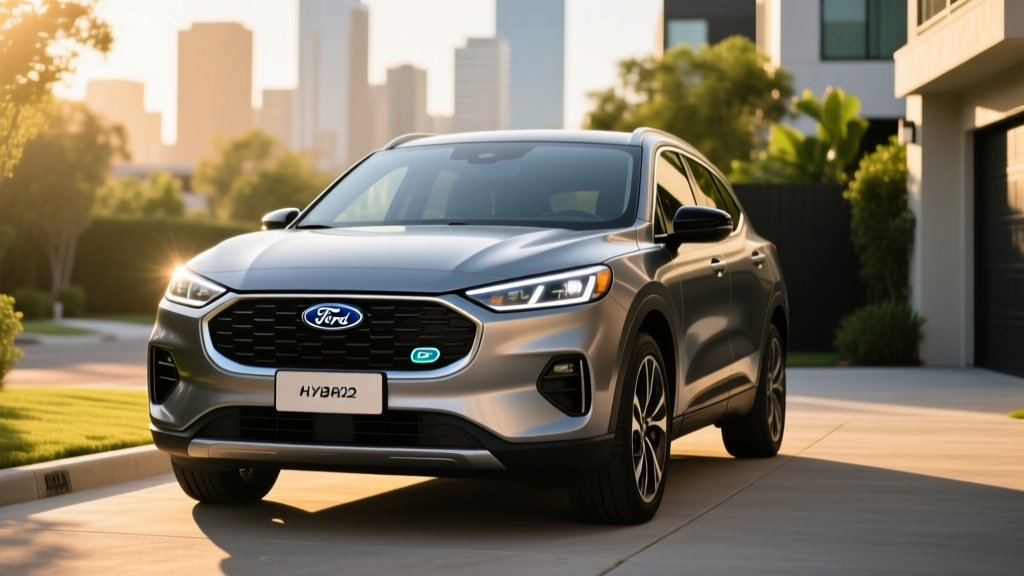
The 2022 Ford Escape Hybrid occupies a practical middle ground for buyers who want electric-motor efficiency without plugging in. Available in front-wheel and all-wheel drive, this compact SUV delivers strong city fuel economy, a comfortable ride, and the packaging flexibility that made the Escape a segment staple. But with Ford also offering a plug-in hybrid (PHEV) variant the same year, and fully electric competitors gaining ground, the question isn't just whether the Escape Hybrid is good — it's whether the HEV or PHEV version is the right electrified choice for your driving pattern.
We've analyzed EPA data, owner reports, and Ford's powertrain specifications to give you a precise, numbers-driven look at what the 2022 Escape Hybrid actually delivers on the road.
HEV vs. PHEV: Which 2022 Escape Electrified Model Is Which?
Ford sold two distinct electrified Escape models for 2022, and confusing them is the most common mistake shoppers make. Here's the critical distinction:
| Attribute | Escape Hybrid (HEV) | Escape Plug-In Hybrid (PHEV) |
|---|---|---|
| Plugs in to charge? | No — self-charging via engine and regen | Yes — 14.4 kWh battery, Level 1/2 charging |
| Electric-only driving | Limited (low-speed EV mode, ~1 mile) | 37 miles EPA electric-only range |
| Total range | ~568 miles (FWD) | ~520 miles combined (electric + gas) |
| Drivetrain options | FWD or AWD | FWD only |
| Combined horsepower | 200 hp (net system) | 210 hp (net system) |
| Battery capacity | 1.1 kWh (traction, not plug-in) | 14.4 kWh usable (lithium-ion) |
| Trims available | SE, SEL, Titanium | SEL, Titanium |
The conventional Hybrid (HEV) never needs a plug. Its small 1.1 kWh battery charges through regenerative braking and the gasoline engine. The PHEV has a much larger 14.4 kWh pack that you charge via a standard 120V outlet (Level 1) or a 240V Level 2 home charger. If you don't plug in a PHEV, you're carrying dead weight — the PHEV still functions as a hybrid but loses its efficiency advantage over the HEV once the battery depletes.
Fuel Economy: EPA Ratings and Real-World MPG
Fuel economy is the headline reason buyers choose the Escape Hybrid. Here's the official EPA breakdown by drivetrain, sourced from fueleconomy.gov:
| Configuration | City MPG | Highway MPG | Combined MPG | Annual Fuel Cost* |
|---|---|---|---|---|
| Escape Hybrid FWD | 44 | 37 | 41 | $1,550 |
| Escape Hybrid AWD | 42 | 36 | 40 | $1,600 |
| Escape PHEV (gas only, battery depleted) | 42 | 36 | 40 | $1,600 |
| Escape PHEV (combined gas + electric) | 105 MPGe combined | $900 | ||
*EPA estimate based on 15,000 miles/year at national average fuel prices.
Real-World MPG: What Owners Actually See
The Escape Hybrid's Atkinson-cycle 2.5-liter four-cylinder and electric motor combination excels in stop-and-go traffic, where regenerative braking recharges the battery frequently. In real-world city driving, many owners report matching or slightly exceeding the 44 MPG EPA city figure — a common trait of series-parallel hybrids that isn't always the case with conventional gas vehicles.
Highway driving tells a different story. At sustained 70-80 mph speeds, expect 33-36 MPG in the FWD model. The electric motor contributes less at high speeds, and aerodynamic drag dominates. If your commute is 90% highway, the Hybrid's advantage over the gas-only Escape (28 city / 34 highway FWD) narrows considerably.
For the PHEV, the 37-mile electric-only range is EPA-rated. In mild weather with moderate acceleration, 35-39 miles is achievable. In cold weather (below 35°F), expect that range to drop to 28-32 miles as battery efficiency decreases and cabin heating draws power.
Powertrain and Performance Specs
| Specification | Escape Hybrid (HEV) | Escape PHEV |
|---|---|---|
| Engine | 2.5L Atkinson-cycle I-4 | 2.5L Atkinson-cycle I-4 |
| Engine horsepower | 163 hp @ 6,250 rpm | 163 hp @ 6,250 rpm |
| Electric motor | Permanent-magnet AC synchronous | Permanent-magnet AC synchronous |
| Net system horsepower | 200 hp | 210 hp |
| Transmission | eCVT (power-split device) | eCVT (power-split device) |
| 0-60 mph (est.) | ~7.7 seconds | ~7.5 seconds |
| Towing capacity | 1,500 lbs | Not rated for towing |
| Cargo volume (rear seats up) | 34.4 cu ft | 32.5 cu ft (battery intrusion) |
| Cargo volume (rear seats folded) | 60.8 cu ft | 58.9 cu ft |
The eCVT is not a traditional belt-and-pulley CVT — it's a planetary gearset that blends engine and motor power seamlessly. There are no fixed "gears," and while acceleration feels linear rather than sporty, the power delivery is smooth and free of the rubber-band effect that plagues some CVTs.
The AWD Hybrid uses a second electric motor on the rear axle rather than a mechanical driveshaft. This means rear-wheel engagement is electronic and instantaneous when slip is detected, but it also means AWD is unavailable on the PHEV — a dealbreaker for snow-belt buyers who want plug-in capability.
PHEV Charging: How Long and What Equipment?
If you're considering the PHEV variant, charging logistics matter:
| Charging Level | Power | 0-100% Time | Equipment Needed |
|---|---|---|---|
| Level 1 (120V household) | ~1.4 kW | ~10-11 hours | Included portable cord |
| Level 2 (240V, 32A) | ~3.3 kW (vehicle-limited) | ~3.5 hours | Home wall charger or public L2 |
| DC Fast Charge | Not supported | N/A | N/A |
The Escape PHEV's onboard charger is limited to 3.3 kW, meaning even a 48-amp Level 2 home charger won't speed things up. Plan for overnight Level 1 charging or a ~3.5-hour Level 2 session. For most PHEV owners with predictable commutes under 37 miles, a standard 120V outlet and overnight charging is sufficient — you wake up with a full battery every morning.
The PHEV does not support DC fast charging. This is typical for PHEVs in this class; the 14.4 kWh battery is small enough that DC infrastructure isn't practical.
Battery Warranty, Lifespan, and Replacement Cost
Ford Hybrid/PHEV Battery Warranty (2022 Model Year):
- Hybrid/EV battery component warranty: 8 years / 100,000 miles (whichever comes first)
- California emissions states (CARB states): 10 years / 150,000 miles for hybrid battery
- Capacity retention threshold: Ford warrants the battery against failure, not a specific degradation percentage. However, hybrid batteries in the Escape are buffered — the system never uses the full 1.1 kWh (HEV) or 14.4 kWh (PHEV), which significantly slows degradation.
Hybrid battery replacement cost is a top buyer concern. For the Escape HEV's 1.1 kWh pack, replacement runs approximately $2,000-$3,500 at a Ford dealer. For the PHEV's larger 14.4 kWh pack, expect $6,000-$8,500. These figures include parts and labor.
In practice, Toyota and Ford hybrid batteries from the 2010s onward have shown strong longevity. The Escape Hybrid's power-split design keeps the battery in a narrow state-of-charge window (roughly 40-60% for the HEV), which is the least stressful operating range for lithium-ion cells. Many first-generation Escape Hybrids (2005-2012 with NiMH packs) exceeded 150,000 miles on original batteries. The current lithium-ion packs are expected to last the life of the vehicle under normal use.
Pricing, Trims, and Tax Credit Eligibility
The 2022 Escape Hybrid is no longer available new, so pricing reflects the used market. When new, MSRPs were:
| Trim | HEV MSRP (2022) | PHEV MSRP (2022) |
|---|---|---|
| SE Hybrid | $29,905 | — |
| SEL Hybrid / SEL PHEV | $32,490 | $34,655 |
| Titanium Hybrid / Titanium PHEV | $36,725 | $38,890 |
Federal Tax Credits (2026 Rules for Used Purchase)
Under current IRS §30D rules, the used clean vehicle credit (IRC 25E) offers up to $4,000 or 30% of the sale price (whichever is less) for qualifying used EVs and PHEVs purchased from a dealer. Key requirements:
- Vehicle price cap: Sale price must be $25,000 or less
- Buyer income cap: AGI ≤ $75,000 single / $112,500 head of household / $150,000 joint
- Vehicle age: Must be at least 2 model years old (2022 qualifies in 2026)
- Battery requirement: PHEV must have ≥ 7 kWh battery capacity (Escape PHEV's 14.4 kWh qualifies)
- Dealer sale required: Private-party sales do not qualify
- HEV exclusion: The conventional Hybrid (HEV) does not qualify — only PHEVs and BEVs are eligible
Source: IRS Used Clean Vehicle Credit. Always verify eligibility with a tax professional before purchase, as rules and qualifying vehicle lists can change.
Reliability and Safety Ratings
The 2022 Escape earned strong safety marks. The NHTSA awarded it a 5-star overall safety rating, and the IIHS named it a Top Safety Pick when equipped with specific headlights (source: IIHS).
On reliability, the Escape Hybrid benefits from a powertrain architecture that Ford has refined since the 2005 Escape Hybrid — one of the first hybrid SUVs sold in the US. The eCVT has no belts, clutches, or bands to wear out, and regenerative braking reduces wear on the friction brake pads (many owners report 80,000+ miles on original brake pads).
Common complaints from owners center on the SYNC infotainment system's responsiveness and occasional software glitches, not the hybrid powertrain itself. The 2.5L Atkinson-cycle engine is naturally aspirated and conservatively tuned, which favors longevity over performance.
Who Should Buy the 2022 Escape Hybrid — and Who Should Look Elsewhere?
Choose the Escape Hybrid (HEV) if:
- You don't have access to home charging (apartment, street parking, no garage outlet)
- You want 40+ MPG without changing any habits — no plugging in, no range planning
- You need AWD for snow or rain (AWD is HEV-only)
- Your budget is under $25,000 on the used market
Choose the Escape PHEV if:
- You have a garage or driveway with a 120V outlet for overnight charging
- Your daily commute is under 35 miles round-trip (you'll rarely burn gas)
- You want the option of electric-only driving for short trips and the gas engine for road trips
- You qualify for the up-to-$4,000 used PHEV tax credit
Consider a full EV instead if:
- You have reliable Level 2 home charging and your daily driving is under 250 miles
- You want to eliminate oil changes, spark plugs, and exhaust system maintenance entirely
- You're eligible for the full $7,500 federal credit on a new EV (which the Escape PHEV no longer qualifies for new)
Pros
- 44 MPG city (FWD HEV) — class-leading for compact hybrid SUVs
- AWD availability on HEV model
- Smooth eCVT with no belt-driven CVT reliability concerns
- Strong NHTSA 5-star and IIHS Top Safety Pick ratings
- Proven hybrid architecture with 15+ years of refinement
- PHEV qualifies for up to $4,000 used-vehicle tax credit
Cons
- PHEV is FWD only — no AWD option
- PHEV cargo space reduced by ~2 cu ft due to battery
- SYNC infotainment can lag; no wireless Apple CarPlay/Android Auto on base trims
- PHEV not rated for towing
- Highway MPG drops to 33-36 real-world at 75+ mph
- No DC fast charging on PHEV
Frequently Asked Questions
How many MPG does the 2022 Ford Escape Hybrid get?
The EPA rates the 2022 Escape Hybrid FWD at 44 city / 37 highway / 41 combined MPG. The AWD model drops slightly to 42 city / 36 highway / 40 combined. In real-world driving, city MPG often matches or exceeds the EPA figure thanks to regenerative braking, while highway driving at 70+ mph typically yields 33-36 MPG.
How far can the Escape PHEV go on electric only?
The EPA rates the 2022 Escape PHEV at 37 miles of electric-only range. In mild weather with moderate driving, expect 35-39 miles. In cold weather (below 35°F), range drops to approximately 28-32 miles. Once the battery depletes, the PHEV operates as a conventional hybrid rated at 40 MPG combined.
Is the 2022 Escape Hybrid reliable, and what does battery replacement cost?
The Escape Hybrid uses Ford's well-proven power-split hybrid system, refined since 2005. The eCVT is mechanically simple and durable, and regenerative braking extends brake pad life. Hybrid battery replacement costs approximately $2,000-$3,500 for the HEV and $6,000-$8,500 for the PHEV, though most batteries last well beyond the 8-year/100,000-mile warranty period.
Does the 2022 Escape Hybrid qualify for any tax credit?
The conventional Escape Hybrid (HEV) does not qualify for any federal tax credit. The Escape PHEV may qualify for the federal used clean vehicle credit (IRC 25E) of up to $4,000 when purchased from a dealer for $25,000 or less, subject to buyer income caps. The new-vehicle §30D credit is no longer available for 2022 models. Consult a tax professional and check IRS guidelines before purchasing.
Hybrid vs. PHEV vs. EV — which is right for me?
Choose the HEV if you lack home charging access and want zero-hassle fuel savings. Choose the PHEV if you can charge at home and have a short commute — you'll drive mostly on electricity with a gas backup for longer trips. Choose a full EV if you have reliable home Level 2 charging, drive under 250 miles daily, and want to eliminate all engine maintenance. The Escape Hybrid HEV is the lowest-risk entry point; the PHEV is the highest-efficiency option if your routine allows regular charging.
Do I need to plug in the Escape Hybrid (HEV)?
No. The conventional Escape Hybrid charges its 1.1 kWh battery entirely through regenerative braking and the gasoline engine. There is no plug, no charging cord, and no change to your fueling routine — you simply fill up at a gas station as usual, less frequently thanks to 40+ MPG.