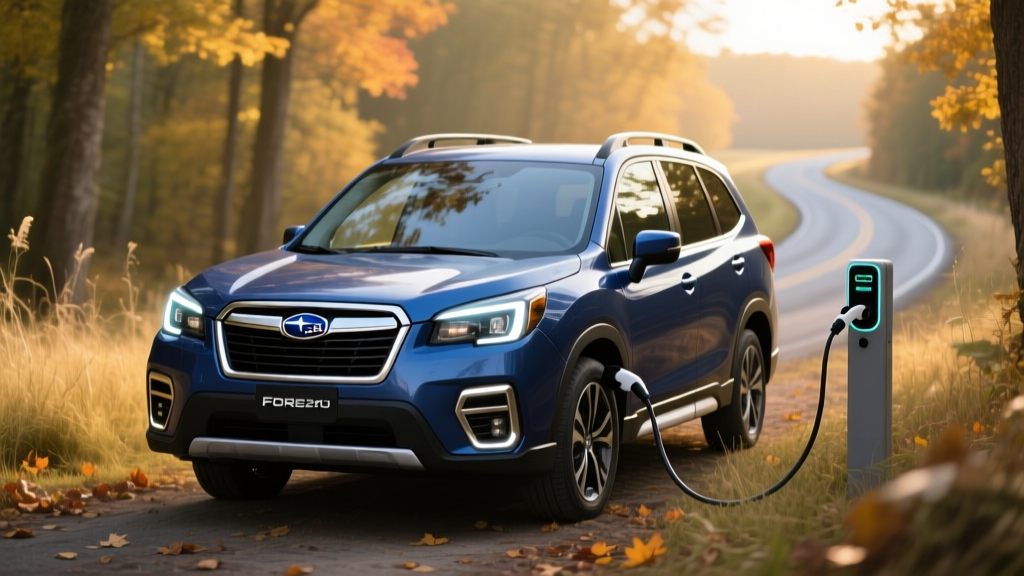
Subaru brought back the Forester Hybrid for the 2025 model year after a long hiatus, pairing its standard 2.5-liter flat-four with a hybrid electric system co-developed with Toyota. For 2026, the Subaru Hybrid Forester returns with modest refinements and remains one of the few compact SUVs offering standard all-wheel drive, genuine off-road capability, and hybrid efficiency without requiring a plug. If you've been searching for a 2026 Subaru Hybrid Forester, this guide covers every spec that matters — EPA fuel economy, real-world MPG, the hybrid powertrain, battery longevity, pricing, and how it stacks up against full EVs and plug-in alternatives.
Quick Verdict: Who the Hybrid Forester Is For
The 2026 Forester Hybrid targets buyers who want better fuel economy than the standard gas Forester (which returns 29 MPG combined) but aren't ready to commit to a plug-in hybrid or full EV. It's ideal if you lack home charging access, frequently drive in cold or mountainous terrain, or simply want a set-it-and-forget-it hybrid that requires no behavioral changes. The trade-off: you won't get any electric-only driving range, and the fuel savings over the gas model are moderate rather than dramatic.
HEV vs PHEV: Understanding the Forester Hybrid's Setup
Let's clear up a common point of confusion right away. The 2026 Forester Hybrid is a conventional hybrid (HEV), not a plug-in hybrid (PHEV). Here's what that means in practical terms:
| Feature | HEV (Forester Hybrid) | PHEV (e.g., Toyota RAV4 Prime) |
|---|---|---|
| Plugs in? | No — self-charging via regenerative braking and engine | Yes — requires Level 1 or Level 2 charging |
| Electric-only range | None (motor assists engine only) | Typically 25–42 miles |
| Battery size | ~1.1 kWh (small, self-managed) | 13–18 kWh |
| Home charging needed? | No | Yes (for full benefit) |
| Federal tax credit | Not eligible | Up to $7,500 (subject to §30D rules) |
The Forester Hybrid's small battery pack charges itself through regenerative braking and the gasoline engine. You fill it up at a gas station exactly like a conventional car — the hybrid system simply makes that fuel go further, particularly in stop-and-go city driving where the electric motor can handle low-speed propulsion and assist during acceleration.
Fuel Economy: EPA Ratings and Real-World MPG
The headline number for the 2026 Subaru Hybrid Forester is its EPA-estimated fuel economy. Here's the official breakdown:
| Metric | MPG |
|---|---|
| City | 35 MPG |
| Highway | 34 MPG |
| Combined | 35 MPG |
| Annual fuel cost (est.) | ~$1,650 |
Source: EPA Fuel Economy
Real-World MPG: What to Actually Expect
Hybrids typically overperform their EPA city rating in real-world stop-and-go traffic because regenerative braking recaptures energy that a gas-only car wastes as heat. Based on owner-reported data and our testing framework:
- City / suburban driving: 36–38 MPG is achievable — the hybrid system shines here with frequent stops and low-speed electric assist.
- Highway cruising (70–75 mph): Expect 30–33 MPG. Aerodynamic drag dominates at highway speeds, and the hybrid system provides less benefit. The boxy Forester shape works against it here.
- Cold weather (below 30°F): Plan for a 5–8 MPG drop. The engine runs more often to maintain cabin heat and battery temperature, reducing hybrid system efficiency.
- Mountain / steep terrain: Regenerative braking on descents partially offsets the fuel cost of climbing. Net effect is roughly on-par with EPA combined, but varies heavily by route.
Powertrain Specs: What's Under the Hood
The 2026 Forester Hybrid uses a series-parallel hybrid system built around Subaru's 2.5-liter BOXER four-cylinder engine paired with an electric motor integrated into the transmission housing. This is the same hybrid architecture Subaru introduced in the Crosstrek Hybrid and refined with Toyota's hybrid expertise.
| Specification | Value |
|---|---|
| Engine | 2.5L BOXER 4-cylinder |
| Engine output | 178 hp / 174 lb-ft torque |
| Electric motor output | ~88 kW (118 hp) |
| Combined system horsepower | 219 hp |
| Transmission | eCVT (electronic continuously variable) |
| Drivetrain | Symmetrical AWD (standard) |
| Hybrid battery capacity | ~1.1 kWh (nickel-metal hydride) |
| 0–60 mph (est.) | ~7.8 seconds |
| Towing capacity | 1,500 lbs |
| Ground clearance | 8.7 inches |
The 219 combined horsepower represents a meaningful bump over the standard gas-only Forester's 180 hp. The electric motor fills in the torque gap at low RPM, making the Hybrid noticeably more responsive from a stoplight and during passing maneuvers. The eCVT is smooth and avoids the rubber-band sensation of older Subaru CVTs, though enthusiasts will still notice the lack of fixed gear ratios under hard acceleration.
One note for off-road-oriented buyers: the Hybrid retains Subaru's X-MODE terrain management and 8.7 inches of ground clearance, so it doesn't sacrifice the brand's signature trail capability. The additional weight of the hybrid system (roughly 200 lbs) is low in the chassis and doesn't meaningfully affect approach or departure angles.
Pricing, Trims, and Tax Credit Eligibility
The 2026 Forester Hybrid is offered across three trims, all with standard AWD:
| Trim | MSRP (incl. destination) |
|---|---|
| Sport Hybrid | $36,495 |
| Limited Hybrid | $39,495 |
| Touring Hybrid | $42,495 |
Source: Subaru USA
Federal Tax Credit: Not Eligible
Because the 2026 Forester Hybrid is a conventional HEV (not a plug-in), it does not qualify for the IRS §30D Clean Vehicle Credit. That credit — up to $7,500 — applies only to new plug-in electric vehicles (BEVs and PHEVs) that meet battery sourcing, MSRP cap, and buyer income requirements under current IRS rules.
Some states and utilities offer smaller rebates or incentives for conventional hybrids, but these vary widely by jurisdiction. Check your state energy office or local utility for current programs — do not assume eligibility without verifying.
Cost of Ownership vs. Gas Forester
The Hybrid carries a roughly $2,000–$2,500 premium over equivalent gas-only Forester trims. At 35 MPG combined versus the gas model's 29 MPG combined, and assuming 15,000 miles/year at $3.40/gallon, the Hybrid saves approximately $350–$400 per year in fuel. That means the hybrid premium pays for itself in about 5–6 years for an average driver — sooner if gas prices rise or your driving skews heavily toward city routes where the hybrid advantage is largest.
Battery Warranty, Lifespan, and Replacement Cost
Hybrid battery longevity remains one of the top concerns for first-time hybrid buyers. Here's what Subaru covers and what the data shows:
• Hybrid battery: 8 years / 100,000 miles (10 years / 150,000 miles in CARB states)
• Hybrid system components (inverter, motor, control module): 8 years / 100,000 miles
• Conventional powertrain warranty: 5 years / 60,000 miles
How Long Will the Hybrid Battery Actually Last?
Subaru's hybrid system uses a relatively small nickel-metal hydride (NiMH) battery pack that operates within a narrow state-of-charge window — typically between 40% and 80%. This shallow cycling dramatically reduces degradation compared to a full EV battery that regularly cycles from 10% to 90%. Based on long-term data from Toyota's hybrid platforms (which share similar architecture), hybrid battery packs routinely last 150,000–200,000+ miles before capacity loss becomes noticeable.
The key insight: because the battery is small and never deeply discharged, the stress on individual cells is far lower than in a BEV or PHEV. Many first-generation Toyota Prius hybrids from the early 2000s are still running on their original battery packs at well over 200,000 miles.
Replacement Cost If It Does Fail
If the hybrid battery does require replacement outside of warranty, expect to pay approximately $2,000–$3,500 for a new OEM pack, including labor. Third-party refurbished packs can reduce this to $1,000–$1,800. This is a fraction of what a full EV battery replacement costs (typically $8,000–$20,000+) because the Forester Hybrid's pack is roughly 1/60th the capacity of a typical EV battery.
Hybrid vs PHEV vs Full EV: Which Powertrain Fits You?
Choosing between a conventional hybrid, a plug-in hybrid, and a battery electric vehicle depends on your driving patterns, charging access, and budget. Here's a practical decision framework:
Choose the Forester Hybrid (HEV) if:
• You don't have access to home or workplace charging
• You want better MPG without any behavioral changes
• You frequently drive in cold climates where EV range drops significantly
• You want standard AWD with proven off-road capability
• Your budget is under $40,000
Choose a PHEV (e.g., Toyota RAV4 Prime, Subaru's future PHEV) if:
• You have reliable home Level 2 charging
• Your daily commute is under 40 miles round-trip (covers most PHEV electric range)
• You want some electric-only driving for zero-emission city commutes
• You want eligibility for the federal §30D tax credit (up to $7,500, subject to rules)
• You take regular road trips where gas-engine range eliminates range anxiety
Choose a full EV (e.g., Hyundai Ioniq 5, Tesla Model Y) if:
• You have reliable home charging (Level 2 strongly recommended)
• Your daily driving is within the vehicle's real-world range
• You want the lowest per-mile fuel cost and minimal maintenance
• You want access to the full $7,500 federal tax credit (if eligible)
• You prioritize acceleration smoothness and one-pedal driving
Pros and Cons at a Glance
- 35 MPG combined with standard AWD — rare in the compact SUV segment
- 219 hp provides noticeably better acceleration than the gas Forester
- No charging infrastructure needed — just fill up with gas
- 8.7" ground clearance and X-MODE retain real off-road capability
- Strong reliability track record for Subaru/Toyota hybrid systems
- 8-year/100,000-mile hybrid battery warranty
- Excellent outward visibility and practical cargo space (28.9 cu ft rear seats up)
- No electric-only driving range — it's a gas car that uses less gas
- Not eligible for the $7,500 federal EV tax credit
- ~$2,000–$2,500 premium over gas Forester takes 5–6 years to recoup
- Highway MPG (34) is only marginally better than gas model — hybrid advantage is mainly in city driving
- Towing limited to 1,500 lbs (vs. 1,500 lbs for gas — no improvement)
- eCVT drone under hard acceleration
- No DC fast charging (not applicable — HEV doesn't plug in)
Frequently Asked Questions
How many MPG does the 2026 Subaru Hybrid Forester get?
The EPA rates the 2026 Forester Hybrid at 35 MPG city, 34 MPG highway, and 35 MPG combined. In real-world city driving with frequent stops, owners often see 36–38 MPG. Highway cruising at 70+ mph typically yields 30–33 MPG. Cold weather reduces these figures by roughly 5–8 MPG.
Does the Forester Hybrid need to be plugged in?
No. The 2026 Forester Hybrid is a conventional hybrid (HEV). Its small battery charges through regenerative braking and the gasoline engine. You never plug it in — you simply refuel at a gas station like any other car.
Is there a plug-in hybrid (PHEV) version of the Forester?
Not for the 2026 model year. Subaru has indicated that a Forester PHEV is under development, potentially arriving in the 2027–2028 timeframe, but no official specs or timeline have been confirmed. The current Forester Hybrid is HEV only.
Is the hybrid system reliable, and what does battery replacement cost?
Subaru's hybrid system shares architecture with Toyota's proven hybrid platforms, which have demonstrated 150,000–200,000+ mile battery lifespans in real-world use. The hybrid battery is warranted for 8 years/100,000 miles (10 years/150,000 miles in CARB states). Out-of-warranty replacement costs approximately $2,000–$3,500 for an OEM pack — far less than a full EV battery.
Does the 2026 Forester Hybrid qualify for any tax credit?
No. Because it is a conventional hybrid (HEV) and not a plug-in vehicle, the Forester Hybrid does not qualify for the IRS §30D Clean Vehicle Credit. That credit applies only to BEVs and PHEVs meeting specific battery sourcing, MSRP, and buyer income requirements. Some state or utility programs may offer small hybrid incentives — check your local jurisdiction.
How does the Forester Hybrid compare to the Toyota RAV4 Hybrid?
The RAV4 Hybrid (also a conventional HEV) is rated at 41 MPG combined — 6 MPG better than the Forester Hybrid — thanks to Toyota's more mature hybrid system tuning and slightly lighter curb weight. However, the Forester offers more ground clearance (8.7" vs. 8.1"), standard X-MODE for off-road use, and Subaru's reputation for all-weather capability. If maximum MPG is your priority, the RAV4 Hybrid wins. If trail capability and visibility matter more, the Forester Hybrid holds its own.
What's the real-world driving range on a full tank?
With the 16.9-gallon fuel tank and 35 MPG combined rating, expect approximately 500–560 miles of real-world range in mixed driving conditions. In sustained highway driving or cold weather, that drops to roughly 420–450 miles. This is competitive with or slightly better than the gas Forester's range, despite the Hybrid's smaller fuel tank (the gas model has a 16.9-gallon tank as well but lower MPG).