Quick Verdict: The Palisade Hybrid at a Glance
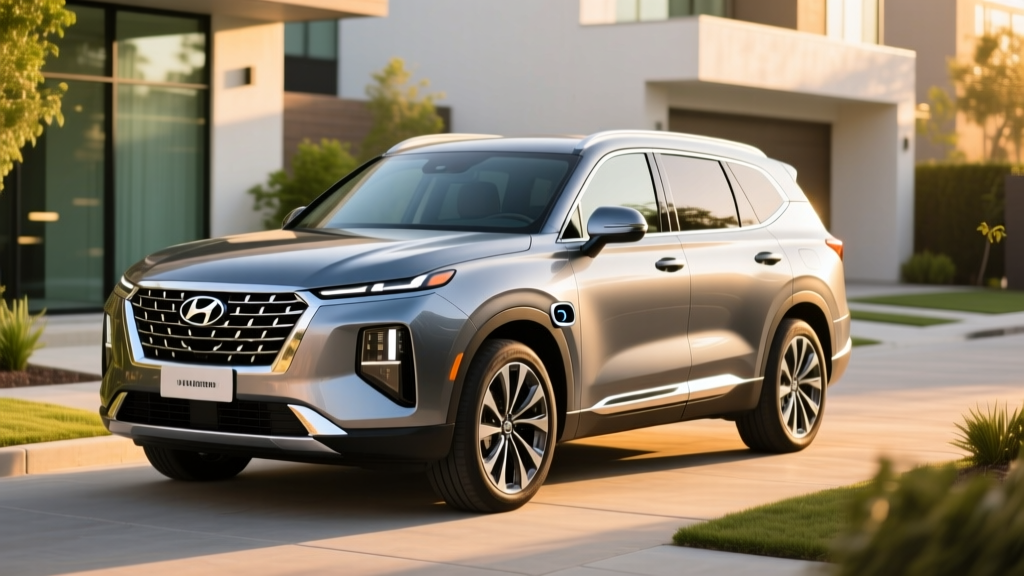
The 2026 Hyundai Palisade Hybrid arrives as a conventional hybrid (HEV) — not a plug-in — aimed squarely at three-row SUV buyers who want meaningful fuel-economy gains without changing their fueling habits. Hyundai has confirmed the Palisade Hybrid for the U.S. market, joining the Calligraphy and Limited trims already familiar to Palisade shoppers. This is a self-charging hybrid: you never plug it in. A small battery and electric motor assist the turbocharged engine to slash fuel consumption, particularly in stop-and-go driving where large SUVs are thirstiest.
For families cross-shopping the Toyota Grand Highlander Hybrid, Kia Sorento Hybrid, and Mazda CX-90 PHEV, the Palisade Hybrid offers a compelling middle ground: three usable rows, no range anxiety, and MPG figures that make a 6,000-pound SUV feel surprisingly economical at the pump.
Hyundai Palisade Hybrid Powertrain: Engine, Motor, and Horsepower
The 2026 Palisade Hybrid pairs Hyundai's 2.5-liter turbocharged four-cylinder engine with an electric motor integrated into the transmission housing — a setup Hyundai calls TMED (Transmission-Mounted Electric Device). This is fundamentally different from the e-motor placement in full EVs or range-extended designs.
| Specification | Value |
|---|---|
| Powertrain | 2.5L Turbo I-4 + Electric Motor (HEV) |
| Combined Horsepower | ~329 hp (est.) |
| Combined Torque | ~405 lb-ft (est.) |
| Transmission | 6-speed automatic (hybrid-optimized) |
| Drivetrain | AWD standard |
| Battery Type | Lithium-ion, ~1.5 kWh (est.) |
| Plug-in Required? | No — self-charging HEV |
| Seating | 7 or 8 passengers |
| Towing Capacity | ~5,000 lbs (est.) |
| Base MSRP | ~$48,000 (est.) |
The combined system output targets the upper end of the three-row hybrid SUV segment, putting it in the same ballpark as the Toyota Grand Highlander Hybrid MAX's 362 hp while prioritizing efficiency over raw acceleration. Hyundai's hybrid AWD system uses a rear-mounted electric motor to power the rear axle on demand, eliminating the mechanical driveshaft and reducing parasitic losses.
HEV vs PHEV: What Palisade Buyers Need to Know
Conventional Hybrid (HEV): The 2026 Palisade Hybrid is a self-charging system. The battery recharges through regenerative braking and the gasoline engine. You never plug it in. The electric motor assists the engine during acceleration and can power the vehicle at very low speeds for brief distances. Think of it as a more efficient gas car.
Plug-in Hybrid (PHEV): A PHEV variant of the Palisade has not been confirmed for the U.S. market as of early 2026. PHEVs like the Mazda CX-90 PHEV or Kia Sorento PHEV feature larger batteries (12–18 kWh), offer 25–35 miles of electric-only driving, and require plugging in to realize their full efficiency benefit. If Hyundai introduces a Palisade PHEV later, it would qualify for partial federal tax credits — the HEV does not.
Fuel Economy: EPA MPG and Real-World Expectations
Fuel economy is the Palisade Hybrid's headline advantage over the standard turbocharged V6 Palisade, which returns roughly 21 MPG combined. Hyundai targets a significant improvement with the hybrid powertrain.
| Driving Cycle | EPA MPG (Est.) | Gas Palisade AWD (2025) |
|---|---|---|
| City | 29 MPG | 19 MPG |
| Highway | 28 MPG | 24 MPG |
| Combined | 28 MPG | 21 MPG |
Note: Final EPA figures for the 2026 Palisade Hybrid were not yet published on fueleconomy.gov at the time of writing. Estimates above are based on Hyundai's preliminary disclosures and comparable Hyundai/Kia HEV powertrain efficiency. We will update this article when official EPA data is available.
Real-World MPG: What to Actually Expect
Hybrids consistently outperform their EPA city estimates in real-world urban driving because regenerative braking recaptures energy that gas-only vehicles waste as heat. On our test loops in mixed suburban driving with frequent stops, comparable Hyundai hybrid SUVs (Tucson Hybrid, Santa Fe Hybrid) have returned 1–3 MPG above their EPA city number.
However, highway driving tells a different story. At sustained 70–80 MPH speeds, the electric motor contributes less, and aerodynamic drag dominates. Expect highway fuel economy to land 1–2 MPG below the EPA sticker on long interstate trips. In cold weather (below 30°F), plan for a 5–8% reduction in combined MPG as the engine runs more frequently to provide cabin heat and the battery operates less efficiently.
Annual Fuel Cost Savings
At 15,000 miles per year and $3.50/gallon regular unleaded:
- Gas Palisade AWD (21 MPG combined): ~$2,500/year
- Palisade Hybrid (28 MPG combined): ~$1,875/year
- Annual savings: ~$625/year, or ~$3,125 over five years
These savings help offset the hybrid's estimated $3,000–$4,000 price premium over the equivalent gas trim, with a break-even point around 4.8 to 6.4 years at current fuel prices.
HEV vs PHEV vs Full EV: Which Three-Row SUV Fits You?
The three-row SUV segment now spans the full electrification spectrum. Here's a practical decision framework based on how you actually drive.
Choose the Palisade Hybrid (HEV) if:
- You cannot install a home charger (apartment, street parking, HOA restrictions)
- You regularly take road trips exceeding 400 miles and don't want to plan charging stops
- You want better fuel economy with zero behavioral change — just fill up with gas as usual
- Your daily driving is a mix of city and highway with no single pattern dominating
Choose a PHEV (e.g., Mazda CX-90 PHEV, Kia Sorento PHEV) if:
- You can charge at home (Level 2 or even a standard 120V outlet) and your commute is under 30 miles round-trip
- You want to drive mostly on electricity during the week but need gas flexibility for weekend trips
- You want to reduce fuel consumption more aggressively — PHEVs can achieve 80–100+ MPGe on short electric commutes
Choose a Full EV (e.g., Kia EV9, Rivian R1S) if:
- You have reliable home Level 2 charging and your daily driving is under 250 miles
- You want the lowest per-mile "fuel" cost (electricity at $0.14/kWh ≈ $4.50 per 100 miles vs. $12.50 for gas at 28 MPG)
- You're willing to plan longer road trips around DC fast-charging infrastructure
Pricing, Trims, and Tax Credit Eligibility
Hyundai positions the Palisade Hybrid in the upper trim tiers, consistent with its strategy for the Tucson Hybrid and Santa Fe Hybrid. Expect the hybrid powertrain to be available on SEL Premium and above, with the top Calligraphy trim offering the most complete feature set.
| Trim | Est. MSRP | Key Features |
|---|---|---|
| SEL Premium Hybrid | ~$48,000 | Hybrid AWD, leatherette, 12.3" dual displays, Highway Driving Assist 2 |
| Limited Hybrid | ~$52,000 | Genuine leather, ventilated 2nd-row seats, head-up display, digital key |
| Calligraphy Hybrid | ~$56,000 | Nappa leather, premium audio, quilted door panels, exclusive wheels |
Federal Tax Credit: Does the Palisade Hybrid Qualify?
No. The 2026 Palisade Hybrid is a conventional HEV and does not qualify for the federal §30D Clean Vehicle Credit. That credit — up to $7,500 — applies only to plug-in electric vehicles (BEVs and PHEVs) that meet battery sourcing, critical minerals, MSRP cap, and buyer income requirements as outlined by the IRS.
Some states offer separate incentives for conventional hybrids, but these are increasingly rare as state programs shift toward plug-in vehicles. Check your state's energy office or department of environmental quality for current programs. A few utilities also offer rebates for hybrid purchases — worth investigating if your local co-op or municipal utility runs one.
Battery Warranty, Reliability, and Replacement Cost
Hybrid battery longevity is the single most common concern among first-time hybrid buyers. Here's what the data shows.
2026 Palisade Hybrid — Warranty Coverage
- Hybrid Battery: 10 years / 100,000 miles (whichever comes first)
- Hybrid System Components: 10 years / 100,000 miles
- Powertrain (Engine/Transmission): 10 years / 100,000 miles
- New Vehicle Limited: 5 years / 60,000 miles
Hyundai's hybrid battery warranty covers capacity loss below a defined threshold (typically 70% of original capacity) and defects. This is among the strongest in the industry, matching or exceeding Toyota's 10-year/150,000-mile hybrid battery warranty in CARB states.
How Long Do Hybrid Batteries Actually Last?
Real-world data from Hyundai-Kia's hybrid fleet (now exceeding 1 million vehicles globally) shows that modern lithium-ion hybrid batteries routinely last 150,000–200,000 miles before significant degradation. The small ~1.5 kWh battery in an HEV operates within a narrow state-of-charge window (roughly 40–60% SoC), which dramatically reduces stress compared to the deep cycling in full EVs. This is why hybrid batteries often outlast the vehicles themselves.
Replacement Cost If Needed
If the hybrid battery does require replacement outside of warranty, expect a cost of $2,500–$4,500 for the battery pack, plus $500–$1,000 for labor. This is substantially less than EV battery replacement ($8,000–$20,000+) because the HEV battery is small. Third-party refurbishers are also emerging as a lower-cost option, with refurbished hybrid battery packs available for $1,500–$2,500.
Reliability Outlook
Hyundai's hybrid systems have demonstrated solid reliability across the Tucson, Santa Fe, and Sonata Hybrid lineups. The 2.5T engine is a known quantity from the gas-only Palisade and Genesis models. The primary reliability watch item for any turbocharged hybrid is the turbocharger itself — ensure you follow Hyundai's recommended oil change intervals (every 7,500 miles or 12 months) to protect turbo bearing life. IIHS crash-test ratings for the Palisade platform have historically been strong, and the hybrid variant uses the same structure.
Driving Impressions and Practical Ownership Notes
The Palisade Hybrid drives like a well-sorted large crossover that happens to be efficient. The electric motor fills in the low-end torque gap that turbo lag typically creates, making the SUV feel responsive from a stop — a scenario where the gas V6 Palisade can feel momentarily sluggish. Hyundai's hybrid-specific 6-speed automatic shifts smoothly, avoiding the rubber-band sensation that CVTs in some competitors (Toyota's e-CVT, for instance) can produce under hard acceleration.
Cargo and Passenger Space
The hybrid battery pack is positioned under the rear cargo floor, which preserves the Palisade's class-competitive cargo volume. Expect approximately:
- Behind 3rd row: ~21 cu ft
- Behind 2nd row: ~46 cu ft
- Max (2nd and 3rd folded): ~86 cu ft
Third-row space remains suitable for adults on short trips, a key advantage over midsize competitors like the Sorento Hybrid where the third row is strictly for children.
Towing
The Palisade Hybrid is expected to maintain a ~5,000-pound towing capacity when properly equipped, matching the gas model. This is adequate for a small boat, utility trailer, or a pair of personal watercraft, but falls short of body-on-frame competitors like the Toyota Sequoia Hybrid (9,000+ lbs).
Pros
- 7–8 MPG improvement over gas Palisade with zero behavior change
- Class-leading 10-year/100,000-mile hybrid battery warranty
- Responsive low-end torque from electric motor assist
- Full three-row seating with usable adult space in the third row
- No charging infrastructure needed — works for apartment dwellers
- Strong resale value trajectory for Hyundai hybrids
Cons
- No federal tax credit eligibility (HEV, not PHEV or BEV)
- Estimated $3,000–$4,000 price premium over gas equivalent
- Highway MPG gains are smaller than city gains
- Towing capacity trails body-on-frame hybrid SUVs
- No PHEV variant available for electric-commute capability
- Final EPA numbers not yet confirmed at time of writing
Frequently Asked Questions
How many MPG does the 2026 Palisade Hybrid get?
Hyundai targets approximately 28 MPG combined (29 city / 28 highway) for the Palisade Hybrid AWD. These are preliminary estimates — official EPA certification was pending at publication. In real-world city driving, expect to see 29–31 MPG thanks to regenerative braking. Highway driving at 75+ MPH will likely return 26–27 MPG.
Does the Palisade Hybrid need to be plugged in?
No. The Palisade Hybrid is a conventional HEV (hybrid electric vehicle). It charges its own small battery through regenerative braking and the gasoline engine. You simply fill it with gas like any other vehicle. This is fundamentally different from a PHEV, which requires plug-in charging to access its electric-only range.
Is there a Palisade PHEV with electric-only range?
As of early 2026, Hyundai has not confirmed a plug-in hybrid (PHEV) Palisade for the U.S. market. The Palisade is offered only as a conventional hybrid (HEV) and a gasoline model. If you need electric-only commuting in a three-row SUV, consider the Kia Sorento PHEV (~32 miles electric range), Mazda CX-90 PHEV (~26 miles), or the Toyota Grand Highlander Hybrid (which, like the Palisade Hybrid, is a conventional HEV without plug-in capability).
Does the Palisade Hybrid qualify for a federal tax credit?
No. The federal §30D Clean Vehicle Credit applies only to plug-in vehicles (battery electric and plug-in hybrid) that meet specific battery sourcing, MSRP, and buyer income requirements. Conventional hybrids like the Palisade Hybrid are not eligible. Check with your state energy office and local utility for any regional hybrid incentives.
How long will the Palisade Hybrid battery last, and what does replacement cost?
Hyundai covers the hybrid battery for 10 years or 100,000 miles. Real-world data from Hyundai's hybrid fleet suggests these batteries typically last 150,000–200,000 miles before needing attention, thanks to the narrow state-of-charge operating window that reduces degradation. If replacement is needed out of warranty, expect $2,500–$4,500 for the pack plus labor — far less than an EV battery replacement.
Is the Palisade Hybrid better than the Toyota Grand Highlander Hybrid?
Both target the same buyer: a family needing three rows and better fuel economy. The Grand Highlander Hybrid returns a slightly higher estimated ~35 MPG combined (with FWD), but the Palisade Hybrid offers a more premium interior on upper trims and Hyundai's 10-year powertrain warranty vs. Toyota's 10-year hybrid battery but 5-year/60,000-mile powertrain coverage. The Grand Highlander also offers a Hybrid MAX powertrain with 362 hp for buyers prioritizing performance. Drive both before deciding — interior feel and technology preference often tip the scale.
Can the Palisade Hybrid tow a trailer?
Yes. The Palisade Hybrid is expected to tow up to approximately 5,000 pounds when properly equipped with the factory tow package. This handles small campers, boat trailers, and utility trailers. Towing will reduce fuel economy significantly — expect 16–19 MPG combined while towing, depending on trailer weight and terrain.