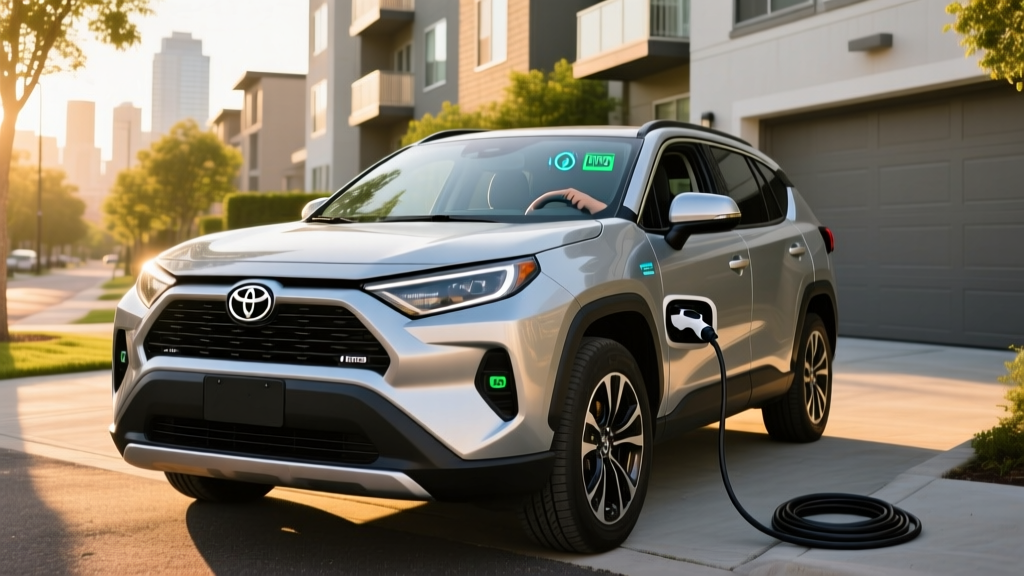
Quick Verdict: Why the 2020 RAV4 Hybrid Still Matters
Six years after its launch, the 2020 Toyota RAV4 Hybrid remains one of the most rational purchases in the compact crossover segment — especially on the used market. With an EPA-estimated 41 MPG combined, standard all-wheel drive, and Toyota's proven hybrid synergy drive system, it delivers near-EV efficiency in city driving without any plug, any range anxiety, or any charging infrastructure dependency.
For 2026 buyers weighing a used electrified vehicle, the 2020 RAV4 Hybrid sits at a compelling intersection: depreciated enough to be affordable (typically $22,000–$28,000 depending on trim and mileage), yet modern enough to include Toyota Safety Sense 2.0, Apple CarPlay, and a hybrid battery still under its original 10-year/150,000-mile warranty in most cases.
But how does it compare to the plug-in RAV4 Prime, and does it make sense versus a full battery electric vehicle (BEV)? Let's break down every number that matters.
2020 RAV4 Hybrid: Core Specifications
| Spec | 2020 RAV4 Hybrid (HEV) | 2020 RAV4 Prime (PHEV) |
|---|---|---|
| Powertrain | 2.5L 4-cyl + 3 electric motors | 2.5L 4-cyl + 3 electric motors (higher output) |
| Combined Horsepower | 219 hp | 302 hp |
| EPA City / Highway / Combined MPG | 41 / 38 / 40 | 40 / 36 / 38 (hybrid mode) |
| MPGe (Electric Mode, PHEV) | N/A | 94 MPGe |
| Electric-Only Range (PHEV) | N/A | 42 miles EPA |
| Total Range | ~570 miles | ~600 miles (combined EV + gas) |
| Battery Capacity (traction) | 1.6 kWh (NiMH, sealed) | 18.1 kWh (lithium-ion) |
| Plug-In Charging | No — self-charging hybrid | Yes — Level 1 (120V) ~12 hrs; Level 2 (240V) ~4.5 hrs |
| DC Fast Charging | N/A | No DC fast charge capability |
| 0–60 mph | 7.8 seconds | 5.7 seconds |
| Drivetrain | AWD (electronic rear motor) | AWD (electronic rear motor, higher output) |
| Cargo Volume | 37.6 cu ft (rear seats up) | 33.5 cu ft (battery intrudes slightly) |
| Original MSRP (base trim) | $28,350 (LE) | $38,100 (SE) |
| Used Price Range (2026 est.) | $22,000–$28,000 | $28,000–$36,000 |
HEV vs PHEV: Which RAV4 Is Right for You?
Conventional Hybrid (HEV) — 2020 RAV4 Hybrid
How it works: The gasoline engine and regenerative braking charge a small 1.6 kWh nickel-metal hydride (NiMH) battery. You never plug it in. The electric motor assists the engine during acceleration and can propel the car at low speeds for very short distances (typically under 1 mile at low speed). The system seamlessly blends gas and electric power to maximize efficiency.
Best for: Drivers who lack home charging access, apartment dwellers, those who want maximum simplicity with zero behavior change from a gas car.
Plug-In Hybrid (PHEV) — 2020 RAV4 Prime
How it works: A much larger 18.1 kWh lithium-ion battery provides 42 miles of EPA-rated electric-only driving. You plug it in overnight (Level 2, 240V recommended — about 4.5 hours for a full charge). Once the battery depletes, it operates as a conventional hybrid at 38 MPG combined. The Prime also delivers significantly more power (302 hp vs 219 hp) because its electric motors are higher-output.
Best for: Drivers with home Level 2 charging who commute under 40 miles round-trip and want EV-like daily driving with gas backup for road trips.
Critical distinction: The standard 2020 RAV4 Hybrid is a self-charging HEV. It does not have a plug, does not qualify for the federal EV tax credit, and cannot drive meaningful distances on electricity alone. The RAV4 Prime is the plug-in variant — a fundamentally different vehicle under the skin despite sharing the RAV4 nameplate.
Fuel Economy: EPA Ratings vs Real-World MPG
| Driving Scenario | EPA Estimate | Real-World Expectation |
|---|---|---|
| City | 41 MPG | 42–46 MPG (hybrids excel in stop-and-go) |
| Highway (70 mph) | 38 MPG | 34–37 MPG (aero drag reduces hybrid advantage) |
| Combined | 40 MPG | 38–42 MPG (depends on driving mix) |
| Cold Weather (below 30°F) | N/A | 33–37 MPG (engine runs more for cabin heat) |
Source: fueleconomy.gov — 2020 Toyota RAV4 Hybrid AWD
Toyota's hybrid system is at its best in city driving, where regenerative braking recaptures kinetic energy and the electric motor handles low-speed propulsion. Many owners report exceeding the 41 MPG city EPA estimate — a rarity in the auto industry where EPA numbers are usually optimistic ceilings. On the highway, however, the RAV4 Hybrid behaves more like a conventional vehicle: the engine does most of the work, and the boxy crossover aerodynamics work against efficiency at sustained speeds above 70 mph.
In cold weather, expect a 10–15% efficiency penalty. The gasoline engine must run more frequently to generate cabin heat (unlike a BEV with a heat pump), and the battery's charge/discharge efficiency drops in low temperatures. This is a smaller penalty than BEVs experience (typically 20–30% range loss in extreme cold), but it's real and worth budgeting for if you live in northern climates.
Powertrain Deep Dive: How 219 HP Gets Delivered
The 2020 RAV4 Hybrid pairs a 2.5-liter Dynamic Force inline-four engine (176 hp, 163 lb-ft) with Toyota's Hybrid Synergy Drive system. Two motor-generators sit in the transaxle up front (MG1 handles engine starting and battery charging; MG2 drives the front wheels), while a third electric motor on the rear axle provides on-demand AWD without a mechanical driveshaft.
Combined system output is 219 hp. That puts it in a sweet spot: quicker than most competitors (the 2020 Honda CR-V Hybrid makes 212 hp, the 2020 Ford Escape Hybrid makes 200 hp) while delivering best-in-class fuel economy. The 0–60 mph time of 7.8 seconds is adequate for merging and passing — not thrilling, but never sluggish.
The electronic AWD system (Toyota calls it AWD-i) engages the rear motor only when needed: during acceleration from stop, in low-traction conditions, or when the front wheels slip. This means the rear motor isn't parasitic during steady cruising, preserving the 40 MPG combined rating. In practice, the system is seamless — you won't feel the rear axle engaging.
Battery Longevity, Warranty & Replacement Cost
Battery Warranty Coverage
Hybrid Battery: 10 years / 150,000 miles (whichever comes first) in states that adopted California's ZEV standards; 8 years / 100,000 miles in other states. This covers capacity loss below a defined threshold and any manufacturing defects.
Hybrid System Components: 8 years / 100,000 miles nationwide (covers inverter, transaxle, control modules).
For a 2020 model, this means the hybrid battery warranty extends through the 2030 model year or 150,000 miles in California and CARB-adopting states (which include New York, Massachusetts, Colorado, and several others). In other states, coverage runs through 2028 or 100,000 miles. Check your state's adoption status and verify with a Toyota dealer using your VIN.
Real-world battery health data: Toyota's NiMH hybrid batteries have an exceptional longevity track record. Data from fleet operators and high-mileage owners suggests the 1.6 kWh NiMH pack in the RAV4 Hybrid typically retains 85–90% of its original capacity at 100,000 miles. Because the battery is small and the system never fully charges or discharges it (Toyota keeps the state of charge between roughly 40% and 80%), the shallow cycling dramatically extends cell life.
Replacement cost if out of warranty: A new OEM hybrid battery from Toyota runs approximately $3,000–$4,000 installed. Refurbished or aftermarket options are available for $1,500–$2,500. Individual cell replacement (only failed modules) can cost $500–$1,000 at a hybrid specialist shop. However, given Toyota's track record, outright battery failure before 200,000 miles is uncommon — gradual capacity loss is the more likely scenario, and even that manifests as a slight MPG reduction rather than a vehicle-stopping fault.
Used Market Pricing & Tax Credit Reality
As of early 2026, a used 2020 RAV4 Hybrid typically lists between $22,000 and $28,000, depending on trim (LE, XLE, XSE, Limited), mileage, condition, and region. The Limited trim with low miles can still command $29,000+. For context, the original MSRP started at $28,350 for the LE and topped out around $37,400 for a fully loaded Limited.
Tax credit status: The 2020 RAV4 Hybrid (HEV) does not qualify for the federal §30D Clean Vehicle Credit. This credit applies only to plug-in vehicles (BEVs and PHEVs) meeting battery sourcing, MSRP, and buyer income requirements. Conventional hybrids are excluded. Some states offer modest rebates for used hybrids, but these vary widely — check your state energy office or IRS §30D guidelines for current rules.
The RAV4 Prime (PHEV) did qualify for a federal credit when purchased new (up to $7,500), but that credit was only available to the original buyer. On the used market, the Used Clean Vehicle Credit (§25E) offers up to $4,000 or 30% of the sale price (whichever is less) for qualifying used PHEVs and BEVs — but the vehicle must be purchased from a dealer, priced at $25,000 or less, and the buyer must meet income caps ($75,000 single / $150,000 joint). Most used RAV4 Primes exceed the $25,000 price cap, making them ineligible. The standard RAV4 Hybrid faces no such complications: you simply pay the negotiated price.
Who Should Buy the 2020 RAV4 Hybrid — And Who Shouldn't
✓ Choose the RAV4 Hybrid If:
- You lack access to home or workplace charging (apartment, street parking)
- Your commute is mixed city/highway and you want 40+ MPG without behavior change
- You want AWD capability for snow/rain without the fuel penalty of a gas AWD SUV
- You plan to keep the vehicle 5+ years and value Toyota's reliability reputation
- You want a proven vehicle with widely available parts and service
✗ Look Elsewhere If:
- You have home Level 2 charging and a short commute — a BEV or PHEV will save more on fuel
- You want the quiet, instant-torque EV driving experience
- You drive primarily highway miles (the hybrid advantage shrinks to 34–37 MPG)
- You want the latest infotainment (2020 RAV4's 8-inch screen and Toyota Entune feel dated vs 2026 offerings)
- You need more than 37.6 cu ft of cargo space (the Honda CR-V Hybrid offers slightly more)
RAV4 Hybrid vs Full EV vs PHEV: Decision Framework
Choose the RAV4 Hybrid (HEV) if: You want electrified efficiency with zero infrastructure requirements. Total cost of ownership is low, reliability is proven, and you'll never think about charging.
Choose the RAV4 Prime (PHEV) if: You can install a Level 2 charger at home, your daily driving is under 40 miles, and you want EV-quiet commuting with gas-engine road-trip flexibility. Higher upfront cost, but potential fuel savings are significant if most miles are electric.
Choose a full BEV (e.g., Tesla Model Y, Hyundai Ioniq 5) if: You have reliable home charging, your typical trips fit within 250–300 miles, and you want the lowest per-mile energy cost, the smoothest driving experience, and zero tailpipe emissions. Higher purchase price, but lower operating costs over time.
Frequently Asked Questions
How many MPG does the 2020 RAV4 Hybrid actually get?
The EPA rates it at 41 city / 38 highway / 40 combined. In real-world driving, most owners see 38–42 MPG combined. City driving often exceeds the EPA estimate (42–46 MPG) because regenerative braking recaptures energy. Highway driving at 70+ mph typically drops to 34–37 MPG. Cold weather reduces efficiency by 10–15%.
Does the 2020 RAV4 Hybrid need to be plugged in?
No. The RAV4 Hybrid is a conventional (self-charging) hybrid. The battery charges through regenerative braking and the gasoline engine. There is no plug, no charging port, and no electric-only driving mode for meaningful distances. If you want plug-in capability, you need the RAV4 Prime (PHEV).
How far can the RAV4 Prime go on electric only?
The 2020 RAV4 Prime delivers 42 miles of EPA-rated electric-only range. In real-world conditions, expect 35–40 miles in mild weather and 28–35 miles in cold weather (below freezing). Once the battery depletes, the Prime operates as a conventional hybrid at 38 MPG combined.
Is the 2020 RAV4 Hybrid reliable?
Yes — it ranks among the most reliable compact SUVs in its model year. Toyota's hybrid system has been refined over 25+ years (since the original Prius). The NiMH battery, eCVT transaxle, and power electronics have very low failure rates. Consumer Reports and J.D. Power consistently rate the RAV4 Hybrid above average for reliability. The main concerns reported are minor infotainment glitches and occasional wind noise, not powertrain issues.
What does a RAV4 Hybrid battery replacement cost?
A new OEM hybrid battery from Toyota costs approximately $3,000–$4,000 installed. However, replacement before 150,000+ miles is rare. Toyota's hybrid battery warranty covers 10 years/150,000 miles in CARB states and 8 years/100,000 miles elsewhere. For a 2020 model, most examples still have some factory warranty remaining. Refurbished batteries are available for $1,500–$2,500 if needed out of warranty.
Does the 2020 RAV4 Hybrid qualify for a tax credit?
No. The federal §30D Clean Vehicle Credit applies only to plug-in vehicles (BEVs and PHEVs). Conventional hybrids like the RAV4 Hybrid are not eligible. On the used market, the §25E Used Clean Vehicle Credit also excludes conventional hybrids. Some states may offer small incentives, but these vary by jurisdiction — consult your state's energy office.
Should I buy the 2020 RAV4 Hybrid or a newer model?
The 2020 model year is significant because it introduced the current-generation RAV4 Hybrid with the 2.5L Dynamic Force engine and AWD-i system. The 2023+ refresh added a larger 10.5-inch touchscreen and Toyota Safety Sense 2.5, but the powertrain and efficiency are virtually identical. If you can save $5,000–$8,000 on a 2020 vs a 2024 model with similar mileage, the older car represents strong value — especially with hybrid battery warranty still in effect.