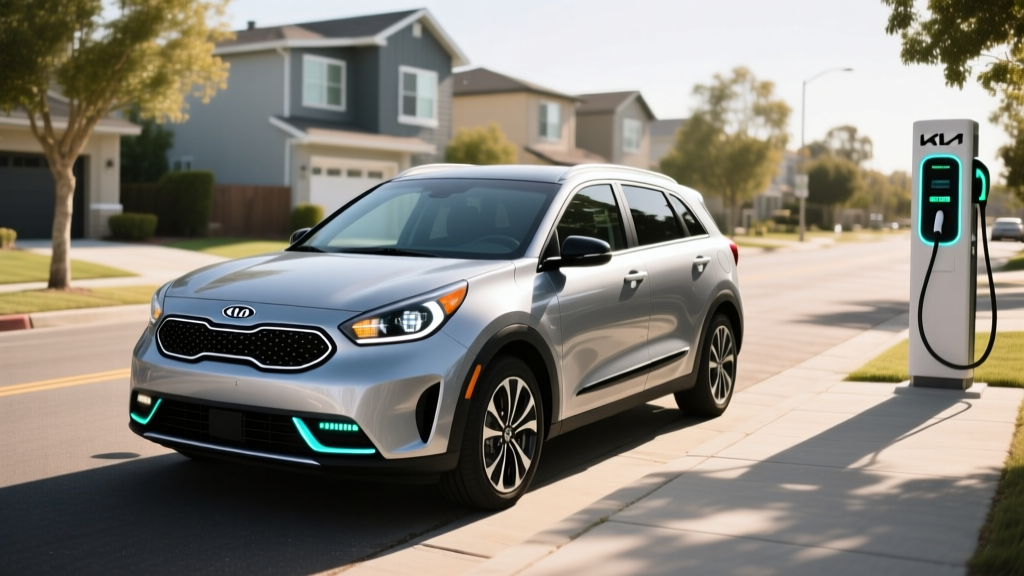
If you're shopping the used-hybrid market in 2026 and want maximum fuel efficiency without plugging in, the 2020 Kia Niro Hybrid remains one of the most compelling options. Built on a dedicated hybrid platform shared with Hyundai's Ioniq, the Niro delivers crossover utility with sedan-like efficiency. But how does its EPA sticker translate to real-world driving six years later, and does the plug-in hybrid variant make more sense for your commute?
This guide covers every 2020 Niro electrified variant — the conventional hybrid (HEV), the plug-in hybrid (PHEV), and the fully electric Niro EV — so you can match the right powertrain to your driving pattern, charging access, and budget.
2020 Kia Niro Hybrid MPG: EPA vs. Real World
The headline number for the 2020 Niro HEV is 50 MPG combined, but the city/highway split tells a more useful story for daily driving. Like most hybrids, the Niro leverages regenerative braking and electric-motor assist to excel in stop-and-go traffic, where a conventional gas car is least efficient.
| Powertrain | City MPG | Highway MPG | Combined MPG | MPGe (EV mode) |
|---|---|---|---|---|
| Niro HEV (FE trim) | 52 | 49 | 50 | N/A |
| Niro HEV (LXS/EX/Touring) | 51 | 46 | 49 | N/A |
| Niro PHEV | 46 (hybrid) | 40 (hybrid) | 43 (hybrid) | 105 MPGe |
| Niro EV | 131 MPGe | 109 MPGe | 120 MPGe | 120 MPGe |
Source: fueleconomy.gov
Expect the 2020 Niro HEV to deliver 47–53 MPG in mixed city driving, with some owners reporting over 55 MPG on flat urban routes. Highway-only driving at 75+ MPH typically drops to 42–45 MPG due to aerodynamic drag — the crossover body is taller than a Prius. In cold weather (below 30°F), plan for a 5–10% efficiency penalty as the engine runs more often for cabin heat. Source: owner-reported data on fueleconomy.gov MyMPG.
HEV vs. PHEV vs. EV: Which 2020 Niro Fits You?
The 2020 Niro lineup offers three distinct electrified powertrains under one body. Confusing them is easy at a glance — they look nearly identical — but the ownership experience differs dramatically.
| Attribute | HEV (Hybrid) | PHEV (Plug-In) | EV (Electric) |
|---|---|---|---|
| Needs to plug in? | No | Yes (optional) | Yes (required) |
| Electric-only range | ~1 mi at low speed | 26 mi (EPA) | 239 mi (EPA) |
| Total range | ~590 mi | ~560 mi (gas + electric) | 239 mi |
| Battery capacity | 1.56 kWh | 8.9 kWh | 64 kWh |
| Charging hardware | None (regen only) | Level 1/2 (J1772) | Level 1/2 + DC fast (CCS) |
| Combined HP | 139 hp | 139 hp | 201 hp |
| 0–60 mph | ~9.8 sec | ~9.5 sec | ~7.3 sec |
| Cargo (rear seats up) | 19.4 cu ft | 19.4 cu ft | 18.5 cu ft |
Choose the HEV if you have no home charging access, drive mostly in the city, and want zero behavior change from a gas car. Choose the PHEV if your commute is under 26 miles round-trip and you can install a Level 2 charger at home — you'll drive on electricity most days and use the gas engine only for longer trips. Choose the EV if you have reliable home charging, rarely exceed 200 miles in a day, and want the lowest per-mile operating cost.
Powertrain Deep Dive: Engine, Motor, and Battery Specs
All three 2020 Niro variants use variations of Kia's 1.6-liter GDI four-cylinder Atkinson-cycle engine paired with a 6-speed dual-clutch automatic — a notable choice versus the continuously variable transmissions (CVTs) used by the Toyota Prius and Honda Insight. The DCT gives the Niro a more natural acceleration feel, free of the rubber-band sensation some drivers dislike in CVTs.
| Specification | HEV | PHEV | EV |
|---|---|---|---|
| Engine | 1.6L I4 Atkinson | 1.6L I4 Atkinson | None |
| Engine HP | 104 hp | 104 hp | N/A |
| Electric motor | 43 hp (32 kW) | 61 hp (45 kW) | 201 hp (150 kW) |
| Combined system output | 139 hp / 195 lb-ft | 139 hp / 195 lb-ft | 201 hp / 291 lb-ft |
| Transmission | 6-speed DCT | 6-speed DCT | Single-speed reduction |
| Traction battery | 1.56 kWh Li-ion | 8.9 kWh Li-polymer | 64 kWh Li-polymer |
| Drivetrain | FWD | FWD | FWD |
PHEV Charging Details
The 2020 Niro PHEV's 8.9 kWh battery charges via a J1772 inlet (no DC fast charging). On a standard 120V household outlet (Level 1 at ~1.4 kW), a full charge takes approximately 9 hours. On a 240V Level 2 charger at 3.3 kW, expect a full charge in roughly 2 hours 45 minutes. Because the battery is small, even a basic Level 2 home charger replenishes it quickly — no need for a 48-amp unit. The PHEV cannot DC fast charge; the onboard charger maxes out at 3.3 kW AC.
Battery Warranty, Lifespan, and Replacement Costs
For a used 2020 Niro in 2026, battery health is the top concern. Here's what Kia covers and what to expect as the vehicle ages past the original warranty window.
- HEV battery: 10 years / 100,000 miles (whichever comes first)
- PHEV battery: 10 years / 100,000 miles
- EV battery: 10 years / 100,000 miles (minimum 70% capacity retention)
- Hybrid system components (motor, inverter, controller): 10 years / 100,000 miles
Source: Kia America Warranty Guide
What this means in 2026: A 2020 Niro is now 6 years old. If you're the original owner, you still have roughly 4 years or 40,000+ miles of battery coverage remaining. For second owners, Kia's hybrid battery warranty transfers to subsequent owners at 10 years/100,000 miles — a significant advantage over some competitors that reduce coverage on transfer.
Realistic Battery Replacement Cost
Hybrid battery failure before 150,000 miles is uncommon based on industry data. The Niro HEV's small 1.56 kWh pack is under minimal stress because it's never deeply cycled — the system keeps it in a narrow state-of-charge window. If replacement is needed:
- HEV battery pack: $2,000–$3,500 (parts + labor)
- PHEV battery pack: $4,000–$6,500
- EV battery pack: $8,000–$14,000 (largest cost, but longest expected life)
Independent hybrid repair shops can sometimes replace individual modules for significantly less than a full pack swap from a Kia dealer.
2020 Niro Hybrid Pricing and Tax Credit Eligibility
The 2020 Niro is no longer sold new, so all purchases happen on the used market. Here's what pricing looks like in early 2026 and whether any tax credits apply.
Used Market Pricing (2026 Estimates)
- Niro HEV (LXS/EX, 50k–80k miles): $14,000–$18,000
- Niro HEV (Touring, 50k–80k miles): $16,000–$20,000
- Niro PHEV (EX Premium, 50k–80k miles): $17,000–$22,000
- Niro EV (EX Premium, 50k–80k miles): $15,000–$19,000
Federal Tax Credit: Used Clean Vehicle Credit (§25E)
Under the current IRS Used Clean Vehicle Credit (§25E), you may qualify for a credit of up to $4,000 or 30% of the sale price (whichever is lower) when buying a qualifying used hybrid, PHEV, or EV from a licensed dealer. Key requirements:
- Vehicle sale price: Must be $25,000 or less — all 2020 Niro variants qualify at current used prices
- Buyer income cap: AGI ≤ $75,000 (single), $112,500 (head of household), $150,000 (joint)
- Vehicle age: Must be at least 2 model years old (2020 qualifies in 2026)
- Dealer requirement: Must purchase from a licensed dealer, not a private party
- First transfer: Credit applies only to the first qualified sale since August 16, 2022
- Battery capacity: PHEV must have ≥ 7 kWh (Niro PHEV's 8.9 kWh qualifies); HEV battery must be ≥ 4 kWh (Niro HEV's 1.56 kWh does NOT qualify)
- ✅ 2020 Niro PHEV: Eligible for up to $4,000 used-EV credit (if buyer meets income cap and dealer-sale requirement)
- ✅ 2020 Niro EV: Eligible for up to $4,000 used-EV credit
- ❌ 2020 Niro HEV: NOT eligible — battery too small (1.56 kWh < 4 kWh minimum)
Always confirm eligibility with a tax professional. Rules current as of 2026 per irs.gov §25E.
Reliability, Safety, and Ownership Track Record
The 2020 Niro benefits from a mature hybrid system that Kia and Hyundai have refined since the original Niro's 2017 launch. The dedicated hybrid platform avoids the packaging compromises of converted gas-car architectures.
Safety Ratings
The 2020 Niro earned an IIHS Top Safety Pick designation with Good ratings in all crashworthiness tests when equipped with LED headlights (available on EX and Touring trims). The NHTSA awarded it 5 stars overall. Standard driver-assist features include forward collision warning, automatic emergency braking, lane-keeping assist, and a driver-attention monitor — all part of Kia's Drive Wise suite.
Per IIHS crash test results, the Niro's small-overlap and moderate-overlap front ratings are Good across the board, making it one of the safer subcompact crossovers from its model year.
Common Owner Complaints
Based on aggregated owner forums and NHTSA complaint data, the most frequently noted issues with the 2020 Niro HEV include:
- 12V battery drain if the vehicle sits unused for extended periods (common across many hybrids)
- Infotainment lag on the base 7-inch screen (resolved in later model-year software updates, but not retrofitted to all 2020 units)
- Road noise at highway speeds — the Niro prioritizes low rolling resistance over cabin insulation
Traction-battery failures are rare in NHTSA data and owner surveys for this generation.
Who Should Buy the 2020 Kia Niro Hybrid?
Buy the Niro HEV if:
- You want 49–50 MPG with zero lifestyle change — no plugs, no apps, no range planning
- Your city driving exceeds your highway miles (hybrids reward stop-and-go patterns)
- You need crossover cargo space (19.4 cu ft) but don't want a RAV4 Hybrid's size or price
- Your budget is under $20,000 on the used market
Buy the Niro PHEV if:
- Your round-trip commute is ≤ 26 miles and you can charge at home (Level 2 recommended)
- You want EV-like daily driving with gas-engine flexibility for road trips
- You qualify for the $4,000 used-vehicle tax credit, bringing effective cost close to the HEV
Look at a full EV instead if:
- You have reliable Level 2 home charging and rarely drive over 200 miles in a single day
- You want the lowest possible cost per mile (electricity at $0.13/kWh ≈ $0.04/mi vs. hybrid gas at ~$0.07/mi)
- You prefer zero maintenance on engine oil, filters, and spark plugs
- Best-in-class city MPG (52 city on FE trim)
- Generous 10-year/100,000-mile hybrid battery warranty, transferable
- Crossover ride height with car-like handling
- Standard advanced driver-assist suite on all trims
- DCT transmission avoids CVT drone
- PHEV variant eligible for up to $4,000 used-EV tax credit
- Highway MPG drops to 46 on non-FE trims
- No AWD option (FWD only across all trims)
- PHEV cannot DC fast charge (3.3 kW max AC)
- Rear-seat headroom tight for passengers over 6'2"
- Infotainment shows its age vs. 2024+ Kia systems
- HEV does not qualify for any federal tax credit
Frequently Asked Questions
How many MPG does the 2020 Kia Niro Hybrid actually get?
The EPA rates the Niro HEV at 52 city / 49 highway / 50 combined on the FE trim, and 51/46/49 on higher trims with larger wheels. In real-world mixed driving, owners consistently report 47–53 MPG. Highway-heavy driving at 75+ MPH typically yields 42–45 MPG. The FE trim's low-rolling-resistance tires and aero wheels account for its 1-MPG advantage.
How far can the 2020 Niro PHEV go on electric only?
The EPA rates the Niro PHEV at 26 miles of electric-only range. In mild weather (50–80°F) with moderate acceleration, expect 24–28 miles. In cold weather or with aggressive throttle inputs, that may drop to 18–22 miles. Once the battery depletes, the PHEV operates as a conventional hybrid rated at 43 MPG combined.
Is the 2020 Kia Niro Hybrid reliable?
Yes. The Niro's hybrid powertrain has been in production since 2017 with minimal revisions, and Kia's 1.6L Atkinson-cycle engine is one of the simplest in the segment (no turbo, no direct-injection complexity beyond the baseline GDI). The 10-year/100,000-mile battery warranty provides long-term protection. J.D. Power and owner-survey data place the Niro at or above segment average for dependability.
What does a Niro hybrid battery replacement cost?
For the HEV's 1.56 kWh pack, expect $2,000–$3,500 at a Kia dealer. The PHEV's 8.9 kWh pack runs $4,000–$6,500. However, hybrid battery failure before 150,000 miles is uncommon. The Niro's system keeps the battery in a narrow charge window (roughly 40–80% SoC), which minimizes degradation. Most Niro hybrids reach 200,000+ miles on the original battery.
Does the 2020 Kia Niro Hybrid qualify for any tax credit?
The conventional HEV does not qualify for any federal tax credit — its battery is too small (1.56 kWh) to meet the 4 kWh minimum under §25E. The Niro PHEV and Niro EV do qualify for the Used Clean Vehicle Credit (§25E) of up to $4,000, provided the buyer meets income caps ($75K single / $150K joint), the vehicle sells for ≤ $25,000, and the sale is through a licensed dealer. Always verify with a tax professional before relying on credit eligibility.
Can I charge the Niro Hybrid at home?
The conventional HEV (Niro Hybrid) does not plug in — it charges its small battery through regenerative braking and the gasoline engine. Only the PHEV and EV variants have charge ports. The PHEV uses a standard J1772 connector and charges on any Level 1 (120V) or Level 2 (240V) home outlet in about 9 hours or 2 hours 45 minutes, respectively.
How does the Niro Hybrid compare to a Toyota Prius or RAV4 Hybrid?
The Prius (2020) rates at 54 MPG combined with a lower ride height and less cargo space. The RAV4 Hybrid delivers 40 MPG combined with AWD and significantly more room, but costs $5,000–$8,000 more on the used market. The Niro occupies a middle ground: near-Prius efficiency with crossover practicality, priced below the RAV4 Hybrid.