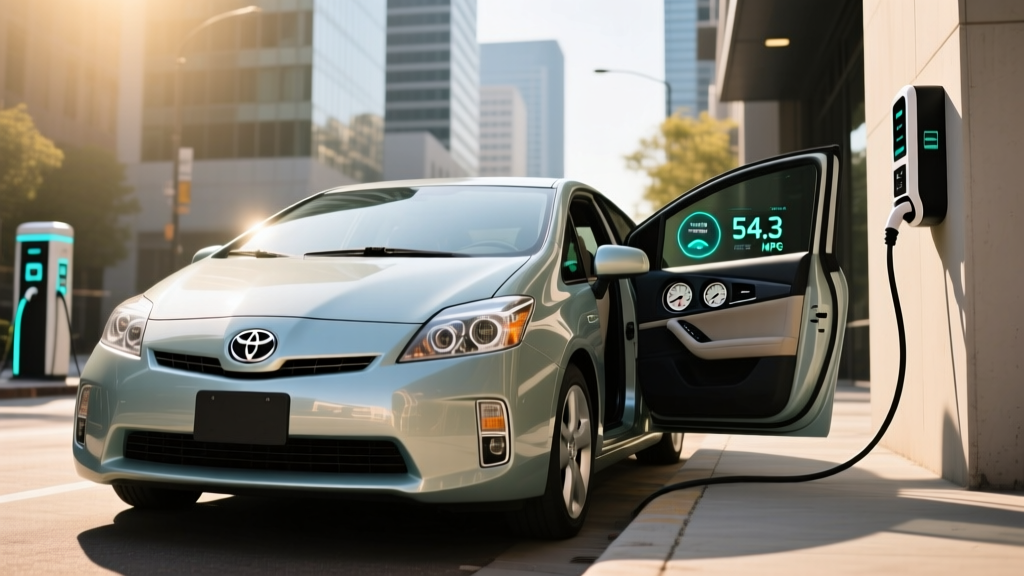
The 2007 Toyota Prius remains one of the most recognizable hybrids ever sold, and nearly two decades later, it still draws searches from buyers curious about its fuel economy and long-term viability. If you are researching the 2007 Prius hybrid MPG — whether you own one, are considering a used purchase, or are benchmarking older hybrids against modern electrified options — this guide covers the exact EPA figures, real-world fuel economy data, battery health expectations, and where this second-generation Prius fits in the 2026 market.
Let's be direct: the 2007 Prius is a conventional hybrid (HEV), not a plug-in hybrid (PHEV). It cannot be plugged in, it has no electric-only driving range, and it does not qualify for federal EV tax credits. What it does offer is proven, simple hybrid efficiency that still holds up in city driving. Here is everything you need to know.
2007 Prius Hybrid MPG: EPA Ratings and Real-World Results
The EPA rated the 2007 Toyota Prius at 60 mpg city / 51 mpg highway / 55 mpg combined under the testing methodology in place at the time. However, the EPA revised its testing procedures for the 2008 model year to better reflect real-world driving (faster acceleration, air conditioning use, colder temperatures). Under the revised methodology — the same standard used for all modern vehicles — the 2007 Prius is more accurately rated at approximately 48 mpg city / 45 mpg highway / 46 mpg combined.
| Metric | Original EPA (2007) | Revised EPA Estimate | Real-World Owner Average |
|---|---|---|---|
| City MPG | 60 mpg | 48 mpg | 44–52 mpg |
| Highway MPG | 51 mpg | 45 mpg | 40–48 mpg |
| Combined MPG | 55 mpg | 46 mpg | 42–50 mpg |
Why real-world city MPG often beats highway: The Prius Hybrid Synergy Drive system recovers energy through regenerative braking and runs the electric motor extensively at low speeds. Stop-and-go city driving plays to its strengths. Highway driving at 70+ mph relies more heavily on the 1.5-liter gasoline engine, reducing efficiency. Owners who drive predominantly in urban environments frequently report 48–52 mpg, while highway-dominant commuters may see 38–44 mpg.
Cold-weather impact: In winter conditions (below 40°F), expect a 5–12% reduction in fuel economy. The engine runs more frequently to maintain cabin heat and keep the hybrid battery at optimal temperature. A 2007 Prius that achieves 48 mpg combined in summer may drop to 42–44 mpg in cold climates, according to fueleconomy.gov cold-weather data.
HEV vs PHEV: What the 2007 Prius Is (and Is Not)
A common source of confusion among used-car shoppers is whether the 2007 Prius needs to be plugged in. It does not. The 2007 Prius is a conventional hybrid electric vehicle (HEV). It generates all its electricity internally through regenerative braking and the gasoline engine.
| Feature | HEV (2007 Prius) | PHEV (e.g., 2026 Prius Prime) | BEV (e.g., Tesla Model 3) |
|---|---|---|---|
| Plug-in Charging | No | Yes | Yes (required) |
| Electric-Only Range | None (EV assist only at low speed) | 39–44 miles (2026 Prius Prime) | 250–400+ miles |
| Battery Size | 1.3 kWh (NiMH) | 13.6 kWh (Li-ion) | 50–100 kWh (Li-ion) |
| Federal Tax Credit (§30D) | Not eligible | Up to $3,750 (varies by sourcing) | Up to $7,500 (varies) |
| Combined MPG / MPGe | 46 mpg | 52 mpg / 127 MPGe | 130+ MPGe |
| Gasoline Required | Yes (always) | Yes (after EV range depleted) | No |
The 2007 Prius's 1.3 kWh nickel-metal hydride (NiMH) battery is small by modern standards — it exists only to buffer energy for acceleration assist and regenerative braking, not to drive the car independently for meaningful distances. At very low speeds (under ~25 mph in light-load conditions), the Prius can creep short distances on electric power alone, typically a few hundred feet in a parking lot. This is not "electric-only range" in any practical sense.
Powertrain: Engine, Motor, and Combined Output
The 2007 Prius uses Toyota's second-generation Hybrid Synergy Drive (HSD), pairing a gasoline engine with two motor-generators through a planetary gearset (e-CVT). Here are the exact specifications:
| Component | Specification |
|---|---|
| Engine | 1.5L 4-cylinder Atkinson cycle (1NZ-FXE) |
| Engine Power | 76 hp @ 5,000 rpm / 82 lb-ft torque |
| Electric Motor (MG2) | 67 hp (50 kW) / 295 lb-ft torque |
| Combined Net Output | 110 hp |
| Transmission | Planetary e-CVT (no fixed gears) |
| Hybrid Battery | 1.3 kWh NiMH, 201.6V nominal |
| 0–60 mph | ~10.0 seconds |
| Curb Weight | ~2,932 lbs |
| Fuel Tank | 11.9 gallons |
| Total Driving Range | ~547 miles (at 46 mpg combined) |
The combined 110 hp is modest, and the 10-second 0–60 time reflects that. The 2007 Prius was never a performance vehicle. Its strength is efficiency, not acceleration. Highway merging and hill climbing require planning, but the electric motor's instant torque (295 lb-ft at 0 rpm from MG2) provides surprisingly responsive takeoffs from stops.
Hybrid Battery Lifespan, Warranty, and Replacement Cost
The 2007 Prius's NiMH hybrid battery is the single biggest concern for used buyers. Here is what the data shows after nearly two decades of real-world operation:
Original Warranty: Toyota warranted the hybrid battery for 8 years / 100,000 miles (10 years / 150,000 miles in CARB states including California, New York, Massachusetts, and others). This warranty has expired for all 2007 models.
Expected Lifespan: NiMH batteries in the Gen 2 Prius typically last 150,000–200,000 miles before significant degradation, though many original batteries have survived beyond 200,000 miles with gradual capacity loss. Battery failure is not sudden — efficiency degrades over time as cells weaken.
Replacement Cost (2026):
- Refurbished/remanufactured battery: $1,000–$1,800 installed
- New OEM Toyota battery: $2,200–$3,000 installed
- Individual cell/module replacement (specialist shops): $500–$900
The NiMH chemistry in the 2007 Prius degrades more gracefully than early lithium-ion packs. Rather than sudden capacity cliffs, NiMH batteries lose capacity gradually. A 2007 Prius with a 190,000-mile original battery may still achieve 40–43 mpg combined — a 10–15% drop from new — rather than failing outright. Many independent hybrid specialists now offer individual module replacement, which extends battery life at a fraction of a full pack swap.
Signs of hybrid battery degradation: Noticeable MPG drop below 38 mpg combined, the engine running more frequently, reduced regenerative braking feel, or dashboard warning lights (specifically the red triangle with an exclamation mark combined with hybrid system messages). A hybrid battery health scan via OBD-II can reveal individual module voltage imbalance before complete failure.
2007 Prius vs Modern Hybrids and PHEVs: Does It Still Compete?
To put the 2007 Prius in context, here is how its fuel economy compares to current hybrid and plug-in hybrid benchmarks available in 2026:
| Vehicle | Type | Combined MPG | EV Range | Used/New Price Range |
|---|---|---|---|---|
| 2007 Toyota Prius | HEV | 46 mpg | None | $3,500–$7,000 (used) |
| 2026 Toyota Prius LE | HEV | 57 mpg | None | $28,550 (new MSRP) |
| 2026 Toyota Prius Prime SE | PHEV | 52 mpg / 127 MPGe | 44 miles | $33,450 (new MSRP) |
| 2026 Hyundai Elantra Hybrid | HEV | 54 mpg | None | $26,500 (new MSRP) |
| 2026 Honda Accord Hybrid | HEV | 48 mpg | None | $30,000 (new MSRP) |
The 2007 Prius's 46 mpg combined still outperforms many non-hybrid vehicles and remains competitive with some 2026 hybrids. The current-generation (fifth-gen) Prius achieves 57 mpg combined — a 24% improvement — but costs $28,550 new. A well-maintained 2007 Prius at $5,000 with a fresh hybrid battery can deliver cost-per-mile efficiency that rivals vehicles costing five times as much.
Tax Credits, Incentives, and Total Cost of Ownership
Federal tax credit: The 2007 Toyota Prius does not qualify for the IRS §30D Clean Vehicle Credit. That credit applies only to new plug-in vehicles (PHEVs and BEVs) meeting battery sourcing, MSRP, and buyer income requirements. Conventional hybrids like the 2007 Prius have never been eligible. The original 2007 Prius did qualify for a federal tax credit of up to $3,150 when new, but that provision expired long ago and applied only to the original purchaser.
State incentives: A handful of states offer used-EV incentives or hybrid-specific rebates, but these are rare and change frequently. Check your state's environmental agency or department of energy for current programs. No broad federal incentive exists for purchasing a used HEV.
Cost of ownership reality (2026):
- Fuel cost: At 46 mpg and $3.40/gallon (2026 national average), driving 12,000 miles/year costs approximately $887/year in gasoline. Compare that to a 25 mpg non-hybrid at $1,632/year.
- Insurance: Typically $800–$1,200/year for a 2007 Prius, lower than most modern EVs due to the vehicle's low value.
- Maintenance: The 2007 Prius has no timing belt (chain-driven), no traditional transmission fluid changes, and regenerative braking extends pad life significantly. Annual maintenance averages $300–$500 for a well-maintained example.
- The hybrid battery wildcard: Budget $1,000–$2,000 for a battery replacement if the car is over 160,000 miles and the battery is original. This is the single biggest financial risk.
Who Should Buy a 2007 Prius — and Who Shouldn't
Pros
- 46 mpg combined still beats most 2026 non-hybrid cars
- Very low purchase price ($3,500–$7,000)
- Proven, well-documented powertrain with abundant aftermarket support
- Low annual fuel cost (~$887/yr at 12K miles)
- Simple to maintain; no plug-in infrastructure needed
- Strong parts availability and independent hybrid specialist network
Cons
- Hybrid battery replacement risk ($1,000–$3,000) on high-mileage examples
- No electric-only range; always burns gasoline
- 110 hp combined — sluggish by 2026 standards (10-sec 0–60)
- No federal tax credit eligibility
- Dated safety tech (no automatic emergency braking, no lane-keep assist)
- Interior quality and infotainment reflect 2007 standards
- NiMH battery less energy-dense than modern lithium-ion
Choose the 2007 Prius if: You need the cheapest possible high-MPG commuter, you drive predominantly in city traffic, you can budget for a potential hybrid battery replacement, and you don't need modern driver-assistance features. It's an excellent budget commuter for students, delivery drivers, or second-car duty.
Choose a modern HEV (2026 Prius, Elantra Hybrid) if: You want 50+ mpg with a full warranty, modern safety features (AEB, lane-keep, adaptive cruise), and no battery replacement risk for a decade. The $26,000–$29,000 investment pays off if you plan to keep the car 8+ years.
Choose a PHEV (2026 Prius Prime, RAV4 Prime) if: You have home charging access and a short commute (under 40 miles). You can drive most days on electricity alone and use gasoline only for longer trips. Federal tax credits of up to $3,750 may apply depending on battery sourcing and your income.
Choose a full BEV if: You have reliable home Level 2 charging, want zero tailpipe emissions, qualify for up to $7,500 in federal tax credits, and are ready to eliminate gasoline entirely. Consider a BEV if your daily driving is under 250 miles and you have access to DC fast charging for road trips.
Frequently Asked Questions
How many MPG does the 2007 Prius actually get?
Under revised EPA methodology, the 2007 Prius is rated at 48 city / 45 highway / 46 combined mpg. Real-world owners report 42–50 mpg combined depending on driving mix. City-dominant drivers often see 48–52 mpg thanks to the hybrid system's regenerative braking and low-speed electric assist. Highway-dominant driving at 70+ mph typically yields 38–44 mpg.
Does the 2007 Prius need to be plugged in?
No. The 2007 Prius is a conventional hybrid (HEV). It charges its 1.3 kWh NiMH battery entirely through regenerative braking and the gasoline engine. There is no plug, no charging port, and no electric-only driving range beyond brief low-speed creeping.
How long does the 2007 Prius hybrid battery last?
Original NiMH batteries in the Gen 2 Prius typically last 150,000–200,000 miles. Some have exceeded 250,000 miles with gradual capacity loss. Battery degradation is progressive rather than sudden — you will notice declining MPG before the battery fails entirely. Replacement costs $1,000–$1,800 for a refurbished unit or $2,200–$3,000 for a new OEM battery.
Is the 2007 Prius reliable?
The 2007 Prius has an excellent long-term reliability record. The Hybrid Synergy Drive powertrain has proven remarkably durable, with the e-CVT planetary gearset having no clutches, bands, or traditional transmission components to wear. The main reliability concern is the hybrid battery in high-mileage examples. Beyond that, the 1NZ-FXE engine is known to exceed 300,000 miles with basic maintenance. NHTSA records show few systemic complaints beyond battery aging.
Does the 2007 Prius qualify for any tax credit in 2026?
No. The 2007 Prius is a conventional hybrid (HEV) and does not qualify for the federal §30D Clean Vehicle Credit, which is limited to new plug-in vehicles (PHEVs and BEVs). The original $3,150 credit available to 2007 Prius buyers expired years ago and applied only to original purchasers. Some states may offer minor used-vehicle or efficiency incentives, but no broad federal incentive applies.
How does the 2007 Prius compare to the 2026 Prius?
The 2026 Toyota Prius achieves 57 mpg combined (vs 46 mpg for the 2007), produces 194 hp (vs 110 hp), includes standard Toyota Safety Sense 3.0 (AEB, lane-keep, adaptive cruise), and comes with a 10-year/150,000-mile hybrid battery warranty. The trade-off is price: $28,550 new vs $3,500–$7,000 used. If you prioritize lowest cost per mile and can accept the battery risk, the 2007 model still delivers remarkable efficiency for the money.
What is the total driving range of a 2007 Prius?
With an 11.9-gallon fuel tank and 46 mpg combined EPA rating, the 2007 Prius can travel approximately 547 miles on a full tank. Real-world range varies from about 480 miles (highway-dominant driving) to 600+ miles (city-dominant driving where the hybrid system is most efficient).
The 2007 Toyota Prius remains a compelling option for budget-conscious drivers who need maximum fuel economy with minimum complexity. Its 46 mpg combined is still competitive, its powertrain is proven, and its ownership costs are among the lowest of any vehicle on the road. The hybrid battery is the key variable — budget for it, inspect it before purchase, and this second-generation Prius can still serve as a remarkably efficient daily driver in 2026.