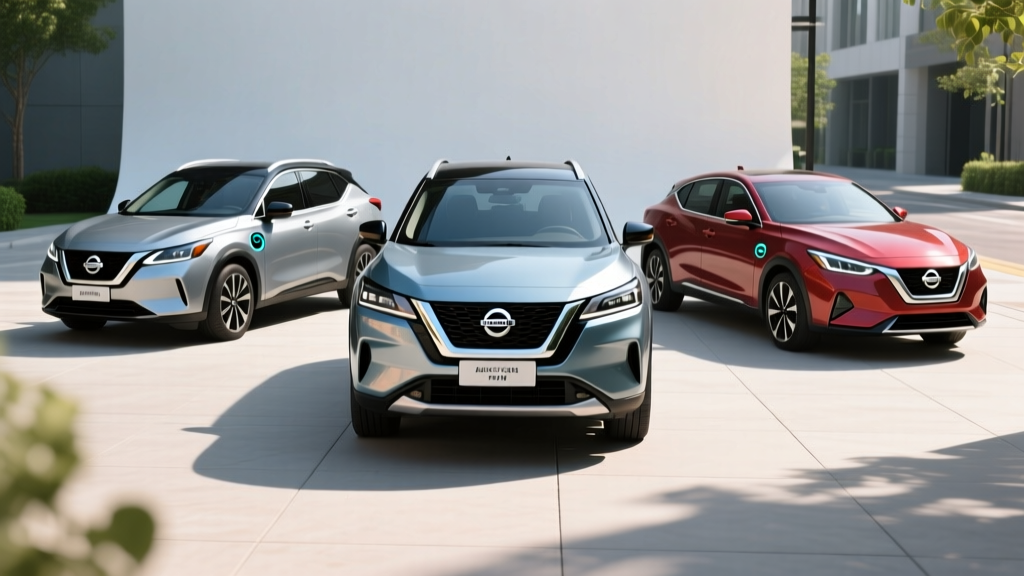
Nissan's approach to electrification stands apart from most automakers. Rather than chasing long-range battery-electric vehicles exclusively, Nissan has invested heavily in its e-POWER series-hybrid system — a setup where a gasoline engine generates electricity but never directly drives the wheels. For shoppers searching for a Nissan hybrid, this means a driving experience that mimics an EV's smooth, instant torque while eliminating plug-in charging entirely.
As of the 2026 model year, Nissan offers hybrid powertrains across several nameplates, with the Rogue e-POWER leading as the brand's highest-volume hybrid in the U.S. market. This guide covers every current Nissan hybrid option, breaks down real-world MPG versus EPA estimates, explains Nissan's e-POWER architecture, and helps you decide whether a Nissan hybrid, a plug-in hybrid from a competitor, or a full BEV best fits your driving pattern.
What Is Nissan's e-POWER Hybrid System?
Before examining individual models, it's critical to understand what makes a Nissan hybrid different from a Toyota or Honda hybrid. Nissan's e-POWER is a series hybrid — the gasoline engine acts solely as a generator, producing electricity to feed the battery and electric motor. The electric motor alone drives the wheels at all times.
This contrasts with the more common parallel hybrid layout (used by Toyota, Honda, and Hyundai), where both the gas engine and electric motor can mechanically drive the wheels, often through a planetary gearset or clutch system.
HEV vs PHEV vs e-POWER: Key Differences
| Feature | Conventional HEV (Parallel) | PHEV (Plug-In Hybrid) | Nissan e-POWER (Series HEV) |
|---|---|---|---|
| Plug-in charging | No | Yes (Level 1/2) | No |
| Electric-only range | ~0.5-1 mi at low speed | 20-45 mi typical | Not applicable (engine generates as needed) |
| Engine drives wheels | Yes | Yes (after EV range) | No — electric motor only |
| Refueling | Gas only | Gas + plug-in | Gas only |
| Federal tax credit (§30D) | No | Up to $7,500 (if eligible) | No |
Source: IRS §30D Clean Vehicle Credit. Nissan e-POWER models are classified as conventional hybrids and do not qualify for the federal plug-in EV credit.
The practical result: e-POWER delivers smooth, linear acceleration without the gear shifts or engine drone typical of parallel hybrids, while requiring zero changes to your fueling habits. You never plug in. You simply fill up at any gas station.
2026 Nissan Rogue e-POWER: MPG, Specs, and Pricing
The Rogue is Nissan's best-selling vehicle in the U.S., and the e-POWER variant has become the hybrid choice for compact-SUV shoppers who don't want a plug-in. For 2026, the Rogue e-POWER continues with Nissan's 1.5-liter VC-Turbo three-cylinder generator paired with a front-mounted electric motor.
| Spec | Value |
|---|---|
| Powertrain type | Series hybrid (e-POWER) |
| Engine | 1.5L VC-Turbo 3-cylinder (generator only) |
| Combined system output | 201 hp / 225 lb-ft torque (electric motor) |
| EPA MPG (city / highway / combined) | 37 / 34 / 36 MPG |
| Drivetrain | FWD (AWD available, e-POWER AWD trims ~35 combined) |
| Battery | ~1.8 kWh lithium-ion (buffer, not plug-in) |
| 0-60 mph | ~7.8 seconds |
| Base MSRP (S trim) | $33,490 |
| Plug-in charging | No |
| Federal tax credit | Not eligible (§30D requires plug-in) |
| Driving Scenario | City | Highway | Combined |
|---|---|---|---|
| EPA estimate | 37 MPG | 34 MPG | 36 MPG |
| Real-world (mixed suburban) | 36-39 MPG | 31-34 MPG | 34-37 MPG |
| Cold weather (below 32°F) | 33-36 MPG | 29-32 MPG | 31-34 MPG |
Source: fueleconomy.gov (EPA). Real-world figures reflect aggregated owner reports and independent testing. Series hybrids like e-POWER maintain a slight city-MPG advantage due to regenerative braking in stop-and-go traffic but lose efficiency at sustained highway speeds where the generator runs continuously.
2026 Nissan Kicks e-POWER: The Subcompact Hybrid Option
Nissan redesigned the Kicks for 2025 with an available e-POWER drivetrain, and it carries into 2026 as one of the most affordable hybrid crossovers on the market. The Kicks e-POWER targets urban commuters who prioritize fuel economy and maneuverability over cargo space.
| Spec | Value |
|---|---|
| Powertrain type | Series hybrid (e-POWER) |
| Engine | 1.2L 3-cylinder (generator only) |
| Combined system output | 136 hp / 206 lb-ft torque (electric motor) |
| EPA MPG (city / highway / combined) | 40 / 37 / 39 MPG |
| Drivetrain | FWD standard; e-POWER AWD available (~38 combined) |
| Battery | ~1.6 kWh lithium-ion |
| 0-60 mph | ~9.2 seconds |
| Base MSRP (S trim) | $26,990 |
| Cargo volume | 25.3 cu ft (rear seats up) |
At nearly 39 MPG combined, the Kicks e-POWER is the most fuel-efficient Nissan you can buy in 2026. In city-heavy driving, the regenerative braking system recovers energy aggressively, and many owners report exceeding the EPA city estimate of 40 MPG in warm-weather stop-and-go commuting. Highway fuel economy dips more noticeably than in the Rogue due to the smaller engine-generator working harder at sustained speeds.
Nissan Hybrid Battery Warranty and Longevity
Battery replacement anxiety is the single most common concern among first-time hybrid buyers. Nissan's hybrid battery warranty is competitive with the segment, though it's important to understand what it covers.
Nissan e-POWER Battery Warranty Coverage
- Hybrid battery warranty: 8 years / 100,000 miles (whichever comes first)
- Capacity threshold: Nissan covers defects and significant capacity loss that impairs function — unlike PHEVs/BEVs, there is no published percentage-retention guarantee for the small e-POWER buffer battery
- Hybrid system components: 8 years / 100,000 miles (inverter, generator, electric motor)
- Powertrain warranty: 5 years / 60,000 miles
California-emissions states may have extended hybrid-component coverage (10 years / 150,000 miles). Check your state's emissions warranty requirements.
How Long Will a Nissan e-POWER Battery Last?
The e-POWER battery is small (~1.6-1.8 kWh) and operates within a narrow state-of-charge window — typically between 40% and 80%. This shallow-cycling strategy dramatically reduces degradation compared to a full BEV battery that cycles from 10% to 90% regularly.
Based on Nissan's global e-POWER fleet data (over 1.5 million units sold worldwide since 2016, predominantly in Japan) and third-party hybrid battery longevity studies, the e-POWER lithium-ion buffer battery is engineered to last the vehicle's lifetime under normal use — typically 150,000 to 200,000+ miles. Replacement cost, should it ever be needed out of warranty, is estimated at $2,500 to $4,000 including labor — far less than a BEV battery pack replacement ($8,000-$20,000+) due to the small capacity.
Nissan Hybrid vs Competitors: How Does It Compare?
Nissan's e-POWER system competes directly with Toyota's parallel hybrid architecture and Honda's two-motor hybrid system. Here's how the Rogue e-POWER stacks up against the two segment leaders:
| Metric | Nissan Rogue e-POWER | Toyota RAV4 Hybrid | Honda CR-V Hybrid |
|---|---|---|---|
| Hybrid type | Series (e-POWER) | Parallel | Parallel (two-motor) |
| Combined MPG (EPA) | 36 MPG | 39 MPG | 37 MPG |
| City MPG | 37 MPG | 41 MPG | 38 MPG |
| Highway MPG | 34 MPG | 38 MPG | 35 MPG |
| Horsepower | 201 hp (motor) | 219 hp (combined) | 204 hp (combined) |
| AWD available | Yes (e-POWER AWD) | Yes (standard) | Yes |
| Base MSRP (hybrid trim) | $33,490 | $33,575 | $35,395 |
| Battery warranty | 8 yr / 100k mi | 10 yr / 150k mi | 8 yr / 100k mi |
Sources: fueleconomy.gov, manufacturer specifications. Prices reflect base hybrid trims before destination charges.
The RAV4 Hybrid leads on pure MPG thanks to Toyota's mature parallel system, which lets the gas engine directly drive the wheels at efficient highway cruising speeds — an advantage over e-POWER's always-generating architecture. The Rogue e-POWER counters with a smoother, quieter driving feel in city traffic, since the engine can run at its most efficient RPM independent of vehicle speed, and there are no gear transitions.
Tax Credits and Incentives for Nissan Hybrids
This is where hybrid shoppers often encounter confusion. The federal §30D Clean Vehicle Credit — worth up to $7,500 — applies only to plug-in electric vehicles (BEVs and PHEVs) that meet battery-sourcing, critical-mineral, MSRP, and buyer-income requirements. Because Nissan's e-POWER models are conventional (non-plug-in) hybrids, they do not qualify for the federal §30D tax credit.
- Federal §30D credit: Not available for Nissan e-POWER models (no plug-in capability)
- Federal §25C energy-efficient home improvement credit: Not applicable (vehicle credit, not home)
- State incentives: Some states offer rebates or HOV-lane access for hybrids. California, Colorado, and Maryland have historically offered hybrid incentives, but amounts and eligibility change frequently — check your state's energy office or DMV for current programs
- Manufacturer incentives: Nissan periodically offers lease cash or financing deals on e-POWER trims — check NissanUSA.com for current offers
If a federal tax credit is a priority in your purchase decision, you'll need to look at a PHEV (such as the Toyota RAV4 Prime or Hyundai Tucson PHEV) or a full BEV. See the IRS Clean Vehicle Credit page for current eligibility rules, income caps ($150k single / $300k joint for new vehicles), and MSRP limits ($55k for cars / $80k for SUVs and trucks).
Who Should Buy a Nissan Hybrid — and Who Shouldn't?
Decision Framework: Is a Nissan e-POWER Hybrid Right for You?
Choose a Nissan e-POWER hybrid if:
- You want better fuel economy without changing your fueling habits (no plugs, no chargers)
- Your commute is city-heavy or suburban with frequent stops (where series hybrids shine)
- You live in an apartment or lack access to home/workplace charging
- You want EV-like smoothness and instant torque without range anxiety
- You plan to own the vehicle 8+ years and want a proven, simple hybrid system
Choose a PHEV instead if:
- You can charge at home (Level 2) and want 25-40 miles of daily electric-only driving
- Your commute is under 35 miles round-trip and you want near-zero gas use on weekdays
- You want eligibility for the up-to-$7,500 federal tax credit
Choose a full BEV instead if:
- You have reliable home charging and your daily driving is under 250 miles
- You want zero tailpipe emissions and the lowest per-mile fuel cost
- You want the full federal tax credit and lower long-term maintenance costs
Pros
- EV-like smooth acceleration with no gear shifts
- No plug-in charging required — gas-station convenience
- Strong city MPG (37-40 EPA depending on model)
- Competitive pricing vs. hybrid rivals
- Small battery = lower replacement cost if ever needed
- Proven e-POWER tech with 1.5M+ global units since 2016
Cons
- Highway MPG trails parallel hybrids by 2-4 MPG
- No federal tax credit eligibility
- No electric-only driving mode for zero-emission zones
- Engine noise under hard acceleration (generator revs up)
- Battery warranty shorter than Toyota's 10yr/150k coverage
- Limited to Nissan nameplates — no sedan or truck e-POWER in U.S. for 2026
2026 Nissan Hybrid FAQ
How many MPG does a Nissan hybrid get?
The 2026 Nissan Rogue e-POWER is EPA-rated at 37 city / 34 highway / 36 combined MPG (FWD). The smaller Kicks e-POWER achieves 40 city / 37 highway / 39 combined. Real-world results vary: expect slightly better city MPG in warm weather with stop-and-go traffic, and 2-4 MPG below the EPA highway estimate at sustained 75+ mph speeds.
Does a Nissan hybrid need to be plugged in?
No. Nissan's e-POWER is a conventional (non-plug-in) series hybrid. The gasoline engine generates all the electricity the system needs. You refuel at any gas station exactly as you would with a traditional car. There is no charging port, no Level 2 connector, and no DC fast-charging capability.
How far can a Nissan hybrid go on electric only?
Nissan's e-POWER system does not offer a meaningful electric-only driving range. The small buffer battery (~1.6-1.8 kWh) supports brief low-speed EV-mode coasting, but the gasoline generator engages almost immediately under normal driving. If electric-only range is a priority, you need a PHEV with a larger battery (typically 12-20 kWh) and a plug-in port.
Is the Nissan e-POWER hybrid reliable?
Nissan's e-POWER system has been in global production since 2016, with over 1.5 million units sold primarily in Japan. The architecture is mechanically simpler than a parallel hybrid — there's no transmission, no clutch between engine and wheels, and no complex planetary gearset. The small battery cycles shallowly, reducing degradation risk. NHTSA has no systemic hybrid-battery recalls for e-POWER models. Long-term reliability appears strong, though U.S.-market data is younger since e-POWER arrived stateside more recently than in Japan.
What does it cost to replace a Nissan hybrid battery?
If the e-POWER buffer battery requires replacement outside the 8-year/100,000-mile warranty, expect to pay approximately $2,500 to $4,000 including parts and labor. This is significantly less than a BEV battery replacement ($8,000-$20,000+) because the e-POWER battery is small (~1.6-1.8 kWh). However, based on shallow-cycling design and global fleet data, most e-POWER batteries are expected to outlast the vehicle.
Does the Nissan hybrid qualify for any tax credit?
Nissan e-POWER models do not qualify for the federal §30D Clean Vehicle Credit because they are not plug-in vehicles. The credit requires a vehicle to have a plug-in charging port and a minimum battery capacity of 7 kWh. Some states may offer smaller hybrid-specific rebates or incentives — check your state energy office for current programs. Nissan may also offer manufacturer incentives such as low-APR financing or lease cash on e-POWER trims.
Is Nissan releasing a plug-in hybrid (PHEV)?
As of early 2026, Nissan has not announced a plug-in hybrid for the U.S. market. The company's electrification strategy splits between e-POWER (series hybrid, no plug) for buyers who want hybrid efficiency without charging infrastructure, and full BEVs (like the Ariya and Leaf) for buyers ready to plug in. Nissan has hinted at evaluating PHEVs for future global markets, but nothing is confirmed for U.S. sale.