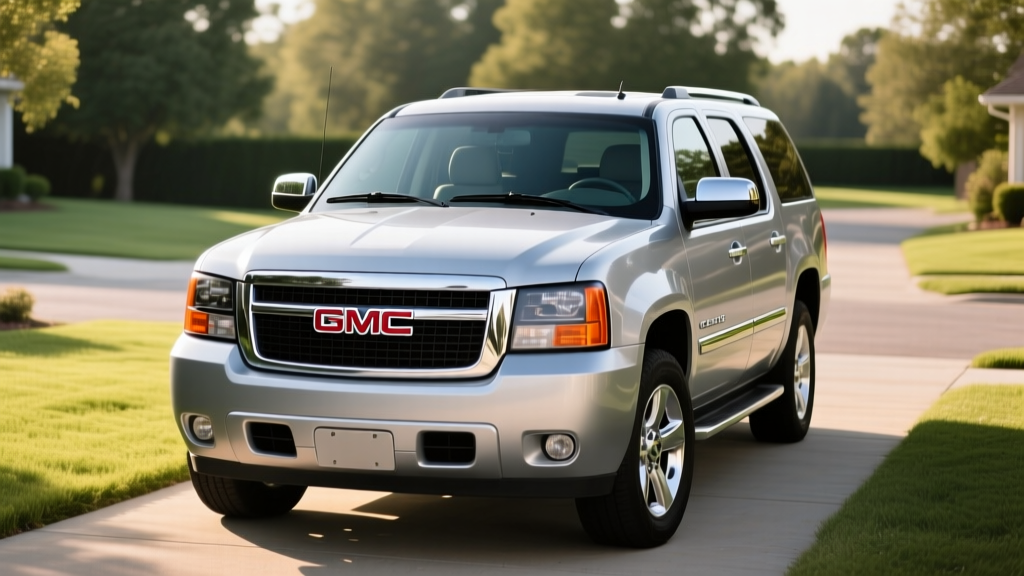
The 2008 GMC Yukon Hybrid at a Glance
The 2008 GMC Yukon Hybrid was one of the first full-size SUVs to pair GM's two-mode hybrid system with a large V8, promising meaningful fuel savings over its gas-only sibling without sacrificing towing or passenger space. Nearly two decades later, it remains a fixture on the used market — typically priced between $4,000 and $9,000 depending on mileage and condition. For buyers considering a budget-friendly large SUV with better fuel economy than a conventional Yukon, the key questions are straightforward: what MPG does it actually deliver, is the hybrid battery a ticking time bomb, and how does it compare to modern electrified alternatives?
This guide covers the real numbers, ownership realities, and decision framework you need before buying a 2008 Yukon Hybrid in 2026.
Powertrain and Hybrid System Specifications
| Specification | Value |
|---|---|
| Engine | 6.0L V8 (Vortec) with Active Fuel Management |
| Engine Horsepower | 332 hp @ 5,100 rpm |
| Electric Motors | Twin 60-kW motors (inside transmission) |
| Combined System Output | 379 hp |
| Transmission | Two-mode hybrid CVT (electrically variable) |
| Hybrid Battery | NiMH (Nickel-Metal Hydride), ~1.8 kWh |
| Drivetrain | 2WD or 4WD |
| Towing Capacity | Up to 6,200 lbs (2WD) / 5,800 lbs (4WD) |
| 0-60 mph | ~8.0 seconds (est.) |
| Curb Weight | ~5,800 lbs |
The two-mode hybrid system was co-developed by GM, Chrysler, and BMW (the "Global Hybrid Cooperation"). In Mode 1, at low speeds and light loads, the vehicle can operate on electric power alone at very low speeds (under ~30 mph in stop-and-go traffic), though not for any meaningful distance. In Mode 2, at highway speeds or under heavy load, the system blends engine and motor power for improved efficiency. The Active Fuel Management system also deactivates four of the eight cylinders under light-load cruising.
Fuel Economy: EPA Ratings vs Real-World MPG
The headline number for the 2008 GMC Yukon Hybrid was a significant improvement over the gas-only Yukon, which returned an EPA-estimated 14 mpg city and 20 mpg highway with the 5.3L V8. Here's how the hybrid compares:
| Configuration | City MPG | Highway MPG | Combined MPG |
|---|---|---|---|
| 2WD Hybrid | 21 | 22 | 21 |
| 4WD Hybrid | 20 | 20 | 20 |
| Gas-only 5.3L V8 (2WD) | 14 | 20 | 16 |
Source: fueleconomy.gov
Real-World MPG Expectations
Conventional hybrids often exceed their EPA city estimates because stop-and-go driving maximizes regenerative braking and electric-motor assist. The 2008 Yukon Hybrid is no exception in city driving — owners commonly report 20-23 mpg in urban use. However, highway fuel economy tends to fall slightly below the EPA sticker, with real-world highway figures often landing between 18-20 mpg. The hybrid system's advantages diminish at sustained high speeds where the V8 carries most of the load.
Expect a combined real-world average of 18-21 mpg depending on driving mix, terrain, and vehicle condition. A well-maintained example driven predominantly in the city can approach or match its EPA combined rating. High-mileage examples with degraded hybrid batteries may see a 1-3 mpg drop.
Hybrid Battery: Lifespan, Warranty, and Replacement Cost
The 2008 Yukon Hybrid uses a nickel-metal hydride (NiMH) battery pack — the same chemistry found in the Toyota Prius of that era. NiMH batteries are robust and proven but heavier and less energy-dense than modern lithium-ion packs.
Battery Lifespan Data
NiMH batteries in GM's two-mode hybrid system have generally proven durable. Many 2008-2013 Tahoe and Yukon Hybrids have reached 150,000-200,000 miles on the original battery pack. However, age is now the primary concern — even low-mileage examples are 17-18 years old, and NiMH cells degrade with time regardless of use.
Common failure indicators include:
- Reduced fuel economy (system stops using electric assist)
- "Service Hybrid System" dashboard warning
- Reduced regenerative braking feel
- Poor acceleration from stops (no electric motor torque fill)
Battery Replacement Cost
| Option | Cost Range | Notes |
|---|---|---|
| New OEM battery (GM) | $3,500 - $5,000+ | Limited availability; may require dealer sourcing |
| Remanufactured battery | $1,500 - $2,800 | Most common route; rebuilt with tested cells |
| Used/salvage battery | $500 - $1,200 | Risky — unknown remaining life; no warranty typically |
| Individual cell replacement | $400 - $900 | Specialist shops can replace bad cells; labor-intensive |
For a vehicle worth $4,000-$9,000, a full OEM battery replacement rarely makes financial sense. Remanufactured packs from hybrid battery specialists are the practical choice, and individual cell repair can extend the pack's life at the lowest cost if caught early.
Tax Credits and Incentives: What Applies in 2026
The 2008 GMC Yukon Hybrid originally qualified for a federal tax credit of up to $2,200 under the Energy Policy Act of 2005 (a different, now-expired credit program for early hybrid vehicles). That credit phased out for GM vehicles after 2010.
In 2026, there are no federal tax credits available for purchasing a used 2008 GMC Yukon Hybrid. The current IRS §30D clean vehicle credit applies only to new qualifying EVs and PHEVs, and the §25E used clean vehicle credit (up to $4,000) applies only to used EVs and PHEVs — not conventional hybrids. State-level incentives for conventional hybrids are virtually nonexistent.
For current federal EV and PHEV incentive rules, consult the IRS Clean Vehicle Credits page.
2008 Yukon Hybrid vs Modern Alternatives
If you're cross-shopping the 2008 Yukon Hybrid, you're likely weighing it against other used large SUVs or newer electrified options. Here's how it stacks up:
| Vehicle | Type | Combined MPG / MPGe | Typical Used Price | Plug-In? |
|---|---|---|---|---|
| 2008 GMC Yukon Hybrid | HEV | 20-21 mpg | $4,000 - $9,000 | No |
| 2016-2020 Toyota Highlander Hybrid | HEV | 28-29 mpg | $18,000 - $30,000 | No |
| 2021+ Toyota Sienna (Hybrid) | HEV | 36 mpg | $30,000 - $42,000 | No |
| 2022+ Jeep Wrangler 4xe | PHEV | 49 MPGe / 20 mpg gas | $28,000 - $42,000 | Yes (21 mi elec.) |
| 2023+ Chrysler Pacifica PHEV | PHEV | 82 MPGe / 30 mpg gas | $28,000 - $38,000 | Yes (32 mi elec.) |
The Yukon Hybrid's primary advantage is its low entry price combined with full-size SUV capability (three-row seating for up to eight, body-on-frame towing). No modern hybrid matches its combination of low cost and large size. However, newer hybrid minivans and midsize SUVs deliver dramatically better fuel economy with more modern safety tech and warranty coverage.
Who Should Buy the 2008 Yukon Hybrid?
- You need a full-size, body-on-frame SUV on a tight budget (under $10K)
- You tow regularly and need 5,800-6,200 lb capacity
- You drive mostly in the city where the hybrid system shines
- You're mechanically inclined and can manage potential battery repair
- You need 8-passenger seating without a minivan
- You want plug-in electric-only driving (look at a PHEV)
- You prioritize modern safety features (no automatic emergency braking, lane keep, etc.)
- You want warranty peace of mind — everything is out of warranty
- You drive mostly highway — the hybrid advantage shrinks at speed
- You can't budget $1,500-$3,000 for a potential battery replacement
Hybrid vs PHEV vs Full EV — Which Fits You?
Conventional Hybrid (HEV) — like the 2008 Yukon Hybrid: No plug, no behavior change needed. You just drive and it saves fuel vs the gas equivalent. Best for buyers without home charging access who want lower fuel costs.
Plug-in Hybrid (PHEV) — like the Chrysler Pacifica Hybrid or RAV4 Prime: Offers 20-40 miles of electric-only range for daily commuting, then operates as a regular hybrid on longer trips. Requires access to charging (ideally a Level 2 home charger) to realize its full benefit. Eligible for federal tax credits when bought new.
Battery Electric Vehicle (BEV) — like the Rivian R1S or Kia EV9: Zero tailpipe emissions, lowest per-mile "fuel" cost (especially with home charging), minimal maintenance. Requires reliable charging access and acceptance of range planning on road trips. Best total cost of ownership if you can charge at home.
Reliability and Common Issues Beyond the Battery
The 2008 Yukon Hybrid shares the GMT900 platform with the Tahoe, Suburban, and Silverado. The 6.0L V8 (LFA/LZ1 engine codes for the hybrid variant) is generally regarded as one of GM's more reliable truck engines. Common non-hybrid issues to inspect for include:
- Active Fuel Management (AFM) lifter failure: The cylinder-deactivation system can cause lifter collapse at high mileage, leading to costly engine repair (~$2,000-$4,000). Listen for tapping or misfire codes.
- Transmission: The two-mode hybrid transmission (2ML70) is complex. Fluid changes every 50,000 miles are critical. Failure is expensive ($3,000-$5,000+ replacement).
- Power steering pump: The electric power steering system can develop faults; replacement runs $800-$1,500.
- Air suspension (if equipped): Autoride air shocks commonly fail on GMT900 SUVs. Aftermarket conversion to standard coil springs is a popular fix ($400-$800).
Overall, the hybrid-specific components (battery, hybrid transmission, electric motors) have proven more reliable than many buyers feared, but the vehicle's age means all major systems are operating on borrowed time. A pre-purchase inspection by a hybrid-experienced mechanic is essential.
Frequently Asked Questions
How many MPG does the 2008 GMC Yukon Hybrid get?
The EPA rates the 2WD model at 21 city / 22 highway / 21 combined mpg, and the 4WD at 20/20/20 mpg. Real-world results typically range from 18-21 mpg combined, with city driving often meeting or exceeding the EPA city figure and highway driving falling 1-3 mpg below the sticker.
Does the 2008 Yukon Hybrid need to be plugged in?
No. It is a conventional hybrid (HEV). The battery recharges through regenerative braking and the gasoline engine. There is no plug, no charging port, and no electric-only driving range.
Is the 2008 Yukon Hybrid reliable?
The 6.0L V8 and two-mode hybrid system have proven reasonably durable, with many examples exceeding 150,000 miles. The primary risk in 2026 is age-related battery degradation. Budget $1,500-$2,800 for a remanufactured battery if needed. AFM lifter issues and transmission maintenance are the other key concerns.
What does it cost to replace the hybrid battery?
A remanufactured NiMH battery pack costs $1,500-$2,800 installed. Individual cell repair can cost $400-$900 at a hybrid specialist. New OEM batteries are $3,500-$5,000+ but are increasingly difficult to source for a 2008 model.
Does the 2008 GMC Yukon Hybrid qualify for any tax credit in 2026?
No. The original federal hybrid tax credit (up to $2,200) expired for GM vehicles after 2010. The current IRS §30D and §25E credits apply only to EVs and PHEVs, not conventional hybrids. No state incentives currently target used conventional hybrid purchases.
How does the Yukon Hybrid compare to a modern hybrid SUV?
Modern hybrid SUVs like the Toyota Highlander Hybrid (28-29 mpg combined) or Toyota Sienna (36 mpg combined) deliver 30-70% better fuel economy with current safety technology and warranty coverage. However, none offer the Yukon's body-on-frame towing capacity or full-size dimensions at a sub-$10,000 price point.