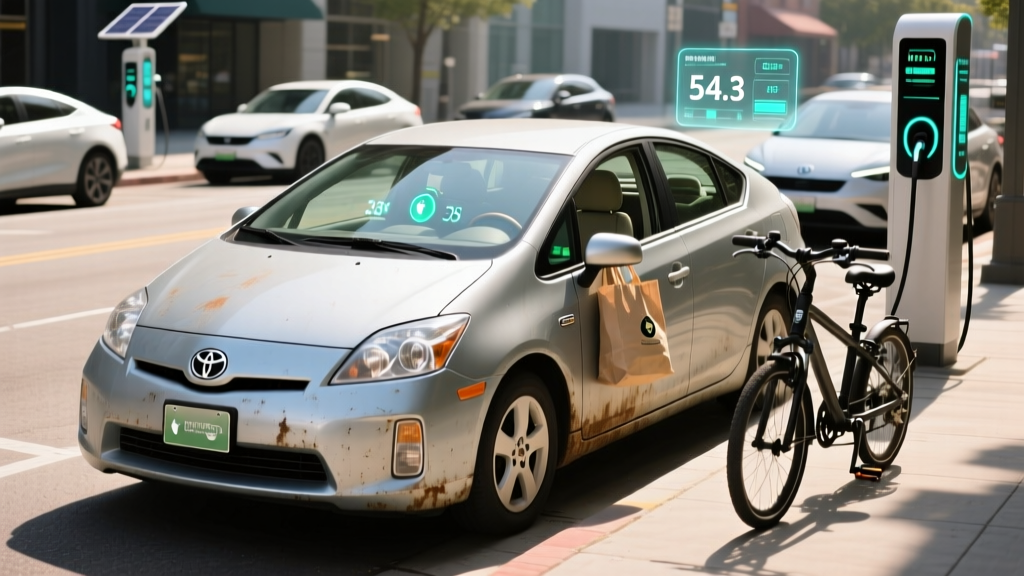
If you've been searching for 2006 Toyota Prius hybrid MPG data, you're likely evaluating one of the most iconic early hybrids as a budget daily driver or curious about how a nearly two-decade-old hybrid holds up in 2026. The second-generation Prius (XW20) put Toyota's Hybrid Synergy Drive on the map, and its fuel economy numbers remain respectable even against modern non-hybrid compacts.
This guide covers the EPA ratings, real-world fuel economy you can expect today, battery longevity and replacement costs, and whether a 2006 Prius still makes financial sense versus a newer hybrid or full EV.
EPA Fuel Economy: The Official Numbers
The 2006 Toyota Prius is a conventional hybrid electric vehicle (HEV) — it cannot plug in and has no electric-only range. It generates all its electricity from the gasoline engine and regenerative braking. Here are the official EPA ratings as published on fueleconomy.gov:
| Driving Cycle | EPA MPG |
|---|---|
| City | 48 MPG |
| Highway | 45 MPG |
| Combined | 46 MPG |
Note: The 2006 Prius was rated under the older EPA test cycle. When the EPA revised its testing methodology in 2008 to better reflect real-world driving (higher speeds, air conditioning use, cold starts), the retroactive adjusted rating for the 2006 Prius dropped to approximately 46 city / 43 highway / 44 combined. This revised figure is what you'll see on modern fueleconomy.gov listings and is a more realistic baseline.
Real-World MPG: What Owners Actually Report
| Metric | Value |
|---|---|
| EPA Combined (revised) | 44 MPG |
| Real-World Avg (Fuelly data) | 42–47 MPG |
| Best Observed (city-heavy, mild climate) | 50+ MPG |
| Worst Observed (cold climate, short trips, aged battery) | 35–38 MPG |
| Fuel Tank Capacity | 11.9 gallons |
| Estimated Range per Tank | 475–550 miles |
The Prius's city MPG advantage is real. In stop-and-go traffic, regenerative braking recovers kinetic energy that a conventional car wastes as heat, and the Atkinson-cycle 1.5L engine can shut off entirely at stops. Highway driving is where the gap narrows — aerodynamic drag at 70+ mph and the lack of regen opportunities bring the Prius closer to an efficient conventional compact.
The biggest variable in 2026 is battery health. A 20-year-old NiMH (nickel-metal hydride) hybrid battery that has lost capacity will force the gasoline engine to run more frequently, dropping real-world MPG by 10–20%. If the previous owner replaced the hybrid battery or had it reconditioned, expect numbers closer to the EPA sticker. If the original battery is still in the car, budget for reduced efficiency or imminent replacement.
2006 Prius Powertrain Specs
| Specification | Detail |
|---|---|
| Engine | 1.5L inline-4 Atkinson cycle (70 hp, 82 lb-ft) |
| Electric Motor | Permanent magnet (50 kW / 67 hp, 295 lb-ft) |
| Combined Net Horsepower | 110 hp |
| Transmission | eCVT (planetary gearset, no belt) |
| Hybrid Battery | 1.3 kWh NiMH (201.6V nominal) |
| 0–60 mph | ~9.8 seconds |
| Drivetrain | Front-wheel drive |
| Curb Weight | ~2,932 lbs |
The 1.3 kWh NiMH battery is tiny by modern standards — a 2026 Prius Prime PHEV carries an 13.6 kWh lithium-ion pack. But the 2006 system never needed a large battery. It uses the pack as a short-term energy buffer: capturing regen braking, assisting acceleration, and enabling brief engine-off coasting. The eCVT transmission is a planetary gearset with no belts, pulleys, or clutches to wear out — a major reason this drivetrain has earned its reliability reputation.
HEV vs PHEV vs EV: Where the 2006 Prius Fits
The 2006 Prius is a conventional hybrid (HEV). Understanding how it differs from plug-in hybrids and full EVs is essential before you buy:
| Feature | 2006 Prius (HEV) | Modern PHEV (e.g., 2026 Prius Prime) | Full EV (e.g., 2026 Tesla Model 3) |
|---|---|---|---|
| Plug-in Charging | No | Yes | Yes |
| Electric-Only Range | 0 miles | ~44 miles | ~340 miles |
| Fuel/Range | Gas only (~520 mi) | Gas + electric (~600 mi total) | Electric only |
| City MPG / MPGe | 46 MPG | 52 MPG / 127 MPGe (EV mode) | 132 MPGe |
| Federal Tax Credit | None | Up to $7,500 (§30D) | Up to $7,500 (§30D) |
| Home Charging Needed | No | Recommended (Level 2) | Required |
| Used Purchase Price (2026) | $3,500–$7,000 | $28,000–$36,000 (new) | $25,000–$40,000 (used/new) |
Choose the 2006 Prius (HEV) if: You need the lowest possible upfront cost, have no home charging access, want a proven commuter with 40+ MPG, and can handle basic maintenance on an older car.
Choose a modern PHEV if: You can charge at home, want 30–45 miles of electric-only commuting with a gas backup for road trips, and want current safety tech and warranty coverage.
Choose a full EV if: You have reliable home charging, drive under 250 miles daily, want to eliminate gasoline entirely, and can invest more upfront for lower per-mile fuel costs.
Hybrid Battery Lifespan and Replacement Cost
Original Battery Warranty
Toyota warranted the 2006 Prius hybrid battery for 8 years / 100,000 miles (10 years / 150,000 miles in California and states adopting CARB emissions standards). That warranty expired long ago for all 2006 examples.
NiMH hybrid batteries in the second-generation Prius have proven remarkably durable. Many original batteries lasted 150,000–200,000 miles before significant capacity loss. However, at 20 years old, age itself degrades NiMH chemistry regardless of mileage. Here's what to expect and budget for:
| Battery Service Option | Typical Cost (2026) | Expected Life |
|---|---|---|
| New OEM Toyota battery | $2,200–$3,000 (installed) | 10–15 years |
| Aftermarket new NiMH pack | $1,500–$2,200 (installed) | 8–12 years |
| Reconditioned/remanufactured pack | $800–$1,400 (installed) | 5–8 years |
| Individual module replacement | $300–$600 (specialist shops) | Varies (stopgap) |
| DIY reconditioning (balance charging) | $50–$150 (equipment) | 1–3 years (temporary) |
Diagnostic tip: Before buying a 2006 Prius, use an OBD-II scanner with hybrid-specific capabilities (such as the Dr. Prius app with a compatible Bluetooth adapter) to check the hybrid battery's State of Health (SoH). A capacity test showing less than 60% of original capacity signals imminent replacement. Also watch for the battery cooling fan running constantly — a sign the pack is struggling with heat and internal resistance.
Reliability and Common Issues at 20 Years
The 2006 Prius powertrain is widely considered one of the most reliable Toyota ever built. The eCVT has no friction bands or torque converter to fail. The Atkinson-cycle engine runs cooler and under less stress than conventional engines. Taxi fleets routinely ran these past 300,000 miles. That said, a 20-year-old car has age-related concerns beyond the hybrid battery:
- 12V auxiliary battery: Located in the trunk, this small lead-accent battery powers electronics and must be functional for the hybrid system to boot. Replacement: $150–$250.
- Inverter coolant pump: The inverter (which converts DC battery power to AC for the motor) has its own electric coolant pump. Failure can overheat and destroy the inverter ($1,500–$2,500 to replace). Check for coolant turbulence in the reservoir when the car is ON — no movement suggests pump failure.
- Brake actuator/accumulator: The regenerative braking system uses an electro-hydraulic actuator. Failure triggers a dashboard warning and reverts to conventional braking. Replacement: $1,200–$1,800.
- Steering intermediate shaft: A known wear item causing clunking when turning. Replacement: $200–$400.
- Headlight HID ballasts: If equipped with HID headlights, ballast failure is common. Replacement: $100–$200 per side.
According to NHTSA records, the 2006 Prius had relatively few recalls and a solid safety record for its era, though it predates modern ADAS features like automatic emergency braking or lane-keeping assist.
Pricing, Value, and Tax Credit Eligibility
As of 2026, a used 2006 Toyota Prius typically sells for $3,500–$7,000 depending on mileage, condition, battery health, and region. Examples with a recently replaced hybrid battery and under 120,000 miles command the top of that range.
Tax credit status: The 2006 Prius does not qualify for the current federal §30D EV tax credit. That credit applies only to plug-in electric vehicles (BEVs and PHEVs) meeting battery capacity, MSRP, buyer income, and critical-mineral sourcing requirements as outlined by the IRS. Conventional hybrids like the 2006 Prius have not qualified for any federal purchase incentive since the original Hybrid Tax Credit phased out for Toyota in 2007.
Some states or local utilities may offer rebates for purchasing any used fuel-efficient vehicle, but these vary by jurisdiction. Check your state energy office or utility provider for current programs.
Is the 2006 Prius Still Worth It in 2026?
Pros
- 44–48 MPG combined — still beats most non-hybrid compacts
- Ultra-low purchase price ($3,500–$7,000)
- Legendary powertrain reliability; eCVT nearly bulletproof
- No plug-in required — works with any gas station
- Massive aftermarket and DIY repair community
- Cheap to insure
Cons
- Hybrid battery likely needs replacement if original ($1,500–$3,000)
- No modern safety tech (no AEB, blind-spot, or lane assist)
- Slow acceleration (9.8s 0–60) and dated interior
- No federal tax credit or incentive eligibility
- Age-related failures (inverter pump, brake actuator) can be costly
- High-mileage examples may need suspension and steering work
At under $7,000 with a healthy battery, the 2006 Prius delivers the lowest cost-per-mile commuting available short of a bicycle. If you factor in a $2,000 battery replacement, your all-in cost is still under $10,000 for a car that returns 44+ MPG. That math works for budget commuters, students, or anyone who needs cheap, reliable transportation without charging infrastructure.
However, if you can spend $25,000+, a newer PHEV or used EV will give you modern safety, warranty coverage, and (for PHEVs/EVs) access to federal tax credits that narrow the price gap significantly.
Frequently Asked Questions
How many MPG does the 2006 Toyota Prius get?
The original EPA rating was 48 city / 45 highway / 46 combined. Under the revised 2008 EPA methodology, the more realistic figure is 46 city / 43 highway / 44 combined. Real-world owners report 42–47 MPG on average, with city driving often exceeding 48 MPG and highway-only driving at 75+ mph dropping to 38–42 MPG.
Can you plug in a 2006 Prius to charge?
No. The 2006 Prius is a conventional hybrid (HEV), not a plug-in hybrid (PHEV). It charges its small 1.3 kWh NiMH battery entirely through regenerative braking and the gasoline engine. You never plug it in — you only fill the gas tank.
How long does a 2006 Prius hybrid battery last?
Original NiMH batteries commonly lasted 150,000–200,000 miles or 10–15 years. At 20 years old, any original battery is near end-of-life regardless of mileage. Replacement batteries (new OEM, aftermarket, or reconditioned) cost $800–$3,000 depending on the option chosen and typically last 5–15 years.
What is the hybrid battery replacement cost?
A new OEM Toyota NiMH battery runs $2,200–$3,000 installed. Aftermarket new packs cost $1,500–$2,200. Reconditioned/remanufactured packs are $800–$1,400. Individual module replacement (a stopgap) costs $300–$600 at a hybrid specialist shop.
Does the 2006 Prius qualify for any tax credit?
No. The federal §30D clean vehicle credit applies only to plug-in vehicles (BEVs and PHEVs) meeting specific battery sourcing, MSRP, and buyer income requirements. Conventional hybrids like the 2006 Prius are not eligible. The original hybrid tax credit for the Prius phased out for Toyota buyers in 2007.
Is a 2006 Prius reliable enough for a daily driver?
Yes, provided the hybrid battery is in good health and routine maintenance has been performed. The powertrain is among the most durable Toyota ever produced. Budget for age-related items (12V battery, inverter coolant pump, brake actuator) and verify hybrid battery State of Health before purchase. Many 2006 Priuses are still daily-driving at 200,000+ miles.
How does the 2006 Prius MPG compare to a 2026 Prius?
The 2026 Toyota Prius (conventional HEV) achieves an EPA-estimated 57 city / 52 highway / 54 combined MPG — roughly 10 MPG better than the 2006 model thanks to a more efficient 2.0L engine, lighter lithium-ion battery, and improved aerodynamics. The 2026 Prius Prime PHEV adds 44 miles of electric-only range on top of its 52 MPG hybrid mode.