Quick Verdict: The Original Hybrid SUV That Started It All
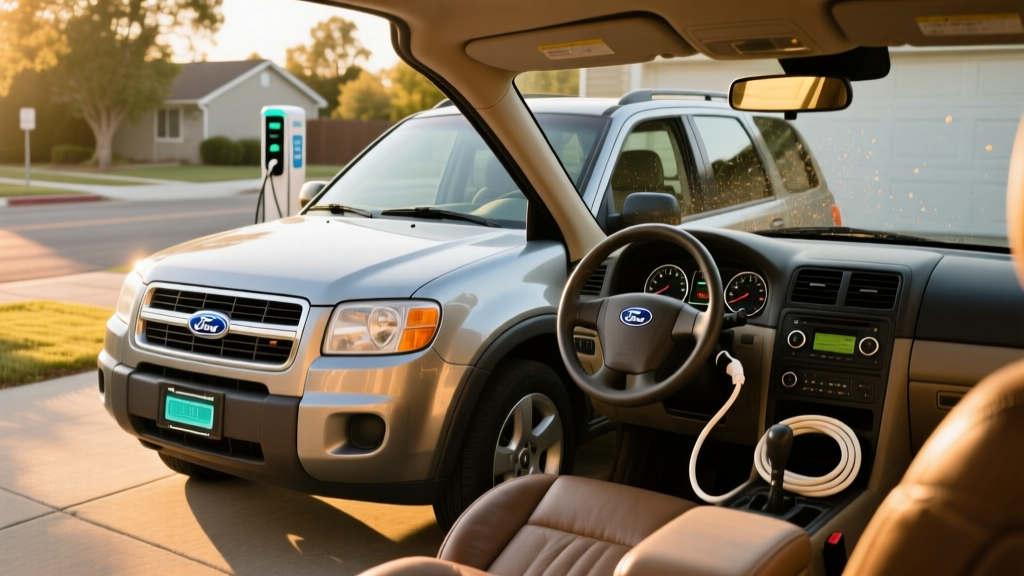
The 2005 Ford Escape Hybrid holds a specific place in automotive history: it was the first hybrid SUV sold in the United States, beating the Lexus RX 400h to market by a few months. Nearly two decades later, it remains a budget-friendly entry point for drivers who want hybrid fuel economy without plug-in complexity. With EPA ratings of 33 mpg city, 29 mpg highway, and 31 mpg combined, the 2005 Escape Hybrid still out-sips most modern non-hybrid compact SUVs in stop-and-go driving.
But buying a 20-year-old hybrid in 2026 means confronting the battery question head-on. The original nickel-metal hydride (NiMH) pack was warrantied for 8 years/100,000 miles, and most examples have long since exceeded both thresholds. This guide breaks down what the real-world data shows about longevity, replacement costs, and whether this pioneer hybrid still makes financial sense.
HEV vs PHEV: Where the 2005 Escape Hybrid Fits
The 2005 Ford Escape Hybrid is a conventional hybrid (HEV). It is not a plug-in hybrid (PHEV). This distinction matters because it determines how you fuel and maintain the vehicle.
| Feature | Conventional Hybrid (HEV) | Plug-In Hybrid (PHEV) |
|---|---|---|
| Plug-in charging | No — charges via engine and regen | Yes — external plug required for EV range |
| Electric-only range | ~1 mile at low speed | 20–50 miles typical (modern PHEVs) |
| Battery size | 1–2 kWh (small buffer) | 10–25 kWh |
| Federal tax credit (new) | No | Up to $7,500 under §30D (if eligible) |
| Example | 2005 Ford Escape Hybrid | 2026 Ford Escape PHEV |
The 2005 Escape Hybrid never needs to be plugged in. Its high-voltage battery recharges through regenerative braking and the gasoline engine. If you want electric-only commuting range, you would need to look at a modern PHEV like the current Ford Escape PHEV (37 miles EPA electric-only) or a full battery-electric vehicle.
Fuel Economy: EPA Ratings vs Real-World MPG
Hybrid powertrains shine in city driving, where regenerative braking recaptures energy that conventional vehicles waste as heat at every stoplight. The 2005 Escape Hybrid's EPA ratings reflect this advantage:
| Configuration | City MPG | Highway MPG | Combined MPG |
|---|---|---|---|
| FWD (Front-Wheel Drive) | 33 | 29 | 31 |
| 4WD (Four-Wheel Drive) | 30 | 27 | 28 |
Source: EPA / fueleconomy.gov
Real-World MPG Reality Check
Owner-reported data on fueleconomy.gov shows the 2005 Escape Hybrid averaging approximately 27–29 mpg combined across hundreds of logged fuel-ups. The FWD model tends to cluster around 29–31 mpg in mixed driving, while the 4WD version often returns 26–28 mpg. City-heavy commutes can push FWD owners toward the mid-30s, but sustained highway driving at 75+ mph drops efficiency to the low-to-mid 20s — a characteristic of all hybrids, where the electric motor contributes less at constant high speed.
Powertrain and Battery Specifications
The 2005 Escape Hybrid pairs a 2.3-liter Atkinson-cycle inline-4 gasoline engine with a permanent-magnet electric motor, connected through an electronically controlled continuously variable transmission (eCVT). This is the same power-split device architecture Toyota popularized in the Prius, licensed to Ford for this generation.
| Specification | Value |
|---|---|
| Gasoline engine | 2.3L Atkinson-cycle I-4 |
| Engine horsepower | 133 hp @ 6,000 rpm |
| Electric motor | Permanent-magnet AC synchronous |
| Electric motor output | 94 hp (70 kW) |
| Combined system horsepower | 155 hp |
| Transmission | eCVT (power-split device) |
| High-voltage battery | NiMH (nickel-metal hydride) |
| Battery capacity | ~1.5 kWh (nominal) |
| Battery voltage | ~330V nominal |
| Plug-in charging | No (HEV only) |
| 0–60 mph | ~10.8 seconds (FWD) |
| Curb weight | ~3,780 lbs (FWD) |
The 1.5 kWh NiMH battery is small by modern standards — a 2026 Prius uses a 4.08 kWh Li-ion pack, and a PHEV like the RAV4 Prime carries 18.1 kWh. But the 2005 Escape Hybrid's battery isn't designed for range; it functions as a buffer to capture regenerative braking energy and assist the engine during acceleration, then hand off to the gasoline engine for sustained driving.
Battery Reliability, Lifespan, and Replacement Cost
This is the single most important question for anyone considering a 2005 Escape Hybrid in 2026. The NiMH battery pack was covered under Ford's hybrid component warranty for 8 years or 100,000 miles, whichever came first. That warranty expired for all 2005 models by 2013 at the latest. Any battery failure today is an out-of-pocket expense.
Battery Replacement Cost Breakdown
OEM Ford replacement pack: Approximately $2,500–$3,500 for the battery module, plus $500–$800 labor, totaling roughly $3,000–$4,300 at a Ford dealer.
Refurbished/remanufactured pack: $1,500–$2,500 installed from independent hybrid specialists. Companies like Green Bean Battery offer refurbished NiMH packs with limited warranties (typically 1–3 years).
Individual module replacement: A skilled technician can identify and swap only the failed modules within the pack for $500–$1,200, but this is a temporary fix if the remaining modules are also near end-of-life.
NiMH chemistry degrades more gracefully than early lithium-ion packs. Rather than sudden capacity cliff, NiMH batteries typically lose 20–30% of their original capacity over 150,000–200,000 miles, which manifests as reduced low-speed electric assist and slightly lower city MPG — not a vehicle that won't start. Many 2005 Escape Hybrids have exceeded 200,000 miles on the original battery pack, though with diminished hybrid functionality.
Pricing, Tax Credits, and Ownership Economics
As a used vehicle in 2026, the 2005 Ford Escape Hybrid carries no federal or state tax incentives. The IRS §30D New Clean Vehicle Credit applies only to new plug-in vehicles meeting battery sourcing and MSRP requirements. The federal Used Clean Vehicle Credit (up to $4,000 or 30% of sale price, capped at $25,000 MSRP) applies only to plug-in electric vehicles and fuel-cell vehicles — conventional HEVs like the 2005 Escape Hybrid do not qualify.
Current market pricing for a 2005 Ford Escape Hybrid in 2026:
- Fair condition (150,000+ miles, original battery): $2,000–$3,500
- Good condition (under 130,000 miles, battery replaced or verified): $3,500–$5,500
- Excellent condition (low miles, full service history): $5,500–$7,000
The ownership math works if you're replacing a less efficient used SUV. At $3.50/gallon and 12,000 miles/year, the FWD Escape Hybrid (31 mpg combined) costs approximately $1,355/year in fuel versus $1,750/year for a comparable non-hybrid compact SUV getting 24 mpg combined — a savings of roughly $395 annually. That payback is modest, so the purchase makes most sense if the acquisition price is low and the battery is healthy.
Who Should Buy the 2005 Escape Hybrid vs Alternatives
Pros
- City MPG (33 EPA) still beats most non-hybrid compact SUVs
- No plug-in charging required — operates like a conventional gas car
- Proven powertrain architecture (shared DNA with Toyota's hybrid system)
- Low entry price as a used vehicle ($2,000–$5,500 typical)
- eCVT transmission has no traditional gears to wear out
Cons
- Highway MPG (29 EPA) offers less advantage — conventional SUVs have closed the gap
- Out-of-warranty NiMH battery is a $3,000+ liability
- No federal or state tax credit eligibility (not a plug-in vehicle)
- 10.8-second 0–60 time feels slow by modern standards
- Dated interior, no modern safety tech (no AEB, no lane-keeping)
- Parts availability declining as the model ages
Choose the 2005 Escape Hybrid if:
- You need a cheap, reliable commuter for city-heavy driving
- You cannot install a home charger and want hybrid efficiency without plug-in hassle
- You're mechanically inclined and comfortable sourcing hybrid battery repairs independently
Choose a modern PHEV (e.g., 2026 Escape PHEV) if:
- You have home charging access and want 37 miles of electric-only commuting
- You want current safety tech and warranty coverage
- You qualify for the §30D federal tax credit (up to $7,500)
Choose a full EV if:
- You want zero tailpipe emissions and the lowest per-mile fuel cost
- You have reliable home or workplace charging
- You want to eliminate all gasoline expenses and engine maintenance
Frequently Asked Questions
How many MPG does the 2005 Ford Escape Hybrid get?
The EPA rates the FWD model at 33 city / 29 highway / 31 combined mpg, and the 4WD model at 30 city / 27 highway / 28 combined. Real-world owner averages on fueleconomy.gov cluster around 27–29 mpg combined, with city-heavy drivers sometimes exceeding 30 mpg.
Does the 2005 Ford Escape Hybrid need to be plugged in?
No. It is a conventional hybrid (HEV), not a plug-in hybrid (PHEV). The battery recharges through regenerative braking and the gasoline engine. You fuel it exclusively at a gas station, just like a conventional vehicle.
Is the 2005 Escape Hybrid reliable?
The powertrain itself — the 2.3L Atkinson-cycle engine and eCVT — has proven durable, with many examples exceeding 200,000 miles. The primary reliability concern is the high-voltage NiMH battery, which is now well past its 8-year/100,000-mile warranty. Budget $3,000–$4,000 for a potential battery replacement if the current pack has not been serviced.
What does a replacement hybrid battery cost for the 2005 Escape Hybrid?
An OEM replacement from Ford runs approximately $3,000–$4,300 installed. Refurbished packs from independent hybrid specialists cost $1,500–$2,500 installed. Individual module repair is possible for $500–$1,200 but may not be a long-term solution on an aging pack.
Does the 2005 Ford Escape Hybrid qualify for any tax credit?
No. The IRS Used Clean Vehicle Credit applies only to plug-in electric vehicles and fuel-cell vehicles. Conventional hybrids like the 2005 Escape Hybrid do not qualify for any federal tax credit. Some states offer used-EV rebates, but these also typically exclude HEVs.
How does the 2005 Escape Hybrid compare to a modern hybrid SUV?
A 2026 Toyota RAV4 Hybrid achieves 41 city / 38 highway / 40 combined EPA mpg — roughly 30% more efficient than the 2005 Escape Hybrid. Modern hybrids also use lighter, more energy-dense lithium-ion batteries and offer significantly more horsepower, modern safety features, and full warranty coverage. The 2005 model's advantage is purely its low acquisition cost.