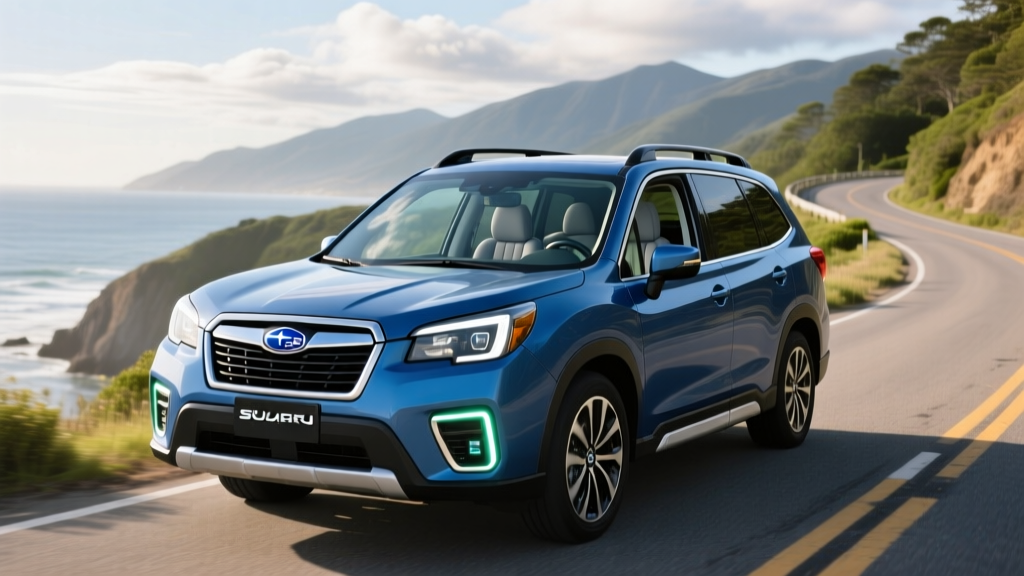
Quick Verdict: The Forester Hybrid Limited Earns Its Place
Subaru brought back the Forester Hybrid for the 2026 model year after a multi-year hiatus, and the Limited trim sits at the top of the lineup with a premium cabin, standard EyeSight safety tech, and the same fourth-generation hybrid system shared with the Crosstrek Hybrid. If you want all-wheel-drive capability, genuine cargo space, and fuel economy that handily beats any turbocharged gas compact SUV — without ever plugging in — the 2026 Subaru Forester Hybrid Limited makes a compelling case at $38,995.
This is a conventional hybrid (HEV), not a plug-in. You fuel it like any other car and let the regenerative braking system recapture energy. For buyers who can't charge at home but still want meaningful fuel savings, that distinction is the whole point.
HEV vs. PHEV: What the Forester Hybrid Actually Is
Before we get into the numbers, let's clear up a common source of confusion. The 2026 Forester Hybrid is a conventional hybrid electric vehicle (HEV). It pairs a gasoline engine with one or more electric motors and a small battery pack that recharges through regenerative braking and engine power. You never plug it in. The battery assists the engine during acceleration, enables low-speed electric-only creeping, and smooths out stop-start traffic — but it does not deliver meaningful electric-only driving range.
Conventional Hybrid (HEV) — Forester Hybrid
- No plug-in charging required
- Small battery (~1.1 kWh usable)
- Electric motor assists engine; brief low-speed EV mode
- Range: ~480+ miles on a full tank
- No federal tax credit under §30D
Plug-In Hybrid (PHEV) — e.g., Toyota RAV4 Prime
- Plug-in charging required for full benefit
- Larger battery (18+ kWh)
- 35–42 miles of electric-only driving
- Range: 40+ miles EV + 500+ miles gas
- May qualify for up to $7,500 federal tax credit (§30D)
Battery Electric (BEV) — e.g., Hyundai Ioniq 5
- Plug-in charging required (Level 2 or DC fast)
- Large battery (58–84+ kWh)
- 250–350+ miles electric-only range
- May qualify for up to $7,500 federal tax credit (§30D)
If you have reliable home charging and a commute under 40 miles, a PHEV or BEV may save you more. If you live in an apartment, street-park, or simply don't want to think about charging infrastructure, the Forester Hybrid's HEV setup is the pragmatic choice.
Fuel Economy: EPA Ratings and Real-World MPG
The 2026 Subaru Forester Hybrid Limited carries EPA estimates of 35 mpg city / 33 mpg highway / 35 mpg combined, according to fueleconomy.gov. That represents a meaningful jump over the gas-only Forester Limited, which rates at 26/33/29 mpg — a 6 mpg combined improvement.
| Trim | City | Highway | Combined | Est. Total Range |
|---|---|---|---|---|
| Forester Hybrid Limited (HEV) | 35 mpg | 33 mpg | 35 mpg | ~487 mi |
| Forester Limited (Gas) | 26 mpg | 33 mpg | 29 mpg | ~403 mi |
| Toyota RAV4 Hybrid Limited (AWD) | 41 mpg | 38 mpg | 39 mpg | ~558 mi |
Real-World MPG vs. EPA Sticker
Hybrids tend to exceed their EPA city rating in stop-and-go driving, where regenerative braking recaptures the most energy. Expect 36–38 mpg in urban commutes. Highway driving is the hybrid's weaker suit — at sustained 75+ mph, the electric motor contributes less and aerodynamic drag dominates. Plan for 30–32 mpg on long interstate trips. In cold weather (below 30°F), expect a 5–10% efficiency drop as the engine runs more frequently to heat the cabin and maintain battery temperature.
Compared to the RAV4 Hybrid, the Forester Hybrid trails by about 4 mpg combined. That gap reflects Subaru's full-time symmetrical AWD system, which carries a slight drivetrain efficiency penalty compared to the RAV4's on-demand rear-axle motor. If maximum fuel economy is your top priority, the RAV4 Hybrid still leads this segment. But the Forester Hybrid's advantage lies elsewhere — visibility, ride quality, and Subaru's proven AWD traction in snow and mud.
Powertrain: 2.5L Boxer Meets Electric Assist
The 2026 Forester Hybrid Limited uses Subaru's updated hybrid powertrain, pairing a 2.5-liter naturally aspirated flat-four (Boxer) engine with an electric motor integrated into the Lineartronic CVT transaxle. Combined system output is 194 horsepower.
| Specification | 2026 Forester Hybrid Limited |
|---|---|
| Engine | 2.5L flat-4 (Boxer), 163 hp |
| Electric Motor | AC synchronous, integrated in CVT |
| Combined System Output | 194 hp |
| Transmission | Lineartronic CVT |
| Drivetrain | Symmetrical AWD (full-time) |
| Hybrid Battery | ~1.1 kWh (lithium-ion) |
| 0–60 mph | ~8.4 seconds (est.) |
| Towing Capacity | 1,500 lbs |
| Fuel Tank | 13.9 gallons |
| Cargo Volume | 28.9 cu ft (rear seats up) / 74.4 cu ft (folded) |
The electric motor fills in the torque gap at low RPMs, giving the Forester Hybrid noticeably better off-the-line response than its gas-only sibling. The CVT is smooth but unremarkable — Subaru has tuned it to avoid the rubber-band drone that plagues some CVT competitors, but it's still a CVT. Under hard acceleration, the engine note is audible and uninspiring. For daily commuting, school runs, and highway cruising, the powertrain is quiet and unobtrusive.
Pricing, Tax Credits, and Ownership Economics
The 2026 Subaru Forester Hybrid Limited starts at $38,995 MSRP (including destination). That's roughly $2,400 more than the gas Forester Limited at $36,595. The hybrid premium is modest, and the fuel savings close the gap relatively quickly.
Does the Forester Hybrid Qualify for a Federal Tax Credit?
No. The Forester Hybrid is a conventional HEV and does not qualify for the IRS §30D Clean Vehicle Credit, which applies only to plug-in electric vehicles (PHEVs and BEVs) meeting battery-sourcing and critical-mineral requirements. The §30D credit of up to $7,500 requires a minimum 7 kWh battery capacity and plug-in capability — neither of which the Forester Hybrid has. Some states offer their own incentives for hybrid purchases; check your state energy office for current programs.
Five-Year Fuel Cost Comparison
At 15,000 miles per year and $3.40/gallon regular unleaded:
| Model | Combined MPG | Annual Fuel Cost | 5-Year Fuel Cost |
|---|---|---|---|
| Forester Hybrid Limited | 35 mpg | $1,457 | $7,286 |
| Forester Limited (Gas) | 29 mpg | $1,759 | $8,793 |
| RAV4 Hybrid Limited | 39 mpg | $1,308 | $6,538 |
The hybrid saves approximately $1,507 over five years versus the gas Forester — not quite enough to offset the $2,400 price premium on fuel alone. However, the hybrid's stronger resale value and lower engine wear (the electric motor reduces strain on the gas engine) narrow that gap further over a longer ownership period.
Battery Warranty, Reliability, and Replacement Cost
Hybrid Battery Warranty
Subaru covers the Forester Hybrid's lithium-ion battery pack for 8 years / 100,000 miles (10 years / 150,000 miles in California and states that follow CARB emissions standards). This covers defects and capacity loss below a defined threshold, typically 60–70% of original capacity.
The broader powertrain warranty is 5 years / 60,000 miles, and the basic bumper-to-bumper warranty is 3 years / 36,000 miles.
How Reliable Is the Forester Hybrid?
Subaru's hybrid system is derived from Toyota's well-proven hybrid synergy architecture — the result of a long-standing partnership between the two automakers. The 2.5L Boxer engine (FB25D) has been in production since 2019 with a solid reliability record. The hybrid battery is small (~1.1 kWh) and operates within a narrow state-of-charge window, which significantly reduces degradation compared to the large batteries in PHEVs and BEVs.
Hybrid battery replacement costs for the Forester Hybrid are estimated at $2,500–$4,000 (parts and labor) if needed outside warranty. For context, Toyota RAV4 Hybrid battery replacements run $3,000–$5,000. Given the warranty coverage and the low stress placed on the small HEV battery, most owners will never face this expense. According to IIHS, the 2026 Forester continues to earn top safety marks, which supports long-term ownership confidence.
Who Should Choose the Forester Hybrid Limited?
Choose the Forester Hybrid Limited if:
- You can't charge at home (apartment, street parking, no garage)
- You need AWD for snow, mud, or mountain roads
- You want better fuel economy without changing your fueling habits
- You value outward visibility, a comfortable ride, and practical cargo space
- You plan to keep the vehicle 8+ years and want proven reliability
Look at a PHEV instead if:
- You have Level 2 home charging and a commute under 40 miles
- You want to drive mostly on electricity and claim the §30D tax credit
- Your state offers additional PHEV rebates (check IRS.gov for federal rules)
Look at a full EV instead if:
- You have reliable home charging and want zero tailpipe emissions
- Your daily driving is under 250 miles and you want the lowest per-mile energy cost
- You want to maximize federal and state incentives
Pros
- 35 mpg combined — 6 mpg better than gas Forester
- Standard symmetrical AWD with strong winter traction
- Spacious cabin with 74.4 cu ft max cargo
- Excellent visibility and comfortable ride quality
- EyeSight driver-assist standard (adaptive cruise, lane centering)
- No plug-in charging required
Cons
- Trails RAV4 Hybrid by ~4 mpg combined
- CVT lacks engagement under hard acceleration
- No federal tax credit eligibility
- Hybrid premium adds ~$2,400 over gas Limited
- Towing limited to 1,500 lbs
- Only one hybrid battery cell — no extended EV range
Frequently Asked Questions
How many MPG does the 2026 Subaru Forester Hybrid Limited get?
The EPA rates it at 35 mpg city, 33 mpg highway, and 35 mpg combined. In real-world city driving with frequent stops, owners often see 36–38 mpg. Highway driving at 75+ mph typically yields 30–32 mpg.
Does the Forester Hybrid need to be plugged in?
No. The Forester Hybrid is a conventional hybrid (HEV). Its small lithium-ion battery recharges through regenerative braking and the gasoline engine. You fuel it exactly like a regular car.
How far can it go on electric power alone?
Only about 1 mile or less at very low speeds (under 25 mph). This is not a plug-in hybrid — the electric motor's role is to assist the gas engine and improve efficiency, not to replace it for extended driving.
Is the hybrid battery reliable and what does replacement cost?
Subaru's hybrid system uses proven Toyota-derived technology with an 8-year/100,000-mile battery warranty (10 years/150,000 miles in CARB states). Replacement cost outside warranty is estimated at $2,500–$4,000, though most owners never need one due to the low-stress battery design.
Does the 2026 Forester Hybrid qualify for any tax credit?
Not the federal §30D credit, which requires plug-in capability and a minimum 7 kWh battery. Some states may offer separate hybrid incentives — check your state's energy or environmental agency for current programs.
How does it compare to the Toyota RAV4 Hybrid?
The RAV4 Hybrid leads on fuel economy (39 mpg combined vs. 35 mpg) and has a more powerful hybrid system (219 hp vs. 194 hp). The Forester Hybrid counters with better outward visibility, a more comfortable ride, and Subaru's full-time symmetrical AWD, which provides more predictable traction in deep snow and off-pavement conditions.
Is the Forester Hybrid Limited worth the premium over the gas model?
If you plan to keep the vehicle 5+ years and drive 15,000+ miles annually, the fuel savings, smoother low-speed driving, and stronger resale value make the hybrid worthwhile. For low-mileage drivers who trade vehicles every 3 years, the gas model may be more cost-effective.