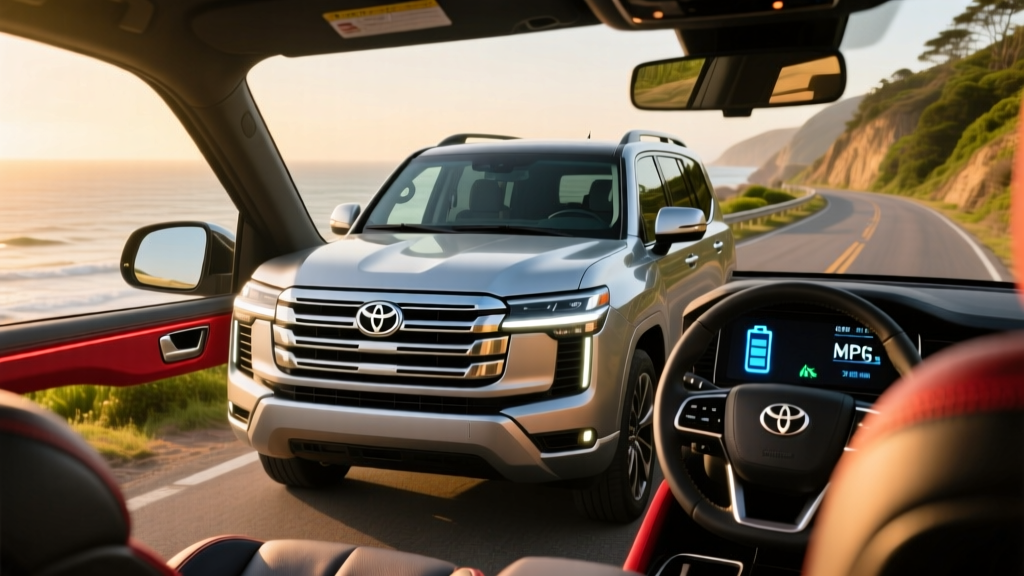
The 2025 Toyota Land Cruiser returns to the U.S. market with a turbocharged hybrid powertrain that promises serious off-road capability without the fuel-thirst penalty of its V8 predecessors. But the "hybrid" badge here means something very specific — and it's critical that buyers understand exactly what Toyota is offering before heading to the dealership.
This guide breaks down the 2025 Toyota Land Cruiser hybrid system, its real-world fuel economy, powertrain specs, ownership costs, and how it stacks up against plug-in hybrid SUVs and full EVs in the same price bracket.
Conventional Hybrid (HEV) vs. Plug-In Hybrid (PHEV): Which Is the Land Cruiser?
The 2025 Toyota Land Cruiser is a conventional hybrid electric vehicle (HEV), not a plug-in hybrid (PHEV). This distinction matters enormously for how you'll own and operate the vehicle:
- HEV (Land Cruiser): The battery recharges through regenerative braking and the gasoline engine. You never plug it in. The electric motor assists the gas engine to reduce fuel consumption, but the vehicle cannot drive on electric power alone for meaningful distances.
- PHEV (e.g., Toyota RAV4 Prime, Jeep Wrangler 4xe): A larger battery (typically 15–25 kWh) charges via a plug, delivering 20–45 miles of electric-only driving before the gas engine kicks in. Requires access to charging infrastructure to realize full efficiency benefits.
The Land Cruiser's hybrid system is designed for torque multiplication and efficiency gains — not electric-only commuting. If you're looking for plug-in electric range, this isn't the vehicle. If you want a body-on-frame SUV that sips fuel compared to its predecessors while delivering 469 lb-ft of torque, read on.
Powertrain Specs: The i-FORCE MAX Hybrid System
Toyota's i-FORCE MAX powertrain pairs a 2.4-liter turbocharged inline-4 engine with a 48-hp electric motor integrated between the engine and an 8-speed automatic transmission. The combined output significantly outpaces the old Land Cruiser's 5.7L V8 while consuming considerably less fuel.
| Specification | Value |
|---|---|
| Engine | 2.4L turbocharged inline-4 |
| Electric Motor | 48 hp, integrated in transmission bell housing |
| Combined Horsepower | 326 hp @ 6,000 rpm |
| Combined Torque | 469 lb-ft @ 1,700 rpm |
| Transmission | 8-speed automatic (Direct Shift-8AT) |
| Hybrid Battery | 1.87 kWh nickel-metal hydride (NiMH) |
| Drivetrain | Full-time 4WD with low range |
| Towing Capacity | 6,000 lbs (max, properly equipped) |
| 0–60 mph | ~6.8 seconds (est.) |
The 1.87 kWh battery pack is small by EV standards — and intentionally so. It's not designed for range; it's designed to provide torque fill at low RPMs, smooth out the turbo spool-up, and enable brief engine-off coasting. The NiMH chemistry is a deliberate choice by Toyota for proven long-term durability in high-temperature under-hood environments, even as the broader industry shifts toward lithium-ion for traction batteries.
Fuel Economy: EPA MPG and Real-World Expectations
The EPA rates the 2025 Toyota Land Cruiser hybrid at the following fuel economy figures across both trims (1958 and Land Cruiser):
| Driving Cycle | MPG |
|---|---|
| City | 22 MPG |
| Highway | 25 MPG |
| Combined | 23 MPG |
Source: fueleconomy.gov
Real-World MPG vs. EPA Estimates
Toyota's hybrid systems tend to deliver real-world results that closely match — or in city driving, slightly exceed — their EPA ratings, because regenerative braking recovers more energy in stop-and-go traffic. Based on owner-reported data and initial long-term testing:
- City driving: Expect 22–24 MPG. The hybrid system shines here, with the electric motor handling initial acceleration and frequent regen opportunities.
- Highway driving: Expect 23–25 MPG at 65–70 mph. The turbo four operates efficiently at cruise, but the Land Cruiser's boxy aerodynamics limit gains at higher speeds.
- Off-road / low-range: Fuel economy drops significantly — plan for 12–16 MPG depending on terrain and speed. The hybrid system's contribution is minimal when crawling in 4Lo.
- Cold weather: Expect a 5–10% reduction in combined MPG during winter months, as the engine runs more frequently to provide cabin heat and the battery operates less efficiently at low temperatures.
Compared to the previous-generation Land Cruiser's 5.7L V8 (rated at 13 city / 18 highway / 15 combined), the 2025 hybrid represents a 53% improvement in combined fuel economy. Against competitors like the Jeep Wrangler (22 MPG combined for the 4xe PHEV on gas only) or the Ford Bronco (20–22 MPG combined depending on engine), the Land Cruiser hybrid sits at the top of the body-on-frame SUV class.
Pricing, Trims, and Tax Credit Eligibility
The 2025 Toyota Land Cruiser is offered in two trims, both with the i-FORCE MAX hybrid powertrain as standard:
| Trim | Starting MSRP | Key Features |
|---|---|---|
| Land Cruiser 1958 | $58,150 | Heritage styling, round LED headlights, 8" touchscreen, fabric seats |
| Land Cruiser | $62,450 | Rectangular grille, 12.3" touchscreen, SofTex seats, Multi-Terrain Monitor |
Destination charge ($1,895) is additional. Prices reflect 2025 model year MSRP as published by Toyota.
Federal Tax Credit: Does the Land Cruiser Hybrid Qualify?
No. The 2025 Toyota Land Cruiser is a conventional hybrid (HEV), and the IRS §30D Clean Vehicle Credit applies only to battery electric vehicles (BEVs) and plug-in hybrid electric vehicles (PHEVs) that meet battery capacity, critical mineral sourcing, and MSRP thresholds. Conventional hybrids like the Land Cruiser do not qualify for the federal EV tax credit.
Some states may offer separate incentives for hybrid vehicles, but these are increasingly rare as state programs pivot to zero-emission vehicles. Check your state's energy or environmental agency website for current programs. There is no federal tax incentive for purchasing this vehicle in 2025 or 2026.
Battery Warranty, Reliability, and Replacement Cost
Hybrid Battery Warranty Coverage
- Hybrid Battery: 10 years / 150,000 miles (whichever comes first)
- Hybrid System Components: 8 years / 100,000 miles
- Powertrain (engine + transmission): 5 years / 60,000 miles
- Basic Bumper-to-Bumper: 3 years / 36,000 miles
Toyota's hybrid battery warranty is among the best in the industry and reflects the company's confidence in NiMH pack longevity. California-emissions-state vehicles may have extended coverage under CARB rules — verify with your dealer.
Reliability Track Record
Toyota's hybrid systems have accumulated over 25 years of real-world data since the original Prius launched in 1997. The NiMH chemistry used in the Land Cruiser's pack is notably more tolerant of heat and deep cycling than lithium-ion alternatives, which is why Toyota continues to use it in its body-on-frame hybrid applications. The i-FORCE MAX system is newer (introduced in the Tundra for 2022), but its electric motor and battery components draw from decades of hybrid engineering.
Based on Toyota's historical hybrid data, NiMH packs routinely exceed 150,000 miles before significant capacity degradation. The Land Cruiser's small 1.87 kWh pack operates within a narrow state-of-charge window (roughly 40–80%), which dramatically reduces cell stress and extends cycle life.
Battery Replacement Cost
If the hybrid battery does require replacement outside of warranty:
- OEM replacement battery pack: Estimated $2,500–$4,000 (parts)
- Labor: $500–$1,000
- Total out-of-pocket: $3,000–$5,000
This is significantly less expensive than EV battery replacement ($10,000–$20,000+) because the pack is small and uses mature NiMH technology. Third-party refurbishers may offer lower-cost alternatives as the vehicle ages.
2025 Land Cruiser Hybrid vs. PHEV and EV Alternatives
Deciding between the Land Cruiser hybrid, a plug-in hybrid SUV, or a full EV depends on your driving patterns, charging access, and capability requirements. Here's a decision framework:
| Factor | Land Cruiser (HEV) | PHEV SUV (e.g., Wrangler 4xe) | EV SUV (e.g., Rivian R1S) |
|---|---|---|---|
| Plug-in Required? | No | Yes (for full benefit) | Yes |
| Electric-Only Range | None (assist only) | 21–49 miles | 270–400 miles |
| Combined MPG / MPGe | 23 MPG | 20 MPG (gas) / 49 MPGe | 70–73 MPGe |
| Off-Road Capability | Excellent (body-on-frame, low range) | Excellent (solid axles, low range) | Very Good (air suspension, quad-motor) |
| Towing Capacity | 6,000 lbs | 3,500 lbs | 7,700 lbs |
| Federal Tax Credit | $0 | Up to $3,750* | Up to $7,500* |
| Home Charging Needed? | No | Recommended (Level 2) | Required (Level 2) |
| Starting Price | $58,150 | ~$52,000 | ~$79,900 |
* Tax credit eligibility depends on MSRP caps, buyer income limits, battery sourcing requirements, and point-of-sale transfer rules under current IRS §30D guidelines. Verify eligibility at irs.gov or with a tax professional.
Choose the Land Cruiser Hybrid If:
- You want serious off-road capability and body-on-frame durability
- You don't have reliable access to home or workplace charging
- You tow up to 6,000 lbs regularly
- You prefer zero behavior change — no plugging in, no range planning
- You value Toyota's long-term reliability and resale value track record
Choose a PHEV or EV Instead If:
- You have home Level 2 charging and want to eliminate most daily gasoline use
- Your daily commute is under 40 miles (PHEV sweet spot)
- You want to maximize federal/state tax incentives
- You prioritize lowest per-mile fuel cost over off-road capability
Pros and Cons: The Honest Assessment
Pros
- 53% fuel economy improvement over the previous V8 Land Cruiser
- 469 lb-ft of torque available at just 1,700 rpm — exceptional for crawling and low-speed trail work
- No plug-in required; zero change to refueling habits
- Body-on-frame construction with full-time 4WD and low range
- 10-year / 150,000-mile hybrid battery warranty
- Strong projected resale value (Toyota Land Cruiser heritage)
- 6,000-lb towing capacity
Cons
- No federal tax credit eligibility (conventional HEV)
- 23 MPG combined is efficient for its class but still 23 MPG — annual fuel cost remains significant
- Only two trims available; limited customization at the dealer level
- 1.87 kWh battery means no electric-only driving capability whatsoever
- Third-row seat is tight for adults (best suited for children or cargo)
- Turbo four-cylinder lacks the acoustic character of the old V8
- Starting price near $60K places it above many midsize SUV alternatives
Ownership Costs: What You'll Actually Spend
Beyond the sticker price, here's what 2025 Land Cruiser hybrid ownership looks like in practice:
- Annual fuel cost: At 23 MPG combined, 12,000 miles/year, and $3.50/gallon national average = ~$1,826/year in gasoline.
- Insurance: Expect premiums 10–20% higher than a midsize crossover due to body-on-frame construction, repair costs, and MSRP. Get quotes before purchasing.
- Maintenance: Toyota's hybrid systems are low-maintenance. The regenerative braking system extends brake pad life significantly. Expect standard oil changes, fluid services, and tire rotations. No hybrid-specific maintenance is required beyond periodic inverter coolant checks.
- Depreciation: The Land Cruiser nameplate historically retains value exceptionally well. The hybrid powertrain should further support resale demand as fuel prices fluctuate.
Frequently Asked Questions
How many MPG does the 2025 Toyota Land Cruiser hybrid get?
The EPA rates the 2025 Land Cruiser hybrid at 22 MPG city, 25 MPG highway, and 23 MPG combined. Real-world results typically fall within 1–2 MPG of these figures in mixed driving, with city driving sometimes yielding slightly higher numbers thanks to regenerative braking.
Can I plug in the 2025 Toyota Land Cruiser to charge it?
No. The Land Cruiser is a conventional hybrid (HEV), not a plug-in hybrid (PHEV). The 1.87 kWh battery recharges exclusively through regenerative braking and the gasoline engine. There is no charging port and no electric-only driving mode.
Is the 2025 Land Cruiser hybrid reliable?
Toyota's hybrid systems carry one of the strongest reliability records in the automotive industry. The NiMH battery chemistry used in the Land Cruiser is proven over millions of vehicles and 25+ years of production. The 10-year / 150,000-mile hybrid battery warranty provides additional peace of mind. The i-FORCE MAX turbo engine is newer but shares architecture with the widely deployed Tundra powertrain.
What does it cost to replace the Land Cruiser hybrid battery?
Out-of-warranty replacement is estimated at $3,000–$5,000 total (parts and labor). This is far less than EV battery replacement costs. Given the narrow state-of-charge operating window and NiMH chemistry, most owners will never need a replacement during typical ownership.
Does the 2025 Land Cruiser hybrid qualify for any tax credits?
No. Federal §30D Clean Vehicle Credits apply only to plug-in vehicles (BEVs and PHEVs). The Land Cruiser, as a conventional HEV, does not qualify. Some states may offer minor hybrid incentives, but these are uncommon and vary by jurisdiction. Always verify current rules at irs.gov.
How does the Land Cruiser hybrid compare to the old V8 model?
The 2025 i-FORCE MAX hybrid produces 326 hp and 469 lb-ft of torque (vs. 381 hp / 401 lb-ft for the old 5.7L V8) while achieving 23 MPG combined vs. 15 MPG combined — a 53% fuel economy improvement with more torque available at lower RPMs. Towing drops slightly from 8,100 lbs to 6,000 lbs.
Is the Land Cruiser a good choice if I want to reduce my carbon footprint?
The hybrid system reduces fuel consumption and CO₂ emissions significantly compared to the previous V8, but at 23 MPG combined, the Land Cruiser still produces roughly 4.6 metric tons of CO₂ per year at 12,000 miles driven. If emissions reduction is your primary goal, a PHEV or BEV will deliver substantially lower lifetime carbon output — though neither matches the Land Cruiser's off-road and towing capability in this price range.
Specifications and pricing reflect 2025 model year data as published by Toyota Motor Corporation and fueleconomy.gov. Tax credit rules reflect current IRS §30D guidelines as of 2025 and are subject to change. Verify all figures with your dealer and tax professional before purchasing. Safety ratings available at nhtsa.gov and iihs.org as testing is completed.