What's a Hybrid Engine, Exactly?
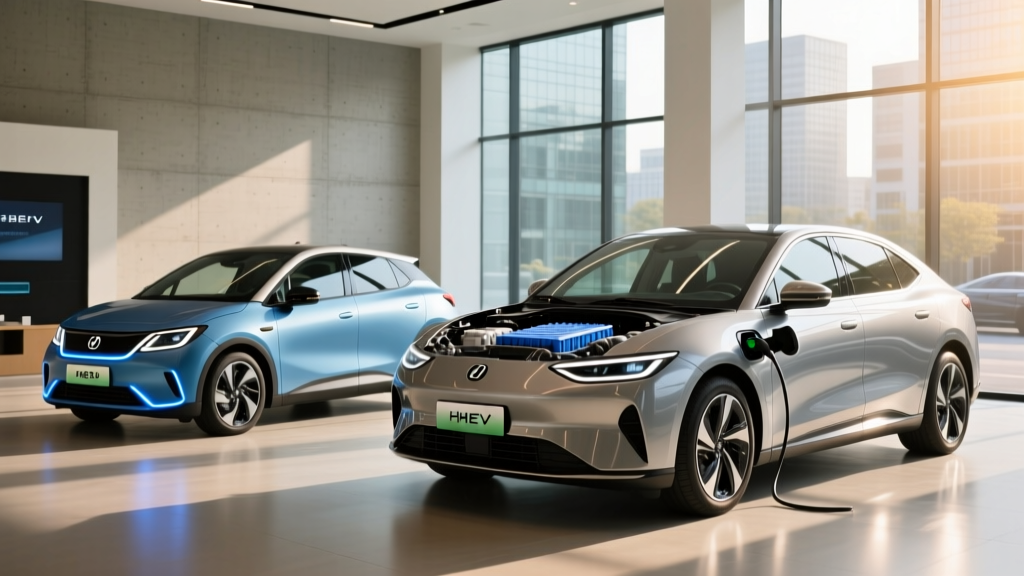
A hybrid engine pairs a conventional internal combustion engine (usually a 4-cylinder gasoline unit) with one or more electric motors and a small battery pack. The electric motor assists during acceleration, captures energy during braking (regenerative braking), and in some configurations can drive the wheels independently at low speeds. The result is significantly better fuel economy than a gas-only vehicle — particularly in stop-and-go city driving — without any change to how you refuel.
But the term "hybrid" now covers two very different architectures, and confusing them is the single most common mistake shoppers make. Let's separate them clearly before we get into the numbers.
HEV vs PHEV: The Core Difference
| Feature | Conventional Hybrid (HEV) | Plug-In Hybrid (PHEV) |
|---|---|---|
| Plug in to charge? | No — charges via engine and regen | Yes — has a charge port (J1772/NACS) |
| Battery size | 0.6–1.6 kWh (usable) | 13–25+ kWh (usable) |
| Electric-only driving | Very limited (under 1 mile, low speed) | 20–50+ miles at full highway speed |
| Refueling | Gas station only | Gas station + electrical outlet/charger |
| Federal tax credit | Not eligible | Up to $7,500 (§30D, if eligible) |
| Typical use case | No home charging access; wants MPG gains with zero behavior change | Home charging available; wants EV-like daily commute with gas backup |
If you cannot charge at home or at work, a conventional HEV is almost certainly the right call. If you have access to a standard 120V outlet overnight or can install a Level 2 charger, a PHEV unlocks dramatically lower operating costs for daily driving.
How Many MPG Does a Hybrid Get?
Fuel economy varies by model, but modern hybrids deliver substantial gains over their gas-only counterparts — especially in city driving, where the electric motor does the most work. Here's how several popular 2025–2026 hybrids stack up per EPA estimates on fueleconomy.gov:
| Vehicle | Type | City MPG | Highway MPG | Combined MPG | Combined MPGe (PHEV EV mode) |
|---|---|---|---|---|---|
| Toyota Prius (2025) | HEV | 57 | 56 | 57 | — |
| Toyota Prius Prime (2025) | PHEV | 52 (gas) | 48 (gas) | 52 (gas) | 114 MPGe |
| Honda Accord Hybrid (2025) | HEV | 51 | 44 | 48 | — |
| Toyota RAV4 Hybrid (2025) | HEV | 41 | 38 | 39 | — |
| Toyota RAV4 Prime (2025) | PHEV | 40 (gas) | 36 (gas) | 38 (gas) | 94 MPGe |
| Hyundai Tucson PHEV (2025) | PHEV | 37 (gas) | 36 (gas) | 37 (gas) | 80 MPGe |
| Ford Maverick Hybrid (2025) | HEV | 42 | 33 | 37 | — |
Real-World MPG vs. EPA Sticker
Here's where hybrids often surprise owners: real-world city MPG frequently exceeds the EPA estimate. The EPA test cycle includes substantial stop-and-go driving, which is exactly where regenerative braking and electric-motor assist shine. Many Prius owners report 60+ MPG on city commutes in mild weather.
Highway driving is a different story. At sustained 70–80 mph speeds, the engine is doing nearly all the work, and the hybrid advantage shrinks. Expect highway numbers to land at or slightly below the EPA sticker, especially in cold weather (below 40°F) when the engine runs more often to provide cabin heat and maintain battery temperature. On a 300-mile highway trip in a RAV4 Hybrid, expect roughly 34–36 MPG rather than the 38 MPG combined sticker.
How Far Can a PHEV Go on Electric Only?
For PHEV buyers, electric-only range is the number that matters most for daily driving. This is the distance you can cover without burning a drop of gasoline — running purely on battery power at full highway speeds.
| PHEV Model | Battery (kWh usable) | EPA Electric Range | Total Range (gas + electric) | Level 2 Charge Time (0–100%) | DC Fast Charge? |
|---|---|---|---|---|---|
| Toyota Prius Prime | 10.9 kWh | 44 miles | ~480 miles | ~4 hours (240V/16A) | No |
| Toyota RAV4 Prime | 14.9 kWh | 42 miles | ~600 miles | ~2.5 hours (240V/32A) | No |
| Hyundai Tucson PHEV | 13.8 kWh | 33 miles | ~420 miles | ~2 hours (240V/32A) | No |
| Jeep Wrangler 4xe | 17.3 kWh | 22 miles | ~370 miles | ~2.5 hours (240V/32A) | No |
| Chrysler Pacifica PHEV | 16.0 kWh | 32 miles | ~460 miles | ~2 hours (240V/32A) | No |
| BMW X5 xDrive50e | 22.3 kWh | 38 miles | ~460 miles | ~3 hours (240V/32A) | Optional (up to 50 kW) |
A few critical notes from real-world ownership:
- Cold weather cuts electric range by 20–35%. A RAV4 Prime rated at 42 miles may deliver only 28–32 miles of electric range on a 25°F morning. The battery is less efficient, and cabin heating draws substantial power.
- Highway speeds reduce electric range. The EPA electric-range test includes low-speed segments. Sustained 70 mph driving may yield 15–20% less than the sticker number.
- Most PHEVs do not support DC fast charging. You'll charge on Level 1 (120V, ~8–12 hours) or Level 2 (240V, ~2–4 hours). This is fine for overnight home charging but means no quick top-ups on road trips.
- Preconditioning matters. If your PHEV offers battery preconditioning (warming the battery while plugged in), use it in cold weather — it preserves electric range and improves regen effectiveness.
Powertrain Specs: How Hybrid Engines Actually Work
Modern hybrids use one of three powertrain architectures, and understanding them helps explain why some hybrids feel more electric than others.
Series-Parallel (Power-Split) — Toyota, Honda, Ford
The most common design. A planetary gearset blends power from the gas engine and electric motor(s), allowing either or both to drive the wheels. The engine can also act as a generator to charge the battery. In a 2025 Toyota Prius, the 2.0L 4-cylinder engine produces 150 hp while the electric motor adds 83 hp, for a combined system output of 196 hp. The result is seamless transitions between electric, gas, and blended power.
Series Hybrid — Older Chevy Volt architecture
The gas engine never drives the wheels — it only generates electricity. The electric motor handles all propulsion. This feels most like an EV but adds weight and complexity. Largely superseded by PHEV designs with larger batteries.
P2 Parallel Hybrid — Hyundai, Kia, BMW, Stellantis
An electric motor sits between the engine and a conventional automatic transmission. The motor can drive the wheels alone (in EV mode), assist the engine, or act as a generator during deceleration. The 2025 Hyundai Tucson PHEV pairs a 1.6L turbo 4-cylinder (180 hp) with a 72 hp electric motor for 261 combined hp. This design delivers strong acceleration but can feel less seamless than a power-split system during engine-on/off transitions.
Hybrid Battery Warranty, Lifespan, and Replacement Cost
Hybrid Battery Warranty — What's Covered
Federal law mandates that hybrid and PHEV battery packs carry a minimum warranty of 8 years / 100,000 miles. In California Air Resources Board (CARB) states — including California, New York, Massachusetts, Colorado, and others — that extends to 10 years / 150,000 miles.
Most manufacturers match or exceed these minimums:
- Toyota: 10 years / 150,000 miles (all 50 states, from 2020 model year onward)
- Honda: 8 years / 100,000 miles (10/150k in CARB states)
- Hyundai/Kia: 10 years / 100,000 miles
- Ford: 8 years / 100,000 miles
- BMW: 8 years / 80,000 miles
The warranty typically guarantees the battery will retain at least 60–70% of original capacity during the coverage period. If it degrades below that threshold, the manufacturer replaces or reconditions it at no cost.
Real-World Battery Longevity
Hybrid batteries have proven remarkably durable. Toyota Prius taxis routinely surpass 300,000 miles on the original battery pack. The smaller battery in a conventional HEV undergoes shallow charge/discharge cycles (typically staying between 40–80% state of charge), which minimizes degradation. PHEV batteries are larger and cycle more deeply, but their active thermal management systems help preserve longevity.
Battery Replacement Cost
If you do need a replacement out of warranty:
- Conventional HEV (Prius, Accord Hybrid, RAV4 Hybrid): $2,000–$4,000 for a new OEM pack. Refurbished packs are available for $1,000–$2,000.
- PHEV (Prius Prime, RAV4 Prime, Tucson PHEV): $5,000–$9,000 for a new OEM pack. The larger capacity drives higher cost.
For context, these costs are comparable to a major engine or transmission repair on a conventional gas vehicle — and they're needed far less frequently.
Pricing and Tax Credit Eligibility
Hybrid vehicles carry a modest price premium over their gas-only equivalents — typically $1,000–$3,000 for an HEV and $4,000–$8,000 for a PHEV. Here's a snapshot of current pricing:
| Model | Base MSRP (2025) | Type | Federal §30D Credit Eligibility |
|---|---|---|---|
| Toyota Prius LE | $28,350 | HEV | Not eligible |
| Toyota Prius Prime SE | $33,445 | PHEV | Up to $3,750* |
| Toyota RAV4 Hybrid LE | $32,975 | HEV | Not eligible |
| Toyota RAV4 Prime SE | $44,265 | PHEV | Up to $3,750* |
| Honda Accord Hybrid LX | $33,655 | HEV | Not eligible |
| Hyundai Tucson PHEV SEL | $39,460 | PHEV | Up to $3,750* |
| Ford Maverick XL Hybrid | $28,440 | HEV | Not eligible |
*PHEV tax credit amounts vary based on battery capacity and critical-mineral/battery-component sourcing requirements under IRS §30D rules. For 2025–2026, many PHEVs qualify for $3,750 (meeting the critical minerals requirement but not the battery components requirement due to Foreign Entity of Concern restrictions). Full $7,500 eligibility is increasingly rare for PHEVs. Buyer income caps apply: $300,000 (married filing jointly), $225,000 (head of household), $150,000 (single). MSRP caps: $55,000 for sedans, $80,000 for SUVs/trucks. Credits can be transferred to the dealer as a point-of-sale discount. Always verify current eligibility with your tax professional before purchasing.
Hybrid vs PHEV vs EV: Which Fits You?
Choose a Conventional Hybrid (HEV) If:
- You cannot charge at home (apartment, street parking, no garage)
- You want maximum MPG with zero behavioral change — no plugging in, no apps, no charging networks
- Your budget is tighter and you want to avoid the PHEV price premium
- You drive mostly in the city where hybrid efficiency peaks
Choose a Plug-In Hybrid (PHEV) If:
- You have home charging (even a standard 120V outlet works for overnight)
- Your daily commute is under 40 miles round-trip — you can do most driving on electricity
- You take regular road trips and want gas-engine flexibility without range anxiety
- You want to reduce fuel costs significantly but aren't ready for a full EV
Choose a Full Battery EV (BEV) If:
- You have reliable home Level 2 charging
- Your daily driving is under 250 miles, or you're willing to plan DC fast-charging stops on road trips
- You want the lowest operating cost (electricity is cheaper than gasoline per mile in most states)
- You want to eliminate oil changes, spark plugs, and exhaust system maintenance entirely
Hybrid (HEV) Pros
- Best-in-class city MPG with zero plug-in requirement
- Lower purchase price than PHEV or EV equivalents
- Proven long-term reliability (20+ years of Prius data)
- No range anxiety — refuel at any gas station in 3 minutes
Hybrid (HEV) Cons
- No electric-only driving to speak of
- Not eligible for federal EV tax credits
- Still pays full gasoline costs
- More complex powertrain than a pure EV (two systems to maintain)
PHEV Pros
- 30–44 miles of EV-like daily driving with gas backup for road trips
- Eligible for partial federal tax credit (up to $3,750 on many models)
- Best of both worlds for one-car households
- Dramatically lower fuel costs if you charge daily
PHEV Cons
- Higher purchase price ($4,000–$8,000 premium over HEV)
- Requires home charging access to realize value
- Most don't support DC fast charging
- Heavier than HEV (carrying both a larger battery and a full gas powertrain)
Frequently Asked Questions
Do hybrid cars need to be plugged in?
Conventional hybrids (HEVs) do not plug in. They generate all their electricity internally through the gas engine and regenerative braking. Only plug-in hybrids (PHEVs) have a charge port and benefit from being plugged in. If you buy a standard Toyota RAV4 Hybrid, Camry Hybrid, or Honda Accord Hybrid, you will never plug it in — just fill up with gas as usual.
How long do hybrid batteries last?
Most hybrid batteries last 150,000–200,000+ miles under normal use. Toyota's hybrid battery warranty covers 10 years / 150,000 miles in all 50 states. Real-world data from taxi fleets and high-mileage owners shows many original packs exceeding 250,000 miles before significant degradation. PHEV batteries cycle more deeply and may degrade somewhat faster, but active thermal management helps maintain longevity.
Is a hybrid more expensive to maintain than a gas car?
Generally no. Hybrids still require oil changes, brake fluid, and tire rotations. However, regenerative braking significantly reduces brake pad wear — many hybrid owners report 80,000–100,000 miles on original brake pads. There's no alternator, starter motor, or serpentine belt to replace (the hybrid motor/generator handles those functions). The main added cost risk is battery replacement out of warranty ($2,000–$4,000 for HEV, $5,000–$9,000 for PHEV), but this is rare before 150,000 miles.
Do hybrids save money compared to gas cars?
Yes, for most drivers. A Toyota RAV4 Hybrid getting 39 MPG combined versus a gas RAV4 at 28 MPG combined saves roughly $450–$600 per year in fuel at 15,000 miles driven and $3.50/gallon gas. With a $1,500 hybrid price premium, payback occurs in about 3 years. PHEV savings are even larger if you charge daily: electricity costs roughly $0.12–$0.18 per mile equivalent versus $0.14–$0.20 for gasoline, and your gas engine barely runs during the work week.
Can I get a tax credit for buying a hybrid?
Conventional hybrids (HEVs) do not qualify for the federal §30D clean vehicle credit. Only plug-in hybrids (PHEVs) and full battery EVs are eligible. Among PHEVs, credit amounts for 2025–2026 range from $3,750 to $7,500 depending on battery sourcing compliance. Income caps and MSRP caps apply. Some states offer additional rebates for PHEVs — check your state energy office or the DOE Alternative Fuels Data Center for local incentives.
What happens when a hybrid battery dies while driving?
The car doesn't stop. If the hybrid battery fails or depletes completely, the gas engine continues to power the vehicle. You'll lose the electric-motor assist (reduced acceleration) and regenerative braking, and fuel economy will drop to near-conventional levels. The vehicle will also illuminate a check-engine or hybrid-system warning. You can safely drive to a service facility, but should address the issue promptly to avoid additional strain on the powertrain.