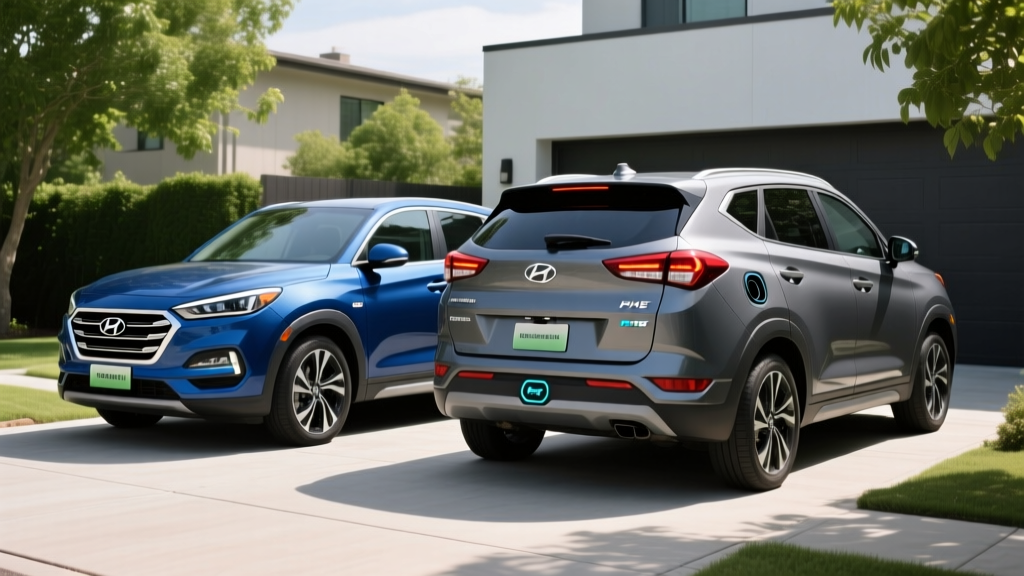
The Hyundai Tucson has been one of the best-selling compact SUVs in America for years, and its electrified variants — the Tucson Hybrid (HEV) and Tucson Plug-in Hybrid (PHEV) — give buyers a way to cut fuel costs without committing to a full battery-electric vehicle. For 2026, Hyundai continues to refine both powertrains, offering strong combined output, competitive fuel economy, and one of the longest hybrid battery warranties in the segment.
If you're researching the Tucson Hybrid, you likely have questions that go beyond the brochure: What's the real-world MPG versus the EPA sticker? How far can the PHEV actually drive on electricity alone? Does either version qualify for a federal tax credit? This guide answers those questions with exact numbers and honest ownership context.
Tucson Hybrid vs. Tucson PHEV: What's the Difference?
Hyundai sells two electrified Tucson variants, and confusing them is the most common mistake shoppers make. Here's the critical distinction:
Tucson Hybrid (HEV)
- No plug required. The battery recharges through regenerative braking and the gasoline engine.
- Small battery (~1.49 kWh): Provides electric assist during acceleration and enables brief low-speed electric-only movement, but you never charge it externally.
- Best for: Drivers who want better MPG without changing their fueling routine or installing a home charger.
Tucson Plug-in Hybrid (PHEV)
- Plugs in like an EV. A larger battery provides meaningful electric-only driving range before the gas engine engages.
- Larger battery (~13.8 kWh): Delivers an EPA-estimated 33 miles of electric-only range, enough for many daily commutes without burning gas.
- Best for: Drivers with home charging access and short-to-moderate commutes who want EV-like daily driving with gas-engine backup for road trips.
Both use Hyundai's 1.6-liter turbocharged four-cylinder engine paired with an electric motor, but the PHEV has a more powerful motor and a substantially larger battery pack. Neither requires you to choose between electricity and gasoline — both systems manage the blend automatically.
Fuel Economy: EPA MPG and Real-World Numbers
Fuel economy is the primary reason most buyers consider the Tucson Hybrid over the conventional gas-only Tucson. Here's what the EPA rates, along with what you can actually expect:
| Model | EPA City | EPA Highway | EPA Combined | Real-World Expectation |
|---|---|---|---|---|
| Tucson Hybrid AWD (Blue trim) | 38 MPG | 38 MPG | 38 MPG | 36–41 MPG (city-biased driving often exceeds EPA) |
| Tucson Hybrid AWD (SEL/Limited) | 37 MPG | 36 MPG | 37 MPG | 35–40 MPG |
| Tucson PHEV AWD (combined gas + electric) | 35 MPG combined (gas-only) / 80 MPGe (with electric) | 33–37 MPG gas-only; MPGe varies heavily with charging habits | ||
Real-world context: Hybrids typically outperform their EPA city ratings in stop-and-go traffic because regenerative braking recovers energy that a gas car wastes as heat. On the highway, where regen opportunities are fewer and aerodynamic drag dominates, the advantage narrows. In our experience and consistent owner reports, Tucson Hybrid drivers who do a mix of suburban errands and city commuting often see 39–41 MPG in warmer months. Highway-heavy road trips at 75+ MPH tend to drop to 33–35 MPG. Cold weather (below freezing) typically reduces hybrid fuel economy by 5–10% due to increased engine idling for cabin heat and reduced battery efficiency.
For the PHEV, the 80 MPGe figure only applies when you're regularly charging and driving within the electric-only range. If you never plug in, the PHEV operates as a conventional hybrid and returns roughly 35 MPG — slightly less than the dedicated HEV due to the extra weight of the larger battery.
Tucson PHEV Electric-Only Range and Charging
The Tucson PHEV's 13.8 kWh battery pack delivers an EPA-estimated 33 miles of electric-only range. That's enough to cover the average American's one-way commute (roughly 16 miles each way, per Census Bureau data) entirely on electricity.
| Spec | Tucson PHEV |
|---|---|
| Battery Capacity | 13.8 kWh (lithium-ion polymer) |
| EPA Electric-Only Range | 33 miles |
| Total Combined Range (Electric + Gas) | ~400+ miles |
| Level 1 Charging (120V) | ~11 hours (0–100%) |
| Level 2 Charging (240V, 7.2 kW onboard charger) | ~2 hours (0–100%) |
| DC Fast Charging | Not available |
| Charge Port | J1772 (Level 1/2 AC) |
Charging reality check: The Tucson PHEV does not support DC fast charging, which is typical for plug-in hybrids in this class. The 7.2 kW onboard charger is adequate for overnight Level 2 replenishment. If you're installing a home Level 2 charger, expect to pay $500–$1,500 for a quality 32-amp or 40-amp wall unit plus $800–$2,500 for professional electrician installation, depending on whether your panel needs an upgrade. That investment pays for itself quickly if you're displacing gasoline with electricity on daily drives.
Real-world electric range varies: expect 28–33 miles in mild weather with moderate speeds, dropping to 22–27 miles in freezing temperatures or at sustained highway speeds above 65 MPH, where electric motors are less efficient.
Powertrain Specs: Horsepower, Acceleration, and Drivetrain
| Specification | Tucson Hybrid | Tucson PHEV |
|---|---|---|
| Engine | 1.6L Turbo I4 | 1.6L Turbo I4 |
| Engine HP | 180 hp | 180 hp |
| Electric Motor HP | 47.7 kW (~64 hp) | 66.9 kW (~90 hp) |
| Combined System Output | 232 hp / 271 lb-ft torque | 268 hp / 271 lb-ft torque |
| Transmission | 6-speed automatic | 6-speed automatic |
| Drivetrain | AWD (standard) | AWD (standard) |
| 0–60 MPH (est.) | ~7.1 seconds | ~6.3 seconds |
| Towing Capacity | 2,000 lbs | 2,000 lbs |
Both models come standard with all-wheel drive, which is a significant value advantage over competitors that charge extra for AWD. The PHEV's more powerful electric motor gives it noticeably quicker off-the-line acceleration, making it the more engaging driver's choice. The 6-speed automatic transmission in both avoids the rubber-band feel of some CVT-equipped hybrids, though it does sacrifice a small amount of efficiency versus a continuously variable design.
Pricing, Trims, and Tax Credit Eligibility
For the 2026 model year, Hyundai positions the Tucson Hybrid and PHEV across several trim levels. Pricing starts in the low-to-mid $30,000s for the HEV and climbs into the low $40,000s for the PHEV:
| Model / Trim | Starting MSRP (approx.) | Federal Tax Credit Eligibility |
|---|---|---|
| Tucson Hybrid Blue | $33,500 | No (HEVs do not qualify for §30D) |
| Tucson Hybrid SEL Convenience | $36,200 | No |
| Tucson Hybrid Limited | $39,750 | No |
| Tucson PHEV SEL Convenience | $40,500 | Potentially — see details below |
| Tucson PHEV Limited | $44,200 | Potentially — see details below |
Federal tax credit details for the Tucson PHEV: Under IRS §30D, plug-in hybrids with battery packs of at least 7 kWh may qualify for up to $3,750 in federal tax credits (the PHEV's battery meets the capacity threshold, but credit amounts depend on critical mineral and battery component sourcing requirements that phase in through 2026). The Tucson Hybrid (HEV) does not qualify for §30D because it cannot be plugged in — it's not a plug-in vehicle.
§30D credit requirements for the Tucson PHEV (2026 rules):
- Vehicle must be new and purchased for personal use in the U.S.
- Buyer's modified adjusted gross income must not exceed $150,000 (single) / $300,000 (joint) / $225,000 (head of household)
- Vehicle MSRP must not exceed $80,000 for SUVs (Tucson PHEV clears this cap)
- Battery components and critical minerals must meet escalating domestic-content thresholds — check the latest IRS guidance for current eligible VINs
- Credit can be transferred to the dealer at point of sale as an immediate price reduction (effective 2024 onward)
Important caveat: Hyundai's battery sourcing has shifted across model years. Always verify your specific VIN's eligibility on fueleconomy.gov or with your dealer before assuming the credit applies. Tax situations vary — consult a tax professional for your specific case.
Reliability, Battery Warranty, and Replacement Costs
Hyundai Hybrid/PHEV Battery Warranty
- Hybrid battery: 10 years / 100,000 miles (original owner, states following CARB rules may extend further)
- Hybrid system components: 10 years / 100,000 miles (inverter, motor, controller)
- Basic vehicle warranty: 5 years / 60,000 miles
- Powertrain warranty: 10 years / 100,000 miles
Hyundai's 10-year/100,000-mile hybrid battery warranty is among the best in the industry and directly addresses the top concern of hybrid buyers: "What if the battery dies?" In practice, modern lithium-ion hybrid batteries rarely fail catastrophically. Degradation is gradual — you'll notice slightly reduced electric assist and marginally lower MPG over many years, not a sudden failure.
According to industry repair data, a Tucson Hybrid battery replacement (if needed out of warranty) costs approximately $2,500–$4,000 including labor. The PHEV's larger pack would cost more — roughly $5,000–$7,000. However, with Hyundai's 10-year coverage, most original owners will never face this expense. Even the conventional gas Tucson's transmission replacement could cost $3,000–$5,000, putting hybrid battery costs in perspective.
Reliability data from sources including Consumer Reports and J.D. Power has rated recent Tucson Hybrid model years as average to above-average for the compact SUV segment. The 1.6L turbo engine has been in Hyundai's lineup for several years with no widespread failure patterns, and the 6-speed automatic is a proven, conventional design without the complexity of a CVT.
Tucson Hybrid vs. PHEV vs. Full EV: Which Is Right for You?
Choose the Tucson Hybrid (HEV) if:
- You don't have access to home or workplace charging
- You want better MPG without any change to your fueling habits
- Your budget is in the $33,000–$40,000 range
- You drive a mix of city and highway and want consistent 37–38 MPG combined
Choose the Tucson PHEV if:
- You can install a Level 2 charger at home (or already have one)
- Your daily round-trip commute is under 35 miles
- You want EV-like daily driving but need gas-engine flexibility for road trips
- You may qualify for the §30D federal tax credit, narrowing the price gap with the HEV
Choose a full EV (like the Hyundai Ioniq 5) instead if:
- Your daily driving is under 250 miles and you have reliable home charging
- You want to eliminate gasoline entirely and minimize maintenance (no oil changes, fewer moving parts)
- You qualify for the full $7,500 federal EV tax credit
- You're willing to plan charging stops on road trips
The Tucson Hybrid makes the most financial sense for buyers who can't charge at home. The PHEV is a strategic middle ground — particularly compelling if your commute falls within the 33-mile electric range, because you'll burn almost no gasoline on weekdays while retaining full road-trip capability. A full EV offers the lowest per-mile energy cost and least maintenance, but requires charging infrastructure and route planning for longer drives.
Pros and Cons at a Glance
Pros
- Standard AWD on all trims (many competitors charge $1,500+ for AWD)
- 38 MPG combined (HEV) is class-competitive with Honda CR-V Hybrid and Toyota RAV4 Hybrid
- 10-year/100,000-mile hybrid battery warranty exceeds most competitors
- PHEV's 33-mile electric range covers most daily commutes
- 268 hp PHEV powertrain provides strong acceleration for the segment
- Conventional 6-speed automatic avoids CVT drone
Cons
- PHEV does not support DC fast charging (no road-trip quick top-ups)
- HEV does not qualify for any federal tax credit
- Cargo space slightly reduced vs. gas-only Tucson (battery packaging)
- Highway MPG drops noticeably above 75 MPH — less efficient than some rivals at sustained speed
- PHEV price premium over HEV is ~$7,000 — takes years of fuel savings to recoup without the tax credit
- Real-world electric range drops to ~25 miles in cold weather
Frequently Asked Questions
How many MPG does the Tucson Hybrid get?
The 2026 Tucson Hybrid Blue trim is EPA-rated at 38 MPG city / 38 MPG highway / 38 MPG combined. Higher trims (SEL, Limited) are rated at 37 MPG combined. In real-world city-biased driving, many owners report 39–41 MPG. Highway-heavy trips at speeds above 75 MPH tend to yield 33–35 MPG.
How far can the Tucson PHEV go on electric only?
The EPA rates the Tucson PHEV at 33 miles of electric-only range. Real-world results vary: expect 28–33 miles in mild weather at moderate speeds, and 22–27 miles in freezing temperatures or at sustained highway speeds. The total combined range (electric plus a full tank of gas) exceeds 400 miles.
Does the Tucson Hybrid need to be plugged in?
No. The conventional Tucson Hybrid (HEV) never needs to be plugged in. Its small battery charges through regenerative braking and the gasoline engine. Only the Tucson PHEV requires (or benefits from) plugging in — you can still drive the PHEV without plugging it in, but you'll miss the electric-only range and fuel savings.
Does the Tucson Hybrid or PHEV qualify for a tax credit?
The Tucson Hybrid (HEV) does not qualify for any federal tax credit because it is not a plug-in vehicle. The Tucson PHEV may qualify for a partial federal tax credit under IRS §30D (up to $3,750 depending on battery sourcing requirements), subject to buyer income limits and MSRP caps. Check fueleconomy.gov for current VIN-level eligibility, and consult a tax professional for your situation.
Is the Tucson Hybrid reliable and what does battery replacement cost?
Recent Tucson Hybrid model years have earned average to above-average reliability ratings. Hyundai covers the hybrid battery for 10 years / 100,000 miles, which is among the longest warranties in the industry. Out-of-warranty replacement costs are estimated at $2,500–$4,000 for the HEV battery and $5,000–$7,000 for the PHEV battery, though catastrophic failures are rare with modern lithium-ion packs.
How long does it take to charge the Tucson PHEV?
On a standard 120V household outlet (Level 1), a full charge takes approximately 11 hours. On a 240V Level 2 home charger using the PHEV's 7.2 kW onboard charger, a full charge takes about 2 hours. The Tucson PHEV does not support DC fast charging.
Is the Tucson Hybrid better than the Toyota RAV4 Hybrid?
The RAV4 Hybrid is rated at 39–41 MPG combined (depending on trim), giving it a slight fuel-economy edge. The Tucson Hybrid counters with more standard horsepower (232 hp vs. 219 hp), a longer hybrid battery warranty (10 years vs. Toyota's 10 years/150,000 miles for hybrid battery only — comparable), and a more premium interior on upper trims. Both are strong choices; the decision often comes down to styling preference, dealer relationships, and which features matter most to you.