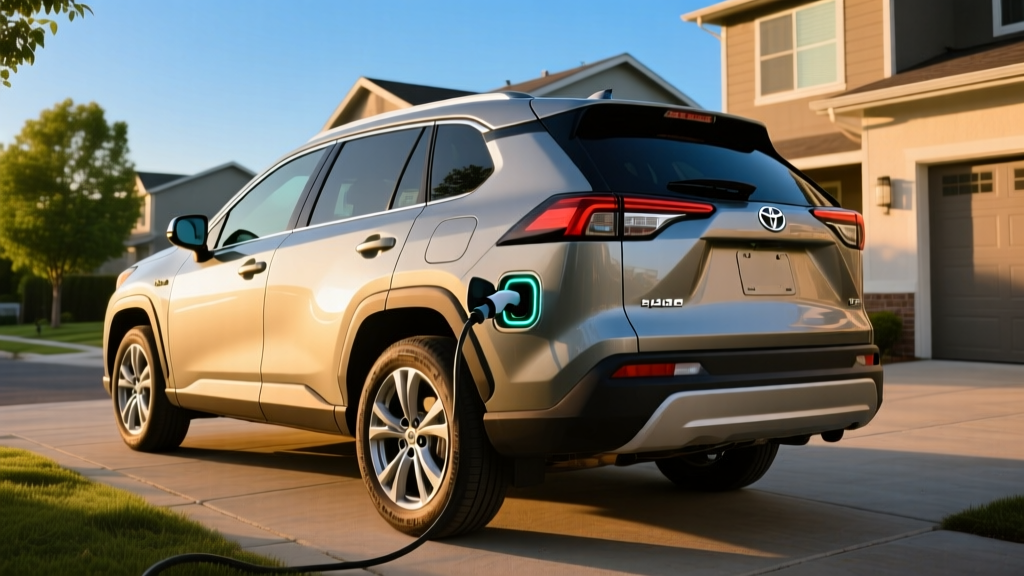
If you've asked yourself "what is a hybrid vehicle" while scrolling through dealer listings, you're not alone. The term covers two fundamentally different powertrains — the conventional hybrid (HEV) and the plug-in hybrid (PHEV) — and the difference determines whether you ever plug in, how far you drive on electricity, and whether you qualify for a federal tax credit.
This guide cuts through the marketing. We'll use real 2026 model-year data from the U.S. EPA and manufacturer spec sheets to explain exactly how each system works, what it costs to own, and which type of buyer each one serves.
The Short Answer: Two Kinds of Hybrid
A hybrid vehicle pairs a gasoline engine with an electric motor and a battery pack. That's the broad definition. But the two subtypes operate very differently in daily use:
Conventional Hybrid (HEV)
How it charges: Regenerative braking and the gas engine — never plugged in.
Battery size: 1.0–2.0 kWh (small buffer).
Electric-only driving: Brief low-speed assist only; not meaningful EV range.
Federal tax credit: None (no plug, no §30D eligibility).
Example: 2026 Toyota Prius, Honda CR-V Hybrid.
Plug-In Hybrid (PHEV)
How it charges: Plugged into a wall outlet or Level 2 charger; also regens and uses the engine.
Battery size: 11–25+ kWh (usable).
Electric-only driving: 25–45+ EPA-rated miles before the engine starts.
Federal tax credit: Up to $7,500 under IRS §30D if sourcing, income, and MSRP caps are met.
Example: 2026 Toyota RAV4 Prime, Chrysler Pacifica PHEV.
The confusion happens because dealers and automakers use "hybrid" loosely. If the vehicle doesn't have a charge port, it's an HEV. If it does, it's a PHEV. That single hardware difference cascades into everything else: fuel cost, daily routine, and incentive eligibility.
How a Hybrid Powertrain Actually Works
Both HEVs and PHEVs use a similar core architecture: a gasoline engine (typically a 1.5L–2.5L four-cylinder, often running the more efficient Atkinson cycle) coupled with one or two electric motor-generators and a power-split device or clutch pack that blends the two power sources.
In an HEV, the battery is small — often 1.1 to 1.6 kWh total capacity. It acts as a buffer, capturing energy from regenerative braking and feeding it back to assist the engine during acceleration, where gas engines are least efficient. The engine shuts off at stops and during low-load coasting. Combined output for a modern HEV like the 2026 Toyota Prius reaches 196 horsepower (AWD-e variant), with the electric motor contributing roughly 80–100 kW of peak assist.
In a PHEV, the battery is 10–20× larger. The 2026 Toyota RAV4 Prime, for instance, carries an 18.1 kWh lithium-ion pack (usable capacity approximately 15.9 kWh). That's enough to power the vehicle entirely on electricity for an EPA-rated 42 miles. Once the battery depletes to its buffer threshold, the 2.5L engine engages and the car operates as a conventional hybrid, delivering an EPA-estimated 38 MPG combined in hybrid mode. Total system output: 302 horsepower.
| Model | Type | Engine | System HP | Battery (kWh) | EPA EV Range | EPA MPG (Hybrid) |
|---|---|---|---|---|---|---|
| Toyota Prius LE | HEV | 2.0L I4 | 196 | 1.3 | N/A | 57/54/57 |
| Honda CR-V Sport Hybrid | HEV | 2.0L I4 | 204 | 1.1 | N/A | 43/36/40 |
| Toyota RAV4 Prime | PHEV | 2.5L I4 | 302 | 18.1 | 42 mi | 40/36/38 |
| Chrysler Pacifica PHEV | PHEV | 3.6L V6 | 260 | 16.0 | 32 mi | 30/28/30 |
| Hyundai Tucson PHEV | PHEV | 1.6L Turbo I4 | 261 | 13.8 | 33 mi | 35/33/35 |
Fuel Economy: EPA Numbers vs. Real-World MPG
Hybrid fuel economy is where the EPA sticker and real-world results often diverge — usually in the buyer's favor for city driving, but sometimes against them on the highway.
| Model | EPA City | EPA Hwy | EPA Combined | Real-World City | Real-World Hwy |
|---|---|---|---|---|---|
| Toyota Prius LE | 57 | 54 | 57 | 55–62 | 48–53 |
| Honda CR-V Hybrid | 43 | 36 | 40 | 40–46 | 33–36 |
| RAV4 Prime (hybrid mode) | 40 | 36 | 38 | 38–42 | 33–36 |
Why city MPG often beats the sticker: Hybrids recapture braking energy that conventional cars waste as heat. Stop-and-go traffic generates more regen opportunities, so actual city consumption can dip below the EPA estimate — especially on flat terrain in mild weather. Owners of the current Prius routinely report 60+ MPG in urban driving during spring and fall.
Why highway MPG often falls short: At sustained 70–80 mph speeds, aerodynamic drag dominates and the electric motor contributes less. The engine does most of the work, and real-world highway numbers for a compact hybrid SUV often land 2–5 MPG below the EPA highway figure, particularly in winter or at high altitude where air density and engine tuning shift.
PHEV efficiency has a second metric: MPGe. While operating on battery alone, the EPA rates PHEVs in MPGe (miles per gallon equivalent), which converts electricity consumption into a gasoline-equivalent number. The RAV4 Prime achieves 94 MPGe in EV mode. But MPGe is only meaningful if you charge daily — once the battery depletes, you're burning gas at the hybrid-mode MPG shown above.
PHEV Electric-Only Range and Charging Details
If you're considering a PHEV, the electric-only range is the number that determines whether you can commute without burning a drop of gasoline. Here's what current models deliver:
PHEV Electric Range — EPA vs. Reality
EPA-rated EV ranges assume moderate temperatures (roughly 68–77°F), mixed city/highway driving, and no heavy HVAC use. In practice:
- Mild weather, city driving: Expect to match or slightly exceed EPA range (e.g., RAV4 Prime may deliver 44–47 miles on a full charge at 35 mph average).
- Highway at 70 mph: EV range drops 15–25% — a 42-mile rated PHEV might give you 32–35 electric miles.
- Cold weather (below 32°F): Battery chemistry slows and cabin heating draws power. Expect 25–40% range loss, so that same 42-mile PHEV may deliver only 25–30 miles electric in a Minnesota January.
Charging a PHEV at home is straightforward and doesn't require the heavy infrastructure of a full EV:
| Level | Power (kW) | Time to Full (18 kWh battery) | Equipment |
|---|---|---|---|
| Level 1 (120V household) | 1.2–1.4 kW | 12–15 hours | Included cord, standard outlet |
| Level 2 (240V home/public) | 3.3–7.2 kW | 2.5–5.5 hours | Home wallbox or public station |
| DC Fast Charge | N/A for most PHEVs | N/A | Most PHEVs lack DC capability |
Most PHEVs — including the RAV4 Prime, Tucson PHEV, and Pacifica PHEV — do not support DC fast charging. Their onboard chargers max out at 6.6 kW (Level 2). That's fine for overnight home charging but means you can't top up quickly on a road trip. A few newer PHEVs are beginning to offer limited DC capability, but it remains uncommon and typically caps at 25–50 kW — far below the 150–350 kW rates of full BEVs.
For most PHEV owners, a standard 120V outlet provides enough overnight replenishment to cover a 30–40 mile commute. A Level 2 home charger ($300–$600 for equipment, $500–$1,500 for electrician installation) is a convenience upgrade, not a necessity.
Battery Longevity, Warranty, and Replacement Cost
Hybrid Battery Warranty — Federal Minimum and Beyond
Federal law mandates that hybrid and PHEV battery packs carry a minimum warranty of 8 years / 100,000 miles. In California Air Resources Board (CARB) states — which include CA, NY, MA, WA, OR, CO, and several others — that extends to 10 years / 150,000 miles for emissions-related components including the hybrid battery.
Most automakers match or exceed these minimums. Toyota, Honda, and Hyundai all provide 10-year/150,000-mile hybrid battery warranties in CARB states and 8-year/100,000-mile coverage elsewhere. Some brands, like Hyundai, offer 10-year/100,000-mile coverage nationwide.
Real-world degradation for hybrid batteries is modest compared to early-generation concerns. HEV batteries are small and rarely cycle deeply — they operate in a narrow state-of-charge window (roughly 40–80% SoC), which dramatically extends cycle life. Data from fleet operators and long-term owners shows that Prius battery packs routinely last 150,000–200,000+ miles before capacity loss becomes noticeable. PHEV batteries, being larger and cycling more deeply, may show 8–15% capacity loss over 100,000 miles — but since the engine backs them up, this translates to a few fewer electric-only miles rather than a stranded vehicle.
Battery replacement costs in 2026:
- HEV (Prius, CR-V Hybrid): $2,000–$4,000 for a new OEM pack; $1,000–$2,000 for a refurbished unit from independent hybrid specialists.
- PHEV (RAV4 Prime, Pacifica PHEV): $6,000–$10,000 for OEM replacement, reflecting the larger capacity.
These are out-of-warranty costs. Given the 8–10 year warranty and typical ownership horizons, most original owners will never pay for a hybrid battery replacement. For used-car buyers, checking the battery's state of health via an OBD-II scan tool or dealer diagnostic is a sensible pre-purchase step.
Tax Credits and Incentives: What Qualifies?
The federal EV tax credit under IRS §30D applies to plug-in hybrids — but not to conventional HEVs. Here's how the 2026 rules break down:
- Conventional hybrids (HEV): No federal tax credit. No plug, no eligibility.
- Plug-in hybrids (PHEV): May qualify for up to $7,500, subject to:
- — Battery capacity ≥ 7 kWh (all current PHEVs meet this).
- — MSRP cap: $80,000 for SUVs, vans, and pickups; $55,000 for sedans.
- — Buyer income cap: $300,000 joint / $225,000 head of household / $150,000 single (modified AGI).
- — Battery component and critical mineral sourcing requirements (phased in annually; many Asian-sourced PHEVs face partial or full credit reduction in 2026).
- — Point-of-sale transfer option available: you can transfer the credit to the dealer at purchase for an immediate price reduction.
As of 2026, the Chrysler Pacifica PHEV (assembled in the U.S. with North American battery sourcing) has been among the more reliable qualifiers for the full $7,500 credit. The Toyota RAV4 Prime (assembled in Japan) has faced credit reduction due to sourcing rules — check the fueleconomy.gov tax credit lookup for the latest status before purchasing. State incentives vary widely; some states like Colorado and California offer additional rebates for PHEVs, while others offer nothing. Consult your state's energy office or a tax professional for specifics.
Who Should Buy a Hybrid, a PHEV, or a Full EV?
The right choice depends on your daily driving pattern, charging access, and willingness to adapt your routine.
Choose a conventional hybrid (HEV) if:
- You drive 30–60 miles daily in mixed city/highway traffic.
- You have no access to home or workplace charging.
- You want maximum fuel savings with zero behavior change — no plugging in, no range planning.
- You plan to own the car 10+ years and want proven long-term reliability.
- Your budget is $28,000–$40,000 and you don't need a tax credit to justify the purchase.
Choose a plug-in hybrid (PHEV) if:
- Your round-trip commute is under 40 miles and you can charge at home overnight.
- You take regular road trips (200+ miles) where EV charging infrastructure is sparse or unreliable.
- You want EV-like daily driving but refuse to depend on public charging for longer trips.
- You qualify for the $7,500 federal credit, which can make a PHEV price-competitive with a gas car.
- You need a larger vehicle (SUV, minivan) where full EV options are limited or expensive.
Choose a full battery electric vehicle (BEV) if:
- You have reliable home Level 2 charging and your daily driving is under 250 miles.
- You want the lowest per-mile fuel cost (electricity at $0.12/kWh ≈ $0.03–0.04/mile vs. gas at $3.50/gal ≈ $0.12–0.15/mile for a 30 MPG car).
- You want zero tailpipe emissions and minimal drivetrain maintenance (no oil changes, no transmission fluid).
- You're comfortable planning DC fast-charging stops on road trips.
Hybrid (HEV) Pros & Cons
Pros:
- 40–57 MPG combined without plugging in
- Lower purchase price than PHEV or BEV
- Proven reliability; 20+ year track record
- No charging infrastructure needed
- Strong resale value (Prius, RAV4 Hybrid)
Cons:
- No federal tax credit
- No electric-only driving
- Still 100% gasoline-dependent
- Highway MPG advantage over gas cars is smaller
Plug-In Hybrid (PHEV) Pros & Cons
Pros:
- 25–45 miles electric for daily commuting
- Gas engine eliminates range anxiety on trips
- Up to $7,500 federal tax credit (if eligible)
- 300+ combined system HP in many models
- Works as efficient hybrid when battery depletes
Cons:
- Higher base price ($5,000–$10,000 more than HEV)
- Requires home charging to realize EV benefits
- Most lack DC fast charging
- Heavier than HEV (larger battery) → slightly lower hybrid-mode MPG
- Tax credit eligibility uncertain due to sourcing rules
Frequently Asked Questions
How many MPG does a hybrid get?
It depends on the model and driving conditions. The most efficient 2026 HEV, the Toyota Prius LE, is EPA-rated at 57 MPG combined (57 city / 54 highway). Compact hybrid SUVs like the Honda CR-V Hybrid deliver around 40 MPG combined. In real-world city driving, many owners report exceeding EPA estimates by 3–5 MPG thanks to regenerative braking. Highway driving at 75+ mph typically drops 3–6 MPG below the sticker.
How far can a PHEV go on electric only?
Current 2026 PHEVs offer 25–45 miles of EPA-rated electric-only range. The Toyota RAV4 Prime leads at 42 miles; the Hyundai Tucson PHEV delivers 33 miles; the Chrysler Pacifica PHEV provides 32 miles. Real-world range varies with temperature and speed — expect 15–40% less in cold weather or sustained highway driving. Once the battery depletes, the vehicle seamlessly switches to hybrid mode and continues on gasoline.
Hybrid vs PHEV vs EV — which fits me?
If you can't charge at home, choose an HEV. If you can charge at home but regularly drive 200+ miles where chargers are sparse, choose a PHEV. If you can charge at home and mostly drive under 250 miles daily, a full BEV gives you the lowest operating cost and least maintenance. The PHEV is the best "no compromises" option for one-car households that need both electric commuting and road-trip flexibility.
Is a hybrid reliable, and what does battery replacement cost?
Modern hybrids are among the most reliable vehicles on the road. Toyota's hybrid system has a 25+ year track record with millions of units in service. Hybrid batteries are warranted for 8–10 years / 100,000–150,000 miles (depending on state), and real-world data shows they frequently last well beyond warranty. Out-of-warranty replacement costs $2,000–$4,000 for an HEV and $6,000–$10,000 for a PHEV. Refurbished batteries from independent shops can cut these costs by 40–50%.
Does a hybrid qualify for a tax credit?
Conventional hybrids (HEVs) do not qualify for any federal tax credit. Plug-in hybrids (PHEVs) may qualify for up to $7,500 under IRS §30D, but eligibility depends on the vehicle's MSRP (under $80,000 for SUVs), the buyer's income (under $300,000 joint), and battery component/critical mineral sourcing requirements that tighten annually. Always verify current eligibility on fueleconomy.gov before purchasing, as credit status can change with model-year sourcing updates.
Do hybrids need to be plugged in?
No — conventional hybrids (HEVs) never plug in. They generate all their electricity internally through regenerative braking and the gasoline engine. Only plug-in hybrids (PHEVs) have a charge port and benefit from being plugged in. If you buy an HEV, your only "fueling" stop is still the gas station.
What's the difference between a hybrid and a mild hybrid?
A mild hybrid (often labeled MHEV) uses a small 48-volt motor-generator that can't drive the wheels on its own. It assists the engine during acceleration and enables smoother stop-start operation. The fuel economy benefit is modest — typically 1–3 MPG improvement over a non-hybrid. A full hybrid (HEV) can propel the car on electric power alone at low speeds and delivers much larger efficiency gains (10–20+ MPG over a comparable gas car).