Ford's hybrid strategy in 2026 is deliberately pragmatic: instead of going all-in on battery-electric vehicles, the automaker offers hybrid and plug-in hybrid powertrains across its most popular nameplates. If you're researching a Ford hybrid SUV, you're likely weighing real fuel savings against the simplicity of a gas station fill-up — no home charger installation, no range anxiety, no behavioral change required.
This guide breaks down every current Ford hybrid SUV and crossover available for the 2026 model year, with exact EPA MPG figures, powertrain specs, pricing, and the critical differences between Ford's conventional hybrids (HEVs) and its plug-in hybrid (PHEV). We'll also cover battery longevity, warranty terms, and federal tax credit eligibility so you can make a spec-driven purchase decision.
Ford's 2026 Hybrid SUV Lineup at a Glance
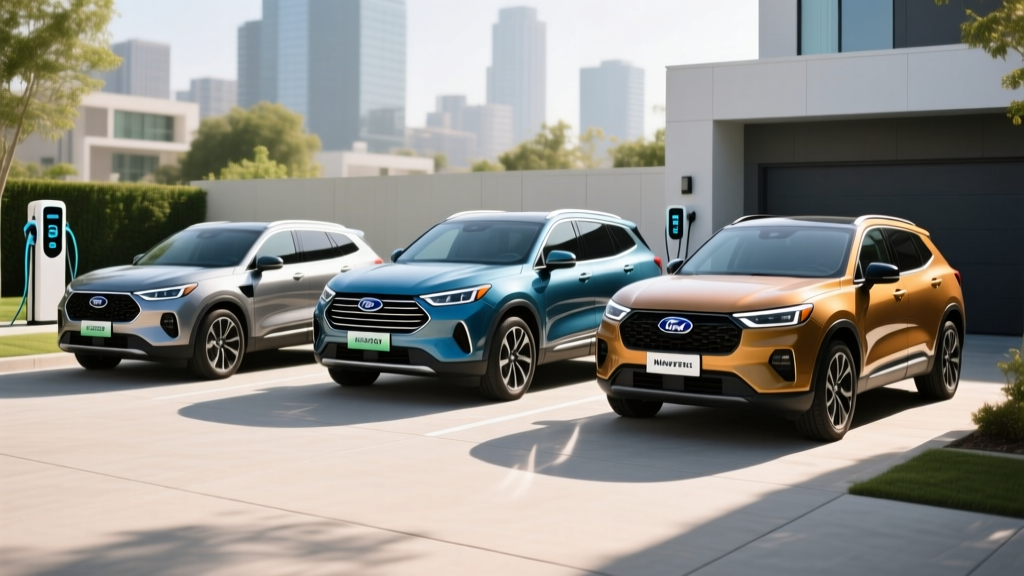
Ford currently offers three hybrid vehicles that fit the SUV or crossover category. Two are conventional hybrids (HEVs) that never need to be plugged in, and one is a plug-in hybrid (PHEV) with a meaningful electric-only driving range. Here's how they stack up:
| Spec | Escape Hybrid (HEV) | Escape PHEV | Explorer Hybrid (HEV) |
|---|---|---|---|
| Powertrain Type | Conventional Hybrid | Plug-in Hybrid | Conventional Hybrid |
| Engine | 2.5L I4 Atkinson-cycle | 2.5L I4 Atkinson-cycle | 3.3L V6 |
| Combined Horsepower | 200 hp (net) | 210 hp (net) | 318 hp (net) |
| EPA Combined MPG / MPGe | 39 MPG | 105 MPGe (elec) / 40 MPG (gas) | 23 MPG |
| EPA City / Highway MPG | 42 city / 36 hwy | 40 city / 37 hwy (gas-only) | 23 city / 24 hwy |
| Electric-Only Range | N/A | 37 miles | N/A |
| Battery Capacity | 1.1 kWh (nominal) | 14.4 kWh (usable) | 1.5 kWh (nominal) |
| Drivetrain | FWD or AWD | FWD only | RWD or AWD |
| 0–60 mph | ~7.8 sec | ~8.0 sec | ~6.3 sec |
| Starting MSRP | $33,485 | $40,400 | $45,260 |
Sources: fueleconomy.gov (EPA estimates), Ford Motor Company 2026 spec sheets. MPG figures are EPA-rated; your actual results will vary with driving style, terrain, and climate.
HEV vs PHEV: Which Ford Hybrid Is Right for You?
The most common confusion among Ford hybrid SUV shoppers is the difference between the conventional hybrid (HEV) and the plug-in hybrid (PHEV). They share a nameplate but operate very differently.
Conventional Hybrid (HEV) — Escape Hybrid, Explorer Hybrid
- No plug-in required. The small battery charges via regenerative braking and the gasoline engine.
- Seamless operation. The vehicle automatically switches between electric motor and gas engine; you drive it exactly like a conventional car.
- Best for: Drivers without access to home or workplace charging who want better fuel economy with zero lifestyle change.
- Real-world MPG reality: Hybrids often exceed their EPA city rating in stop-and-go traffic because regenerative braking recovers more energy. Highway MPG may fall slightly below the EPA estimate at sustained 75+ mph speeds.
Plug-in Hybrid (PHEV) — Escape PHEV
- Plugs in to charge. The larger 14.4 kWh battery provides 37 miles of electric-only driving before the gas engine engages.
- Level 2 charging (240V): Full charge in approximately 3.5 hours using a Level 2 home charger. No DC fast charging capability — the Escape PHEV uses a J1772 connector for Level 1 (120V, ~10 hours) and Level 2 only.
- Best for: Drivers with home charging access whose daily commute is under 37 miles round-trip. You'll burn almost no gasoline on weekdays and still have a 400+ mile total range for road trips.
- Total combined range: 37 miles electric + approximately 380 miles on gasoline = ~420 miles total before needing fuel or a plug.
The decision framework is simple: if you can install a Level 2 charger at home and your daily driving is under 40 miles, the Escape PHEV will save significantly more fuel. If you live in an apartment, park on the street, or regularly drive long distances, the HEV models deliver strong MPG without any charging infrastructure.
Fuel Economy Deep Dive: Real-World MPG vs. EPA Stickers
EPA estimates provide a standardized baseline, but real-world hybrid fuel economy depends heavily on your driving profile. Here's what to expect from each Ford hybrid SUV:
| Model | EPA Combined | Real-World City | Real-World Highway (75 mph) | Real-World Cold Weather |
|---|---|---|---|---|
| Escape Hybrid (FWD) | 39 MPG | 40–44 MPG | 34–37 MPG | 33–36 MPG |
| Escape Hybrid (AWD) | 37 MPG | 38–41 MPG | 32–35 MPG | 31–34 MPG |
| Escape PHEV (gas-only mode) | 40 MPG | 38–42 MPG | 35–38 MPG | 34–37 MPG |
| Explorer Hybrid (RWD) | 23 MPG | 22–25 MPG | 21–24 MPG | 19–22 MPG |
| Explorer Hybrid (AWD) | 22 MPG | 21–24 MPG | 20–22 MPG | 18–21 MPG |
Why hybrids often beat EPA city estimates: The EPA city test cycle includes frequent stops and low average speeds — exactly the conditions where regenerative braking shines. Every time you brake, the electric motor recovers kinetic energy that a gas-only vehicle wastes as heat. Owners who drive primarily in urban traffic consistently report exceeding the EPA city figure by 2–5 MPG.
Why highway MPG drops: At sustained 75+ mph speeds, aerodynamic drag dominates and the electric motor provides minimal assistance. Cold weather (below 35°F) further reduces efficiency because the engine runs more often to provide cabin heat and maintain battery temperature. Expect a 5–10% reduction in combined MPG during winter months in northern climates.
Escape PHEV: Electric-Only Range and Charging Details
The 2026 Ford Escape PHEV carries a 14.4 kWh usable lithium-ion battery pack, which Ford rates at 37 miles of electric-only range per the EPA. This is sufficient for most daily commutes, school runs, and errands without engaging the gasoline engine at all.
Here's what the charging experience looks like in practice:
- Level 1 (120V standard outlet): Approximately 10–12 hours for a full charge. Practical for overnight charging if your daily electric driving needs are under 20 miles.
- Level 2 (240V home charger, 32A): Approximately 3–3.5 hours from empty to full. A dedicated home Level 2 charger (such as a Ford Connected Charge Station or a third-party unit like the ChargePoint Home Flex) is strongly recommended for PHEV owners.
- DC fast charging: Not available. The Escape PHEV does not have a CCS or NACS port. This is typical for PHEVs — the battery is small enough that Level 2 charging is adequate overnight.
Real-world electric range caveat: In mild weather (55–75°F) with moderate acceleration, expect 34–38 miles of electric range. In cold weather (below 30°F), the electric range can drop to 28–32 miles because battery efficiency decreases and cabin heating draws additional power. Using the seat heaters instead of cabin heat can recover 2–3 miles of range.
Powertrain and Performance Specs
Ford uses two distinct hybrid architectures across its SUV lineup:
2.5L Inline-4 Hybrid System (Escape HEV & PHEV)
This Atkinson-cycle four-cylinder engine pairs with an electric motor integrated into the eCVT transaxle. The HEV produces a combined 200 horsepower, while the PHEV bumps output to 210 hp thanks to a more powerful electric motor drawing from the larger battery. Acceleration is adequate for merging and passing — the 0–60 mph time of roughly 7.8 seconds (HEV) and 8.0 seconds (PHEV) won't win drag races, but it's competitive with rivals like the Toyota RAV4 Hybrid.
3.3L V6 Hybrid System (Explorer HEV)
The Explorer Hybrid pairs a naturally aspirated 3.3-liter V6 with an electric motor for a combined 318 horsepower. This gives the three-row SUV legitimate passing power and a 0–60 mph time of approximately 6.3 seconds — genuinely quick for a vehicle of its size. The hybrid system also enables a 5,000-pound maximum towing capacity when properly equipped, something neither the Escape variants nor most competing hybrid SUVs can match.
Pricing, Trims, and Tax Credit Eligibility
Here's where the Ford hybrid SUV lineup gets nuanced for budget-conscious buyers:
| Model / Trim | MSRP (incl. destination) | Federal §30D Tax Credit | Effective Price (if eligible) |
|---|---|---|---|
| Escape Hybrid Base | $33,485 | Not eligible | $33,485 |
| Escape Hybrid Premium | $37,615 | Not eligible | $37,615 |
| Escape PHEV | $40,400 | Up to $3,750* | ~$36,650* |
| Explorer Hybrid Base | $45,260 | Not eligible | $45,260 |
| Explorer Hybrid Limited | $54,895 | Not eligible | $54,895 |
*Federal tax credit details for the Escape PHEV: Under current IRS §30D rules, plug-in hybrids with battery capacities of at least 7 kWh may qualify for a partial federal tax credit. The Escape PHEV's 14.4 kWh battery makes it potentially eligible for up to $3,750, contingent on critical-mineral sourcing requirements and your personal tax liability. Key eligibility rules:
- The credit is non-refundable — you must owe at least that much in federal income tax to claim it.
- As of 2026, the credit can be transferred to the dealer as a point-of-sale discount, reducing your purchase price directly regardless of tax liability.
- Income caps apply: Modified adjusted gross income must not exceed $150,000 (single), $225,000 (head of household), or $300,000 (joint filers).
- MSRP cap: The vehicle MSRP must not exceed $80,000 for SUVs (the Escape PHEV clears this easily).
- Battery component and critical-mineral sourcing requirements may reduce or eliminate the credit depending on supply-chain compliance. Check the latest eligibility list at IRS.gov clean vehicle credits.
Conventional hybrids (Escape HEV, Explorer HEV) do not qualify for the federal §30D tax credit. However, some states and utilities offer rebates or HOV lane access for hybrid vehicles — check your state energy office or Alternative Fuels Data Center for local incentives.
Battery Longevity, Warranty, and Replacement Costs
Ford Hybrid Battery Warranty Coverage
Ford covers the hybrid battery pack in all its hybrid and PHEV models with an 8-year / 100,000-mile warranty (whichever comes first). In states that follow California Air Resources Board (CARB) emissions standards — including California, New York, Massachusetts, and several others — the hybrid battery warranty extends to 10 years / 150,000 miles.
The warranty guarantees the battery will retain sufficient capacity to operate the hybrid system. If the battery degrades below Ford's defined performance threshold during the warranty period, Ford will repair or replace it at no cost.
Real-world longevity data: Ford's hybrid battery packs use proven lithium-ion chemistry with conservative thermal management. Based on fleet data from earlier-generation Escape and Fusion Hybrids now exceeding 150,000–200,000 miles, battery failures before 10 years are uncommon. The most frequent failure mode is gradual capacity loss (typically 10–15% over 10 years), which reduces electric-assist contribution but does not render the vehicle inoperable.
Out-of-warranty replacement cost: If a hybrid battery fails after the warranty period, expect a replacement cost of $2,000–$4,000 for the Escape HEV battery and $4,000–$6,500 for the larger Escape PHEV pack, including parts and labor at a Ford dealer. Independent hybrid battery specialists and refurbished units can reduce this cost by 30–40%. The Explorer Hybrid battery replacement typically runs $3,000–$5,000.
Maintenance advantage: Hybrid vehicles eliminate several maintenance items found on gas-only cars. Regenerative braking reduces brake pad wear significantly — many hybrid owners go 80,000+ miles on original brake pads. There is no alternator, starter motor, or conventional accessory belt to replace. Oil change intervals remain similar (7,500–10,000 miles), but overall maintenance costs trend 10–15% lower than equivalent gas-only models over a 5-year ownership period.
Hybrid vs PHEV vs Full EV: Which Ford Fits Your Life?
Choose a Ford Hybrid (HEV) If:
- You don't have access to home or workplace charging (apartment, street parking, condo without EV infrastructure).
- You want better fuel economy without changing any habits — just fill up at any gas station.
- You regularly take long road trips and don't want to plan around DC fast-charging stops.
- Your budget is under $45,000 and you want the lowest total cost of ownership with minimal upfront investment.
- You want the three-row Explorer with hybrid efficiency and 5,000-lb towing capability.
Choose the Escape PHEV If:
- You have a garage or driveway where you can install a Level 2 (240V) charger.
- Your daily commute and errands total under 37 miles — you'll drive electric most days and use gas only for longer trips.
- You want to reduce fuel consumption by 60–80% compared to a gas-only SUV without committing to a full EV.
- You want to potentially claim a federal tax credit of up to $3,750.
Choose a Full EV (Ford Mustang Mach-E) If:
- You have reliable home charging and your daily driving is under 250 miles.
- You want the lowest per-mile fuel cost (electricity at ~$0.04–0.06/mile vs. gasoline at ~$0.12–0.16/mile).
- You want to eliminate oil changes, spark plugs, and exhaust-system maintenance entirely.
- You qualify for the full $7,500 federal EV tax credit and your state offers additional EV incentives.
Pros and Cons: Ford Hybrid SUV Lineup
Pros
- Escape Hybrid delivers class-leading 42 MPG city without plug-in charging
- Escape PHEV's 37-mile electric range covers most daily commutes entirely on electricity
- Explorer Hybrid offers V6 power (318 hp) with hybrid efficiency and 5,000-lb towing
- Proven hybrid reliability with 8-yr/100,000-mi battery warranty (10-yr/150,000-mi in CARB states)
- No range anxiety — gas engine provides unlimited range between fill-ups
- Lower maintenance costs: extended brake pad life, no alternator or starter motor
- Escape PHEV eligible for partial federal tax credit and point-of-sale transfer
Cons
- Explorer Hybrid's 23 MPG combined is modest — barely beats some turbo-4 gas competitors
- Escape PHEV is FWD only — no AWD option for snow-belt buyers
- PHEV has no DC fast charging — impractical to recharge on road trips
- Conventional hybrids (HEV) do not qualify for federal tax credits
- Escape Hybrid AWD loses 2 MPG combined vs. FWD variant
- Hybrid premium over gas-only trims adds $1,500–$3,000 to purchase price (payback takes 3–5 years at current fuel prices)
- Cargo space slightly reduced in PHEV due to larger battery placement
Frequently Asked Questions
How many MPG does the Ford Escape Hybrid get?
The 2026 Ford Escape Hybrid with front-wheel drive achieves an EPA-rated 42 MPG city, 36 MPG highway, and 39 MPG combined. The AWD variant is rated at 39 city / 34 highway / 37 combined. In real-world city driving, many owners report 40–44 MPG thanks to regenerative braking efficiency in stop-and-go traffic. Highway driving at 75+ mph typically yields 34–37 MPG.
How far can the Ford Escape PHEV go on electric only?
The 2026 Escape PHEV has an EPA-rated electric-only range of 37 miles on a full charge of its 14.4 kWh battery. In mild weather with moderate driving, expect 34–38 real-world electric miles. In cold weather below 30°F, range drops to approximately 28–32 miles. Once the battery is depleted, the vehicle seamlessly switches to hybrid mode and delivers 40 MPG combined on gasoline.
Does the Ford Escape PHEV qualify for a tax credit?
Yes, the Escape PHEV may qualify for a partial federal tax credit of up to $3,750 under IRS §30D, subject to your income level, tax liability, and current battery-sourcing requirements. Since 2024, the credit can be transferred to the dealer as a point-of-sale discount. Conventional hybrid models (Escape HEV, Explorer HEV) do not qualify for the federal credit. Always verify current eligibility at IRS.gov before purchasing.
Are Ford hybrid SUVs reliable? What about battery replacement cost?
Ford's hybrid powertrains have demonstrated strong reliability based on fleet and owner data from previous-generation models. The hybrid battery is warranted for 8 years/100,000 miles (10 years/150,000 miles in CARB states). Out-of-warranty battery replacement costs range from $2,000–$4,000 for the Escape HEV, $4,000–$6,500 for the Escape PHEV, and $3,000–$5,000 for the Explorer Hybrid. Most hybrid batteries retain 85–90% capacity at the 10-year mark, and complete failures before 150,000 miles are uncommon.
Do I need to plug in the Ford Escape Hybrid or Explorer Hybrid?
No. The Escape Hybrid and Explorer Hybrid are conventional hybrids (HEVs). They charge their small batteries entirely through regenerative braking and the gasoline engine. You never plug them in — you simply fill up at a gas station as you would with any conventional vehicle. Only the Escape PHEV requires plug-in charging to access its electric-only range.
Which Ford hybrid SUV is best for towing?
The 2026 Ford Explorer Hybrid is the clear choice, with a maximum towing capacity of 5,000 pounds when properly equipped. Neither the Escape Hybrid nor the Escape PHEV is rated for significant towing (both are limited to approximately 1,500 pounds). If you need three-row seating, hybrid efficiency, and legitimate towing capability, the Explorer Hybrid is the only option in Ford's lineup.
How does the Ford hybrid system work?
Ford's hybrid system uses an electric motor integrated into an electronically controlled continuously variable transmission (eCVT). The system automatically manages power delivery between the gasoline engine and electric motor based on driving conditions. At low speeds and light loads, the vehicle can operate on electric power alone. Under hard acceleration, both the engine and motor work together for maximum output. During braking and deceleration, the electric motor acts as a generator, converting kinetic energy back into battery charge — this is regenerative braking, and it's why hybrids excel in city driving.
Editorial note: All pricing, specifications, and tax credit information reflect 2026 model-year data available at time of publication. Federal tax credit rules under §30D are subject to change. Consult a tax professional for personal eligibility. Always confirm final pricing and availability with your local Ford dealer.