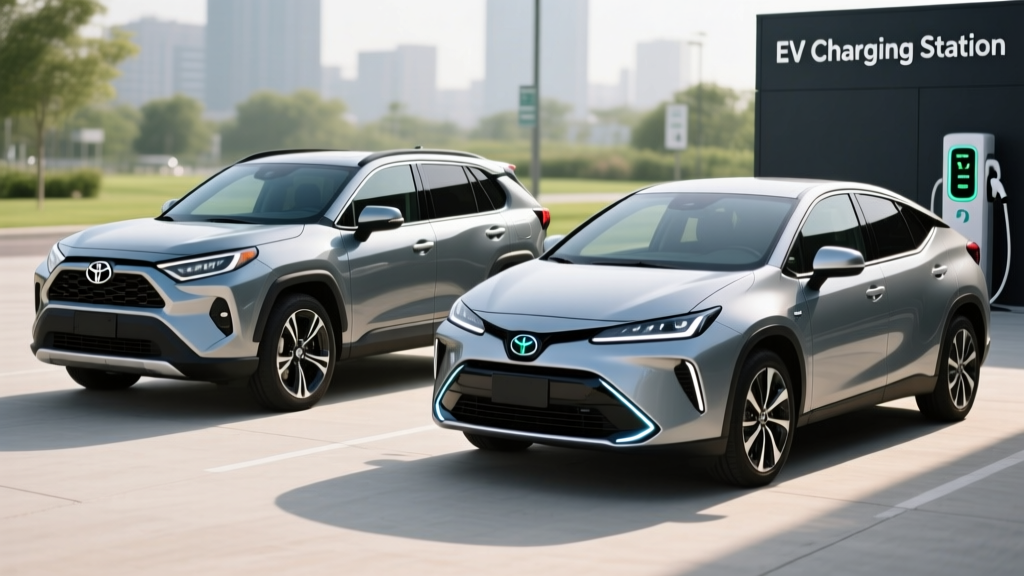
If you're searching for a Toyota hybrid plug in, you're looking at two of the most proven plug-in hybrid electric vehicles (PHEVs) on the market: the RAV4 Prime and the Prius Prime. Both let you drive on pure electricity for short commutes, then seamlessly transition to hybrid mode for longer trips — no range anxiety, no charging-desert stress.
But which one fits your life? And how do they compare to a full battery-electric vehicle (BEV) or a conventional Toyota hybrid (HEV) like the standard RAV4 Hybrid? This guide breaks down every spec that matters — electric-only range, real-world MPG, charging times, powertrain output, pricing, and federal tax credit eligibility — so you can make a data-driven decision.
Toyota's PHEV Lineup: RAV4 Prime vs Prius Prime at a Glance
Toyota currently sells two plug-in hybrids in the U.S. market. Both pair a gasoline engine with a larger battery pack and more powerful electric motors than their conventional hybrid siblings, enabling meaningful electric-only driving.
| Spec | RAV4 Prime | Prius Prime |
|---|---|---|
| Body Style | Compact SUV (AWD) | Compact Hatchback (FWD) |
| Engine | 2.5L 4-cyl + 2 electric motors | 2.0L 4-cyl + 1 electric motor |
| Combined Horsepower | 302 hp | 220 hp |
| 0-60 mph | 5.7 seconds | 6.6 seconds |
| Battery (usable) | 14.9 kWh (lithium-ion) | 13.6 kWh (lithium-ion) |
| EPA Electric-Only Range | 42 miles | 44 miles |
| EPA Combined Range (elec + gas) | 600 miles | 440 miles |
| EPA Combined MPG (hybrid mode) | 38 MPG | 52 MPG |
| MPGe (electric mode) | 94 MPGe | 127 MPGe |
| Level 1 Charge (120V) | ~12 hours (full) | ~11 hours (full) |
| Level 2 Charge (240V) | ~4.5 hours (full) | ~4 hours (full) |
| DC Fast Charging | No | No |
| Drivetrain | AWD (electronic rear motor) | FWD |
| Starting MSRP | $43,690 | $33,445 |
Source: fueleconomy.gov and Toyota Motor Corporation U.S.A. Always verify current model-year specs at toyota.com.
HEV vs PHEV vs BEV: Which Toyota Powertrain Fits You?
Before diving deeper, it's critical to understand the distinction between Toyota's three electrified options. Confusing them is the most common mistake buyers make.
Conventional Hybrid (HEV) — e.g., RAV4 Hybrid, Prius
No plug required. A small battery (typically 1-2 kWh) is recharged by regenerative braking and the gasoline engine. You never plug it in. Electric-only driving is limited to very low speeds for short distances. EPA combined MPG typically 39-57.
Plug-In Hybrid (PHEV) — e.g., RAV4 Prime, Prius Prime
Plug in to unlock full benefit. A larger battery (13-15 kWh) provides 42-44 miles of electric-only range. Plug in at home or work to recharge. Once the battery depletes, it operates as a conventional hybrid. You get the best of both worlds — EV-like commuting with gas-car flexibility for road trips.
Battery Electric Vehicle (BEV) — e.g., bZ4X
All-electric, no gas engine. Requires regular charging. Range of 220-250+ miles depending on model. Lowest running costs but requires reliable charging access.
Quick Decision Framework
Choose a Toyota PHEV if: Your daily commute is under 45 miles, you can charge at home (even a standard 120V outlet works overnight), and you want zero range anxiety on longer road trips.
Choose a conventional Toyota HEV if: You can't charge at home or work, your commute varies widely, or you want maximum MPG without any plug-in behavior change.
Choose a BEV if: You have reliable home Level 2 charging, your daily driving is predictable, and you want to eliminate gas entirely.
Electric-Only Range and Real-World MPG Breakdown
The headline feature of any Toyota hybrid plug in is the ability to drive without using a drop of gasoline — for a meaningful distance.
Prius Prime: EPA 44 Miles Electric-Only
Expect roughly 38-42 miles of electric range in real-world mixed driving. Highway speeds above 65 mph and cold weather (below 40°F) will reduce this to 30-35 miles. In mild conditions with city driving and regen braking, some owners report hitting 45+ miles.
RAV4 Prime: EPA 42 Miles Electric-Only
Expect roughly 36-40 miles in real-world conditions. The AWD system's rear motor draws more energy under acceleration, and the SUV's higher weight and drag reduce efficiency versus the Prius Prime. Cold weather highway driving may yield 28-32 miles.
Once the electric range is depleted, both vehicles operate as conventional hybrids:
| Model | City MPG | Highway MPG | Combined MPG |
|---|---|---|---|
| RAV4 Prime | 40 | 36 | 38 |
| Prius Prime | 53 | 51 | 52 |
| RAV4 Hybrid (HEV baseline) | 41 | 38 | 39 |
| Prius (HEV baseline) | 57 | 56 | 57 |
Real-world MPG note: Toyota hybrids, particularly the Prius family, often exceed EPA city estimates in stop-and-go traffic thanks to aggressive regenerative braking. Highway MPG tends to run 1-3 MPG below the EPA sticker at speeds above 70 mph. Expect the Prius Prime to deliver 48-55 MPG combined in hybrid mode depending on conditions.
Charging Your Toyota Plug-In Hybrid: What You Need to Know
Neither Toyota PHEV supports DC fast charging. This is a deliberate engineering choice — the battery packs are small enough that Level 2 AC charging is sufficient for overnight replenishment.
| Charging Level | Power (kW) | RAV4 Prime (Full Charge) | Prius Prime (Full Charge) |
|---|---|---|---|
| Level 1 (120V household outlet) | ~1.4 kW | ~12 hours | ~11 hours |
| Level 2 (240V, home or public) | ~3.3 kW | ~4.5 hours | ~4 hours |
| DC Fast Charge | N/A | Not supported | Not supported |
Practical charging advice: Most PHEV owners find that a standard 120V outlet is sufficient if the vehicle is parked overnight for 10+ hours. A Level 2 home charger (typically a 240V/32A circuit) isn't strictly necessary but will fully recharge the battery in about 4 hours — useful if you make multiple trips per day and want to recharge between them.
For home Level 2 installation, budget $500-$1,500 for a quality charger and $500-$2,000 for electrician labor and permitting, depending on your panel capacity and run distance. A dedicated 240V/20A circuit is usually adequate for PHEV charging, which draws far less power than a full BEV.
Powertrain Performance: More Than Just Efficiency
Toyota's PHEV powertrains deliver a surprising performance bonus over their conventional hybrid siblings.
The RAV4 Prime's 302 combined horsepower makes it the quickest RAV4 in the lineup — its 5.7-second 0-60 mph time outpaces even the turbocharged RAV4 TRD. The electronic AWD system uses a dedicated 54 hp rear electric motor for instant torque distribution without a mechanical driveshaft, giving it confident traction in rain and light snow.
The Prius Prime's 220 combined horsepower represents a massive leap from the previous-generation Prius Prime's 121 hp. The current model's 2.0L engine paired with a more powerful transaxle motor delivers a 6.6-second 0-60 time — genuinely quick for a compact hatchback focused on efficiency.
Both PHEVs feature Toyota's hybrid synergy drive system with multiple modes:
- EV Mode: Pure electric driving up to ~84 mph (Prius Prime) or ~84 mph (RAV4 Prime)
- HV Mode: Conventional hybrid operation, optimizing engine and motor use
- Auto EV/HV Mode: The system decides when to use electric vs. hybrid based on route and battery level
- Charge Mode: Uses the gasoline engine to recharge the battery while driving (useful if you're approaching an electric-only zone or want to save battery for later)
Pricing, Trims, and Federal Tax Credit Eligibility
Here's where careful research pays off — tax credit eligibility for PHEVs is more complex than most buyers realize.
| Model / Trim | MSRP | Federal §30D Credit Eligible? |
|---|---|---|
| Prius Prime SE | $33,445 | Potential — verify sourcing |
| Prius Prime XSE | $36,715 | Potential — verify sourcing |
| Prius Prime XSE Premium | $40,065 | Potential — verify sourcing |
| RAV4 Prime SE | $43,690 | Potential — verify sourcing |
| RAV4 Prime XSE | $47,560 | Potential — verify sourcing |
Federal §30D Clean Vehicle Credit Requirements
As of 2026, the IRS clean vehicle credit for new PHEVs and BEVs can provide up to $7,500, but eligibility depends on multiple factors:
- Battery capacity: Vehicle must have at least 7 kWh — both Toyota PHEVs qualify (13.6 and 14.9 kWh)
- MSRP cap: SUVs (RAV4 Prime) must be under $80,000; sedans/hatchbacks (Prius Prime) under $55,000 — both qualify
- Buyer income cap: Modified AGI must not exceed $150,000 (single), $225,000 (head of household), or $300,000 (joint)
- Critical minerals & battery component sourcing: Specific percentages of battery components and critical minerals must be sourced from the U.S. or FTA partners — this is the requirement that has disqualified many vehicles in recent years
- Point-of-sale transfer: Eligible buyers can transfer the credit to the dealer at purchase, reducing the purchase price directly
Always verify current eligibility at irs.gov before purchasing. Rules change frequently, and battery sourcing requirements have tightened significantly. Consult a tax professional for your specific situation.
Battery Longevity, Warranty, and Replacement Costs
This is the number-one concern for hybrid buyers, and Toyota has one of the strongest track records in the industry.
Toyota Hybrid Battery Warranty
10 years / 150,000 miles — whichever comes first. This covers the hybrid battery pack against defects and excessive capacity loss. This warranty is transferable to subsequent owners.
Toyota defines "excessive loss" as the battery falling below approximately 70% of its original capacity, though exact thresholds can vary. If the battery degrades beyond this point within the warranty period, Toyota will repair or replace it at no cost.
Real-world longevity data: Toyota's hybrid battery packs, particularly in the Prius family, routinely last well beyond the warranty period. Third-party fleet data and owner surveys suggest most Toyota hybrid batteries retain 85-90% capacity at 100,000 miles. Failures before 150,000 miles are uncommon but not unheard of.
Out-of-warranty replacement cost: If a Toyota PHEV battery fails after the warranty expires, replacement costs range from approximately $4,000 to $7,000 for the battery pack alone, with labor adding $500-$1,500. Toyota also offers refurbished battery packs at lower cost. Individual module replacement (replacing only the degraded cells) is sometimes possible for $1,500-$3,000 at specialized hybrid repair shops.
Battery care tips for maximum longevity:
- Avoid routinely charging to 100% and leaving the vehicle parked in extreme heat — the battery management system already buffers the top and bottom of the pack, but thermal stress still matters
- Don't let the vehicle sit for weeks at very low state of charge
- Use the vehicle regularly — hybrid batteries prefer regular cycling over long storage
- Keep up with scheduled maintenance — the battery cooling system's air filter (on models that have one) should be inspected and cleaned per the maintenance schedule
Reliability and Ownership Costs
Toyota consistently ranks at or near the top in reliability surveys from Consumer Reports and J.D. Power, and the PHEV models benefit from decades of hybrid system refinement. The Prius nameplate alone has over 25 years of real-world data behind it.
Total cost of ownership advantages for Toyota PHEVs:
- Fuel savings: If you charge daily and commute under 42-44 miles, you may use gasoline only on road trips. A Prius Prime driven 12,000 miles/year with daily charging could use under 100 gallons annually vs. ~400 gallons for a 30 MPG gas car
- Maintenance: PHEVs have less brake wear (regenerative braking), no transmission fluid changes (eCVT), and the gasoline engine runs fewer hours than in a conventional car
- Insurance: Typically 5-15% higher than the equivalent gas model — get quotes before purchasing
- Depreciation: Toyota PHEVs hold value exceptionally well; the RAV4 Prime has been one of the strongest-residual vehicles in its segment, sometimes selling above MSRP in its first few years
Who Should Buy a Toyota Plug-In Hybrid?
Toyota PHEV Strengths
- 42-44 miles of electric range covers most commutes gas-free
- No range anxiety — 440-600 miles total range with full tank + full battery
- No home charging infrastructure required (120V outlet sufficient)
- Proven Toyota hybrid reliability with 10yr/150k battery warranty
- Strong resale value
- RAV4 Prime offers genuine AWD capability with 302 hp
Toyota PHEV Limitations
- No DC fast charging — not ideal for mid-trip electric top-ups
- Electric range drops significantly in cold weather and highway driving
- RAV4 Prime pricing starts above $43K — premium over RAV4 Hybrid
- Federal tax credit eligibility uncertain due to battery sourcing rules
- Only two body styles available — no PHEV minivan or truck from Toyota
- Cargo space slightly reduced vs. non-PHEV versions due to larger battery
The Toyota hybrid plug in lineup is ideal for drivers who want electric commuting without the infrastructure commitment of a full BEV. If you can plug in at home (even a standard outlet), drive under 45 miles daily, and occasionally take road trips, a RAV4 Prime or Prius Prime offers the most practical bridge between gas and electric driving available in 2026.
Frequently Asked Questions
How many MPG does a Toyota plug-in hybrid get?
Once the electric battery is depleted, the Prius Prime achieves an EPA-estimated 52 MPG combined (53 city / 51 highway) and the RAV4 Prime achieves 38 MPG combined (40 city / 36 highway). In real-world driving, expect the Prius Prime to deliver 48-55 MPG combined depending on conditions, and the RAV4 Prime to deliver 35-40 MPG combined.
How far can a Toyota PHEV go on electric only?
The EPA rates the Prius Prime at 44 miles of electric-only range and the RAV4 Prime at 42 miles. In real-world conditions, expect 36-42 miles depending on temperature, speed, and terrain. Cold weather and sustained highway speeds above 65 mph will reduce range to roughly 28-35 miles.
Do I need a special charger for a Toyota plug-in hybrid?
No. Both Toyota PHEVs can charge on a standard 120V household outlet (Level 1), which fully recharges the battery overnight in about 11-12 hours. A 240V Level 2 charger reduces this to about 4-4.5 hours but is not required. Neither vehicle supports DC fast charging.
Is the Toyota PHEV battery reliable and what does replacement cost?
Toyota hybrid batteries carry a 10-year/150,000-mile warranty and routinely last well beyond that period with 85-90% capacity retention at 100,000 miles. Out-of-warranty replacement costs $4,000-$7,000 for the pack, or $1,500-$3,000 for module-level repair at a hybrid specialist.
Does a Toyota plug-in hybrid qualify for a federal tax credit?
Both the Prius Prime and RAV4 Prime meet the battery capacity and MSRP requirements for the federal §30D clean vehicle credit (up to $7,500). However, eligibility depends on critical mineral and battery component sourcing rules that change periodically, plus buyer income limits ($150K single / $300K joint). Always verify current eligibility at irs.gov before purchasing.
Should I get a Toyota PHEV or a full electric vehicle?
Choose a Toyota PHEV if you can't reliably charge at home with a Level 2 charger, regularly drive more than 250 miles in a single day, live in an area with sparse public charging infrastructure, or simply want the flexibility to take road trips without planning charging stops. Choose a BEV if you have home charging, your daily driving is predictable, and you want the lowest possible running costs and zero tailpipe emissions.