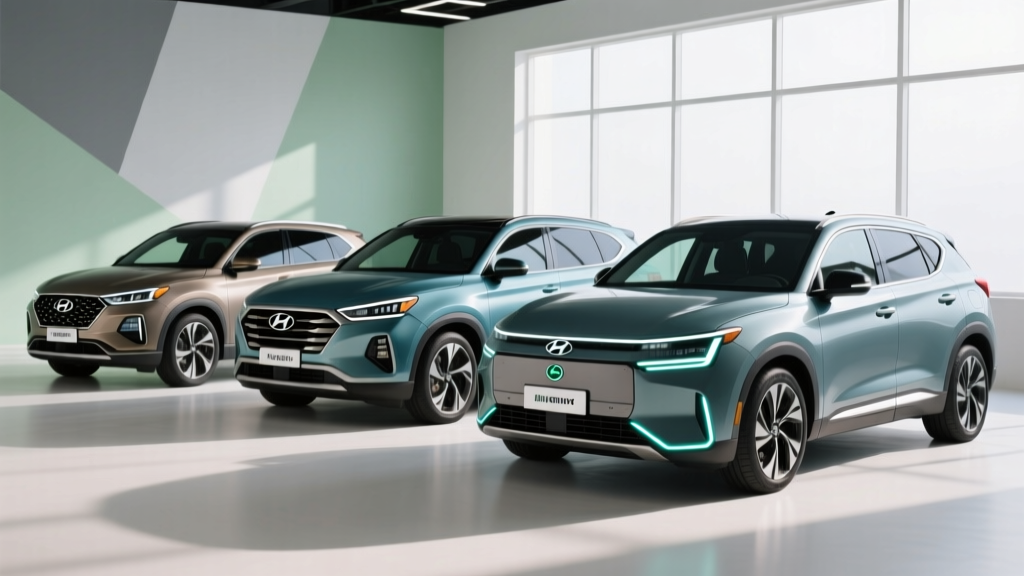
Hyundai's 2025 hybrid lineup spans four distinct nameplates — from the compact Elantra Hybrid to the three-row Santa Fe Hybrid — each offered in both conventional hybrid (HEV) and plug-in hybrid (PHEV) configurations. This guide breaks down every 2025 Hyundai hybrid model with exact EPA figures, real-world expectations, battery specs, and tax-credit eligibility so you can match the right powertrain to your driving pattern.
HEV vs PHEV: Which Hyundai Hybrid Is Right for You?
Before comparing models, it's essential to understand the two hybrid architectures Hyundai uses across its 2025 lineup.
Conventional Hybrid (HEV)
- How it works: A small battery (typically 1.5–2.0 kWh) pairs with a gasoline engine and electric motor. The battery recharges through regenerative braking and the engine — no plug required.
- Best for: Drivers without home charging access who want maximum fuel efficiency with zero behavior change.
- Trade-off: No electric-only driving beyond very low-speed creeping; MPG gains are strongest in city driving.
Plug-In Hybrid (PHEV)
- How it works: A larger battery (13–22 kWh) provides 25–35+ miles of electric-only driving before the gasoline engine engages. You plug in at home or a public charger to replenish the battery.
- Best for: Drivers with home Level 2 charging who commute under 30 miles daily but still want gasoline flexibility for road trips.
- Trade-off: Higher purchase price, added weight, and you need charging access to capture the efficiency benefit.
If you never plan to plug in, buy the HEV. A PHEV driven without regular charging is simply a heavier, less efficient conventional hybrid.
2025 Hyundai Elantra Hybrid: The Efficiency Leader
The Elantra Hybrid remains Hyundai's most fuel-efficient vehicle. For 2025, it carries over with a 1.6-liter GDI four-cylinder paired with a 32 kW (43 hp) electric motor and a 6-speed dual-clutch automatic — no CVT drone here.
| Spec | Blue Trim | Limited Trim |
|---|---|---|
| Combined HP | 139 hp | |
| EPA City / Hwy / Combined | 54 / 58 / 56 MPG | 50 / 54 / 52 MPG |
| Battery | 1.32 kWh lithium-ion polymer | |
| 0–60 mph | ~9.0 seconds | |
| Base MSRP | ~$26,250 | ~$29,450 |
| Federal Tax Credit | Not eligible (§30D excludes HEVs) | |
Real-world MPG: Per fueleconomy.gov, the Blue trim's 56 MPG combined is among the highest of any non-plug-in car sold in the U.S. In our experience, city-heavy drivers regularly see 55–60 MPG because regenerative braking recaptures energy at every stop. Highway-only driving at 75+ mph drops to roughly 48–50 MPG due to reduced regen opportunity and higher aero drag.
2025 Hyundai Tucson Hybrid and PHEV
The Tucson is Hyundai's volume SUV, and its hybrid variants account for a growing share of sales. For 2025, the Tucson Hybrid uses a 1.6-liter turbo four-cylinder with a 47.7 kW electric motor, while the Tucson PHEV pairs the same engine with a 66.9 kW motor and a larger battery.
| Model | City | Highway | Combined | Electric-Only Range | Total Range |
|---|---|---|---|---|---|
| Tucson Hybrid (Blue) | 38 | 38 | 38 MPG | N/A | ~460 mi |
| Tucson PHEV | 35 (gas) | 35 (gas) | 35 MPG + 80 MPGe | 33 mi | ~420 mi total |
Tucson PHEV battery and charging: The PHEV carries an 18.0 kWh battery (13.8 kWh usable). On a Level 2 (240V) home charger at 7.2 kW, a full charge takes approximately 2 hours and 15 minutes. There is no DC fast-charging capability — a deliberate trade-off that keeps cost and weight down, and is typical for PHEVs in this class.
Powertrain output: The Tucson Hybrid produces a combined 226 hp and 258 lb-ft of torque. The PHEV bumps that to 261 hp and 277 lb-ft, making it the quickest Tucson variant short of the N Line.
| Spec | Tucson Hybrid | Tucson PHEV |
|---|---|---|
| Combined HP | 226 hp | 261 hp |
| Drivetrain | AWD (standard) | AWD (standard) |
| Battery (usable) | 1.49 kWh | 13.8 kWh |
| Base MSRP | ~$34,250 | ~$40,550 |
| §30D Tax Credit | Not eligible | Check IRS eligibility |
Real-world PHEV range: The EPA rates the Tucson PHEV at 33 miles electric-only. In mild weather (55–75°F) with mixed city/highway driving, expect 30–34 miles. In freezing conditions with cabin heat active, plan for 22–26 miles — the PHEV uses engine coolant heat, which can engage the gas engine early on very cold days.
2025 Hyundai Santa Fe Hybrid and PHEV
Redesigned for 2024 with a boxy, upright design, the Santa Fe carries into 2025 with the same hybrid and PHEV powertrains. Both use a 1.6-liter turbo four-cylinder, but the PHEV gets a more powerful motor and larger battery.
| Model | City | Highway | Combined | EV Range | Seats |
|---|---|---|---|---|---|
| Santa Fe Hybrid | 35 | 31 | 33 MPG | N/A | 7 |
| Santa Fe PHEV | 30 (gas) | 29 (gas) | 30 MPG + 79 MPGe | 31 mi | 7 |
PHEV battery: The Santa Fe PHEV uses a 22.8 kWh battery (18.0 kWh usable) — one of the largest in the midsize PHEV segment. Level 2 charging at 7.2 kW replenishes the pack in roughly 2 hours 45 minutes. No DC fast charging is available.
Powertrain: The Hybrid delivers 230 hp combined; the PHEV produces 278 hp combined with standard HTRAC AWD. Both feel adequately quick for a three-row family hauler, with the PHEV's electric torque filling in the low-end gap that turbo lag can create.
Pricing: The Santa Fe Hybrid starts around $39,000 (Premium trim); the PHEV begins near $47,500. The PHEV may qualify for a partial or full federal tax credit under IRS §30D rules, depending on battery-component and critical-mineral sourcing requirements, your taxable income, and the $80,000 MSRP cap for SUVs. Always verify current eligibility on the IRS website before purchasing, as sourcing rules tighten periodically.
2025 Hyundai Ioniq Hybrid (Discontinued) — What Replaced It?
Hyundai discontinued the Ioniq Hybrid after the 2022 model year. For 2025, buyers seeking a dedicated hybrid sedan should look at the Elantra Hybrid (covered above) or consider the Ioniq 5 if they're ready for a full battery-electric vehicle. There is no 2025 Ioniq Hybrid in Hyundai's U.S. lineup.
Hybrid vs PHEV vs Full EV: Which Fits Your Life?
Choose a Hyundai HEV (Elantra, Tucson, Santa Fe Hybrid) if:
- You don't have access to home or workplace charging
- You want lower fuel costs with zero lifestyle change
- Your budget is under $40,000
- You drive more than 15,000 miles per year in mixed city/highway conditions
Choose a Hyundai PHEV (Tucson PHEV, Santa Fe PHEV) if:
- You can install a Level 2 home charger (240V, 30–50A circuit)
- Your daily commute is under 35 miles round-trip
- You take road trips where charging infrastructure is sparse
- You want EV-like daily driving without range anxiety
Choose a full EV (Ioniq 5, Ioniq 6, Kona Electric) if:
- You have reliable home charging and your daily drive is under 250 miles
- You want zero tailpipe emissions and minimal maintenance
- You're eligible for the full $7,500 §30D federal tax credit
- You're comfortable planning around DC fast-charging stops on road trips
Battery Reliability, Warranty, and Replacement Costs
Hyundai's hybrid battery reliability track record is strong. The company uses lithium-ion polymer packs sourced from LG Energy Solution and SK On, both established suppliers. Unlike early-generation hybrids from other brands, Hyundai's hybrid batteries have shown low failure rates in the first 100,000 miles.
| Model | Battery Warranty | Estimated Replacement Cost |
|---|---|---|
| Elantra Hybrid | 10 yr / 100,000 mi | $2,000–$3,500 |
| Tucson Hybrid | 10 yr / 100,000 mi | $2,500–$4,000 |
| Tucson PHEV | 10 yr / 100,000 mi | $5,000–$8,000 |
| Santa Fe Hybrid | 10 yr / 100,000 mi | $2,500–$4,000 |
| Santa Fe PHEV | 10 yr / 100,000 mi | $6,000–$9,500 |
The 10-year/100,000-mile warranty covers defects and capacity loss below a defined threshold (typically 70% of original capacity). Note that the warranty transfers to a second owner at 5 years/60,000 miles — an important detail if you buy used. Hyundai's warranty is among the longest in the hybrid segment, matched by Kia and exceeded only by Toyota's 10-year/150,000-mile coverage on some models.
Degradation reality: Conventional hybrid batteries (1–2 kWh) experience minimal noticeable degradation because the battery management system (BMS) operates in a narrow state-of-charge window — typically 40–80%. This shallow cycling dramatically extends cell life. PHEV batteries see more stress from deeper cycling but still benefit from robust thermal management. Expect less than 10% capacity loss over 10 years for HEVs and 15–20% for PHEVs under normal use.
Tax Credits and Incentives for 2025 Hyundai Hybrids
Under current IRS §30D rules, the federal clean vehicle credit applies only to plug-in vehicles — meaning conventional HEVs (Elantra Hybrid, Tucson Hybrid, Santa Fe Hybrid) are not eligible for any federal tax credit.
For the Tucson PHEV and Santa Fe PHEV, eligibility for up to $7,500 depends on three factors:
- MSRP cap: SUVs must have an MSRP at or below $80,000 (both PHEVs qualify)
- Buyer income cap: Modified AGI must not exceed $150,000 (single), $225,000 (head of household), or $300,000 (joint)
- Battery sourcing: A percentage of critical minerals and battery components must be sourced from the U.S. or free-trade-agreement countries — thresholds increase annually, and some PHEV trims may qualify for only $3,750 or none at all depending on the production month
As of 2025, buyers can also elect to transfer the credit to the dealer at the point of sale, reducing the purchase price directly rather than waiting for a tax refund. Verify the specific VIN's eligibility on fueleconomy.gov before signing paperwork.
Additionally, several states offer their own rebates for PHEVs (California, Colorado, New York, and others) — check your state's energy office or DMV for current programs, as these change frequently.
Frequently Asked Questions
How many MPG does the 2025 Hyundai Elantra Hybrid get?
The EPA rates the Elantra Hybrid Blue at 54 city / 58 highway / 56 combined MPG. The Limited trim is rated at 50/54/52 MPG due to larger wheels and additional equipment weight. Real-world city driving frequently yields 55–60 MPG thanks to strong regenerative braking.
How far can the Tucson PHEV go on electric only?
The 2025 Tucson PHEV has an EPA-rated 33 miles of electric-only range. Expect 30–34 miles in moderate temperatures and 22–26 miles in freezing weather when the gasoline engine may engage for cabin heat.
Do Hyundai hybrids need to be plugged in?
No. Conventional Hyundai hybrids (HEV) charge their battery through regenerative braking and the gasoline engine — they never need to be plugged in. Only the PHEV models benefit from plugging in, which replenishes the larger battery for electric-only driving.
Is the Hyundai hybrid battery reliable and what does replacement cost?
Hyundai's hybrid batteries have a strong reliability record and are backed by a 10-year/100,000-mile warranty. Replacement costs range from $2,000–$4,000 for conventional hybrid packs and $5,000–$9,500 for PHEV packs, depending on the model.
Does any 2025 Hyundai hybrid qualify for a tax credit?
Only the PHEV models (Tucson PHEV, Santa Fe PHEV) may qualify for the federal §30D clean vehicle credit of up to $7,500, subject to MSRP, income, and battery-sourcing requirements. Conventional HEVs do not qualify for the federal credit.
Which 2025 Hyundai hybrid is best for families?
The Santa Fe Hybrid or PHEV offers three-row seating for up to seven passengers, standard AWD, and strong fuel economy. The Tucson Hybrid is a strong choice for smaller families needing two rows and more cargo flexibility at a lower price.
Hyundai Hybrid Lineup — Pros
- Class-leading warranty (10 yr / 100k mi battery)
- Elantra Hybrid achieves 56 MPG combined
- PHEV models offer 31–33 mi electric-only range
- Standard AWD on all Tucson and Santa Fe hybrids
- Dual-clutch transmissions avoid CVT drone
- Competitive pricing vs Toyota and Honda hybrids
Hyundai Hybrid Lineup — Cons
- No DC fast charging on any PHEV
- PHEV pricing premium of $5,000–$8,000 over HEV
- Highway MPG drops more than city MPG on all trims
- Tax-credit eligibility for PHEVs is uncertain and VIN-dependent
- Ioniq Hybrid discontinued — no dedicated hybrid hatchback
- Cold-weather PHEV electric range drops 20–30%