The 2018 Chrysler Pacifica Hybrid was the first plug-in hybrid minivan sold in the United States, and it remains one of the only PHEV minivans on the used market. For families who want school-run electric commuting with the flexibility for gas-powered road trips, it occupies a unique niche. But with a model year that's now eight years old, prospective used buyers need hard data on what this van actually delivers — not what the brochure promised.
This guide covers the 2018 Pacifica Hybrid's powertrain, real-world electric range, fuel economy, battery longevity, and what it costs to own in 2026. We'll also clarify the HEV vs. PHEV distinction, since Chrysler also sold a conventional gas-only Pacifica alongside this plug-in variant.
HEV vs. PHEV: Which Pacifica Are We Talking About?
Chrysler sold two very different Pacifica models in 2018, and confusing them is easy on the used lot:
2018 Pacifica (Gas / Conventional)
- Type: Internal combustion engine (ICE), no hybrid system
- EPA MPG: 18 city / 28 highway / 22 combined
- Plug-in charging: No — gas-only
- Battery: Standard 12V auxiliary only
- Federal tax credit (when new): None
2018 Pacifica Hybrid (PHEV)
- Type: Plug-in hybrid electric vehicle (PHEV)
- EPA MPG: 82 MPGe (electric + gas combined) / 32 MPG gas-only combined
- Plug-in charging: Yes — Level 1 and Level 2 AC charging
- Traction battery: 16 kWh lithium-ion (NMC chemistry)
- Federal tax credit (when new): Up to $7,500 under §30D (now expired for used purchases)
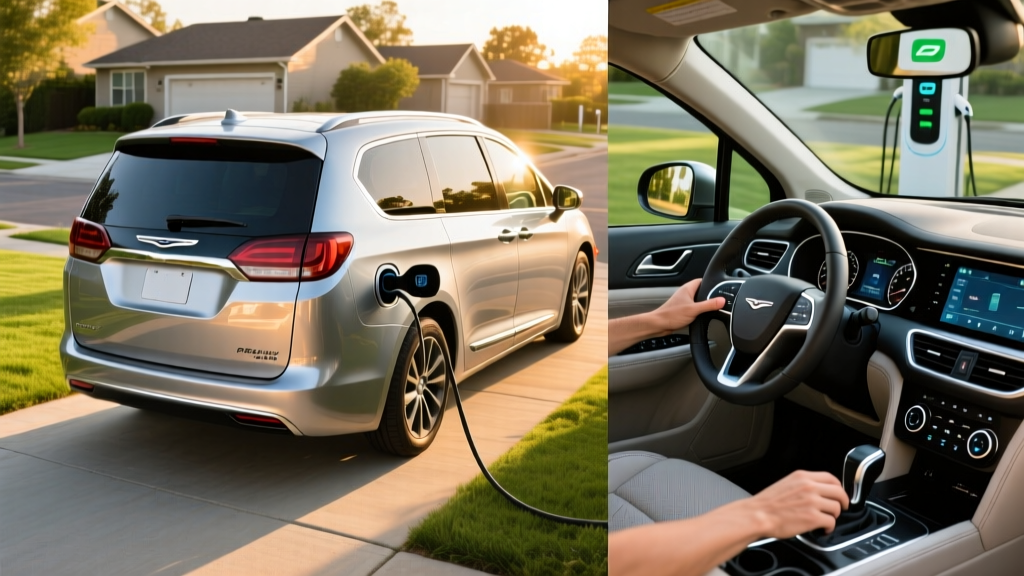
This article focuses exclusively on the 2018 Pacifica Hybrid (PHEV). If you're cross-shopping, note that the gas-only Pacifica has no electric drivetrain, no plug, and significantly lower fuel economy. The PHEV badge, charge port on the driver's side front fender, and "eHybrid" badging are the visual tells.
Powertrain Specs: Engine, Motors, and Combined Output
| Specification | 2018 Pacifica Hybrid |
|---|---|
| Engine | 3.6L Atkinson-cycle V6 |
| Electric Motors | Dual-motor eFlite EVT (electrically variable transmission) |
| Combined System Output | 260 hp (net) |
| Transmission | Single-speed EVT with integrated motors |
| Drivetrain | Front-wheel drive (FWD only — no AWD option) |
| 0-60 mph | ~7.1 seconds (motor torque assists off the line) |
| Towing Capacity | Not recommended (PHEV model — gas Pacifica rated 3,600 lbs) |
| Battery Pack | 16 kWh total / ~13 kWh usable (NMC lithium-ion) |
| Battery Location | Under second-row floor (eliminates Stow 'n Go for row 2) |
The Atkinson-cycle V6 sacrifices some peak power for thermal efficiency, while the two electric motors handle low-speed propulsion and regenerative braking. The eFlite transmission is a power-split device — similar in concept to Toyota's Hybrid Synergy Drive — that blends engine and motor torque seamlessly. In practice, the Pacifica Hybrid pulls away from stoplights on electric power alone under moderate throttle, with the V6 engaging when you demand more acceleration or when the battery depletes.
Electric-Only Range and MPGe: EPA Numbers vs. Reality
| Metric | EPA Rating | Real-World Expectation |
|---|---|---|
| Electric-only range | 32 miles | 25–30 miles (varies with temperature, speed, terrain) |
| MPGe (electric + gas) | 82 MPGe | 70–80 MPGe if you charge regularly and drive mixed routes |
| Gas-only combined MPG | 32 MPG | 28–30 MPG highway; 24–26 MPG loaded/cold |
| Gas-only city MPG | 32 MPG | 28–31 MPG (hybrids typically match or exceed EPA city) |
| Gas-only highway MPG | 31 MPG | 27–29 MPG at 70+ mph |
| Total combined range | 566 miles | 480–540 miles depending on conditions |
According to fueleconomy.gov, the 2018 Pacifica Hybrid consumes 41 kWh per 100 miles in electric mode and achieves 32 MPG combined once the battery is depleted. That gas-only figure is remarkable for a minivan — it matches many compact sedans — but remember that this is a heavy vehicle, so real-world highway fuel economy will fall short, especially when loaded with passengers and cargo.
Charging: Level 1, Level 2, and What to Expect
The 2018 Pacifica Hybrid charges via a J1772 AC connector located on the driver's side front fender. It does not support DC fast charging — a limitation worth understanding if you're coming from a full EV.
| Charging Level | Power (kW) | Time (0–100%) | Notes |
|---|---|---|---|
| Level 1 (120V household outlet) | ~1.4 kW | ~14 hours | Emergency/trickle only — too slow for daily use |
| Level 2 (240V, 16A) | ~3.7 kW | ~4.5 hours | Included portable cordset; works with standard NEMA 14-50 at lower amperage |
| Level 2 (240V, 32A) | ~6.6 kW | ~2 hours | Requires aftermarket EVSE or wall-mounted charger (vehicle onboard charger maxes at 6.6 kW) |
| DC Fast Charge | N/A | N/A | Not supported — no CCS or CHAdeMO port |
The onboard charger is capped at 6.6 kW, so even if you plug into a 48A Level 2 station, the Pacifica Hybrid will only draw 6.6 kW. For overnight charging, a basic 240V / 16A circuit (like a dryer outlet) is sufficient to refill the battery in roughly 4–5 hours, which covers most owners' needs. Install a Level 2 home charger on a 30A or 40A circuit and you'll wake up to a full battery every morning in about 2 hours.
Expect to spend $400–$1,200 on a Level 2 home charging setup (EVSE unit plus electrician labor for a 240V circuit), depending on your panel's proximity to the garage and whether a panel upgrade is needed. The Pacifica Hybrid's small battery means you won't need the fastest home charger — a $300–$500 16A or 32A unit is perfectly adequate.
Battery Longevity, Warranty, and Replacement Cost
The 16 kWh NMC (nickel manganese cobalt) battery pack is located beneath the second-row floor. This placement means the Pacifica Hybrid loses the Stow 'n Go folding feature for the second row — those seats must be manually removed rather than folded into the floor. The third row still folds flat, and cargo volume behind the third row is 32.3 cubic feet, which is less than the gas Pacifica's 32.3 cu ft (similar, but the hybrid lacks the under-floor storage bin).
Degradation data: Early owner reports and fleet data suggest the Pacifica Hybrid's battery loses roughly 1–2% of capacity per year under normal use. A 2018 model in 2026 with 80,000–100,000 miles might show 85–90% state of health (SoH), meaning the electric range could be 27–29 miles instead of the original 32. This is moderate degradation and still useful for daily commuting.
Replacement cost: If the battery fails outside warranty, a replacement pack from Chrysler (Mopar) costs approximately $7,000–$9,000 including labor, based on dealer pricing and independent shop reports. Third-party refurbishment options may become available as these vehicles age, potentially reducing cost to $4,000–$6,000. However, given the 8–10 year warranty coverage, most 2018 models should still be within or just exiting their warranty window in 2026.
To maximize battery lifespan, avoid routinely charging to 100% and leaving the vehicle parked at full charge in extreme heat. The Pacifica Hybrid's battery management system includes a buffer (roughly 3 kWh reserved at top and bottom), which protects against deep discharge and overcharge damage.
Is the 2018 Pacifica Hybrid Reliable?
The 2018 model year was the second year of the Pacifica Hybrid's production, and it carried over some first-year issues while resolving others. Key reliability considerations:
- Electrical system glitches: Some owners reported infotainment freezes, phantom battery drain, and Uconnect software bugs. Most were addressed via firmware updates at the dealer.
- Powertrain: The 3.6L Pentastar V6 is one of Stellantis's most proven engines, with a long track record in other models. The eFlite transmission has been generally reliable, though a small number of early units experienced inverter faults covered under warranty.
- NHTSA recalls: Check the VIN at nhtsa.gov/recalls — the Pacifica Hybrid had recalls related to the high-voltage battery shutdown during certain crash scenarios and a potential fire risk from the 12V battery cable. Most should be resolved by now, but verify with the seller.
- Common wear items: Brake pads last significantly longer than on the gas Pacifica thanks to regenerative braking. Expect original brakes to last 80,000–120,000 miles in mixed driving.
Overall, the Pacifica Hybrid is a moderately reliable PHEV. It's not Toyota Prius Prime bulletproof, but the powertrain is well-understood and most issues are electrical/software rather than mechanical. A pre-purchase inspection by a technician familiar with PHEV systems is strongly recommended for any used 2018 model.
Pricing in 2026: Used Market and Tax Credit Status
When new, the 2018 Pacifica Hybrid started at $41,995 (Touring L trim) and climbed to roughly $46,000 for the Platinum (Limited) trim, before the $7,500 federal tax credit that was available at the time.
On the used market in 2026, expect to pay:
- $14,000–$18,000 for a 2018 Pacifica Hybrid Touring L with 80,000–110,000 miles
- $18,000–$23,000 for a Limited/Platinum with 50,000–80,000 miles and clean history
- $23,000–$27,000 for low-mileage examples (under 50,000 miles) in excellent condition
Tax credit for used PHEV purchase: Under the current IRS §25E used clean vehicle credit, buyers may qualify for up to $4,000 (30% of the sale price, capped at $4,000) on a used PHEV purchased from a dealer. Key requirements:
- Sale price must be $25,000 or less (most 2018 Pacifica Hybrids qualify)
- Buyer income limits: $75,000 single / $112,500 head of household / $150,000 married filing jointly (modified AGI)
- Vehicle must be at least 2 model years old (2018 qualifies)
- Must be purchased from a licensed dealer (private-party sales excluded)
- Credit can only be claimed once per VIN in its lifetime under §25E
- Buyer must not have claimed the used EV credit in the prior 3 years
This means a 2018 Pacifica Hybrid priced at $18,000 from a dealer could net a $4,000 credit, bringing effective cost to $14,000 — an excellent value for a PHEV minivan. Confirm eligibility with a tax professional and check the IRS's current-year guidance, as rules may shift.
Who Should Buy the 2018 Pacifica Hybrid vs. a Full EV or Gas Minivan?
Choose the 2018 Pacifica Hybrid (PHEV) if:
- You need minivan space (7 passengers, sliding doors) but want to commute on electricity
- Your daily driving is under 30 miles and you can charge at home overnight
- You take road trips where charging infrastructure is sparse or unreliable
- You want to reduce fuel costs without committing to a full EV's range limitations
- You're buying used and want PHEV capability at a fraction of new-PHEV pricing
Choose a full EV (e.g., Tesla Model X, Kia EV9) if:
- You have reliable home and workplace charging
- Your daily driving rarely exceeds 250 miles and you plan road trips along Supercharger/DCFC corridors
- You want zero tailpipe emissions and minimal maintenance (no oil changes, no V6)
- You can absorb a higher purchase price ($50,000+ even used for most 3-row EVs)
Choose the gas-only Pacifica (or Toyota Sienna hybrid) if:
- You cannot charge at home and don't want to rely on public charging
- You need Stow 'n Go second-row seating (unavailable on the PHEV due to battery placement)
- You want a lower purchase price and simpler maintenance with no high-voltage system
- You tow regularly (the gas Pacifica is rated for 3,600 lbs; the PHEV is not rated for towing)
The 2018 Pacifica Hybrid's closest competitor in 2026 is the Toyota Sienna, which is a conventional hybrid (HEV) — not a PHEV. The Sienna gets an EPA-rated 36 MPG combined without plugging in, but it offers no electric-only driving. If your priority is maximum fuel economy without charging hassle, the Sienna wins. If you want the first 25–30 miles of each day to be electric (and nearly silent), the Pacifica Hybrid is the only minivan that delivers that.
Pros and Cons at a Glance
Pros
- 32 miles EPA electric-only range covers most daily commutes
- 32 MPG combined on gas alone — exceptional for a minivan
- Smooth, quiet electric driving at low speeds
- 7-passenger seating with minivan convenience (sliding doors, low step-in)
- Regenerative braking extends brake pad life significantly
- Strong value on the used market, potentially with $4,000 §25E credit
- Proven 3.6L V6 with extensive service network
Cons
- No DC fast charging — long road trips are gas-only
- Second-row Stow 'n Go eliminated by battery pack (seats must be removed)
- No AWD option (FWD only)
- Towing not recommended on PHEV model
- Cargo volume reduced slightly vs. gas Pacifica
- Some early-model-year electrical/software gremlins reported
- Original 8-year federal battery warranty expired in 2026 for most units
Frequently Asked Questions
How many MPG does the 2018 Pacifica Hybrid get?
The EPA rates it at 82 MPGe when combining electric and gas driving. Once the battery is depleted, it operates as a hybrid and achieves 32 MPG combined (32 city / 31 highway). In real-world driving, expect 28–30 MPG combined on gas alone, with better numbers in city driving where regenerative braking helps most.
How far can the 2018 Pacifica Hybrid go on electric only?
The EPA rates it at 32 miles of electric-only range. Real-world results range from 25–30 miles in moderate conditions, dropping to 20–25 miles in cold weather or at sustained highway speeds. Total combined range (electric + full gas tank) is rated at 566 miles.
Does the 2018 Pacifica Hybrid qualify for any tax credit in 2026?
It no longer qualifies for the new-vehicle §30D credit. However, under the IRS §25E used clean vehicle credit, buyers purchasing from a dealer for $25,000 or less may qualify for up to $4,000 (30% of sale price, capped). Income limits apply: $75,000 single / $150,000 married filing jointly. Consult a tax professional and verify current-year rules at irs.gov.
Is the 2018 Pacifica Hybrid reliable, and what does battery replacement cost?
Reliability is moderate — the powertrain is proven, but some electrical and software issues were reported in early model years. The high-voltage battery was warranted for 8–10 years / 100,000 miles (depending on state). Out-of-warranty replacement costs approximately $7,000–$9,000 from a dealer, though most batteries are lasting well with 85–90% SoH at 8 years of age. Always check the VIN for open recalls at nhtsa.gov.
Can the 2018 Pacifica Hybrid DC fast charge?
No. The Pacifica Hybrid only supports AC charging via a J1772 connector at Level 1 (120V, ~1.4 kW) or Level 2 (240V, up to 6.6 kW). A full charge takes about 2 hours on a 32A Level 2 charger or roughly 4.5 hours on a 16A Level 2 circuit. There is no DC fast charging port.
How does the Pacifica Hybrid compare to the Toyota Sienna hybrid?
The Sienna is a conventional hybrid (HEV) — it doesn't plug in and has no electric-only range, but it delivers a consistent 36 MPG combined. The Pacifica Hybrid offers 32 miles of electric driving (effectively zero fuel cost for short commutes) but drops to 32 MPG on gas alone. Choose the Pacifica if you can charge at home and want electric commuting. Choose the Sienna if you want simpler ownership and slightly better gas-only fuel economy without plugging in.
Does the Pacifica Hybrid lose Stow 'n Go seating?
Yes. The 16 kWh battery pack occupies the space normally used for second-row Stow 'n Go folding. The second-row captain's chairs must be physically removed (not folded) to create a flat load floor. The third row still folds flat into the floor. This is a meaningful trade-off for families who frequently reconfigure cargo space.