Quick Verdict: The RAV4 Plug-In Hybrid Still Sets the PHEV Benchmark
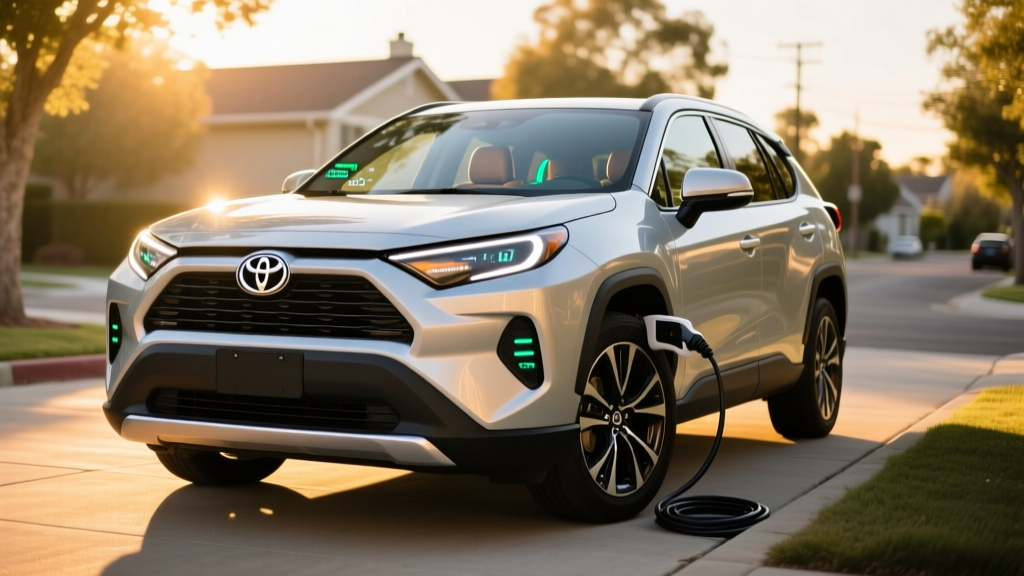
The Toyota RAV4 Prime — Toyota's nameplate for the RAV4 plug-in hybrid — remains one of the most compelling PHEVs on the market in 2026. It pairs a 42-mile EPA-rated electric-only range with a combined 302 horsepower all-wheel-drive powertrain, all wrapped in a compact SUV package that routinely tops reliability surveys. For buyers who want daily electric commuting without the range limitations of a full battery-electric vehicle, the RAV4 Prime occupies a practical sweet spot that few competitors match.
But the RAV4 Prime isn't perfect. Its Level 2 charging speed is modest, DC fast charging is unavailable, and the federal tax credit landscape for PHEVs has tightened. This guide breaks down every spec, real-world expectation, and ownership cost you need to evaluate before buying.
HEV vs. PHEV: Which RAV4 Hybrid Is Which?
Toyota sells two electrified RAV4 variants, and confusing them is one of the most common buyer mistakes. Here is the critical distinction:
RAV4 Hybrid (HEV)
- No plug required. The battery charges via regenerative braking and the gasoline engine.
- Battery: ~1.6 kWh (small, not externally chargeable)
- Electric-only driving: Minimal — assists at low speeds but cannot sustain EV mode for meaningful distances
- EPA MPG: 41 city / 38 highway / 40 combined
- Federal tax credit: Not eligible (no plug-in capability)
RAV4 Prime (PHEV)
- Plug-in required for full benefit. A larger battery provides meaningful electric-only range.
- Battery: 18.1 kWh lithium-ion (usable capacity ~14.5 kWh)
- Electric-only driving: Up to 42 miles EPA-rated
- EPA rating: 94 MPGe (electric + gas combined), 38 MPG combined after battery depletes
- Federal tax credit: Eligibility depends on battery sourcing, MSRP caps, and buyer income — see tax credit section below
If you cannot install a home charger or lack reliable access to Level 2 charging, the conventional RAV4 Hybrid delivers outstanding efficiency without any plug-in obligation. The Prime only unlocks its full value when you charge regularly.
Fuel Economy: EPA Ratings and Real-World MPG
The RAV4 Prime carries two sets of efficiency numbers — one for when the battery is charged (MPGe) and one for when it operates as a conventional hybrid after the battery depletes (charge-sustaining mode).
| Metric | EPA Rating | Real-World Expectation |
|---|---|---|
| Combined MPGe (EV + Gas) | 94 MPGe | 85–100 MPGe with daily charging |
| Electric-only range | 42 miles | 35–40 mi (highway/cold weather); up to 45 mi (city, mild temps) |
| Charge-sustaining MPG (city) | 40 MPG | 38–43 MPG (hybrids often beat EPA in city) |
| Charge-sustaining MPG (highway) | 36 MPG | 33–36 MPG |
| Charge-sustaining MPG (combined) | 38 MPG | 35–39 MPG |
| Total range (EV + gas tank) | ~600 miles | 550–620 miles depending on conditions |
Real-world note: The 42-mile electric range is achievable in mixed city/suburban driving at moderate temperatures. Expect a 15–25% reduction in cold weather (below 35°F) due to battery chemistry limitations and cabin heating demands. Highway driving at 70+ mph also reduces electric range to roughly 32–35 miles. Once the battery depletes, the RAV4 Prime operates as a conventional hybrid and returns fuel economy very close to the standard RAV4 Hybrid — a key advantage of Toyota's PHEV architecture.
According to fueleconomy.gov, the RAV4 Prime's combined MPGe of 94 places it among the most efficient PHEVs in the compact SUV segment.
Powertrain: 302 HP and Standard AWD
The RAV4 Prime's plug-in powertrain is significantly more powerful than the standard RAV4 Hybrid, making it the quickest RAV4 Toyota currently sells.
| Specification | Detail |
|---|---|
| Engine | 2.5L 4-cylinder Atkinson-cycle |
| Front electric motor | 134 kW (180 hp) |
| Rear electric motor | 40 kW (54 hp) |
| Combined system output | 302 hp |
| 0–60 mph | 5.7 seconds |
| Drivetrain | Electronic AWD (AWD-i) — standard on all trims |
| Transmission | eCVT (planetary gearset, no traditional gears) |
| Towing capacity | 1,500 lbs |
The electronic AWD system uses the rear motor to power the rear axle independently — there is no mechanical driveshaft connecting the front and rear. This provides confident traction in rain and light snow, though it is not designed for serious off-road use. The 302-hp output makes the Prime noticeably quicker than the standard hybrid (219 hp) and gives it confident highway merging performance.
Battery, Charging, and What You Need to Know
The RAV4 Prime's 18.1 kWh lithium-ion battery pack is the heart of its plug-in capability. However, its charging hardware is where buyers should set realistic expectations.
| Charging Level | Power (kW) | Time (0–100%) | Notes |
|---|---|---|---|
| Level 1 (120V household outlet) | ~1.4 kW | ~12 hours | Emergency/top-up only; included cord |
| Level 2 (240V, 3.3 kW onboard charger) | 3.3 kW | ~4.5 hours | SE trim; requires home Level 2 station |
| Level 2 (240V, 6.6 kW onboard charger) | 6.6 kW | ~2.5 hours | XSE trim and with Premium Package on SE |
| DC Fast Charging | Not supported | N/A | No CCS or CHAdeMO port |
Critical detail on the onboard charger: The SE trim comes with a 3.3 kW onboard charger, which means even on a 240V Level 2 home station, a full charge takes roughly 4.5 hours. Upgrading to the XSE trim or adding the Premium Package on the SE unlocks a 6.6 kW onboard charger, cutting that to about 2.5 hours. For most overnight charging scenarios, the 3.3 kW charger is adequate — you plug in at bedtime and wake up fully charged. But if you need mid-day top-ups or have a short window between trips, the 6.6 kW option is worth the upgrade.
Battery Warranty and Replacement Cost
Toyota covers the RAV4 Prime's hybrid battery with a 10-year / 150,000-mile warranty (in all 50 states, following California's CARB adoption). This covers defects and capacity loss below a defined threshold. The standard hybrid system warranty is 8 years / 100,000 miles in non-CARB states.
Replacement cost: If the battery requires replacement outside of warranty, expect a dealer quote in the range of $4,000–$6,000 for the pack, plus labor. Independent hybrid battery specialists may offer refurbished packs for $2,500–$3,500. In practice, Toyota's hybrid batteries have demonstrated strong longevity — many first-generation Prius packs exceeded 200,000 miles with acceptable degradation. The RAV4 Prime's larger pack operates with a generous buffer (roughly 3.6 kWh reserved at top and bottom), which reduces stress on cells and should support long service life.
Pricing, Trims, and Tax Credit Eligibility
The 2026 RAV4 Prime is offered in two trims. Pricing below reflects MSRP before any incentives (destination charges additional, typically ~$1,395).
| Trim | MSRP (approx.) | Onboard Charger | Key Features |
|---|---|---|---|
| SE | $44,900 | 3.3 kW | SofTex seats, 8-inch touchscreen, heated front seats, power liftgate |
| XSE | $48,500 | 6.6 kW | Panoramic glass roof option, 9-inch touchscreen, premium audio, ambient lighting |
Does the RAV4 Prime Qualify for a Federal Tax Credit?
Under the current IRS §30D rules, PHEV tax credit eligibility is determined by several factors that change periodically. Here is what applies to the RAV4 Prime:
- Battery capacity: The 18.1 kWh pack exceeds the 7 kWh minimum — ✅ qualifies
- MSRP cap: SUVs must be under $80,000 MSRP — ✅ qualifies (both trims well under cap)
- Buyer income cap: Modified AGI must not exceed $150,000 (single), $225,000 (head of household), or $300,000 (joint) — varies by filer
- Battery component sourcing: A percentage of battery components must be manufactured or assembled in North America, with thresholds increasing annually. Toyota's battery supply chain for the RAV4 Prime has faced scrutiny under these rules. The eligible credit amount may be reduced or eliminated depending on the model year's sourcing compliance.
- Critical minerals: A percentage of critical minerals must be sourced from the US or free-trade-agreement countries, with escalating thresholds.
- Point-of-sale transfer: Eligible buyers can transfer the credit to the dealer at purchase for an immediate price reduction rather than claiming it on their tax return.
Bottom line: The RAV4 Prime's federal tax credit eligibility is not guaranteed at the full $7,500. Due to battery sourcing requirements, the eligible amount may be partial ($3,750) or, in some model years, zero. Always verify current eligibility on the IRS qualified manufacturers page and consult a tax professional before relying on the credit in your purchase decision.
RAV4 Prime vs. Full EV vs. Gas RAV4: Which Fits You?
Choose the RAV4 Prime (PHEV) if:
- You can charge at home (Level 2 preferred) and your daily commute is under 40 miles round-trip
- You take road trips regularly and don't want to plan around charging infrastructure
- You want AWD and strong acceleration without stepping to a full EV
- You live in an area with limited public DC fast charging
- You value Toyota's long-term reliability track record and strong resale value
Choose a Full EV (e.g., Tesla Model Y, Hyundai Ioniq 5) if:
- You want zero gasoline use and minimal maintenance (no oil changes, no engine)
- Your daily driving is within the EV's range and you have reliable home charging
- You want access to DC fast charging for road trips (20–30 min stops)
- You want the lowest per-mile energy cost (electricity is cheaper than gas in most states)
- You qualify for the full federal EV tax credit on a qualifying model
| Factor | RAV4 Gas (ICE) | RAV4 Hybrid (HEV) | RAV4 Prime (PHEV) | Full EV (e.g., Model Y) |
|---|---|---|---|---|
| Starting MSRP | ~$30,000 | ~$34,000 | ~$44,900 | ~$44,000 |
| Combined efficiency | 30 MPG | 40 MPG | 94 MPGe / 38 MPG | 120+ MPGe |
| Electric-only range | 0 mi | ~1 mi | 42 mi | 300+ mi |
| Home charging needed | No | No | Yes (for full benefit) | Yes |
| Road-trip convenience | Best | Best | Excellent | Good (requires planning) |
| Maintenance cost | Highest | Low | Low-moderate | Lowest |
Ownership Costs and Long-Term Value
The RAV4 Prime commands a ~$10,900 premium over the standard RAV4 Hybrid at the SE trim level. The key question is whether the fuel savings, electric commuting, and performance justify that gap.
Annual fuel savings estimate: Assuming 12,000 miles/year, 70% of driving within electric range, electricity at $0.15/kWh, and gasoline at $3.50/gallon, a RAV4 Prime owner could save approximately $800–$1,200 per year compared to the gas-only RAV4, and $400–$700 compared to the standard hybrid. At those rates, the price premium over the hybrid takes roughly 8–12 years to recoup through fuel savings alone — meaning the Prime's value proposition rests heavily on the driving experience, performance upgrade, and environmental benefit rather than pure payback math.
Insurance: Expect insurance premiums 10–15% higher than the standard RAV4 Hybrid due to the higher MSRP and more complex powertrain. Get quotes before purchasing.
Resale value: Toyota RAV4 models consistently rank at the top of compact SUV resale value retention. The Prime variant, with its limited production and high demand, has historically held value exceptionally well — in some markets, used RAV4 Primes have sold near or above MSRP in the first two years.
Frequently Asked Questions
How many MPG does the Toyota RAV4 plug-in hybrid get?
The RAV4 Prime achieves 94 MPGe when operating on its charged battery (combining electric and gas use). Once the battery depletes, it operates as a conventional hybrid and returns an EPA-rated 38 MPG combined (40 city / 36 highway). In real-world driving, many owners report exceeding the city MPG figure thanks to Toyota's efficient hybrid system, while highway fuel economy may fall slightly below the EPA estimate at sustained high speeds.
How far can the RAV4 Prime go on electric only?
The EPA rates the RAV4 Prime at 42 miles of electric-only range. In real-world conditions, expect 35–40 miles during highway driving or in cold weather, and up to 45 miles in city driving at moderate temperatures. The electric-only top speed is approximately 84 mph, which is sufficient for most commuting scenarios.
Is the Toyota RAV4 Prime reliable? What about battery replacement?
Toyota's hybrid systems have an extensive track record of reliability spanning over two decades since the original Prius. The RAV4 Prime's hybrid battery is covered by a 10-year / 150,000-mile warranty. Out-of-warranty replacement costs approximately $4,000–$6,000 at a dealer. Independent data from sources like Consumer Reports and J.D. Power consistently place Toyota at or near the top of brand reliability rankings, and the RAV4 specifically has been a strong performer.
Does the RAV4 Prime qualify for a federal tax credit in 2026?
Eligibility depends on several factors including battery component sourcing, critical mineral requirements, buyer income, and MSRP caps under IRS §30D rules. The RAV4 Prime meets the MSRP and battery capacity thresholds, but battery sourcing compliance may limit the credit to a partial amount or, depending on the production batch, disqualify it entirely. Always check the IRS qualified manufacturers list for the specific model year and consult a tax professional.
Can I charge the RAV4 Prime on a regular household outlet?
Yes, but slowly. Using the included Level 1 charging cord on a standard 120V outlet, a full charge takes approximately 12 hours. This is viable for overnight charging if you drive less than 42 miles daily. For faster replenishment, a 240V Level 2 home station is strongly recommended — it cuts charge time to 4.5 hours (3.3 kW charger) or 2.5 hours (6.6 kW charger).
Does the RAV4 Prime support DC fast charging?
No. The RAV4 Prime does not have a DC fast charging port (no CCS or CHAdeMO connector). Maximum charging speed is 6.6 kW on Level 2 (XSE trim or SE with Premium Package). This is a deliberate engineering trade-off — adding DC fast charging hardware would increase cost, weight, and complexity for a battery that is small enough to fill quickly on Level 2.
Hybrid vs. PHEV vs. EV — which should I choose?
Choose the conventional RAV4 Hybrid if you lack home charging access and want maximum simplicity. Choose the RAV4 Prime (PHEV) if you can charge at home, commute under 40 miles daily, and want the flexibility of a gas engine for road trips. Choose a full EV if you want zero tailpipe emissions, the lowest running costs, and have reliable home charging plus access to DC fast charging for longer trips. The RAV4 Prime is the bridge option — it rewards daily charging with EV-like commuting while eliminating range anxiety entirely.