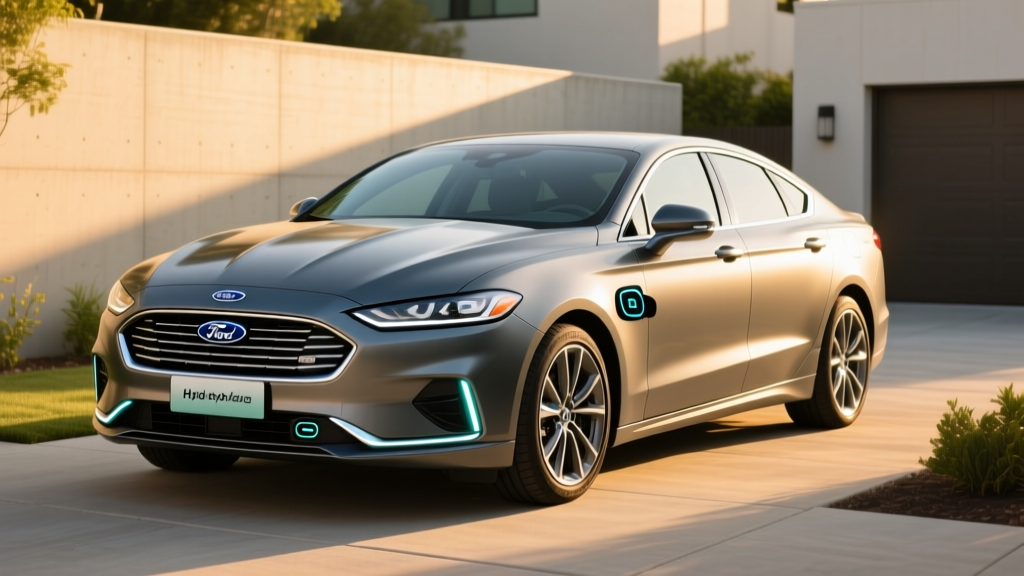
The Ford Fusion Hybrid remains one of the most-researched midsize sedans in the used hybrid market, and for good reason: its fuel economy still holds up against newer competitors. Whether you're evaluating a used Fusion Hybrid or comparing it against a current plug-in alternative, understanding the real MPG — not just the EPA sticker — is critical to making a smart purchase.
This guide breaks down every efficiency number, explains the difference between the conventional Fusion Hybrid (HEV) and the plug-in Fusion Energi (PHEV), and gives you the data to decide which electrified powertrain actually fits your driving life.
Ford Fusion Hybrid MPG: EPA Numbers and Real-World Results
The conventional Ford Fusion Hybrid (HEV) — produced through the 2020 model year — carries EPA fuel economy ratings that remain competitive. Here's the official breakdown from fueleconomy.gov:
| Metric | Value |
|---|---|
| Combined MPG | 42 MPG |
| City MPG | 43 MPG |
| Highway MPG | 41 MPG |
| Fuel Tank Capacity | 13.5 gallons |
| Total Range (est.) | ~567 miles |
| Annual Fuel Cost (est.) | ~$1,200 (15,000 mi/yr at $3.40/gal) |
The 2.0-liter Atkinson-cycle inline-four paired with an electric motor and a 1.4 kWh lithium-ion battery pack produces a combined 188 horsepower. The Atkinson cycle sacrifices some peak power for thermal efficiency — a trade-off that pays off at the pump but means the Fusion Hybrid isn't a quick car. Expect 0-60 MPH in roughly 8.1 seconds, adequate for merging but not sporty.
Fusion Hybrid (HEV) vs. Fusion Energi (PHEV): What's the Difference?
Ford sold two electrified Fusion variants, and confusing them is the single most common mistake buyers make. The distinction matters enormously for your fuel costs, charging setup, and daily routine.
| Feature | Fusion Hybrid (HEV) | Fusion Energi (PHEV) |
|---|---|---|
| Powertrain Type | Conventional hybrid — no plug | Plug-in hybrid — charges via outlet |
| Battery Capacity | 1.4 kWh | 9.0 kWh (7.6 kWh usable) |
| Electric-Only Range | N/A (EV assist only) | 26 miles (EPA) |
| Combined MPG (gas) | 42 MPG | 42 MPG (charge-sustaining) |
| MPGe (electric + gas) | N/A | 103 MPGe |
| Total Range | ~567 miles | ~610 miles (EV + gas) |
| Combined HP | 188 HP | 188 HP |
| Needs External Charging? | No — self-charging via regen | Optional — charges on Level 1/2 |
| DC Fast Charging? | No | No |
| Level 2 Charge Time (0-100%) | N/A | ~2.5 hours at 3.3 kW |
| Trunk Space | 12.0 cu ft | 8.2 cu ft (battery intrusion) |
The Fusion Energi's 26-mile electric-only range covers most daily commutes without burning a drop of gasoline — provided you plug in nightly. Once the battery depletes, the car operates as a conventional hybrid at roughly 42 MPG. The trade-off: the larger battery pack intrudes into the trunk, reducing cargo space from 12.0 to 8.2 cubic feet. If you regularly haul luggage or gear, this matters.
The Energi does not support DC fast charging. It maxes out at 3.3 kW on a Level 2 (240V) connection, which fills the small battery in about 2.5 hours. On a standard 120V household outlet (Level 1), expect roughly 7-8 hours for a full charge — fine for overnight top-ups, impractical for mid-day replenishment.
Powertrain Deep Dive: Engine, Motor, and Drivetrain
Both the HEV and PHEV variants share Ford's 2.0L Atkinson-cycle four-cylinder engine producing 141 HP and 129 lb-ft of torque. An AC synchronous electric motor adds additional output, with the combined system rated at 188 HP. Power routes through an electronically controlled continuously variable transmission (eCVT) — not a belt-driven CVT like some competitors, but a planetary gearset design similar to Toyota's Hybrid Synergy Drive.
This eCVT design is significant for long-term reliability: there are no traditional gears, clutch packs, or belts to wear out. The transmission is essentially a sealed, maintenance-free unit. Ford specifies no transmission fluid change interval under normal driving conditions, which reduces long-term ownership costs.
| Specification | Value |
|---|---|
| Engine | 2.0L Atkinson-cycle I-4 |
| Engine Power | 141 HP @ 6,000 RPM |
| Engine Torque | 129 lb-ft @ 4,000 RPM |
| Electric Motor Type | AC synchronous permanent-magnet |
| Combined System Output | 188 HP |
| Transmission | eCVT (planetary gearset) |
| Drivetrain | Front-wheel drive |
| 0-60 MPH | ~8.1 seconds |
Battery Warranty, Lifespan, and Replacement Cost
Hybrid battery longevity is the top concern for used-hybrid shoppers — and it's where the Fusion Hybrid has a strong track record. Ford's original hybrid battery warranty covers 8 years or 100,000 miles (whichever comes first), with an extended 10-year/150,000-mile warranty in California Air Resources Board (CARB) states including California, New York, Massachusetts, Oregon, and several others.
- Standard coverage: 8 years / 100,000 miles
- CARB-state coverage: 10 years / 150,000 miles
- Capacity threshold: Ford warrants the battery against defects and abnormal capacity loss
- Replacement cost (out of warranty): $2,000–$4,000 for a refurbished pack; $4,000–$6,500 for a new OEM pack (installed)
In practice, Fusion Hybrid batteries have shown excellent longevity. The 1.4 kWh pack in the HEV variant operates within a narrow state-of-charge window (roughly 40-80%), which dramatically reduces degradation compared to a full EV battery that cycles through its full range daily. Many Fusion Hybrids have surpassed 150,000-200,000 miles on the original battery pack without significant capacity loss.
The Energi's 9.0 kWh pack faces harder duty — daily charge-discharge cycles to near-zero — but its larger size means each cycle represents a shallower depth of discharge relative to total capacity. Real-world reports of Energi battery failures before 100,000 miles are uncommon, though the larger pack does cost more to replace: budget $5,000-$8,000 for an out-of-warranty Energi battery replacement.
Pricing, Tax Credits, and Total Cost of Ownership
The Ford Fusion Hybrid was discontinued after the 2020 model year as Ford shifted its North American lineup to SUVs and trucks. This means all available Fusion Hybrids are now on the used market. As of 2026, expect to pay:
- 2017-2018 Fusion Hybrid: $12,000–$16,000 (depending on mileage and condition)
- 2019-2020 Fusion Hybrid: $16,000–$22,000
- 2017-2020 Fusion Energi (PHEV): $13,000–$20,000
Federal tax credit status: The Fusion Hybrid (HEV) has never qualified for the federal §30D new clean vehicle credit, which applies only to plug-in vehicles. The Fusion Energi (PHEV) qualified for up to $4,000-$4,500 in federal credit when purchased new, but this credit is no longer available for used purchases unless the vehicle qualifies under the used clean vehicle credit (§25E) — which provides up to $4,000 or 30% of the sale price (whichever is less) for qualifying used EVs and PHEVs purchased from a dealer for $25,000 or less. Income caps apply: modified adjusted gross income must not exceed $75,000 (single), $112,500 (head of household), or $150,000 (joint). Always verify current eligibility on irs.gov or consult a tax professional, as rules can change.
| Cost Category | Fusion Hybrid (42 MPG) | Comparable Gas Sedan (28 MPG) |
|---|---|---|
| Purchase Price (used, avg.) | $17,000 | $14,000 |
| Fuel Cost (15k mi/yr, $3.40/gal, 5 yr) | $6,071 | $9,107 |
| Maintenance (5 yr est.) | $2,200 | $2,800 |
| Insurance (5 yr est.) | $6,500 | $6,000 |
| Total 5-Year Cost | $31,771 | $31,907 |
The Fusion Hybrid's fuel savings nearly erase its higher purchase price within five years. The gap widens if gas prices rise or if you drive more than 15,000 miles annually. Hybrids also tend to have lower brake wear costs because regenerative braking reduces mechanical brake usage — many owners report original brake pads lasting 80,000+ miles.
Who Should Choose the Fusion Hybrid vs. a Full EV or Gas Car?
- You lack access to home or workplace charging (apartment, street parking)
- You regularly take road trips exceeding 300 miles and don't want to plan charging stops
- You want 40+ MPG with zero behavior change — just gas up and drive
- Your budget is under $20,000 for a reliable, efficient sedan
- You can charge at home nightly (even a 120V outlet works)
- Your daily commute is under 25 miles round-trip
- You want electric-only daily driving but gas flexibility for longer trips
- You can accept the reduced trunk space
- You have Level 2 home charging and a predictable daily route under 200 miles
- You want to eliminate oil changes, gas stations, and tailpipe emissions entirely
- You qualify for the full §30D $7,500 federal credit on a new EV
- You're comfortable with charging infrastructure on road trips
For buyers who can install a Level 2 home charger and whose daily driving stays within an EV's range, a current battery-electric vehicle will deliver lower per-mile energy costs (roughly $0.04-$0.06/mile on electricity vs. $0.08-$0.10/mile on gasoline in the Fusion Hybrid). But the Fusion Hybrid's advantage is total freedom from charging logistics — it works everywhere, in every season, with no planning required.
Reliability Ratings and Common Issues
The Fusion Hybrid has earned strong reliability marks. IIHS named the 2017-2020 Fusion a Top Safety Pick, and Consumer Reports has consistently rated the Fusion Hybrid as average to above-average in reliability across model years. The eCVT transmission, in particular, has proven more durable than traditional automatic transmissions because it lacks friction components that wear over time.
Common issues reported by high-mileage owners include:
- 12V auxiliary battery drain: Like many hybrids, the Fusion can experience 12V battery issues if left sitting for extended periods. This is the standard 12V battery (not the hybrid traction battery) and costs ~$150-$200 to replace.
- Brake actuator recalls: Certain 2013-2014 model years had brake-related recalls. Verify any used purchase has had recall work completed via NHTSA's recall lookup.
- Infotainment glitches: Ford's SYNC 3 system is generally stable, but some owners report occasional screen freezes — usually resolved with a software update.
Frequently Asked Questions
How many MPG does the Ford Fusion Hybrid get?
The EPA rates the Ford Fusion Hybrid at 43 MPG city, 41 MPG highway, and 42 MPG combined. Real-world city driving often yields 44-48 MPG thanks to regenerative braking, while sustained highway driving above 75 MPH can drop to 36-38 MPG.
How far can the Fusion Energi go on electric only?
The EPA rates the Fusion Energi at 26 miles of electric-only range. In mild weather at city speeds, some drivers report 28-30 miles. Cold weather (below 30°F) and highway speeds can reduce this to 18-22 miles. Once the battery depletes, the car operates as a conventional hybrid at approximately 42 MPG.
Does the Ford Fusion Hybrid need to be plugged in?
No. The conventional Fusion Hybrid (HEV) never needs external charging. It generates electricity through regenerative braking and the gasoline engine. Only the Fusion Energi (PHEV) variant benefits from being plugged in — and even the Energi can operate without plugging in, though you'll miss the electric-only range benefit.
Is the Fusion Hybrid reliable and what does a battery replacement cost?
The Fusion Hybrid has an above-average reliability record, with the eCVT transmission and hybrid battery proving durable past 150,000 miles in many cases. Ford warrants the hybrid battery for 8 years/100,000 miles (10 years/150,000 in CARB states). Out-of-warranty replacement costs $2,000-$4,000 for a refurbished pack or $4,000-$6,500 for a new OEM pack, installed.
Does the Ford Fusion Hybrid qualify for a tax credit?
The conventional Fusion Hybrid (HEV) does not qualify for any federal tax credit. The Fusion Energi (PHEV) may qualify for the federal used clean vehicle credit (§25E) of up to $4,000 if purchased from a dealer for $25,000 or less and you meet income requirements. Check current eligibility on irs.gov, as rules are subject to change.
How does the Fusion Hybrid compare to a Toyota Camry Hybrid?
The Toyota Camry Hybrid (current generation) achieves 52 MPG combined — a significant 10 MPG advantage over the Fusion Hybrid. However, the Fusion typically costs $3,000-$5,000 less on the used market. If maximum MPG is your priority, the Camry Hybrid wins. If value and a lower entry price matter more, the Fusion Hybrid delivers excellent efficiency at a discount.
- 42 MPG combined; often exceeds EPA in city driving
- Proven, durable eCVT powertrain
- Strong safety ratings (IIHS Top Safety Pick)
- Competitive used pricing vs. newer hybrids
- No charging infrastructure required (HEV)
- Reduced brake wear from regenerative braking
- Discontinued after 2020 — no new models available
- Highway MPG drops at speeds above 75 MPH
- Modest 188 HP — not a quick car
- Energi PHEV trunk space reduced to 8.2 cu ft
- No DC fast charging on Energi
- Older infotainment vs. current models