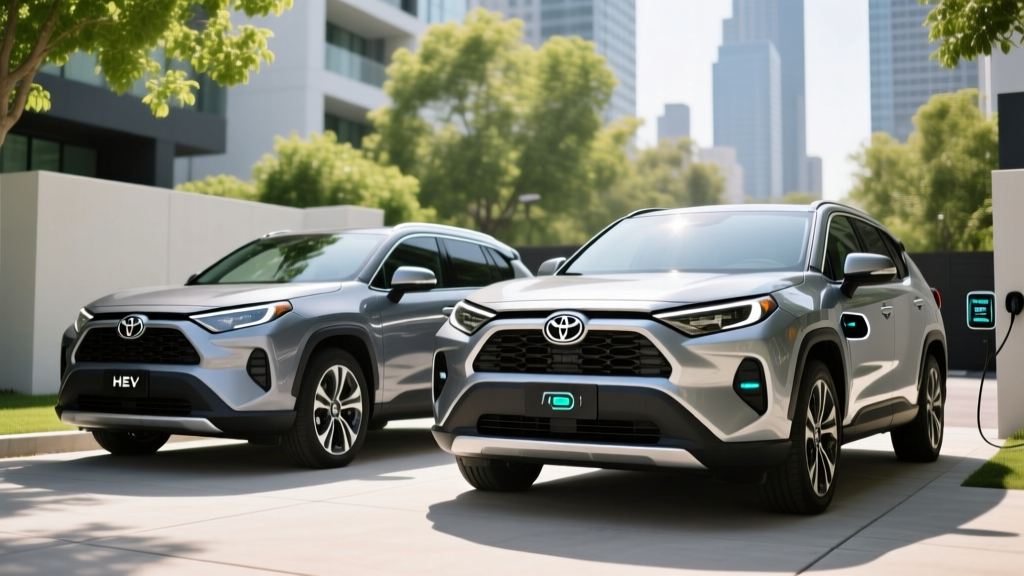
If you're researching Toyota RAV4 Hybrid models, you're likely navigating a choice that doesn't exist with most competitors: Toyota sells the RAV4 in two distinct electrified flavors — a conventional Hybrid Electric Vehicle (HEV) that never needs plugging in, and the RAV4 Prime, a Plug-in Hybrid Electric Vehicle (PHEV) with a substantial electric-only range. Both share the same 2.5-liter four-cylinder engine and Toyota's proven hybrid synergy drive architecture, but their batteries, pricing, and daily-driving experiences diverge sharply.
This guide breaks down every spec that matters — EPA MPG, electric range, battery chemistry and warranty, horsepower, charging times, and real-world ownership costs — so you can match the right RAV4 Hybrid model to your commute, your garage, and your budget.
HEV vs PHEV: What's the Actual Difference?
Before comparing trims, it's critical to understand the mechanical distinction between the two Toyota RAV4 Hybrid models, because it dictates everything from your fuel bill to your tax-return eligibility.
| Attribute | RAV4 Hybrid (HEV) | RAV4 Prime (PHEV) |
|---|---|---|
| Plugs in? | No — charges via regen & engine | Yes — J1772 Level 1/2 AC |
| Battery capacity | ~1.6 kWh (NiMH/NMC) | 18.1 kWh usable (NMC lithium-ion) |
| Electric-only driving | Brief low-speed EV mode only | Up to 42 miles EPA |
| Combined horsepower | 219 hp | 302 hp |
| DC fast charging | N/A | Not supported |
| Federal tax credit (§30D) | Not eligible | Up to $7,500 (sourcing/income rules apply) |
| Starting MSRP (2026 est.) | ~$33,500 | ~$44,500 |
The HEV is a self-charging system: regenerative braking and the gasoline engine keep a small buffer battery topped up. You drive it exactly like a gas car — just fill up and go. The Prime adds a much larger lithium-ion pack and more powerful electric motors, enabling genuine electric-only commutes before the engine ever fires. Think of the HEV as "efficiency without behavior change" and the Prime as "an EV for short commutes with a gas backup for road trips."
Fuel Economy: EPA MPG for Every RAV4 Hybrid Model
Fuel economy is the headline number most buyers search for, so let's get exact. Below are the EPA-rated figures per fueleconomy.gov for the current-generation RAV4 Hybrid lineup:
| Model / Drivetrain | City MPG | Highway MPG | Combined MPG | MPGe (PHEV) |
|---|---|---|---|---|
| RAV4 Hybrid LE (AWD) | 41 | 38 | 39 | — |
| RAV4 Hybrid XLE / XSE / Limited (AWD) | 41 | 38 | 39 | — |
| RAV4 Prime SE / XSE (AWD, PHEV) | 40 (gas mode) | 36 (gas mode) | 38 (gas mode) | 94 MPGe |
Real-World MPG vs. the EPA Sticker
Toyota's hybrid system excels in stop-and-go city driving, where the electric motor handles low-speed propulsion and the engine operates only at its most efficient RPM. In real-world testing by multiple outlets, the RAV4 Hybrid HEV routinely matches or slightly exceeds its 41 MPG city rating in urban and suburban driving. Highway driving at sustained 75+ mph is where real numbers dip — expect roughly 35–36 MPG on flat interstate runs due to aerodynamic drag the EPA test cycle underrepresents.
For the Prime, the 94 MPGe figure applies only while the battery is charged and you're driving in EV mode. Once the 18.1 kWh pack is depleted, you're operating as a conventional hybrid at roughly 38 MPG combined. If you rarely charge the Prime, you're carrying 400+ pounds of battery you never use — making the lighter HEV the smarter buy.
RAV4 Prime Electric Range, Charging & Battery Specs
The RAV4 Prime's 42-mile EPA electric-only range is the longest of any compact PHEV SUV in its class, and it's a genuine game-changer for commuters with sub-40-mile round trips. Here are the charging specifics:
| Spec | RAV4 Prime Detail |
|---|---|
| Battery chemistry | NMC (Nickel Manganese Cobalt) lithium-ion |
| Usable battery capacity | 18.1 kWh |
| EPA electric-only range | 42 miles |
| Total combined range (EV + gas) | ~600 miles |
| Level 1 charging (120V, 1.4 kW) | ~12 hours (0–100%) |
| Level 2 charging (240V, 3.3 kW onboard) | ~4.5 hours (0–100%) |
| Optional 6.6 kW onboard charger (XSE pkg) | ~2.5 hours (0–100%) |
| DC fast charging | Not available — no CCS or CHAdeMO port |
| Charge port | J1772 (AC only) |
A critical caveat for prospective Prime buyers: Toyota does not offer DC fast charging on the RAV4 Prime. The charge port is J1772 AC-only, meaning public fast-charging stations (Electrify America, EVgo, Tesla Superchargers) are useless to you. All charging happens at home, at work, or at Level 2 destination chargers. If your daily commute exceeds 42 miles and you were counting on topping up at a highway charger, the Prime won't support that workflow. The 6.6 kW onboard charger upgrade (available on the XSE with the Premium Package) is worth seeking — it cuts Level 2 charge time nearly in half, which matters if you're charging at a workplace station during an 8-hour shift.
Powertrain: Horsepower, 0–60 & Drivetrain Breakdown
Both Toyota RAV4 Hybrid models use Toyota's Hybrid Synergy Drive with a 2.5-liter Dynamic Force four-cylinder engine, but the Prime's larger battery and more powerful electric motors deliver a dramatic performance gap.
| Powertrain Spec | RAV4 Hybrid (HEV) | RAV4 Prime (PHEV) |
|---|---|---|
| Engine | 2.5L I4 Atkinson-cycle | 2.5L I4 Atkinson-cycle |
| Engine output | 176 hp / 163 lb-ft | 177 hp / 165 lb-ft |
| Front electric motor | 118 hp | 174 hp |
| Rear electric motor (AWD) | 54 hp | 40 hp |
| Net combined horsepower | 219 hp | 302 hp |
| 0–60 mph | 7.4 seconds | 5.7 seconds |
| Drivetrain | Electronic AWD (AWD-i) | Electronic AWD (AWD-i) |
| Towing capacity | 1,750 lbs | 1,750 lbs |
The Prime's 5.7-second 0–60 time makes it one of the quickest vehicles in Toyota's lineup — faster than a V6 Camry and nearly sports-sedan quick. The HEV's 7.4 seconds is perfectly adequate for highway merging but won't win any stoplight contests. Both use an electronically controlled CVT (eCVT) that's smooth and drone-free under normal acceleration, thanks to Toyota's refined planetary gearset design rather than the belt-driven CVTs found in some competitors.
Pricing, Trims & Federal Tax Credit Eligibility
Toyota RAV4 Hybrid pricing spans a wide range depending on whether you choose the HEV or Prime, and the federal tax-credit picture is dramatically different for each.
| Trim | Approx. MSRP (2026) | Powertrain | §30D Federal Credit |
|---|---|---|---|
| RAV4 Hybrid LE | $33,500 | HEV | Not eligible |
| RAV4 Hybrid XLE | $35,000 | HEV | Not eligible |
| RAV4 Hybrid XSE | $37,500 | HEV | Not eligible |
| RAV4 Hybrid Limited | $40,000 | HEV | Not eligible |
| RAV4 Prime SE | $44,500 | PHEV | Up to $7,500* |
| RAV4 Prime XSE | $48,000 | PHEV | Up to $7,500* |
*Federal tax credit eligibility under IRS §30D Clean Vehicle Credit depends on multiple factors that change annually:
- MSRP cap: SUVs must be priced at or below $80,000 — both Prime trims qualify.
- Buyer income cap: Modified AGI must not exceed $150,000 (single), $225,000 (head of household), or $300,000 (joint).
- Battery sourcing: Critical minerals and battery components must meet escalating domestic-content thresholds. Toyota's supply chain has been adapting, but specific eligibility can shift model year to model year. Verify current-year status on the IRS qualified vehicles list before purchasing.
- Point-of-sale transfer: As of 2024+, eligible buyers can transfer the credit to the dealer for an immediate price reduction at purchase rather than waiting for tax-time filing.
The conventional HEV models do not qualify for the §30D federal credit because they lack sufficient battery capacity and plug-in capability. However, some states and utilities offer their own incentives for hybrids — check your state energy office or local utility for rebates that may apply to either model.
Battery Warranty, Lifespan & Replacement Cost
Battery longevity is consistently the top concern among hybrid buyers, and Toyota's track record here is among the best in the industry. The RAV4 Hybrid's nickel-metal-hydride and the Prime's NMC lithium-ion packs are both covered by Toyota's hybrid battery warranty.
Toyota Hybrid Battery Warranty
- Coverage: 10 years / 150,000 miles (whichever comes first)
- Applies to: Hybrid battery pack, battery control module, hybrid control module, inverter
- Capacity retention: Toyota does not publish a specific degradation threshold (e.g., 70%) in the warranty — coverage applies to battery failure or significant malfunction
- Transferable: Yes — warranty transfers to subsequent owners, which supports resale value
In practice, Toyota's hybrid batteries have proven remarkably durable. Data from fleet operators and long-term owner surveys shows most Toyota hybrid packs retain 85–90%+ capacity after 150,000 miles. The HEV's small NiMH pack is exceptionally well-proven — the same architecture has been in the Prius since 2001 with minimal failure rates.
What Does Replacement Cost?
If your battery does fail outside warranty, here's what to expect:
- RAV4 Hybrid (HEV): $2,000–$4,000 for a new OEM replacement battery, plus ~$500–$800 labor
- RAV4 Prime (PHEV): $6,000–$9,000+ for the larger 18.1 kWh NMC pack, plus labor
- Refurbished/remanufactured options: Available from third-party shops for 30–50% less than OEM new, particularly for the HEV pack
For context, at 15,000 miles per year, the 10-year / 150,000-mile warranty covers most original owners for the entire duration they'll own the vehicle. The HEV battery replacement cost is comparable to a major transmission repair on a conventional car — not trivial, but not catastrophic.
Who Should Buy Which RAV4 Hybrid Model?
Choose the RAV4 Hybrid (HEV) if:
- You don't have access to home or workplace charging (apartment, street parking)
- Your budget is under $38,000 and you want AWD standard
- You drive 30+ miles daily but want zero charging hassle
- You prioritize lower upfront cost over electric-only driving
- You plan to keep the vehicle 10+ years and value mechanical simplicity
Choose the RAV4 Prime (PHEV) if:
- Your daily round-trip commute is under 42 miles and you can charge at home overnight
- You qualify for the full $7,500 federal tax credit (bringing effective price closer to the HEV Limited)
- You want 302 hp and 5.7-second 0–60 performance
- You want to drive on electricity daily but need gas flexibility for road trips
- You have a 240V outlet or can install a Level 2 charger in your garage
Consider a full BEV (like the bZ4X or Ioniq 5) if:
- Your commute is under 250 miles and you rarely road-trip beyond charger-network coverage
- You want zero gasoline purchases and minimal drivetrain maintenance
- You have reliable home charging and access to DC fast chargers for longer trips
RAV4 Hybrid (HEV) — Pros
- 39 MPG combined with no behavior change required
- Lowest entry price in the hybrid lineup
- Proven, simple NiMH battery with outstanding longevity
- AWD standard across all trims
- Strong resale value
RAV4 Hybrid (HEV) — Cons
- No federal tax credit
- No electric-only commuting capability
- 219 hp feels adequate, not exciting
- Cargo space slightly reduced vs. gas RAV4
RAV4 Prime (PHEV) — Pros
- 42-mile electric range covers most commutes gas-free
- 302 hp / 5.7s 0–60 — genuinely quick
- Up to $7,500 federal tax credit (if eligible)
- 600+ mile total range eliminates range anxiety
- Standard AWD with robust electric rear motor
RAV4 Prime (PHEV) — Cons
- $11,000+ premium over base HEV
- No DC fast charging — AC only
- Heavy battery adds weight, slightly hurts highway MPG in gas mode
- Long wait times at some dealers due to high demand
- Requires home charging access to realize full value
Toyota RAV4 Hybrid Models FAQ
How many MPG does the Toyota RAV4 Hybrid get?
The RAV4 Hybrid HEV achieves an EPA-rated 41 city / 38 highway / 39 combined MPG across all AWD trims. In real-world city driving, owners frequently report matching or slightly exceeding the 41 MPG city figure. Highway cruising at 75+ mph typically yields 35–36 MPG. The RAV4 Prime PHEV returns 94 MPGe in electric mode and 38 MPG combined once the battery is depleted.
How far can the RAV4 Prime go on electric only?
The EPA rates the RAV4 Prime at 42 miles of electric-only range. Real-world results vary: in mild weather at city speeds, some owners report 44–46 miles. In cold weather (below freezing) or at sustained highway speeds, expect 34–38 miles before the gasoline engine engages. The total combined range (electric + 14.5-gallon fuel tank) exceeds 600 miles.
Does the RAV4 Hybrid qualify for a tax credit?
The conventional RAV4 Hybrid (HEV) does not qualify for the federal §30D Clean Vehicle Credit because it is not a plug-in vehicle. The RAV4 Prime (PHEV) can qualify for up to $7,500, but eligibility depends on your income, the vehicle's battery component and critical-mineral sourcing compliance, and MSRP caps. Always verify current-year eligibility on the IRS qualified vehicles page before purchasing.
Is the RAV4 Hybrid reliable, and what does battery replacement cost?
Toyota's hybrid system has an industry-leading reliability track record spanning two decades. The hybrid battery is warranted for 10 years / 150,000 miles. Real-world data shows most packs retain 85–90%+ capacity at 150,000 miles. Out-of-warranty replacement costs approximately $2,000–$4,000 for the HEV and $6,000–$9,000+ for the Prime's larger pack. Toyota's hybrid components (inverter, eCVT, motors) have similarly low failure rates.
Can I charge the RAV4 Hybrid at home?
The conventional RAV4 Hybrid (HEV) cannot and does not need to be plugged in — it charges its small battery through regenerative braking and the gasoline engine. The RAV4 Prime (PHEV) charges at home via a standard 120V outlet (Level 1, ~12 hours) or a 240V Level 2 charger (~2.5–4.5 hours depending on onboard charger option). The Prime does not support DC fast charging.
Hybrid vs PHEV vs EV — which should I choose?
Choose the HEV if you lack charging access and want maximum simplicity. Choose the PHEV (Prime) if you can charge at home and want electric-only commuting with gas-trip flexibility. Choose a full BEV if your daily driving stays within ~250 miles, you have reliable home charging, and you want to eliminate gasoline entirely. The RAV4 Prime occupies a compelling middle ground: it's an EV for your commute and a hybrid for your road trips.
Does the RAV4 Prime lose electric range in cold weather?
Yes. Like all lithium-ion batteries, the Prime's pack delivers reduced usable capacity in freezing temperatures. Expect a 15–25% reduction in electric-only range when temperatures drop below 32°F — roughly 32–36 miles instead of 42. Using the cabin heater in EV mode also draws from the battery, further reducing range. The HEV is less affected by cold since its small NiMH pack isn't relied upon for extended electric driving.