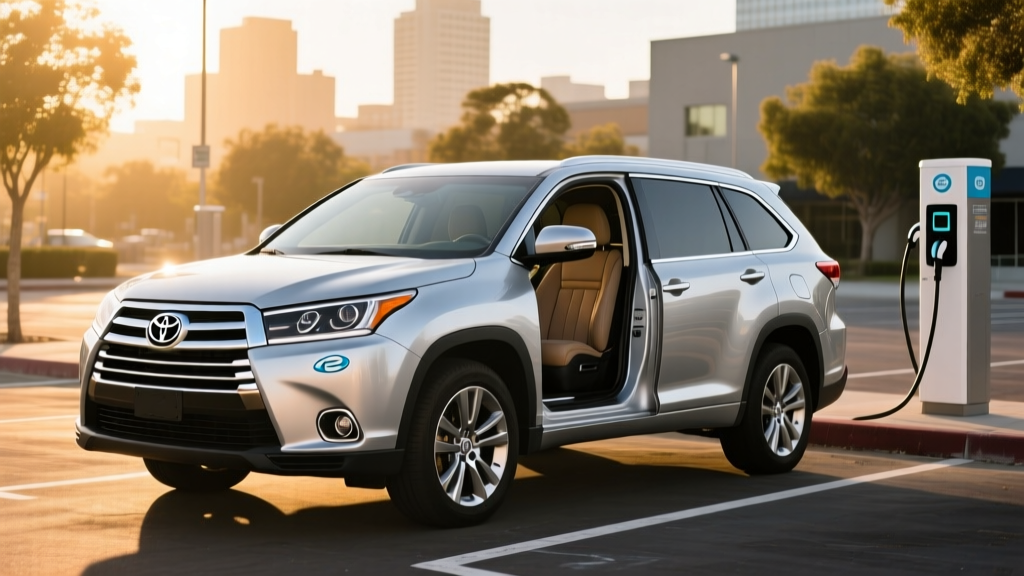
The 2014 Toyota Highlander Hybrid occupies a specific niche in the used market: a three-row, all-wheel-drive family hauler that sips fuel without requiring a plug. More than a decade after its debut, this third-generation Highlander Hybrid remains one of the most sought-after used hybrid SUVs — and for good reason. Toyota's Synergy Drive system has proven remarkably durable, and the 28 MPG combined EPA rating still holds up against many newer crossovers.
But buying a 12-year-old hybrid in 2026 comes with real questions. What's the battery replacement cost? How does real-world fuel economy compare to the EPA sticker? And does it still make financial sense versus a newer plug-in hybrid or a full battery-electric vehicle? This guide answers every question a used-car buyer needs resolved before signing the paperwork.
HEV vs PHEV: What the 2014 Highlander Hybrid Actually Is
Before evaluating this specific model, it's essential to clarify what it is — and what it isn't.
Conventional Hybrid (HEV) vs Plug-in Hybrid (PHEV)
| Feature | 2014 Highlander Hybrid (HEV) | Plug-in Hybrid (e.g., 2026 RAV4 Prime) |
|---|---|---|
| Plug-in charging required? | No — charges via regenerative braking and engine | Yes — Level 1 or Level 2 plug-in |
| Electric-only range | ~1 mile at low speed (EV mode) | 35-42 miles typical |
| Battery size | 1.9 kWh NiMH (small buffer) | 18.1 kWh lithium-ion |
| DC fast charging? | No | Typically no (PHEV batteries are small) |
| Federal tax credit (new) | None (never eligible) | Up to $7,500 under §30D (if eligible) |
| Gas engine needed? | Yes — always available, primary power source | Yes — kicks in after battery depletes |
The 2014 Highlander Hybrid is a conventional hybrid (HEV). It never plugs in. Its nickel-metal hydride (NiMH) battery pack is small — roughly 1.9 kWh — and serves as a buffer that captures energy from regenerative braking and the gasoline engine, then deploys it to assist acceleration and enable brief low-speed electric-only driving. You fuel it exclusively with gasoline. There is no charging port, no electric-only commute mode, and no range-anxiety trade-off.
2014 Highlander Hybrid Specs: Powertrain, MPG, and Performance
| Specification | 2014 Toyota Highlander Hybrid |
|---|---|
| Powertrain | 3.5L V6 + 2 electric motors (front/rear AWD-i) |
| Combined horsepower | 280 hp (net system) |
| Gas engine output | 236 hp / 215 lb-ft torque |
| Front electric motor | 114 kW (153 hp) |
| Rear electric motor | 50 kW (67 hp) |
| Transmission | eCVT (electronically controlled CVT) |
| Drivetrain | AWD-i (electronic on-demand AWD via rear motor) |
| Battery chemistry | NiMH (nickel-metal hydride) |
| Battery capacity | ~1.9 kWh |
| EPA fuel economy | 27 city / 28 highway / 28 combined MPG |
| Fuel tank | 17.2 gallons |
| Total range (est.) | ~480 miles |
| 0-60 mph | ~7.9 seconds |
| Seating | 7 passengers |
| Cargo (behind 3rd row) | 13.8 cu ft |
How Many MPG Does the 2014 Highlander Hybrid Get?
The EPA rates the 2014 Highlander Hybrid at 27 MPG city / 28 MPG highway / 28 MPG combined, according to fueleconomy.gov. These figures apply to all trims (Limited and Limited Platinum were the only hybrid trims offered in 2014).
EPA Fuel Economy Breakdown
| Driving Cycle | EPA MPG | Real-World Expectation |
|---|---|---|
| City | 27 MPG | 26-29 MPG (hybrids often match or beat EPA city) |
| Highway | 28 MPG | 25-27 MPG (sustained 75+ mph reduces hybrid advantage) |
| Combined | 28 MPG | 25-28 MPG depending on driving mix |
| Cold weather (sub-30°F) | — | 22-25 MPG (engine runs more for cabin heat, battery less efficient) |
Real-world note: Unlike full EVs, which lose significant range in cold weather, the Highlander Hybrid's fuel economy drops modestly — roughly 10-15% in deep winter — because the gasoline engine's waste heat warms the cabin. In city driving during mild weather, many owners report matching or slightly exceeding the 27 MPG city figure because the hybrid system excels at stop-and-go efficiency. Highway driving above 70 mph narrows the hybrid advantage since the electric motors contribute less at sustained high speed.
Hybrid Battery Lifespan, Warranty, and Replacement Cost
This is the single most important question for any used hybrid buyer in 2026. A 2014 model is now 12 years old, and the original NiMH battery pack may be approaching — or past — its practical service life.
Battery Warranty & Replacement Facts
- Original factory warranty: 8 years / 100,000 miles (10 years / 150,000 miles in CARB states: CA, CT, ME, MA, NJ, NY, OR, RI, VT, WA)
- Warranty status in 2026: Expired on all 2014 models, regardless of mileage
- Typical NiMH battery lifespan: 150,000-200,000 miles / 12-18 years under normal use
- OEM replacement battery cost: $3,000-$4,500 (parts + labor at a Toyota dealer)
- Aftermarket/remanufactured battery: $1,500-$2,500 installed
- Individual cell module replacement: $300-$800 (if only 1-2 modules have failed, a specialist can swap them)
Is the 2014 Highlander Hybrid Reliable?
Toyota's Hybrid Synergy Drive is among the most proven hybrid systems ever mass-produced. The eCVT transmission contains no traditional belts or clutches — it uses a planetary gearset that has shown exceptional longevity. The 3.5L 2GR-FXE V6 engine is a derivative of one of Toyota's most durable powerplants.
The weak link is the NiMH battery. Unlike the lithium-ion packs in modern EVs and PHEVs, NiMH degrades primarily through charge-discharge cycling and heat exposure. Vehicles driven in hot climates (Arizona, Texas, Southern California) tend to see earlier battery degradation. That said, many 2014 Highlander Hybrids with 150,000+ miles still run on their original battery packs.
Pre-purchase tip: Have a Toyota dealer or hybrid specialist run a battery health check (State of Health, or SoH). This diagnostic measures individual module voltages and internal resistance. If module imbalance is significant, budget for a replacement or reconditioned pack. A healthy original battery should show less than 10% voltage variance across modules.
2014 Highlander Hybrid vs Modern Alternatives: HEV, PHEV, or EV?
Buyers cross-shopping a used 2014 Highlander Hybrid in 2026 are likely also considering newer options. Here's how the decision breaks down.
Choose the 2014 Highlander Hybrid If:
- Your budget is $12,000-$18,000 (typical used market range in 2026)
- You need 7-passenger seating and AWD
- You have no access to plug-in charging at home or work
- You want proven, simple hybrid tech with low maintenance costs
- You drive 12,000+ miles/year and want to reduce fuel spend without a premium purchase price
Choose a Newer PHEV or EV If:
- You can install a Level 2 home charger (240V, 32-48A circuit)
- Your daily commute is under 40 miles (a PHEV covers it on electricity alone)
- You want modern safety tech (automatic emergency braking, lane-keeping — not standard on 2014 Highlander)
- You qualify for the federal §30D tax credit (up to $7,500 for eligible new PHEVs/EVs)
- You want the latest infotainment, Apple CarPlay/Android Auto, and OTA updates
Hybrid vs PHEV vs EV — Which Fits the Reader?
| Factor | HEV (2014 Highlander Hybrid) | PHEV (e.g., 2026 Grand Highlander Hybrid) | BEV (e.g., 2026 Kia EV9) |
|---|---|---|---|
| Purchase price | $12K-$18K (used) | $48K-$55K (new) | $55K-$70K (new) |
| Plug-in required? | No | Yes (for EV mode) | Yes (always) |
| Electric-only range | ~1 mile (low speed) | ~32-40 miles | 250-310 miles (full battery) |
| Fuel/energy cost per mile | ~$0.12-$0.14 (gas) | ~$0.04 (electric) / $0.12 (gas) | ~$0.04-$0.06 (electric) |
| Federal tax credit | None | Up to $7,500 (if eligible) | Up to $7,500 (if eligible) |
| Maintenance cost | Low (proven system) | Moderate (dual systems) | Lowest (no engine, no oil changes) |
| 3rd-row seating? | Yes (tight) | Yes (spacious) | Yes (EV9, others) |
Tax Credits, Pricing, and Total Cost of Ownership
Does the 2014 Highlander Hybrid Qualify for Any Tax Credit?
No. The 2014 Highlander Hybrid has never qualified for a federal plug-in vehicle tax credit, and it does not qualify now. The IRS §30D Clean Vehicle Credit applies only to plug-in electric vehicles (BEVs and PHEVs) with qualifying battery sourcing, MSRP caps, and buyer income limits. Conventional hybrids like this one are ineligible.
Some states and local utilities offer modest rebates for used hybrid purchases or for hybrid battery replacement, but these vary widely by jurisdiction. Check your state energy office or utility provider for current programs.
Used Market Pricing in 2026
As of early 2026, the 2014 Highlander Hybrid trades in the used market at approximately:
- 100,000-130,000 miles: $14,000-$18,000 (private party/dealer)
- 130,000-170,000 miles: $11,000-$15,000
- 170,000+ miles: $8,500-$12,000 (budget for potential battery replacement)
For context, a new 2026 Toyota Grand Highlander Hybrid starts at roughly $45,000 and achieves 34-36 MPG combined — a meaningful efficiency gain, but at 3x the purchase price.
5-Year Cost Estimate (Used 2014 Highlander Hybrid)
| Cost Category | 5-Year Estimate |
|---|---|
| Purchase price (avg. 120K miles) | $15,000 |
| Fuel (15,000 mi/yr, $3.40/gal, 26 MPG avg) | $9,800 |
| Insurance (national avg. used SUV) | $6,500 |
| Maintenance & repairs (incl. potential battery) | $3,500-$6,500 |
| Depreciation (5-year) | -$5,000 to -$7,000 |
| Total 5-year cost | $29,800-$35,800 |
Safety, Features, and What's Missing in 2026 Context
The 2014 Highlander Hybrid earned a Top Safety Pick designation from IIHS, with "Good" ratings in moderate overlap front, side, roof strength, and head restraint tests. However, it predates modern active safety suites.
What it has: Standard rearview camera, antilock brakes, stability control, seven airbags, front and rear parking sensors (Limited trim).
What it lacks (standard on most 2026 vehicles): Automatic emergency braking (AEB), lane departure warning, lane-keeping assist, adaptive cruise control, blind-spot monitoring (added in later model years), Apple CarPlay, Android Auto, and over-the-air software updates.
If advanced driver-assistance systems (ADAS) are a priority, this vehicle will feel dated. Toyota Safety Sense — the brand's suite of AEB, lane-keeping, and radar cruise — didn't arrive on the Highlander until the 2016 refresh.
Frequently Asked Questions
How many MPG does the 2014 Highlander Hybrid get in real-world driving?
The EPA rates it at 27 city / 28 highway / 28 combined MPG. In real-world use, expect 25-28 MPG combined depending on your driving mix. City driving often matches or slightly exceeds the EPA figure thanks to regenerative braking. Sustained highway speeds above 75 mph and cold weather will reduce fuel economy to the low-to-mid 20s.
Does the 2014 Highlander Hybrid need to be plugged in?
No. This is a conventional hybrid (HEV), not a plug-in hybrid (PHEV). It charges its battery entirely through regenerative braking and the gasoline engine. There is no charging port. You fuel it exclusively with gasoline, just like a conventional car.
How much does it cost to replace the hybrid battery?
A new OEM Toyota NiMH replacement battery costs $3,000-$4,500 installed at a dealership. Remanufactured aftermarket batteries run $1,500-$2,500 installed. If only one or two cell modules have failed, a hybrid specialist can replace individual modules for $300-$800. The original battery typically lasts 150,000-200,000 miles.
Is the 2014 Highlander Hybrid good for towing?
Toyota rates the 2014 Highlander Hybrid at 3,500 pounds of towing capacity — adequate for a small utility trailer, a pair of jet skis, or a light pop-up camper, but not enough for most travel trailers or boats. The non-hybrid V6 Highlander from the same generation is rated at 5,000 pounds.
Does it qualify for any federal tax credit?
No. The federal §30D Clean Vehicle Credit applies only to plug-in electric vehicles (BEVs and PHEVs) meeting battery sourcing, MSRP, and income requirements. Conventional hybrids like the 2014 Highlander Hybrid have never been eligible for this credit. Check your state and local utility for possible used-vehicle or hybrid-specific rebates, which vary by jurisdiction.
How does it compare to the current Grand Highlander Hybrid?
The 2026 Grand Highlander Hybrid offers 34-36 MPG combined (a 20-25% improvement), significantly more third-row and cargo space, Toyota Safety Sense 3.0 (AEB, lane-keeping, adaptive cruise), wireless CarPlay/Android Auto, and a new-car warranty. However, it starts around $45,000 — roughly 3x the cost of a used 2014 Highlander Hybrid. If budget is the primary constraint, the 2014 model delivers strong value per dollar.
What should I check before buying a used 2014 Highlander Hybrid?
Priority items: (1) Have the hybrid battery State of Health tested by a Toyota dealer or hybrid specialist. (2) Check for any outstanding recalls via NHTSA's recall lookup. (3) Verify maintenance records — the 3.5L V6 requires timing-chain inspection at higher mileage and regular transmission fluid changes. (4) Inspect the inverter coolant system for leaks. (5) Test all three rows of seating and the cargo area for wear consistent with family use.
The 2014 Highlander Hybrid remains a rational, budget-friendly choice for families who need three rows and AWD without the complexity — or cost — of plug-in charging. Its fuel economy still outpaces most gas-only SUVs of similar size, and Toyota's hybrid reliability track record is among the best in the industry. The main risk in 2026 is battery age: budget $2,000-$4,500 for a potential replacement, factor it into your purchase negotiation, and this SUV can deliver dependable, efficient family transportation for years to come.