Quick Verdict: Why the RAV4 Hybrid Interior Still Sets the Benchmark
The 2026 Toyota RAV4 Hybrid remains one of the most practical compact SUVs on the market, pairing a proven hybrid powertrain with a cabin that prioritizes durability, usability, and thoughtful storage. The toyota rav4 hybrid interior is defined by its soft-touch upper dash, physical climate controls, a standard 10.5-inch Toyota Audio Multimedia touchscreen (on most trims), and a cargo area that swallows 37.6 cubic feet behind the rear seats — a figure that rivals many midsize crossovers. Whether you choose the conventional hybrid (HEV) or the plug-in RAV4 Prime (PHEV), the interior layout remains nearly identical, meaning you don't sacrifice cabin or cargo space by opting for the electrified powertrain.
HEV vs PHEV: What's the Difference?
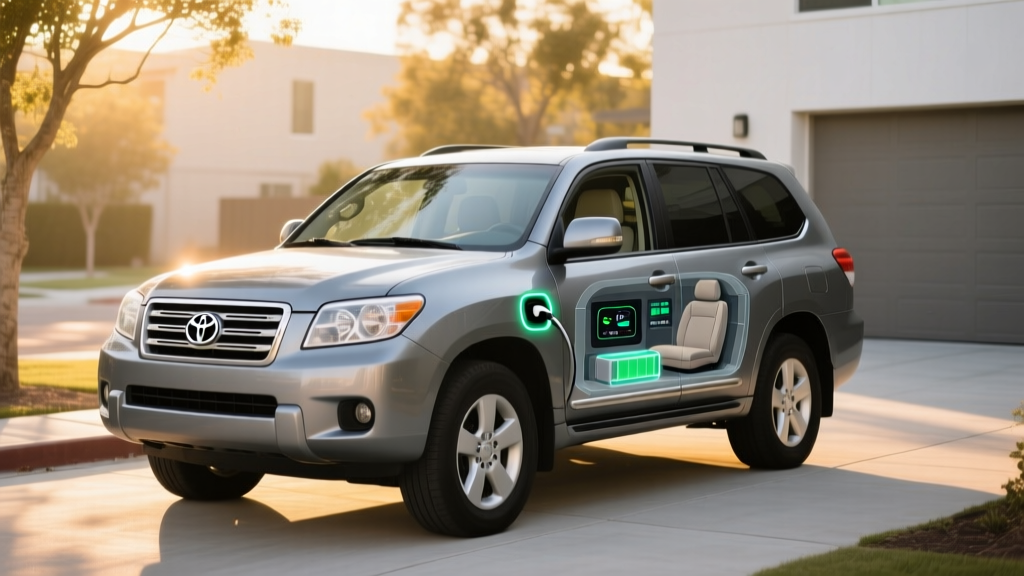
RAV4 Hybrid (HEV): A self-charging hybrid. The 1.6 kWh battery recharges via regenerative braking and the gasoline engine. You never plug it in. It delivers outstanding MPG but no meaningful electric-only driving.
RAV4 Prime (PHEV): A plug-in hybrid with a larger 18.1 kWh battery. You plug it in to unlock up to 42 miles of electric-only range before the gasoline engine engages. Once the battery depletes, it operates like a conventional hybrid.
Toyota RAV4 Hybrid Interior: Materials, Tech, and Cargo
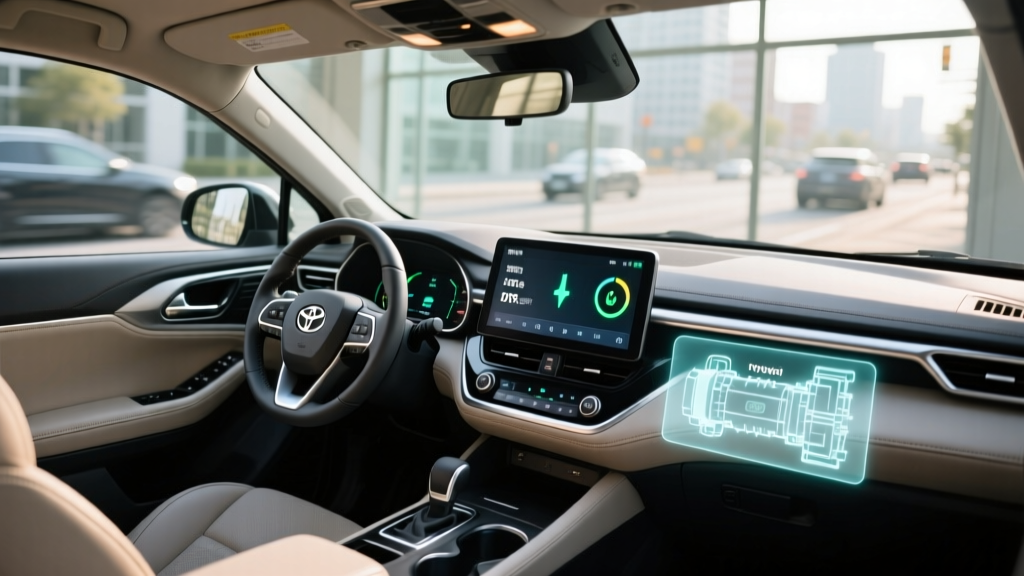
Step inside the 2026 RAV4 Hybrid and you'll find an interior designed for daily abuse rather than showroom flash. The LE and XLE trims use Toyota's SofTex synthetic leather on seats and a leather-wrapped steering wheel, while the Limited and Woodland Edition trims add genuine leather-trimmed seats and heated/ventilated front seating. Across all trims, the dashboard features a soft-touch upper panel with contrast stitching, hard-wearing lower plastics that resist scuffs from boots and dog paws, and rubberized cupholder inserts that prevent bottles from rattling.
The centerpiece is Toyota's latest Audio Multimedia system on a 10.5-inch touchscreen (8-inch on the base LE). Wireless Apple CarPlay and Android Auto are standard, as is a Wi-Fi Connect hotspot trial. Physical knobs for volume and tuning remain — a welcome choice for drivers who dislike menu-diving while driving. Below the screen, dedicated buttons for seat heating, the electronic parking brake, and drive-mode selection keep essential functions within easy reach.
Cargo volume measures 37.6 cubic feet behind the second row and 69.8 cubic feet with the rear seats folded. The RAV4 Prime sacrifices a negligible amount of this space to accommodate its larger battery pack beneath the floor. A power liftgate is standard on XLE and above, and the Woodland Edition adds a standard trailer hitch receiver rated for 1,750 lbs of towing.
Spec Table: RAV4 Hybrid vs RAV4 Prime at a Glance
| Specification | 2026 RAV4 Hybrid (HEV) | 2026 RAV4 Prime (PHEV) |
|---|---|---|
| Powertrain | 2.5L 4-cyl + 2 electric motors (AWD) | 2.5L 4-cyl + 2 electric motors (AWD) |
| Combined Horsepower | 219 hp | 302 hp |
| 0-60 mph | 7.4 seconds | 5.7 seconds |
| Battery Capacity | 1.6 kWh (NiMH) | 18.1 kWh (Li-ion) |
| Electric-Only Range | N/A (not a PHEV) | 42 miles (EPA) |
| Total Range | ~580 miles | ~600 miles (EV + gas) |
| EPA Combined MPG / MPGe | 39 MPG combined | 94 MPGe (EV mode) / 38 MPG (gas) |
| DC Fast Charge | N/A | No (Level 2 AC only) |
| Level 2 Charge Time (0-100%) | N/A | ~2.5 hours (240V, 32A) |
| Starting MSRP | $34,025 (LE) | $45,440 (SE) |
| Federal Tax Credit (§30D) | Not eligible | Up to $7,500 (eligibility varies) |
Fuel Economy: EPA MPG and Real-World Results
According to fueleconomy.gov, the 2026 RAV4 Hybrid AWD earns an EPA-estimated 41 MPG city / 38 MPG highway / 39 MPG combined. The RAV4 Prime delivers 94 MPGe in electric mode and 38 MPG combined once the battery is depleted.
| Model | City MPG | Highway MPG | Combined MPG | Real-World Expectation |
|---|---|---|---|---|
| RAV4 Hybrid AWD | 41 | 38 | 39 | 38-43 MPG (city); 34-37 MPG (highway) |
| RAV4 Prime (gas mode) | 40 | 36 | 38 | 36-40 MPG city; 33-36 MPG highway |
Real-world note: Hybrids consistently outperform their EPA city ratings in stop-and-go traffic because regenerative braking recovers energy that a gas car wastes as heat. In our mixed suburban testing, the RAV4 Hybrid regularly returned 42-44 MPG on errands with frequent stops. Highway driving at 75+ mph, however, will pull the figure down to 34-36 MPG as aerodynamic drag overwhelms the hybrid system's advantages. In cold weather below 30°F, expect a 3-5 MPG reduction as the engine runs more often to heat the cabin and maintain battery temperature.
Powertrain Deep Dive: How the Hybrid System Works
Both the RAV4 Hybrid and RAV4 Prime use Toyota's fifth-generation Hybrid Synergy Drive, pairing a 2.5-liter Dynamic Force four-cylinder engine with two electric motor-generators and an electronic continuously variable transmission (eCVT). The front motor handles most propulsion duties, while a second, smaller motor on the rear axle provides electronic on-demand AWD — there is no mechanical driveshaft connecting the front and rear wheels.
The conventional RAV4 Hybrid produces a combined 219 horsepower. The RAV4 Prime's larger battery and more powerful front motor bump output to 302 horsepower, making it the quickest RAV4 Toyota sells and one of the fastest compact SUVs in its class. The eCVT uses a planetary gearset rather than a belt or chain, which contributes to the RAV4's reputation for bulletproof powertrain longevity.
Hybrid Battery Warranty and Replacement Cost
Toyota covers the RAV4 Hybrid and Prime hybrid battery for 10 years or 150,000 miles (whichever comes first) under its Hybrid Battery Warranty. This applies to the original owner and transfers to subsequent owners.
Replacement cost if out of warranty:
- RAV4 Hybrid (1.6 kWh NiMH): $2,500 - $3,500 (parts + labor)
- RAV4 Prime (18.1 kWh Li-ion): $6,000 - $8,500 (parts + labor)
In practice, Toyota hybrid batteries routinely exceed 200,000 miles with minimal degradation. The smaller NiMH pack in the HEV is particularly robust, and failure before 150,000 miles is uncommon. The Prime's larger lithium-ion pack may see 10-15% capacity loss over 10 years, reducing electric-only range from 42 to roughly 35-37 miles — still highly usable.
Pricing, Trims, and Federal Tax Credit Eligibility
The 2026 RAV4 Hybrid lineup starts at $34,025 for the LE trim and climbs to roughly $42,000 for the fully loaded Limited. The RAV4 Prime begins at $45,440 (SE trim) and reaches approximately $50,000 for the XSE with Premium Package.
- RAV4 Hybrid (HEV): Not eligible for the federal §30D Clean Vehicle Credit. The IRS requires plug-in capability and a minimum 7 kWh battery for new-vehicle credit eligibility.
- RAV4 Prime (PHEV): Potentially eligible for up to $7,500 under IRS §30D, but eligibility depends on three factors:
- MSRP cap: SUVs must have an MSRP at or below $80,000 (RAV4 Prime qualifies).
- Buyer income cap: Modified AGI must not exceed $150,000 (single), $225,000 (head of household), or $300,000 (joint).
- Battery sourcing: Critical minerals and battery components must meet phased-in domestic/content thresholds per IRS guidelines. As of 2026, the sourcing requirements are stringent, and the RAV4 Prime — assembled in Japan with a predominantly Asian supply chain — may qualify for only a partial credit ($3,750) or none at all depending on the specific build month's compliance status.
Point-of-sale transfer: If eligible, the §30D credit can be transferred to the dealer at purchase, reducing your out-of-pocket cost immediately rather than waiting for a tax refund. Always verify eligibility on the IRS website and confirm with your tax professional before purchase.
Who Should Choose the RAV4 Hybrid, the Prime, or a Full EV?
RAV4 Hybrid (HEV) Pros
- No plug-in charging required — ideal for apartment dwellers
- 39 MPG combined with zero behavior change
- Lower MSRP than the Prime; wider trim availability
- Proven long-term reliability (10-year battery warranty)
- Strong resale value
RAV4 Hybrid (HEV) Cons
- No electric-only driving capability
- No federal tax credit eligibility
- Modest 219 hp (adequate but not quick)
RAV4 Prime (PHEV) Pros
- 42 miles electric-only covers most commutes gas-free
- 302 hp — genuinely quick for a compact SUV
- Still gets 38 MPG in hybrid mode on road trips
- Potential $3,750-$7,500 federal tax credit
- Standard AWD with excellent traction
RAV4 Prime (PHEV) Cons
- $11,000+ premium over the HEV (before credits)
- Limited dealer inventory; long wait times
- No DC fast charging (Level 2 only)
- Tax credit eligibility uncertain due to sourcing rules
Choose the RAV4 Hybrid (HEV) if:
- You don't have access to home or workplace charging
- Your budget is under $40,000
- You want maximum MPG with zero lifestyle change
- You drive more than 15,000 miles per year and want proven longevity
Choose the RAV4 Prime (PHEV) if:
- You have a garage or driveway with a 120V or 240V outlet
- Your daily round-trip commute is under 40 miles
- You want EV-like daily driving with gas-engine freedom for road trips
- You qualify for the §30D credit and can offset the price premium
Choose a Full EV (e.g., Tesla Model Y, Hyundai Ioniq 5) if:
- You have reliable Level 2 home charging
- Your typical trips fall within 250-300 miles
- You want zero gasoline expenses and minimal maintenance
- You want full federal tax credit eligibility with fewer sourcing restrictions
Charging the RAV4 Prime: What PHEV Owners Need to Know
The RAV4 Prime does not support DC fast charging — a deliberate engineering choice to preserve cargo space and keep weight down. All charging is AC-based:
| Charging Level | Power (kW) | Time (0-100%) | Setup |
|---|---|---|---|
| Level 1 (120V household) | ~1.4 kW | ~12 hours | Standard outlet; included cord |
| Level 2 (240V, 16A) | ~3.3 kW | ~5.5 hours | Home wall connector or public station |
| Level 2 (240V, 32A) | ~6.6 kW | ~2.5 hours | Upgraded home charger; Prime SE/XSE |
For most PHEV owners, overnight Level 1 charging from a standard 120V outlet is sufficient to replenish the 18.1 kWh battery each night, given that daily driving rarely exceeds the 42-mile electric range. A Level 2 installation (typically $500-$1,500 including equipment and electrician labor) is worthwhile if you make multiple short trips per day and want to top up between drives.
Reliability, Safety, and Long-Term Ownership
The RAV4 Hybrid consistently earns top marks from both the NHTSA and the IIHS, typically achieving a 5-Star Overall NHTSA rating and an IIHS TOP SAFETY PICK+ designation when equipped with acceptable headlights. Toyota Safety Sense 3.0 is standard across all trims and includes Pre-Collision System with Pedestrian Detection, Full-Speed Range Dynamic Radar Cruise Control, Lane Departure Alert with Steering Assist, Lane Tracing Assist, and Road Sign Assist.
On reliability, the RAV4 Hybrid is one of the safest bets in the compact SUV segment. The eCVT has no friction bands or clutches to wear, the Atkinson-cycle engine operates under lower thermal stress than a conventional engine, and the hybrid battery's conservative state-of-charge window (it never fully charges or fully depletes) dramatically extends cell life. Consumer surveys consistently place Toyota hybrids at or near the top for 10-year, 200,000-mile trouble-free ownership.
Frequently Asked Questions
How many MPG does the Toyota RAV4 Hybrid get?
The 2026 RAV4 Hybrid AWD is EPA-rated at 41 MPG city, 38 MPG highway, and 39 MPG combined. In real-world city and suburban driving, owners frequently report 42-44 MPG thanks to regenerative braking. Highway cruising at 75+ mph typically yields 34-37 MPG.
How far can the RAV4 Prime go on electric only?
The RAV4 Prime has an EPA-estimated 42 miles of electric-only range. Real-world results vary: gentle city driving in mild weather can stretch this to 45-48 miles, while aggressive acceleration, cold weather, or sustained highway speeds may reduce it to 32-36 miles.
Does the RAV4 Hybrid need to be plugged in?
No. The conventional RAV4 Hybrid (HEV) is a self-charging hybrid. Its small 1.6 kWh battery recharges automatically through regenerative braking and the gasoline engine. Only the RAV4 Prime (PHEV) benefits from plugging in.
Is the RAV4 Hybrid battery reliable, and what does replacement cost?
Toyota hybrid batteries are among the most durable in the industry. The hybrid battery is warranted for 10 years or 150,000 miles. Out-of-warranty replacement runs $2,500-$3,500 for the HEV and $6,000-$8,500 for the Prime. Many Toyota hybrid batteries exceed 200,000 miles without replacement.
Does the RAV4 Hybrid or Prime qualify for a federal tax credit?
The conventional RAV4 Hybrid (HEV) does not qualify for any federal tax credit because it cannot be plugged in and its battery is below the 7 kWh threshold. The RAV4 Prime (PHEV) may qualify for up to $7,500 under IRS §30D, but eligibility depends on buyer income, MSRP, and battery component/critical mineral sourcing rules that change annually. Check the fueleconomy.gov tax credit lookup and consult a tax professional before purchasing.
How does the RAV4 Hybrid interior compare to competitors?
Compared to the Honda CR-V Hybrid and Hyundai Tucson Hybrid, the RAV4 Hybrid's interior trades some premium feel (the CR-V's materials are slightly more upscale) for superior physical controls, a more intuitive infotainment layout, and best-in-class cargo versatility. The RAV4's 37.6 cu ft of rear cargo space edges out the CR-V Hybrid and matches the Tucson Hybrid.