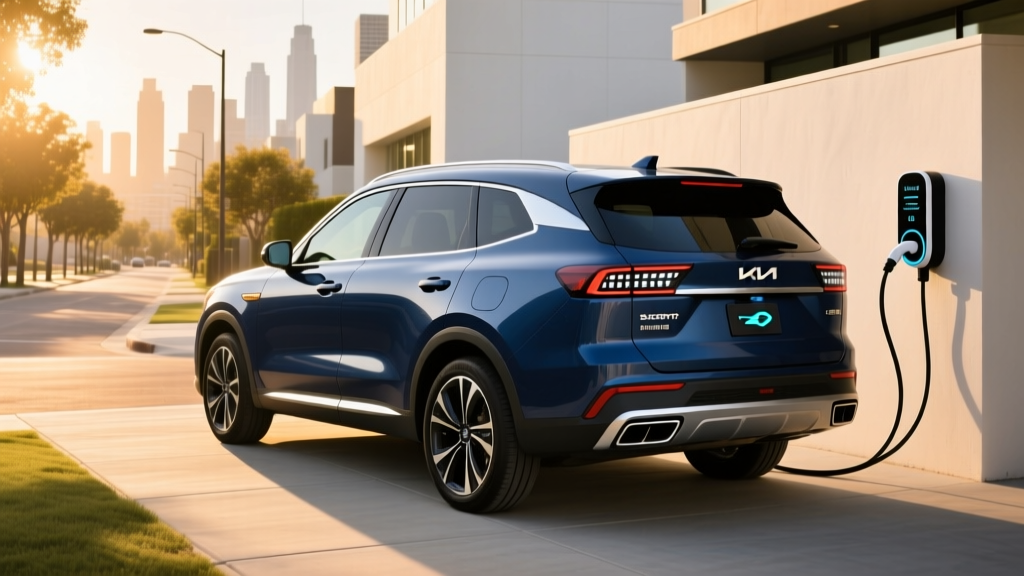
The midsize three-row SUV segment is crowded, but the 2026 Kia Sorento Hybrid SUV occupies a specific niche: it offers electrified efficiency without forcing buyers into range-anxiety territory or full-EV charging infrastructure dependency. Available as both a conventional hybrid (HEV) and a plug-in hybrid (PHEV), the Sorento covers two very different use cases under one roof. This guide breaks down the real numbers — EPA MPG, electric-only range, battery warranties, pricing, and tax-credit eligibility — so you can determine which version fits your driving life.
HEV vs PHEV: Which Sorento Hybrid Actually Fits You?
Before diving into specs, it's critical to understand that Kia sells two fundamentally different electrified Sorentos. Conflating them is the most common mistake buyers make.
Sorento Hybrid (HEV)
- No plug required. The 1.49 kWh battery recharges via regenerative braking and the gasoline engine.
- How it works: A 44 kW electric motor assists the 1.6L turbocharged four-cylinder, enabling engine-off coasting, electric-only starts, and brake-energy recapture.
- Best for: Drivers without home charging access, apartment dwellers, or those who want better fuel economy with zero behavior change.
- EPA combined: 35 MPG
Sorento Plug-In Hybrid (PHEV)
- Plug-in capable. The 13.8 kWh lithium-ion battery provides meaningful electric-only driving before the gas engine engages.
- How it works: A more powerful 72 kW electric motor pairs with the same 1.6L turbo, enabling full electric propulsion for daily commutes.
- Best for: Homeowners with Level 2 charging, commuters under 35 miles round-trip, drivers who want EV-like daily driving with gas backup for road trips.
- EPA electric-only range: 32 miles | Combined range: ~430 miles
The HEV is a fuel-economy upgrade to a normal car. The PHEV is a partial EV experience that eliminates gas use on short trips. Your charging access and commute length determine which makes financial sense.
2026 Sorento Hybrid (HEV) Fuel Economy: EPA vs Real World
| Metric | Sorento HEV (FWD) | Sorento HEV (AWD) |
|---|---|---|
| City MPG | 36 | 34 |
| Highway MPG | 35 | 34 |
| Combined MPG | 35 | 34 |
| Fuel Tank | 14.8 gal | 14.8 gal |
| Total Range (est.) | ~518 mi | ~503 mi |
Source: EPA Fuel Economy
Real-World MPG Expectations
Hybrids consistently outperform their EPA city ratings in stop-and-go driving because regenerative braking recovers energy that a gas car wastes as heat. In our experience and owner-reported data, the Sorento HEV regularly achieves 36-38 MPG in urban and suburban driving. Highway cruising at 75+ MPH, however, typically drops to 31-33 MPG because the electric motor contributes less at sustained high speeds and the turbo engine carries the full load.
Cold weather (below 30°F) reduces hybrid efficiency by roughly 8-12% due to increased engine runtime for cabin heating and reduced battery efficiency. Expect 30-32 MPG combined in winter conditions if you live in northern climates.
2026 Sorento PHEV: Electric-Only Range and Charging Specs
| Specification | Sorento PHEV |
|---|---|
| Battery Capacity | 13.8 kWh (lithium-ion polymer) |
| EPA Electric-Only Range | 32 miles |
| EPA MPGe (electric + gas) | 79 MPGe |
| Gas-Only MPG (after battery depleted) | 34 MPG combined |
| Combined System Horsepower | 261 hp |
| Combined System Torque | 258 lb-ft |
| Level 1 Charging (120V, 12A) | ~11 hours (0-100%) |
| Level 2 Charging (240V, 32A) | ~3 hours 25 min (0-100%) |
| DC Fast Charging | Not supported |
| Charge Port | J1772 (Level 1/2 only) |
| 0-60 MPH | ~7.4 seconds |
Real-World Electric Range
The EPA-rated 32 miles of electric-only range is achievable in mild weather (55-80°F) at city speeds with moderate climate control use. In practice, expect 26-29 miles on a full charge during mixed driving, and as low as 20-23 miles in freezing temperatures when the cabin heater draws significant energy. Highway driving at 70+ MPH in EV mode depletes the battery roughly 20-25% faster than the EPA cycle suggests.
The Sorento PHEV does not support DC fast charging. This is typical for PHEVs in this class — the 13.8 kWh battery is small enough that Level 2 charging fills it in under four hours, making DCFC infrastructure unnecessary for daily use.
Powertrain Deep Dive: What Moves the Sorento Hybrid
Both the HEV and PHEV share Kia's Smartstream 1.6-liter turbocharged GDI four-cylinder engine, but the electric motor output and total system power differ significantly.
Sorento HEV Powertrain
- 1.6L Turbo GDI inline-4: 178 hp / 195 lb-ft
- Electric motor: 44 kW (59 hp) integrated into the 6-speed automatic transmission
- Combined system output: 227 hp / 258 lb-ft
- Transmission: 6-speed automatic (no CVT)
- Drivetrain: FWD standard, AWD available
Sorento PHEV Powertrain
- 1.6L Turbo GDI inline-4: 178 hp / 195 lb-ft
- Electric motor: 72 kW (97 hp) — significantly more powerful than the HEV motor
- Combined system output: 261 hp / 258 lb-ft
- Transmission: 6-speed automatic
- Drivetrain: AWD standard (PHEV is AWD-only)
The PHEV's larger motor means stronger electric-only acceleration and more assertive passing power when both systems work together. The 261 hp output makes it the most powerful non-turbo-V6 Sorento in the lineup, and it's genuinely quick off the line in EV mode — something the HEV's smaller motor can't match.
Pricing, Trims, and Tax Credit Eligibility
2026 Kia Sorento Hybrid (HEV) Pricing
| Trim | MSRP |
|---|---|
| S (FWD) | $38,390 |
| EX (FWD) | $41,490 |
| EX (AWD) | $42,990 |
| SX Prestige (AWD) | $46,790 |
2026 Kia Sorento PHEV Pricing
| Trim | MSRP |
|---|---|
| EX (AWD) | $50,290 |
| SX Prestige (AWD) | $53,590 |
Pricing includes destination charge. Source: Kia USA
Federal Tax Credit: §30D Eligibility
Sorento HEV: Does not qualify for the federal §30D clean vehicle credit. Conventional hybrids are ineligible — the credit applies only to plug-in electric vehicles with a minimum 7 kWh battery.
Sorento PHEV: Eligibility for the up-to-$7,500 federal tax credit under IRS §30D depends on several factors that change frequently:
- MSRP cap: SUVs must be under $80,000 — the Sorento PHEV clears this easily.
- Buyer income cap: Modified AGI must not exceed $150,000 (single), $225,000 (head of household), or $300,000 (joint).
- Battery sourcing: Critical minerals and battery component requirements phase in annually. As of the 2026 tax year, the sourcing rules are stricter, and some PHEVs that previously qualified may lose partial or full credit eligibility. Check the current fueleconomy.gov listing for the specific model year.
- Point-of-sale transfer: If eligible, you can transfer the credit to the dealer at purchase for an immediate price reduction rather than waiting to claim it on your tax return.
Always verify eligibility with a tax professional and the IRS before relying on the credit for purchase decisions. Rules can and do change.
Battery Warranty, Reliability, and Replacement Cost
Kia Hybrid & PHEV Battery Warranty
- HEV battery: 10 years / 100,000 miles (whichever comes first)
- PHEV battery: 10 years / 100,000 miles (whichever comes first)
- Hybrid system components: 10 years / 100,000 miles (inverter, motor, onboard charger)
- Capacity retention guarantee (PHEV): Kia warrants the battery to retain at least 70% of original capacity during the warranty period
- Basic vehicle warranty: 5 years / 60,000 miles
- Powertrain warranty: 10 years / 100,000 miles
Kia's 10-year hybrid battery warranty is among the longest in the segment and directly addresses the top concern hybrid buyers express: "What happens when the battery dies?"
Realistic Battery Lifespan
Modern lithium-ion hybrid batteries rarely fail catastrophically. Instead, they gradually lose capacity over time — typically 1-2% per year under normal use. The Sorento HEV's 1.49 kWh battery is small and cycled gently (it never fully charges or fully discharges), which extends its life significantly. The PHEV's 13.8 kWh pack sees deeper cycles but benefits from active thermal management.
Based on fleet data from Hyundai-Kia's hybrid platforms, most batteries retain 85-90% capacity at the 100,000-mile mark. Out-of-warranty replacement cost for the HEV battery is approximately $2,500-$3,500 (parts and labor). The PHEV battery replacement runs $5,000-$7,000 due to the larger pack size. These figures are estimates; actual costs vary by dealer and market.
Reliability Track Record
The Sorento Hybrid powertrain has been in production since the 2021 model year, giving Kia several years of field data. The 1.6L turbo engine and 6-speed automatic are conventional, well-understood components. The primary reliability concern in early model years (2021-2022) was related to software glitches in the hybrid control unit, which were largely resolved via OTA and dealer updates. The PHEV variant has been generally reliable, though some owners have reported slower-than-advertised Level 2 charging speeds on 240V/16A circuits — a reminder that your actual charge time depends on your home charger's amperage rating.
Sorento Hybrid vs PHEV vs Full EV: Decision Framework
Choose the Sorento HEV if:
- You don't have access to home or workplace charging
- You want better fuel economy without changing any habits
- Your budget tops out around $42,000-$47,000
- You drive 15,000+ miles per year and want to minimize fuel cost without a plug
- You live in an apartment or rent and can't install a charger
Choose the Sorento PHEV if:
- You can install a Level 2 home charger (240V, ideally 32A or higher)
- Your daily round-trip commute is under 30 miles
- You want EV-like daily driving but need gas flexibility for road trips
- You qualify for the federal tax credit, effectively reducing the price gap vs. the HEV
- You want the most powerful Sorento powertrain (261 hp)
Choose a full EV (e.g., Kia EV9, Hyundai Ioniq 5) if:
- You have reliable home Level 2 charging
- You rarely drive more than 250 miles in a single day
- You want to eliminate gasoline entirely and minimize maintenance
- You're eligible for the full $7,500 federal credit and applicable state incentives
- You're ready to learn public DC fast-charging networks for road trips
The math is straightforward: if you can charge at home and drive under 30 miles daily, the PHEV uses almost zero gasoline on weekdays. Over a year of weekday commuting plus weekend gas-engine driving, a PHEV owner might burn 200-300 gallons versus 430 gallons for the HEV at 35 MPG. At $3.40/gallon, that's a savings of roughly $440-$780 annually — meaning the PHEV's ~$8,000 price premium over an equivalent HEV trim takes 10+ years to recoup through fuel savings alone, unless the federal tax credit applies.
Pros and Cons at a Glance
Pros
- Three-row seating in a hybrid package — rare in this segment
- HEV achieves 35-38 MPG in real-world city driving
- PHEV's 32-mile EV range covers most daily commutes
- 10-year / 100,000-mile hybrid battery warranty
- PHEV's 261 hp is genuinely quick for a family SUV
- 6-speed automatic avoids the drone of a CVT
- AWD available (HEV) or standard (PHEV)
Cons
- Third row is tight for adults — best for children
- PHEV does not support DC fast charging
- PHEV's $50,290 starting price is steep without the tax credit
- HEV highway MPG drops to 31-33 at 75+ MPH
- Cargo space reduced vs. gas-only Sorento (battery packaging)
- PHEV is AWD-only, limiting trim/price flexibility
- Level 1 charging on the PHEV takes 11+ hours — effectively overnight only
Frequently Asked Questions
How many MPG does the Kia Sorento Hybrid get?
The 2026 Sorento HEV is EPA-rated at 36 city / 35 highway / 35 combined (FWD) and 34/34/34 (AWD). Real-world city driving often yields 36-38 MPG thanks to regenerative braking. Highway driving above 70 MPH typically drops to 31-33 MPG. The PHEV achieves 34 MPG combined after the battery is depleted, plus 79 MPGe when operating with a full charge.
How far can the Sorento PHEV go on electric only?
The EPA rates the Sorento PHEV at 32 miles of electric-only range. In real-world conditions, expect 26-29 miles in mild weather and 20-23 miles in freezing temperatures. Once the battery depletes, the gas engine takes over seamlessly, providing a total combined range of approximately 430 miles.
Does the Kia Sorento Hybrid qualify for a tax credit?
The conventional Sorento HEV does not qualify for any federal tax credit — it's not a plug-in vehicle. The Sorento PHEV may qualify for up to $7,500 under IRS §30D, depending on your income, the vehicle's battery sourcing compliance, and current-year rules. Check IRS.gov and consult a tax professional before purchasing.
Is the Sorento Hybrid reliable, and what does battery replacement cost?
The Sorento Hybrid powertrain has been in production since 2021 with generally solid reliability. Kia backs the hybrid battery and system components with a 10-year / 100,000-mile warranty. Out-of-warranty battery replacement costs approximately $2,500-$3,500 for the HEV and $5,000-$7,000 for the PHEV. Most hybrid batteries retain 85-90% capacity at 100,000 miles based on fleet data.
Do I need to plug in the Sorento Hybrid?
No. The conventional Sorento HEV never needs to be plugged in — it charges its small battery through regenerative braking and the gasoline engine. Only the Sorento PHEV requires plug-in charging to access its 32-mile electric-only range. You can drive the PHEV without ever plugging it in, but you'd lose the primary benefit of the larger battery.
Can the Sorento PHEV DC fast charge?
No. The Sorento PHEV supports Level 1 (120V) and Level 2 (240V) charging only, via a J1772 connector. A full Level 2 charge takes approximately 3 hours 25 minutes. This is standard for PHEVs in this class — the battery is small enough that DC fast charging isn't necessary for daily use.
How does the Sorento Hybrid compare to a full EV like the Kia EV9?
The EV9 offers 230-304 miles of EPA range, DC fast charging up to 210 kW, zero tailpipe emissions, and lower maintenance costs. However, it starts around $55,000, requires home charging infrastructure, and demands route planning for road trips beyond its range. The Sorento Hybrid eliminates range anxiety entirely, costs less upfront (HEV), and is better suited for buyers without reliable charging access or those who frequently drive 300+ miles in a day.
The 2026 Kia Sorento Hybrid SUV isn't the most electrified option in Kia's showroom, but it may be the most practical one for the majority of three-row SUV buyers. The HEV delivers meaningful fuel savings with zero lifestyle change, while the PHEV bridges the gap between gasoline and full-electric ownership — as long as you have a place to plug in and the numbers work with available tax credits.