The 2006 Toyota Highlander Hybrid: Toyota's First Hybrid SUV at a Crossroads
When Toyota launched the 2006 Highlander Hybrid, it was one of the first mainstream hybrid SUVs on American roads — a midsize family hauler that promised V6 power with four-cylinder fuel economy. Nearly two decades later, many of these vehicles are still on the road, which says something about Toyota's Hybrid Synergy Drive engineering. But for buyers considering a used 2006 Highlander Hybrid in 2026, the real questions are about battery longevity, real-world fuel economy, and whether a 20-year-old hybrid is a smart budget buy or a money pit waiting to happen.
This guide breaks down the exact specs, ownership costs, and reliability data you need to make that decision — with honest numbers, not marketing nostalgia.
2006 Highlander Hybrid MPG: EPA Ratings vs. Real-World Results
The 2006 Toyota Highlander Hybrid was rated by the EPA under the older, more generous testing methodology used before the 2008 revision. Here's what the official numbers look like, alongside what owners actually report:
| Metric | EPA Estimate (Original) | Real-World Owner Reports |
|---|---|---|
| City MPG | 33 MPG | 26–30 MPG |
| Highway MPG | 28 MPG | 24–27 MPG |
| Combined MPG | ~29 MPG (estimated) | 25–28 MPG |
Why the gap? The pre-2008 EPA testing cycle was notably optimistic, especially for hybrids whose city advantage comes from regenerative braking and electric-only low-speed operation. Under the revised EPA methodology (post-2008), the same powertrain would likely be rated closer to 25 combined. Real-world owners on fueleconomy.gov report an average of approximately 25–27 MPG combined, which is still a meaningful improvement over the non-hybrid 2006 Highlander V6 (rated at roughly 19–21 MPG combined under the old cycle).
City advantage: Like most Toyota hybrids, the 2006 Highlander Hybrid performs better in stop-and-go traffic where regenerative braking recharges the battery and the electric motor handles low-speed launches. Highway driving at 70+ MPH relies more heavily on the gasoline V6, narrowing the hybrid advantage.
Powertrain Specs: How the Hybrid Synergy Drive Works
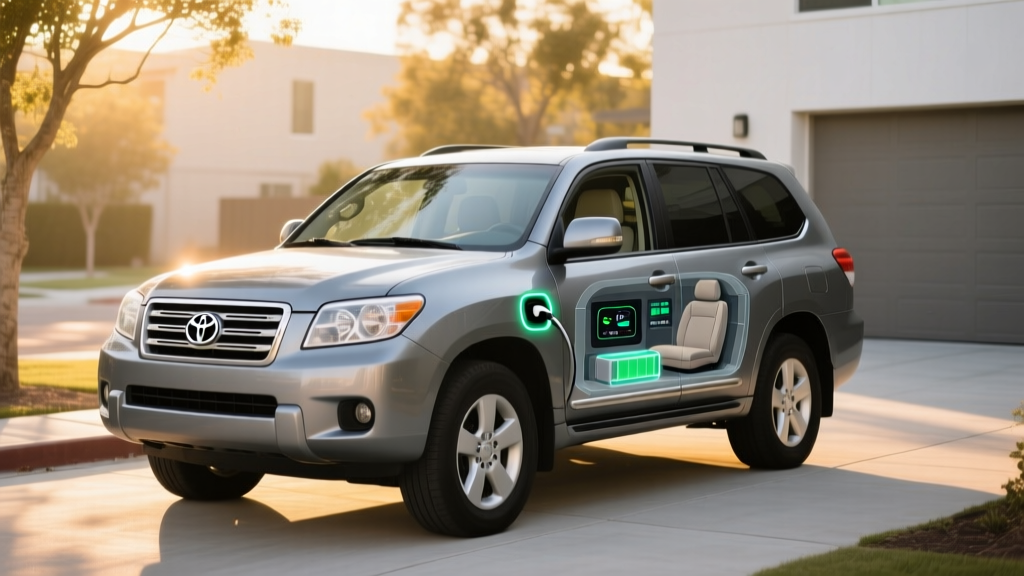
The 2006 Highlander Hybrid pairs a 3.3-liter V6 gasoline engine with Toyota's second-generation Hybrid Synergy Drive (HSD) system. This is a conventional hybrid (HEV) — not a plug-in hybrid. You never plug it in; the battery charges through regenerative braking and the gasoline engine.
| Specification | 2006 Toyota Highlander Hybrid |
|---|---|
| Engine | 3.3L V6 (3MZ-FE) |
| Engine Horsepower | 208 HP (net combined system) |
| Electric Motor | Permanent magnet synchronous (front + rear) |
| Drivetrain | AWD (e-Four electric rear axle) |
| Transmission | eCVT (electronically controlled CVT) |
| Hybrid Battery | NiMH (Nickel-Metal Hydride), ~1.9 kWh |
| 0–60 MPH | ~7.8 seconds |
| Towing Capacity | 3,500 lbs |
| Seating | 5–7 passengers (optional third row) |
The e-Four AWD system is notable: instead of a mechanical driveshaft to the rear wheels, a separate rear electric motor provides all-wheel-drive capability. This means there's no traditional driveshaft, reducing weight and mechanical complexity. The rear motor engages automatically when the system detects front-wheel slip or during hard acceleration.
HEV vs. PHEV vs. EV: Where Does the 2006 Highlander Hybrid Fit?
If you're shopping for an electrified vehicle today, it helps to understand where a 2006-era conventional hybrid sits in the landscape:
| Feature | HEV (This Vehicle) | PHEV (e.g., RAV4 Prime) | BEV (e.g., Tesla Model Y) |
|---|---|---|---|
| Plug-in charging? | No — self-charging | Yes — 120V or 240V | Yes — 240V or DC fast charge |
| Electric-only range | ~1 mile at low speed | 35–42 miles | 260–330+ miles |
| Gasoline required? | Yes — always | Yes — for longer trips | No |
| Federal tax credit (2026) | None | Up to $7,500 (§30D, if eligible) | Up to $7,500 (§30D, if eligible) |
| Home charging install needed? | No | Recommended (Level 2) | Required (Level 2) |
| Typical used price (2026) | $4,000–$8,000 | $28,000–$42,000 | $22,000–$40,000 |
Key distinction: The 2006 Highlander Hybrid is a conventional HEV. It does not have a plug, does not have meaningful electric-only range, and does not qualify for any federal or state electrified-vehicle tax credits. The gasoline engine and regenerative braking handle all battery charging automatically.
Battery Life, Reliability & Replacement Cost
This is the single most important question for anyone buying a 20-year-old hybrid. Here's what the data shows:
Original Battery Warranty
Toyota covered the 2006 Highlander Hybrid's NiMH battery pack for 8 years / 100,000 miles (10 years / 150,000 miles in California-emission states: CA, CT, ME, MA, NJ, NY, OR, RI, VT, WA). That warranty has expired on all remaining examples unless an extended warranty was purchased separately.
Real-world battery longevity: Toyota's NiMH battery packs from this era have proven remarkably durable. Many 2006 Highlander Hybrids have reached 150,000–200,000+ miles on the original battery pack. However, at nearly 20 years old, capacity degradation is inevitable. Owners typically notice a gradual decline in fuel economy (1–3 MPG loss) and more frequent engine engagement as the battery ages.
Battery replacement cost (2026 estimates):
- New OEM Toyota NiMH pack: $2,500–$3,500 (parts) + $500–$800 (labor) = roughly $3,000–$4,300 total
- Refurbished/remanufactured pack: $1,500–$2,200 total installed
- Individual module replacement: Some specialists can replace only the failed cells/modules for $800–$1,500, though this is a temporary fix if the remaining modules are also degraded
Reliability track record: The 3.3L V6 (3MZ-FE) engine is one of Toyota's most reliable powerplants, shared with the Camry and Lexus RX of the same era. The eCVT transmission has no traditional belts or clutches to wear — it's a planetary gearset that's virtually bulletproof. The most common age-related issues are:
- Hybrid battery degradation (expected at this age)
- Hybrid battery cooling fan clogging (clean or replace the cabin air filter regularly)
- Inverter coolant pump failure (~$400–$700 replacement)
- Standard age-related wear: suspension bushings, brakes, hoses
According to long-term owner data tracked by NHTSA, the 2006 Highlander Hybrid has relatively few major recalls, and most complaints center on standard aging components rather than systemic hybrid-system failures.
Does the 2006 Highlander Hybrid Qualify for Any Tax Credits?
No. The 2006 Highlander Hybrid does not qualify for the current federal §30D Clean Vehicle Credit. That credit applies only to new plug-in electric vehicles (BEVs and PHEVs) meeting specific battery-sourcing, MSRP, and buyer-income requirements, as outlined by the IRS.
When new, the 2006 Highlander Hybrid did qualify for a modest federal tax deduction (not a credit) of up to $2,600 under the Energy Policy Act of 2005, but that provision expired and applied only to the original purchaser. There are no current federal or state incentives for purchasing a used conventional hybrid.
Used EV credit note: The §25E used clean vehicle credit (up to $4,000) applies only to used BEVs and PHEVs — not conventional HEVs like this Highlander Hybrid.
Who Should Buy a 2006 Highlander Hybrid in 2026?
Reasons to Buy
- Budget-friendly family SUV: $4,000–$8,000 used
- Proven Toyota reliability with 200K+ mile potential
- AWD capability via e-Four electric rear axle
- 25–28 MPG real-world — better than most gas-only SUVs of the era
- No plug-in charging required — works like a normal car
- 3,500-lb towing capacity for a hybrid
- Available third-row seating for families
Reasons to Hesitate
- Hybrid battery is near end-of-life; budget $2,000–$4,000 for replacement
- No tax credits or incentives available
- Outdated infotainment and safety technology (no backup camera standard, no modern ADAS)
- EPA ratings were inflated under pre-2008 testing — real MPG is closer to 25–27 combined
- NiMH battery is heavier and less energy-dense than modern lithium-ion packs
- Parts availability may decrease as the model ages further
Decision Framework: Is This the Right Electrified Vehicle for You?
Choose the 2006 Highlander Hybrid If:
- You need a cheap, reliable AWD family SUV under $8,000
- You want better fuel economy than a gas-only SUV without any charging infrastructure
- You drive mostly in the city where the hybrid system shines
- You're prepared to budget for a potential battery replacement
Choose a Modern PHEV Instead If:
- You can charge at home and want 30–40 miles of electric-only daily driving
- You want current safety tech (automatic emergency braking, lane-keeping, backup camera)
- You want to take advantage of the §30D tax credit (up to $7,500 for qualifying new PHEVs)
Choose a Full EV Instead If:
- You have home Level 2 charging access
- Your daily commute is under 250 miles round-trip
- You want minimal maintenance and zero gasoline costs
Ownership Costs: 2006 Highlander Hybrid vs. Gas-Only Equivalent
Let's compare annual fuel costs for a realistic 15,000-mile/year driving scenario (55% city, 45% highway) using current 2026 fuel prices:
| Metric | 2006 Highlander Hybrid (26 MPG) | 2006 Highlander V6 Gas (19 MPG) |
|---|---|---|
| Annual fuel use | ~577 gallons | ~789 gallons |
| Annual fuel cost (at $3.50/gal) | ~$2,020 | ~$2,762 |
| Annual savings with hybrid | ~$742/year | |
| 5-year fuel savings | ~$3,710 | |
At roughly $742 per year in fuel savings, the hybrid version pays for a battery replacement ($3,000–$4,000) over about 4–5 years. If you plan to keep the vehicle long-term and the battery hasn't been replaced, that math still works in the hybrid's favor — but only if you're not facing other major repairs simultaneously.
Frequently Asked Questions
How many MPG does the 2006 Toyota Highlander Hybrid actually get?
Real-world owners report 25–28 MPG combined, with city driving yielding the best results (26–30 MPG) and highway cruising returning 24–27 MPG. The original EPA ratings of 33 city / 28 highway were inflated under the pre-2008 testing methodology.
Do I need to plug in the 2006 Highlander Hybrid?
No. This is a conventional hybrid (HEV), not a plug-in hybrid (PHEV). The battery charges automatically through regenerative braking and the gasoline engine. There is no plug, no charging port, and no electric-only driving range beyond about one mile at very low speeds.
How long does the hybrid battery last, and what does replacement cost?
Many original NiMH battery packs have lasted 150,000–200,000+ miles, but at nearly 20 years old, degradation is expected. A new OEM replacement costs roughly $3,000–$4,300 installed; refurbished packs run $1,500–$2,200 installed. Budget for this expense if the battery hasn't been replaced.
Is the 2006 Highlander Hybrid reliable?
Yes, with caveats. The 3.3L V6 engine and eCVT transmission are among Toyota's most durable components. The main age-related risk is hybrid battery degradation, which is expected and budgetable. Overall, it's one of the more reliable early hybrid SUVs, provided maintenance has been kept up.
Does the 2006 Highlander Hybrid qualify for any tax credit?
No. The federal §30D Clean Vehicle Credit applies only to new plug-in vehicles (BEVs and PHEVs). The §25E used clean vehicle credit also applies only to used plug-in vehicles. Conventional hybrids like this one do not qualify for any current federal electrified-vehicle incentives.
Is the 2006 Highlander Hybrid AWD?
Yes. All 2006 Highlander Hybrids came with Toyota's e-Four AWD system, which uses a separate rear electric motor to power the rear wheels when needed. There is no mechanical driveshaft connecting the front and rear axles.
Can I tow with the 2006 Highlander Hybrid?
Yes. The 2006 Highlander Hybrid is rated to tow up to 3,500 pounds when properly equipped, which is adequate for a small trailer, jet ski, or lightweight camper.