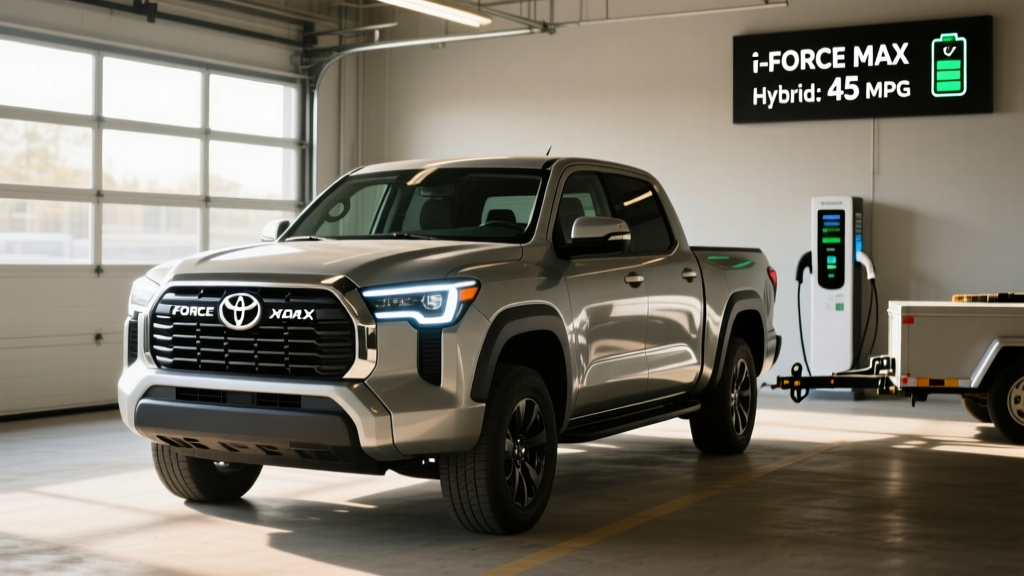
If you've been watching Toyota's truck and SUV lineup, you've likely encountered the i-FORCE MAX hybrid badge. It's Toyota's answer to the full-size truck efficiency problem: a twin-turbo V6 paired with a hybrid electric motor system that delivers V8-rivaling torque while squeezing out meaningfully better fuel economy. But the i-FORCE MAX is a conventional hybrid (HEV), not a plug-in — and that distinction matters enormously for how you'll use it, what you'll pay at the pump, and whether any tax credits apply.
This guide breaks down everything you need to know about the i-FORCE MAX hybrid powertrain as it appears across the 2026 Toyota Tundra, Sequoia, and Land Cruiser — including real-world MPG data, towing specs, battery longevity, and how it stacks up against full EVs and plug-in hybrids for truck buyers.
What Is the i-FORCE MAX Hybrid Powertrain?
The i-FORCE MAX is Toyota's performance hybrid system for body-on-frame trucks and SUVs. It pairs a 3.4-liter twin-turbocharged V6 engine with a 49-horsepower electric motor integrated between the engine and the 10-speed automatic transmission. Combined output is 437 horsepower and 583 lb-ft of torque — numbers that eclipse the old 5.7L V8 the Tundra used for over a decade.
Critically, this is a self-charging hybrid (HEV), not a plug-in hybrid (PHEV). The small battery pack recharges through regenerative braking and the gasoline engine. You never plug it in. You fuel it at a gas station like any conventional truck, but the hybrid system captures energy that would otherwise be wasted during braking and deceleration, then deploys it to assist acceleration and reduce engine load.
HEV vs. PHEV: Where the i-FORCE MAX Fits
| Feature | i-FORCE MAX (HEV) | Typical PHEV (e.g., RAV4 Prime) |
|---|---|---|
| Plugs in to charge? | No | Yes |
| Electric-only range | ~1 mile (low-speed assist only) | 25–42 miles |
| Battery size | ~1.5 kWh (nickel-metal hydride) | 13–18 kWh (lithium-ion) |
| Federal tax credit (§30D) | Not eligible | Up to $7,500 (if eligible) |
| Home charger needed? | No | Recommended for full benefit |
The i-FORCE MAX trades electric-only driving range for simplicity — no charging infrastructure, no range planning, no plug-in routine.
i-FORCE MAX Fuel Economy: EPA MPG and Real-World Numbers
Fuel economy is the headline reason buyers choose the i-FORCE MAX over a non-hybrid truck. Here's how the powertrain performs across the 2026 model-year vehicles that use it:
| 2026 Model | City MPG | Highway MPG | Combined MPG | Real-World Expectation |
|---|---|---|---|---|
| Tundra i-FORCE MAX (4x2) | 20 | 24 | 22 | 20–23 combined |
| Tundra i-FORCE MAX (4x4) | 19 | 22 | 20 | 18–21 combined |
| Sequoia (4x2) | 21 | 24 | 22 | 20–23 combined |
| Sequoia (4x4) | 19 | 22 | 20 | 18–21 combined |
| Land Cruiser (4x4) | 22 | 25 | 23 | 21–24 combined |
Source: fueleconomy.gov EPA estimates for 2025–2026 model years.
📊 Real-World MPG vs. EPA Sticker
Toyota's hybrid system shines in stop-and-go city driving, where regenerative braking recaptures the most energy. Many Tundra i-FORCE MAX owners report exceeding the EPA city estimate by 1–3 MPG in suburban and urban driving. However, sustained highway speeds above 75 mph, heavy towing, or cold-weather operation can drop fuel economy to 16–18 MPG for the Tundra and Sequoia.
When towing near the 10,000+ lb capacity, expect fuel economy in the 10–13 MPG range regardless of hybrid assistance. The electric motor helps with initial load pull but can't overcome the aerodynamic and rolling resistance of a heavy trailer.
Powertrain Specs and Towing Performance
| Specification | i-FORCE MAX Value |
|---|---|
| Engine | 3.4L twin-turbo V6 + electric motor |
| Combined horsepower | 437 hp |
| Combined torque | 583 lb-ft @ 2,400 rpm |
| Transmission | 10-speed automatic |
| Max towing (Tundra) | 10,890 lbs (properly equipped) |
| Max towing (Sequoia) | 9,520 lbs |
| 0–60 mph (Tundra) | ~5.7 seconds |
| Hybrid battery type | Nickel-metal hydride (NiMH), ~1.5 kWh |
The torque figure deserves emphasis: 583 lb-ft arriving at just 2,400 rpm gives the i-FORCE MAX an immediate, electric-motor-assisted shove off the line that makes the Tundra feel genuinely quick for a full-size truck. The electric motor fills in the turbo lag gap, delivering smooth, linear acceleration that the non-hybrid i-FORCE (389 hp, 479 lb-ft) can't match.
i-FORCE MAX Battery: Warranty, Lifespan, and Replacement Cost
🔋 Toyota Hybrid Battery Warranty
- Coverage: 10 years / 150,000 miles (whichever comes first)
- Applies to: Hybrid battery pack and all hybrid system components (inverter, motor, control module)
- Transferable: Yes — transfers to subsequent owners automatically
- Capacity threshold: Toyota warrants against defects and abnormal degradation; no published minimum capacity retention percentage (unlike EV batteries)
Source: Toyota Warranty Guide
Toyota's hybrid battery track record is among the best in the industry. The Prius has demonstrated that Toyota NiMH hybrid batteries routinely last 150,000–200,000+ miles with minimal degradation. The i-FORCE MAX uses a similar chemistry and management philosophy, though in a higher-output application.
Replacement cost if out of warranty: Based on current Toyota hybrid battery pricing, expect $3,000–$5,000 for a replacement hybrid battery pack (parts and labor) for the i-FORCE MAX system. This is dramatically less than a full EV battery replacement ($10,000–$20,000+) because the pack is small (~1.5 kWh vs. 75–100+ kWh in an EV). Toyota also offers refurbished battery packs at a discount through its dealer network.
Pricing and Tax Credit Eligibility
Here's the pricing landscape for 2026 models equipped with the i-FORCE MAX:
| 2026 Model | i-FORCE MAX Starting MSRP | Federal Tax Credit |
|---|---|---|
| Tundra (TRD Off-Road, first i-FORCE MAX trim) | ~$57,500 | Not eligible |
| Sequoia (SR5 base) | ~$63,000 | Not eligible |
| Land Cruiser (1958 edition) | ~$58,000 | Not eligible |
The i-FORCE MAX does not qualify for the federal §30D Clean Vehicle tax credit. Under current IRS rules, the §30D credit applies only to plug-in electric vehicles (BEVs and PHEVs) with battery packs of at least 7 kWh that can be recharged from an external power source. The i-FORCE MAX's ~1.5 kWh self-charging hybrid system does not meet this threshold.
Some state-level incentives may apply to hybrid vehicles depending on your jurisdiction — check your state's energy or environmental agency for current programs. However, most state incentives also prioritize plug-in vehicles.
Who Should Choose the i-FORCE MAX vs. a PHEV or Full EV?
🎯 Decision Framework: Which Powertrain Fits You?
Choose the i-FORCE MAX (HEV) if:
- You need serious towing capacity (9,000–10,890 lbs) regularly
- You don't have access to home or workplace charging
- You take frequent long road trips where charging infrastructure is sparse
- You want better fuel economy than a gas truck without changing your fueling habits
- You live in a rural area or region with limited public charging
Choose a PHEV (like the Toyota RAV4 Prime or Jeep Wrangler 4xe) if:
- Your daily commute is under 30–40 miles and you can charge at home
- You want electric-only driving for errands but gas flexibility for road trips
- You want to qualify for the §30D federal tax credit (up to $7,500)
- You don't need full-size truck towing capacity
Choose a full EV (like the Ford F-150 Lightning or Rivian R1T) if:
- You have reliable home Level 2 charging
- Your daily driving is under 250 miles and you can plan charging on road trips
- You want the lowest per-mile "fuel" cost and minimal maintenance
- You want maximum torque and instant acceleration
- You're eligible for the full $7,500 federal tax credit
Pros and Cons of the i-FORCE MAX Hybrid
✅ Pros
- 583 lb-ft torque at low RPM — excellent for towing and acceleration
- 2–4 MPG improvement over non-hybrid Tundra/Sequoia
- No plug-in charging required — fuel at any gas station
- 10-year / 150,000-mile hybrid battery warranty
- Proven Toyota hybrid reliability track record
- Strong resale value (Tundra and Land Cruiser historically hold value well)
- Regenerative braking reduces brake pad wear
❌ Cons
- No electric-only driving range (not a PHEV)
- No federal tax credit eligibility
- Premium fuel recommended for maximum performance
- ~$3,000–$4,500 upcharge over non-hybrid i-FORCE trims
- Real-world highway MPG drops significantly when towing
- Still a body-on-frame truck — ride quality and efficiency can't match unibody EVs
- Hybrid system adds ~150 lbs of weight
Frequently Asked Questions
How many MPG does the i-FORCE MAX hybrid get?
The EPA rates the 2026 Tundra i-FORCE MAX at 20 city / 24 highway / 22 combined MPG (4x2) and 19/22/20 (4x4). The Sequoia matches these figures. The Land Cruiser, which is lighter and more aerodynamic, achieves 22/25/23 combined. In real-world suburban driving, many owners see 1–3 MPG above the city estimate thanks to regenerative braking. Highway-only driving at 80+ mph or while towing will drop below EPA estimates.
Can the i-FORCE MAX drive on electric power alone?
Not meaningfully. The i-FORCE MAX is a conventional hybrid (HEV), not a plug-in. The electric motor assists the gasoline engine during acceleration and can move the truck at very low speeds (parking lots, traffic creep) for brief distances — typically under 1 mile at speeds below 15 mph. It cannot sustain highway speeds or meaningful distances on electric power alone. If electric-only driving matters to you, look at a PHEV or full BEV.
Is the i-FORCE MAX hybrid reliable? What about battery replacement cost?
Toyota's hybrid systems have an exceptional reliability record spanning 25+ years (since the original Prius in 1997). The i-FORCE MAX uses a proven NiMH battery chemistry with conservative charge/discharge management that prioritizes longevity over maximum electric assist. The hybrid battery is warranted for 10 years / 150,000 miles. If replacement is needed out of warranty, expect $3,000–$5,000 — far less than an EV battery. Many Toyota hybrid batteries last 200,000+ miles without issue.
Does the i-FORCE MAX qualify for any tax credit?
No. The federal §30D Clean Vehicle Credit requires a vehicle to have a battery capacity of at least 7 kWh and the ability to recharge from an external power source (i.e., plug in). The i-FORCE MAX's ~1.5 kWh self-charging system does not qualify. This applies to all conventional hybrids (HEVs). If a tax credit is a priority, consider a PHEV like the Jeep Wrangler 4xe or a full EV like the Ford F-150 Lightning — both may qualify for up to $7,500 depending on your income, the vehicle's MSRP, and battery sourcing requirements per IRS guidelines.
How does the i-FORCE MAX compare to the Ford F-150 PowerBoost hybrid?
Ford's PowerBoost is the closest competitor — also a conventional HEV in a full-size truck. The PowerBoost pairs a 3.5L twin-turbo V6 with a 47-hp electric motor for 430 hp and 570 lb-ft, rated at 22–25 MPG combined (slightly higher EPA than the Tundra i-FORCE MAX). The PowerBoost also offers Pro Power Onboard with up to 7.2 kW of generator output. The i-FORCE MAX counters with slightly higher torque (583 vs. 570 lb-ft), a stronger long-term hybrid reliability track record, and better resale value projections. Both are solid choices; the decision often comes down to brand preference and dealer pricing.
Should I get the i-FORCE MAX or just save money with the standard i-FORCE?
The standard i-FORCE (non-hybrid) produces 389 hp and 479 lb-ft and gets roughly 17–20 MPG combined depending on configuration. The i-FORCE MAX costs approximately $3,000–$4,500 more upfront but gains 94 hp, 104 lb-ft of torque, and 2–4 MPG improvement. At 15,000 miles per year and $3.50/gallon fuel, the MPG improvement saves roughly $300–$500 annually in fuel. The performance and towing gains are the more compelling reason to upgrade — the fuel savings partially offset the premium but won't fully pay for it over a typical ownership period unless you drive high annual miles in city conditions.