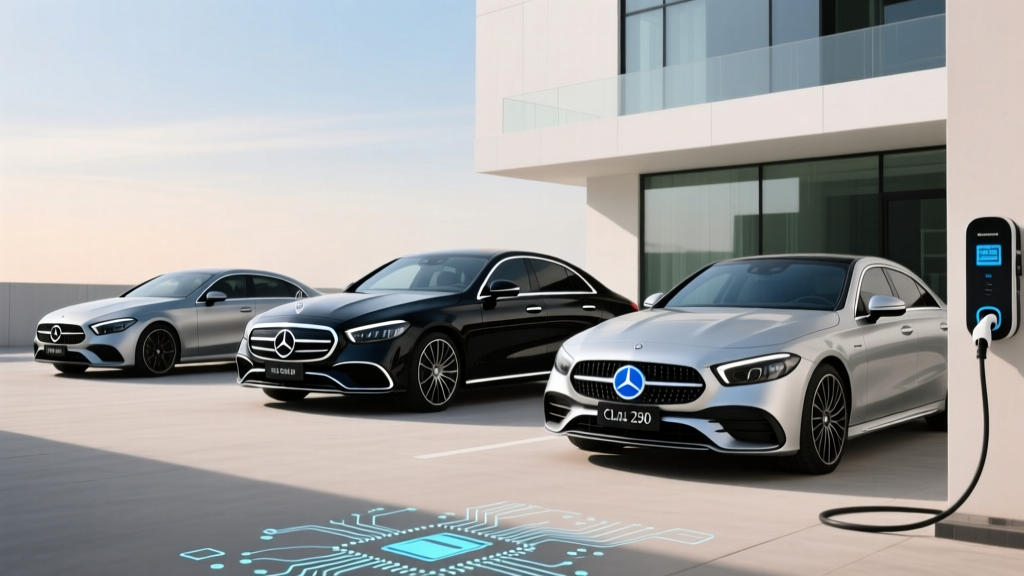
If you are shopping for a Mercedes-Benz hybrid sedan in 2026, the brand's electrified lineup spans three distinct tiers — from the compact CLA 250e plug-in hybrid to the mid-size C 300e and the flagship S 580e PHEV. Each takes a different approach to combining a gasoline engine with electric propulsion, and the right choice depends heavily on your commute, charging access, and budget.
This guide breaks down every current Mercedes-Benz hybrid sedan with exact EPA figures, battery specifications, real-world efficiency expectations, and federal tax credit eligibility under current IRS §30D rules. We will also clarify a critical distinction: Mercedes-Benz no longer sells conventional hybrid (HEV) sedans in the US market. Every electrified sedan in the lineup is a plug-in hybrid (PHEV) — meaning you can plug in and drive on electricity alone for a meaningful distance before the gas engine engages.
HEV vs PHEV: What Mercedes-Benz Actually Sells
Conventional Hybrid (HEV): Uses a small battery and electric motor to assist a gasoline engine. The battery recharges through regenerative braking and engine power. You never plug it in. Think Toyota Prius. Mercedes-Benz does not currently offer HEV sedans in the US.
Plug-In Hybrid (PHEV): Carries a larger battery (typically 20–30 kWh) that you plug in to recharge. It can drive on electric power alone for 30–55 miles before the gas engine takes over. Once the battery depletes, it operates like a conventional hybrid. All three current Mercedes-Benz hybrid sedans — the CLA 250e, C 300e, and S 580e — are PHEVs.
This matters because PHEV ownership economics depend entirely on whether you can charge at home or work. If you plug in nightly and your commute falls within the electric-only range, you may go weeks without burning gasoline. If you never plug in, you are carrying hundreds of pounds of dead battery weight and achieving worse fuel economy than a conventional hybrid would deliver.
2026 Mercedes-Benz Hybrid Sedan Specs at a Glance
| Specification | CLA 250e | C 300e | S 580e |
|---|---|---|---|
| Body Style | Compact Sedan | Mid-Size Sedan | Full-Size Luxury Sedan |
| Powertrain | 1.3L Turbo I4 + Electric Motor | 2.0L Turbo I4 + Electric Motor | 3.0L Turbo I6 + Electric Motor |
| Combined Horsepower | 218 hp | 313 hp | 503 hp |
| Combined Torque | 280 lb-ft | 406 lb-ft | 516 lb-ft |
| Battery Capacity (usable) | 15.6 kWh | 25.4 kWh | 28.6 kWh |
| Battery Chemistry | NMC | NMC | NMC |
| EPA Electric-Only Range | ~44 miles | ~54 miles | ~46 miles |
| EPA Combined MPGe | ~83 MPGe | ~87 MPGe | ~68 MPGe |
| EPA Combined MPG (gas-only) | ~32 MPG | ~30 MPG | ~27 MPG |
| AC Charging (Level 2) | 7.4 kW (onboard charger) | 11 kW (onboard charger) | 11 kW (onboard charger) |
| DC Fast Charging | Not available | Optional 60 kW DC | Optional 60 kW DC |
| 0–60 mph | ~7.2 sec | ~5.4 sec | ~4.7 sec |
| Starting MSRP | ~$45,950 | ~$59,900 | ~$120,450 |
| Federal Tax Credit (§30D) | Up to $3,750* | Up to $3,750* | Not eligible (MSRP cap) |
| Battery Warranty | 6 yr / 62,000 mi | 6 yr / 62,000 mi | 6 yr / 62,000 mi |
*Tax credit amounts depend on battery sourcing, buyer income, and current-year IRS rules. See the tax credit section below for full eligibility details. Source: fueleconomy.gov and Mercedes-Benz USA specifications.
Electric-Only Range and Real-World Efficiency
The headline number for any PHEV is how far it travels on electricity alone. For the 2026 Mercedes-Benz hybrid sedan lineup, the C 300e leads with an EPA-rated 54 miles of electric range, followed by the S 580e at roughly 46 miles and the CLA 250e at approximately 44 miles.
Real-World Electric Range Reality: EPA electric-range figures assume moderate temperatures, mixed driving, and gentle acceleration. Expect 15–25% less electric range in cold weather (below 40°F) due to cabin heating demands and reduced battery efficiency. Highway-only driving at 70+ mph also reduces electric range by roughly 10–15% compared to city driving, where regenerative braking recovers energy. For the C 300e, plan on approximately 40–48 miles of real-world electric range in normal conditions and 33–40 miles in winter.
Once the battery depletes, the gasoline engine takes over and the car operates as a series-parallel hybrid. Here, the EPA combined MPG figures (gas-only mode) are relevant: the CLA 250e returns approximately 32 MPG combined, the C 300e about 30 MPG combined, and the heavier S 580e around 27 MPG combined.
How Many MPG Does a Mercedes-Benz Hybrid Sedan Get?
| Model | EPA City (gas) | EPA Highway (gas) | EPA Combined (gas) | Combined MPGe (electric+gas) |
|---|---|---|---|---|
| CLA 250e | ~34 MPG | ~30 MPG | ~32 MPG | ~83 MPGe |
| C 300e | ~32 MPG | ~28 MPG | ~30 MPG | ~87 MPGe |
| S 580e | ~29 MPG | ~25 MPG | ~27 MPG | ~68 MPGe |
Real-world note: PHEVs typically exceed their EPA city MPG in actual urban driving because stop-and-go traffic maximizes regenerative braking. Conversely, sustained highway cruising yields lower MPG than the EPA city figure. If your driving is predominantly highway, expect gas-mode fuel economy to trend toward the highway column.
Charging: Level 2, DC Fast Charge, and What You Need at Home
All three Mercedes-Benz PHEV sedans accept Level 2 AC charging via a J1772 connector (or NACS with adapter, depending on model year and market transition). The key difference is the onboard charger capacity and whether DC fast charging is available.
CLA 250e: Equipped with a 7.4 kW onboard AC charger. A full charge from empty takes approximately 2 hours and 15 minutes on a Level 2 home charger. DC fast charging is not available — this is a meaningful limitation if you rely on public charging during the day.
C 300e: Comes with an 11 kW onboard AC charger standard, reducing a full charge to roughly 2 hours and 45 minutes. Mercedes-Benz offers an optional DC fast-charging capability (up to 60 kW) on select trims, which can replenish the battery from 10–80% in approximately 25 minutes at a compatible station.
S 580e: Also features an 11 kW onboard charger with optional 60 kW DC fast charging. With its larger 28.6 kWh battery, a full Level 2 charge takes approximately 3 hours. DC fast charging drops the 10–80% replenishment to roughly 30 minutes.
| Charging Level | Power | Approximate Miles Added per Hour | Typical Use Case |
|---|---|---|---|
| Level 1 (120V outlet) | 1.4 kW | 3–5 miles | Overnight trickle; emergency top-up |
| Level 2 (240V home) | 7.4–11 kW | 18–30 miles | Daily home/work charging |
| DC Fast Charge (optional) | Up to 60 kW | ~150+ miles | Public fast charging on road trips |
Home charging setup: A dedicated Level 2 home charger (240V, 32–48 amp circuit) is strongly recommended for PHEV ownership. Installation typically costs $800–$2,000 depending on panel capacity and wiring distance. With nightly home charging, most PHEV owners cover their entire commute on electricity and only use gasoline for longer trips.
Powertrain Deep Dive: Engine Meets Electric Motor
Mercedes-Benz equips each PHEV sedan with a turbocharged gasoline engine paired with an electric motor integrated into the transmission housing. This configuration allows seamless transitions between electric-only, hybrid, and engine-only driving modes.
CLA 250e: A 1.3-liter turbocharged inline-four producing 163 hp pairs with a 109 hp electric motor for a combined 218 hp. The system is front-wheel-drive only, which keeps weight and complexity down. It is adequate for daily commuting but not a performance-oriented setup.
C 300e: The 2.0-liter turbo four (204 hp) teams with a 129 hp electric motor for 313 combined horsepower and 406 lb-ft of torque. Rear-wheel drive is standard; 4MATIC all-wheel drive is available on certain trims. The electric motor's instant torque fill makes the C 300e feel considerably quicker than its 5.4-second 0–60 time suggests in everyday driving.
S 580e: The flagship pairs a 3.0-liter turbocharged inline-six (362 hp) with a 148 hp electric motor for a combined 503 hp. All-wheel drive (4MATIC) is standard. The inline-six's refinement combined with silent electric motoring at low speeds delivers the isolation expected of an S-Class, and the 4.7-second 0–60 time means this luxury sedan can hustle when needed.
Tax Credit Eligibility Under IRS §30D Rules
Federal plug-in hybrid tax credits are governed by the same IRS §30D rules that apply to full EVs, but the credit amount for PHEVs is often lower because it depends on battery capacity and the percentage of critical minerals and battery components sourced from US free-trade-agreement partners.
- Battery capacity requirement: At least 7 kWh (all three Mercedes PHEVs qualify).
- MSRP cap: Sedans must be priced below $55,000 to qualify. This immediately disqualifies the S 580e (~$120,450) and most C 300e trims (~$59,900 base, often higher with options).
- Buyer income cap: Modified adjusted gross income must not exceed $150,000 (single), $225,000 (head of household), or $300,000 (joint filing).
- Battery sourcing: The credit splits into two halves — $3,750 for critical minerals sourcing and $3,750 for battery component assembly. Most Mercedes-Benz PHEVs currently qualify for only one half ($3,750) due to supply chain composition.
- Point-of-sale transfer: Eligible buyers can transfer the credit to the dealer at purchase, reducing the out-of-pocket price immediately rather than waiting for a tax refund.
- Final assembly: Vehicle must undergo final assembly in North America. Verify at irs.gov before purchasing.
Bottom line: The CLA 250e is the most likely candidate for a partial federal credit (up to $3,750) due to its sub-$55,000 MSRP. The C 300e may qualify on base trims only if optioned carefully. The S 580e does not qualify for the federal credit. Always confirm eligibility with a tax professional and check the IRS qualified vehicle list at the time of purchase, as sourcing requirements tighten annually.
Battery Longevity, Warranty, and Replacement Cost
Mercedes-Benz PHEV Battery Warranty: 6 years or 62,000 miles (whichever comes first) for high-voltage battery capacity retention. This covers the battery dropping below a specified state-of-health threshold (typically 70% of original capacity). This warranty is shorter than the 8-year/100,000-mile warranty common on full EVs — a trade-off worth noting.
Is This Hybrid Reliable and What Is Battery Replacement Cost?
Mercedes-Benz PHEV powertrains have proven reasonably reliable, though the complexity of combining a turbocharged engine, electric motor, high-voltage battery, and associated power electronics introduces more potential failure points than a conventional hybrid like a Toyota Prius. The NMC lithium-ion batteries in these vehicles are liquid-cooled, which helps manage thermal degradation.
Expected battery lifespan: Based on industry degradation data for liquid-cooled NMC packs, expect approximately 10–15% capacity loss over 8–10 years of typical use. PHEV batteries experience more frequent charge-discharge cycles (daily full cycles versus partial cycles in full EVs), which can accelerate degradation slightly.
Battery replacement cost: Out-of-warranty high-voltage battery replacement for a Mercedes-Benz PHEV sedan ranges from approximately $8,000 to $16,000 depending on the model, plus labor. The S 580e's larger, more complex pack sits at the higher end. This is a significant cost that buyers planning long-term ownership should budget for.
Reliability context: According to owner surveys and industry data, Mercedes-Benz PHEVs rank in the middle of the pack for reliability — behind Toyota and Lexus hybrids but comparable to BMW and Audi PHEV offerings. Common issues include software glitches in the energy management system and occasional sensor-related warnings rather than catastrophic battery failures. The standard 4-year/50,000-mile new-vehicle warranty covers most early-life concerns.
Pricing, Trims, and Total Cost of Ownership
Here is where the Mercedes-Benz hybrid sedan lineup spreads dramatically:
| Model | Base MSRP | Typical Well-Equipped Price | Est. Federal Credit | Effective Starting Price |
|---|---|---|---|---|
| CLA 250e | ~$45,950 | ~$52,000 | Up to $3,750 | ~$42,200 |
| C 300e | ~$59,900 | ~$68,000 | Up to $3,750 (base only) | ~$56,150 |
| S 580e | ~$120,450 | ~$140,000+ | $0 | ~$120,450 |
5-year operating cost advantage: If you charge at home and your daily round-trip commute falls within the electric-only range, a Mercedes PHEV sedan can reduce fuel costs by 50–70% compared to its gasoline-only equivalent. At $0.14/kWh (national average residential electricity rate) and $3.50/gallon gasoline, the C 300e costs approximately $0.045 per mile on electricity versus $0.117 per mile on gasoline — a savings of roughly $720 per year for a 10,000-mile electric commute.
However, insurance premiums for Mercedes PHEVs run 10–20% higher than their gas-only counterparts due to repair complexity and higher replacement part costs. Factor this into your total cost calculation.
Who Should Choose a Mercedes-Benz Hybrid Sedan?
Choose the CLA 250e if: You want the most affordable entry into a Mercedes PHEV, your commute is under 40 miles round-trip, you can charge at home, and you want to potentially capture a partial federal tax credit. Best for: budget-conscious luxury buyers in urban/suburban settings.
Choose the C 300e if: You want a mid-size luxury sedan with genuine passing power, 50+ miles of electric range for most commutes, and optional DC fast charging for road-trip flexibility. Best for: professionals with predictable commutes who still want a traditional luxury sedan experience.
Choose the S 580e if: Budget is not a primary constraint, you value S-Class refinement and technology, and you want electric-only driving for city errands with inline-six power for highway cruising. Best for: executive transport, luxury-first buyers who view the PHEV system as a refinement feature rather than a cost-saving one.
Choose a full EV instead if: You have reliable home charging, your daily driving rarely exceeds 200 miles, you want zero gasoline expenses, and you prefer lower maintenance (no oil changes, no spark plugs, no turbo-related service). Consider the Mercedes EQE or EQS sedan.
Choose a conventional gas car instead if: You cannot charge at home or work, you drive primarily long highway routes, and you want the lowest purchase price and simplest ownership experience.
Frequently Asked Questions
How far can a Mercedes-Benz hybrid sedan go on electric only?
The C 300e offers the most electric-only range at approximately 54 miles EPA. The S 580e delivers about 46 miles, and the CLA 250e approximately 44 miles. Real-world range drops to 33–48 miles depending on temperature, driving style, and terrain.
Do Mercedes-Benz hybrid sedans need to be plugged in?
Yes — all current Mercedes-Benz hybrid sedans sold in the US are plug-in hybrids (PHEVs). They generate their own electricity through regenerative braking and the gasoline engine, but to access the full electric-only range and maximize fuel savings, you must plug them in. Without regular charging, a PHEV operates as a heavier, less efficient conventional hybrid.
Does a Mercedes-Benz hybrid sedan qualify for a tax credit?
Under current IRS §30D rules, only PHEVs priced below $55,000 (sedans) qualify, and the credit amount depends on battery sourcing. The CLA 250e is the most likely to qualify for a partial credit (up to $3,750). The C 300e may qualify on base trims. The S 580e exceeds the MSRP cap and does not qualify. Income caps also apply. Always verify at irs.gov before purchasing.
How long will the PHEV battery last and what does replacement cost?
Mercedes-Benz covers the high-voltage battery for 6 years or 62,000 miles. Based on NMC degradation patterns, expect the battery to retain 85–90% of original capacity after 8–10 years with normal use. Out-of-warranty replacement costs range from approximately $8,000 to $16,000 depending on the model.
Hybrid vs PHEV vs EV — which Mercedes sedan fits me?
If you have home charging and a commute under 50 miles, a PHEV like the C 300e offers the best of both worlds — electric commuting with gas-engine freedom for road trips. If you can charge at home and rarely drive over 250 miles in a day, a full EV (EQE/EQS) eliminates gasoline entirely and reduces maintenance. If you cannot charge at home, a PHEV still works but you will burn more fuel than the EPA sticker suggests — consider whether the premium over a gas model is justified.
Can I DC fast charge a Mercedes-Benz PHEV sedan?
DC fast charging is optional on the C 300e and S 580e (up to 60 kW), enabling a 10–80% charge in roughly 25–30 minutes. The CLA 250e does not offer DC fast charging — Level 2 AC charging at 7.4 kW is the fastest option.