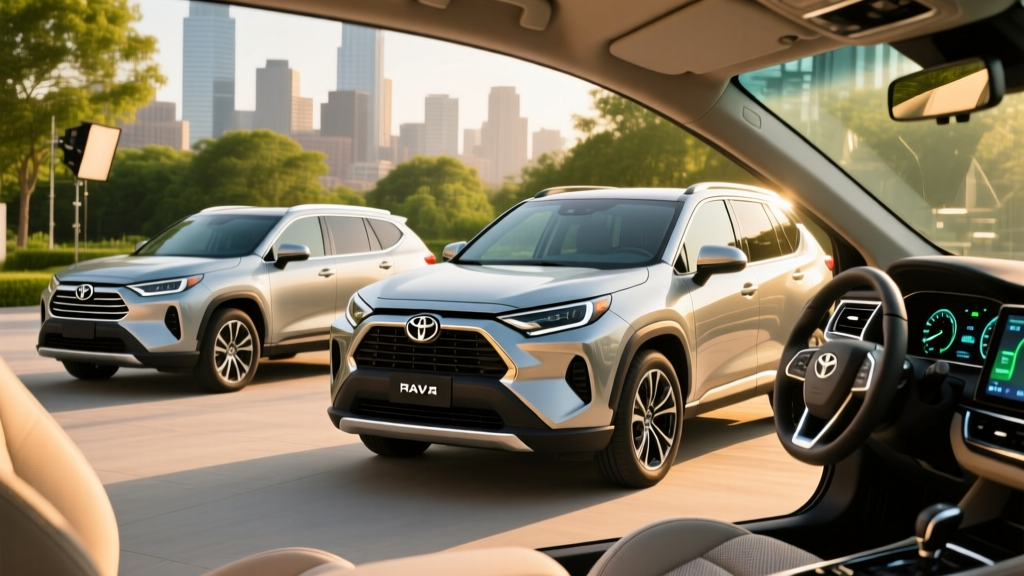
If you're shopping for a Toyota hybrid SUV, you're not alone — Toyota has sold millions of hybrid vehicles globally and dominates the hybrid SUV segment in the United States. For 2026, Toyota offers four distinct hybrid SUV options spanning compact, midsize, and three-row categories, including both conventional hybrids (HEVs) and a plug-in hybrid (PHEV). This guide breaks down every model with exact EPA MPG figures, powertrain specs, pricing, tax credit eligibility, and real-world ownership data so you can pick the right one.
Toyota's 2026 Hybrid SUV Lineup at a Glance
Before diving into each model, here's how Toyota's hybrid SUVs stack up side by side on the numbers that matter most:
| Model | Type | EPA Combined MPG | EV-Only Range | Combined HP | Starting MSRP |
|---|---|---|---|---|---|
| RAV4 Hybrid | HEV | 39 MPG | N/A | 219 hp | $33,575 |
| RAV4 Prime (PHEV) | PHEV | 94 MPGe / 38 MPG (gas) | 42 miles | 302 hp | $44,915 |
| Highlander Hybrid | HEV | 35 MPG | N/A | 243 hp | $42,220 |
| Venza (Grand Highlander Hybrid) | HEV | 36 MPG | N/A | 243 hp | $39,445 |
HEV vs. PHEV: What's the Difference?
Toyota sells two fundamentally different hybrid architectures in its SUV lineup, and confusing them is the most common buyer mistake:
Conventional Hybrid (HEV)
Models: RAV4 Hybrid, Highlander Hybrid, Grand Highlander Hybrid/Venza
How it works: A small battery (typically 1.6–2.5 kWh) is charged entirely by the gasoline engine and regenerative braking. You never plug it in. The electric motor assists the gas engine during acceleration and can propel the vehicle at low speeds for short distances.
Best for: Drivers without access to home or workplace charging who want maximum fuel efficiency with zero behavior change.
Plug-In Hybrid (PHEV)
Model: RAV4 Prime
How it works: A larger battery (18.1 kWh usable) can be charged via a wall outlet or Level 2 charger, providing a substantial electric-only driving range before the gas engine engages. Once the battery is depleted, it operates as a conventional hybrid.
Best for: Drivers with home charging who want EV-like daily commuting with gas-engine backup for road trips — and who may qualify for federal tax credits.
2026 RAV4 Hybrid: The Best-Selling Toyota Hybrid SUV
The RAV4 Hybrid remains Toyota's volume leader in the hybrid SUV segment, and for good reason: it delivers exceptional fuel economy, standard all-wheel drive, and competitive pricing in the most popular SUV size class.
EPA Fuel Economy & Real-World MPG
| Driving Condition | EPA Estimate | Real-World Expectation |
|---|---|---|
| City | 41 MPG | 38–44 MPG (hybrids often exceed EPA city in stop-and-go) |
| Highway | 38 MPG | 34–37 MPG (hybrid advantage shrinks at sustained high speed) |
| Combined | 39 MPG | 36–40 MPG |
According to fueleconomy.gov, the RAV4 Hybrid achieves 41 city / 38 highway / 39 combined MPG. In real-world driving, hybrid owners frequently report exceeding the EPA city estimate because stop-and-go traffic maximizes regenerative braking and electric motor use. Highway efficiency is more closely aligned with the sticker — expect 34–37 MPG at 70+ mph, especially with roof cargo or in cold weather.
Powertrain & Performance
The RAV4 Hybrid pairs a 2.5-liter four-cylinder engine with front and rear electric motors for a combined 219 horsepower. Electronic on-demand AWD is standard across all trims — the rear motor independently drives the rear axle without a mechanical driveshaft. The 0–60 mph time sits around 7.4 seconds, which is brisk for the segment.
Pricing & Tax Credit Eligibility
The 2026 RAV4 Hybrid starts at $33,575 (LE trim, including destination) and tops out near $43,000 for the fully loaded Limited or Woodland Edition. As a conventional hybrid, the RAV4 Hybrid does not qualify for the federal §30D new clean vehicle tax credit — that credit is reserved for plug-in vehicles with sufficient battery capacity. Some states offer hybrid-specific rebates or HOV lane access, but these vary by jurisdiction. Check your state's energy office or DMV for current programs.
2026 RAV4 Prime: The Plug-In Hybrid Powerhouse
The RAV4 Prime is the performance flagship of Toyota's hybrid SUV lineup — and one of the most compelling PHEVs on the market. It combines 42 miles of electric-only range with 302 horsepower and the option to qualify for federal tax incentives.
Electric-Only Range & Total Range
The RAV4 Prime's 18.1 kWh lithium-ion battery delivers an EPA-rated 42 miles of electric-only range. For many commuters, this covers an entire day of driving without burning a drop of gasoline. Once the battery is depleted, the vehicle seamlessly transitions to hybrid mode, delivering 38 MPG combined on gasoline — meaning total range exceeds 520 miles with a full tank and full charge.
Battery, Charging & Powertrain
| Specification | Value |
|---|---|
| Battery Capacity (usable) | 18.1 kWh |
| Level 1 Charging (120V, 12A) | ~12 hours (0–100%) |
| Level 2 Charging (240V, 32A) | ~2.5 hours (0–100%) |
| DC Fast Charging | Not supported |
| EV-Only Top Speed | 84 mph |
| Combined System HP | 302 hp |
| 0–60 mph | 5.7 seconds |
Critical note: The RAV4 Prime does not support DC fast charging. Charging is limited to Level 1 (standard household outlet) and Level 2 (240V home or public charger). For daily use, this is rarely an issue — most owners charge overnight at home and start each day with a full battery. But if your routine requires quick public top-ups, a full BEV with DC fast charging capability may serve you better.
Pricing & Federal Tax Credit
The 2026 RAV4 Prime starts at $44,915 (SE trim) and reaches approximately $49,000 for the XSE Premium. Under current IRS §30D rules, the RAV4 Prime may qualify for a partial or full federal tax credit of up to $7,500, but eligibility depends on several factors:
- MSRP cap: SUVs must have an MSRP at or below $80,000 (RAV4 Prime qualifies)
- Buyer income cap: Modified AGI must not exceed $150,000 (single), $225,000 (head of household), or $300,000 (joint)
- Battery sourcing: Critical mineral and battery component requirements phase in progressively — the exact credit amount depends on where the battery materials are sourced, and this changes annually
- Point-of-sale transfer: Eligible buyers can transfer the credit to the dealer at purchase, reducing the upfront price directly
Because sourcing rules tighten each year, we recommend consulting a tax professional and checking the IRS's current eligible vehicle list before purchasing. The credit is not guaranteed for every buyer in every tax year.
2026 Highlander Hybrid & Grand Highlander Hybrid: Three-Row Efficiency
For families needing three rows of seating, Toyota offers the Highlander Hybrid and the larger Grand Highlander Hybrid. Both use Toyota's proven hybrid powertrain architecture to deliver meaningful fuel savings over their gas-only counterparts.
EPA Fuel Economy
| Model | City MPG | Highway MPG | Combined MPG |
|---|---|---|---|
| Highlander Hybrid (AWD) | 35 | 35 | 35 |
| Grand Highlander Hybrid (AWD) | 36 | 36 | 36 |
For context, the gas-only Highlander AWD returns approximately 24 MPG combined — meaning the hybrid saves roughly 11 MPG, or about $600–$800 per year in fuel costs for a driver covering 15,000 miles annually (assuming $3.50/gallon). Over a 10-year ownership period, that's $6,000–$8,000 in fuel savings alone.
Powertrain & Performance
Both three-row hybrids use a 2.5-liter four-cylinder engine paired with electric motors for a combined 243 horsepower. The Grand Highlander Hybrid MAX variant swaps in a 2.4-liter turbocharged hybrid system producing 362 hp and 400 lb-ft of torque, at the cost of lower fuel economy (approximately 27 MPG combined). The standard hybrid achieves 0–60 mph in roughly 7.9 seconds; the MAX variant drops that to about 6.3 seconds.
Pricing
The 2026 Highlander Hybrid starts at $42,220 (LE trim), while the Grand Highlander Hybrid begins at $44,970. Like the RAV4 Hybrid, these are conventional HEVs and do not qualify for the federal §30D tax credit. Toyota does not currently offer a plug-in hybrid version of either three-row SUV.
Battery Warranty, Reliability & Replacement Costs
Toyota Hybrid Battery Warranty
All 2026 Toyota hybrid and PHEV models include a hybrid battery warranty of 10 years or 150,000 miles (whichever comes first), transferable to subsequent owners. This covers the high-voltage traction battery against defects and excessive capacity loss. The hybrid system components (inverter, motor, control module) carry the same 10-year/150,000-mile coverage.
Toyota's hybrid battery reliability record is among the best in the industry. The company has been producing the Prius since 1997 and the RAV4 Hybrid since 2016, with millions of units on the road. Real-world data from fleet operators and long-term owners shows that Toyota hybrid batteries routinely last 150,000–200,000+ miles before requiring replacement.
If replacement is needed out of warranty, costs vary by model:
- RAV4 Hybrid: $3,000–$4,500 (refurbished/aftermarket options available from ~$1,500)
- RAV4 Prime: $5,000–$7,000 (larger battery, fewer aftermarket options currently)
- Highlander Hybrid: $3,500–$5,000
These costs have trended downward over the past decade as supply chains mature and refurbished units become more available. Toyota dealerships also offer battery reconditioning programs in some markets that can extend battery life at lower cost than full replacement.
Hybrid vs. PHEV vs. Full EV: Which Toyota SUV Is Right for You?
Choose a Toyota HEV (RAV4 Hybrid, Highlander Hybrid) If:
- You don't have reliable access to home or workplace charging
- You want maximum simplicity — no plugs, no charging apps, no behavior changes
- Your budget is under $45,000
- You drive a mix of city and highway and want consistent 35–41 MPG regardless of conditions
- You plan to keep the vehicle 10+ years and want Toyota's proven long-term reliability
Choose the RAV4 Prime (PHEV) If:
- You have a garage or driveway where you can install a Level 2 charger
- Your daily commute is under 40 miles round-trip (you'll rarely use gas on weekdays)
- You want the performance boost — 302 hp and 5.7-second 0–60 is genuinely quick
- You may qualify for the federal tax credit, effectively reducing the price premium over the standard RAV4 Hybrid
- You take road trips and don't want to plan around DC fast-charging infrastructure
What About a Full EV Instead?
If you're considering a Toyota hybrid SUV, you may also be weighing a full battery-electric vehicle like the Toyota bZ4X or competitors such as the Hyundai Ioniq 5 or Tesla Model Y. A full EV makes sense if:
- You can charge at home and your daily driving stays under 200 miles
- You want zero tailpipe emissions and minimal maintenance (no oil changes, no gas engine)
- You qualify for the full $7,500 federal tax credit on an eligible BEV
- You're comfortable with route planning on road trips around DC fast-charging stations
A hybrid or PHEV remains the better choice if charging access is uncertain, you frequently drive 300+ miles in a single day, or you live in an area with sparse public charging infrastructure.
Real-World Ownership: What Toyota Hybrid SUV Owners Report
Beyond EPA stickers, here's what long-term owners consistently report about Toyota hybrid SUVs:
- City MPG exceeds expectations: Hybrid owners in urban environments routinely report 2–5 MPG above the EPA city estimate, thanks to frequent regenerative braking opportunities. The RAV4 Hybrid is particularly strong here, with many owners reporting 42–45 MPG in city driving.
- Highway MPG is honest but lower: At 75+ mph, the aerodynamic disadvantage of an SUV and the reduced hybrid system benefit at steady state mean highway numbers align closely with or fall slightly below EPA estimates.
- Cold weather impact: Expect a 5–10% MPG reduction in sub-freezing temperatures as the engine runs more frequently to provide cabin heat. This is less severe than the 20–30% range loss seen in full EVs, but it's measurable.
- Brake pad longevity: Regenerative braking significantly reduces wear on friction brakes. Many Toyota hybrid owners report original brake pads lasting 80,000–100,000+ miles.
- RAV4 Prime electric range accuracy: The 42-mile EPA EV range estimate is conservative in mild weather — owners report 44–48 miles in 60–75°F conditions. In freezing temperatures, expect 32–38 miles as battery efficiency drops and cabin heating draws power.
Frequently Asked Questions
How many MPG does the Toyota RAV4 Hybrid get?
The 2026 Toyota RAV4 Hybrid achieves an EPA-estimated 41 city / 38 highway / 39 combined MPG. Real-world city driving often yields 42–45 MPG due to regenerative braking, while sustained highway driving at 70+ mph typically returns 34–37 MPG. According to fueleconomy.gov, this makes it one of the most fuel-efficient AWD compact SUVs available.
How far can the RAV4 Prime go on electric only?
The 2026 RAV4 Prime delivers an EPA-rated 42 miles of electric-only range on a full charge. In mild weather (60–75°F), owners frequently achieve 44–48 miles. In cold weather (below 32°F), expect 32–38 miles. The vehicle can reach up to 84 mph in EV mode, making it viable for highway commuting on electric power alone.
Does the Toyota RAV4 Hybrid qualify for a tax credit?
No. The conventional RAV4 Hybrid (HEV) does not qualify for the federal §30D new clean vehicle tax credit, which requires plug-in capability and a minimum battery capacity. The RAV4 Prime (PHEV) may qualify for up to $7,500 depending on your income, the vehicle's battery sourcing compliance, and current-year IRS rules. Consult irs.gov or a tax professional for your specific eligibility.
Is the Toyota hybrid battery reliable, and what does replacement cost?
Toyota hybrid batteries have an industry-leading reliability record, with most lasting 150,000–200,000+ miles. All 2026 Toyota hybrids include a 10-year/150,000-mile hybrid battery warranty. Out-of-warranty replacement costs range from $3,000–$5,000 for HEV models and $5,000–$7,000 for the RAV4 Prime, with refurbished options available at lower cost. Many owners never need a battery replacement within the vehicle's lifetime.
Do I need to plug in a Toyota hybrid SUV?
Only the RAV4 Prime (PHEV) benefits from plugging in. The RAV4 Hybrid, Highlander Hybrid, and Grand Highlander Hybrid are conventional hybrids that charge their batteries entirely through the gas engine and regenerative braking — you never plug them in, and they don't have a charging port. The RAV4 Prime can be plugged into a standard 120V outlet (Level 1, ~12 hours for a full charge) or a 240V Level 2 charger (~2.5 hours).
Which Toyota hybrid SUV is best for a family?
If you need three rows of seating, the Highlander Hybrid (35 MPG combined, starting at $42,220) or Grand Highlander Hybrid (36 MPG combined, starting at $44,970) are the clear choices. For a two-row compact SUV, the RAV4 Hybrid offers the best value at 39 MPG combined and $33,575 starting. The RAV4 Prime is ideal for families with home charging who want 42 miles of electric commuting plus 302 hp for highway merging and mountain driving.
Hybrid vs. PHEV vs. EV — which should I choose?
Choose a conventional hybrid (HEV) if you lack home charging or want zero lifestyle changes. Choose a PHEV like the RAV4 Prime if you can charge at home, commute under 42 miles daily, and want the flexibility of a gas engine for road trips. Choose a full EV if you have reliable home charging, drive under 200 miles daily, want minimal maintenance, and can plan road trips around DC fast-charging stations. For most buyers without guaranteed home charging, a Toyota HEV remains the lowest-risk, highest-reward electrified option.