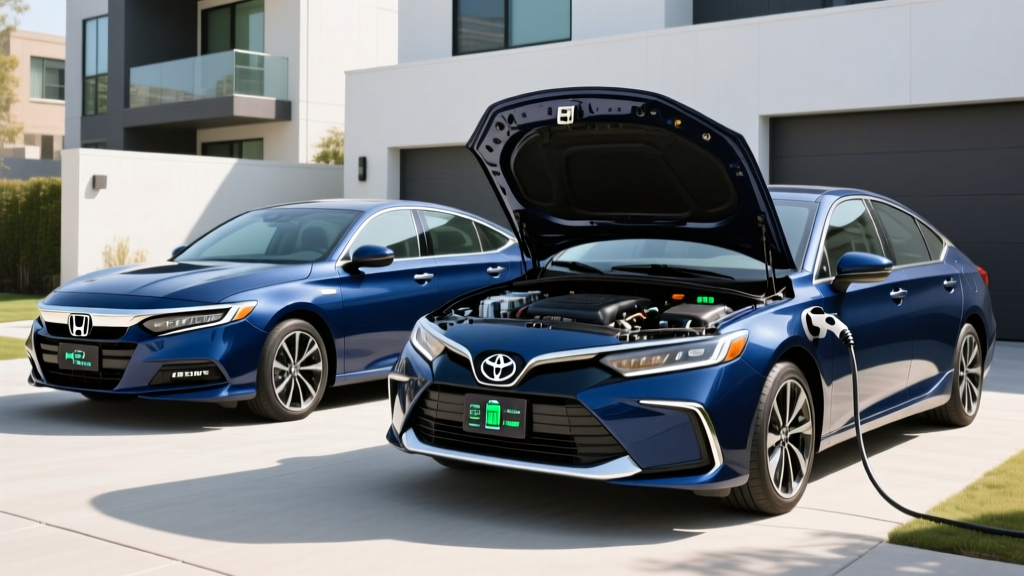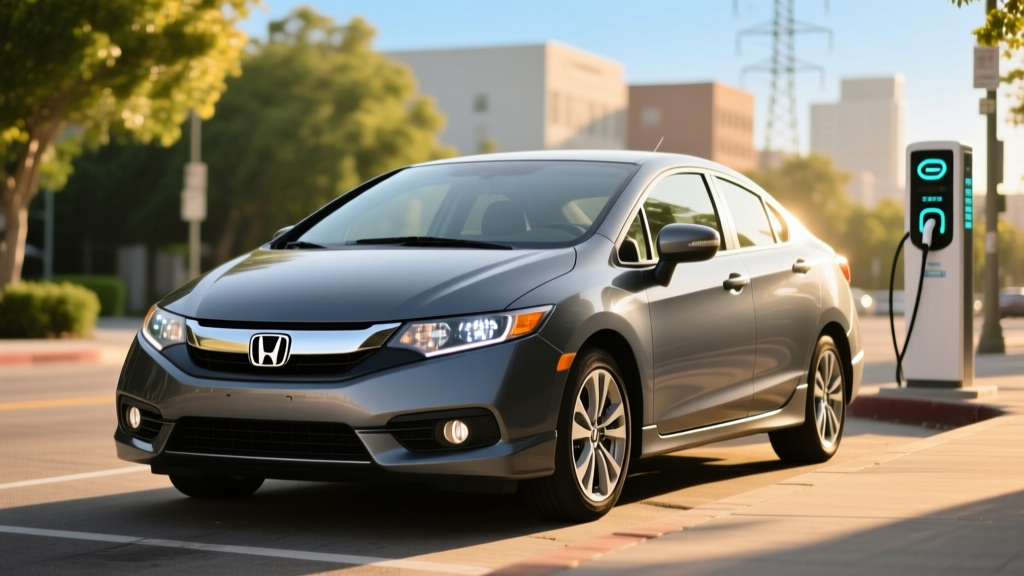
The Honda Accord Hybrid has long been the benchmark midsize sedan for buyers who want electric-motor efficiency without plugging in. For 2025, Honda continues the 11th-generation Accord with a refined interior, updated infotainment, and the same proven two-motor hybrid system that delivers class-leading fuel economy. If you've been searching for details on the 2025 Honda Accord Hybrid interior alongside the powertrain data that actually matters for ownership costs, this guide covers both — with exact EPA numbers, real-world expectations, and a clear look at whether this HEV makes sense versus a PHEV or full BEV.
HEV vs PHEV: What the Accord Hybrid Actually Is
Before examining the cabin, let's be precise about what you're buying. The 2025 Accord Hybrid is a conventional hybrid electric vehicle (HEV). It uses a small lithium-ion battery (approximately 1.06 kWh) that recharges through regenerative braking and the gasoline engine. You never plug it in. There is no electric-only driving range to speak of — the electric motors assist the engine and enable brief low-speed EV mode, but the 1.5L turbo or 2.0L Atkinson-cycle engine (depending on trim) is always part of the equation.
This is fundamentally different from a plug-in hybrid (PHEV) like the Toyota Prius Prime or Hyundai Tucson PHEV, which carries a larger battery (typically 13–20 kWh), offers 25–45 miles of electric-only range, and requires regular plug-in charging to realize its efficiency advantage. The Accord Hybrid has no plug, no electric-only commute capability, and does not qualify for the federal §30D EV tax credit.
- HEV: No plug. ~1 kWh battery. Regenerative braking charges it. Best for drivers without home charging access. Accord Hybrid: EPA 48 MPG combined.
- PHEV: Plug required for full benefit. ~13–20 kWh battery. 25–45 miles electric-only. Best for short commutes with home Level 2 charging. Example: Prius Prime at 44 miles EV range.
- BEV: Plug required. 60–100+ kWh battery. 250–400+ miles range. Best for drivers with reliable home/work charging and low range anxiety. Example: Tesla Model 3 at 341 miles EPA.
2025 Honda Accord Hybrid Interior: Cabin, Tech, and Comfort
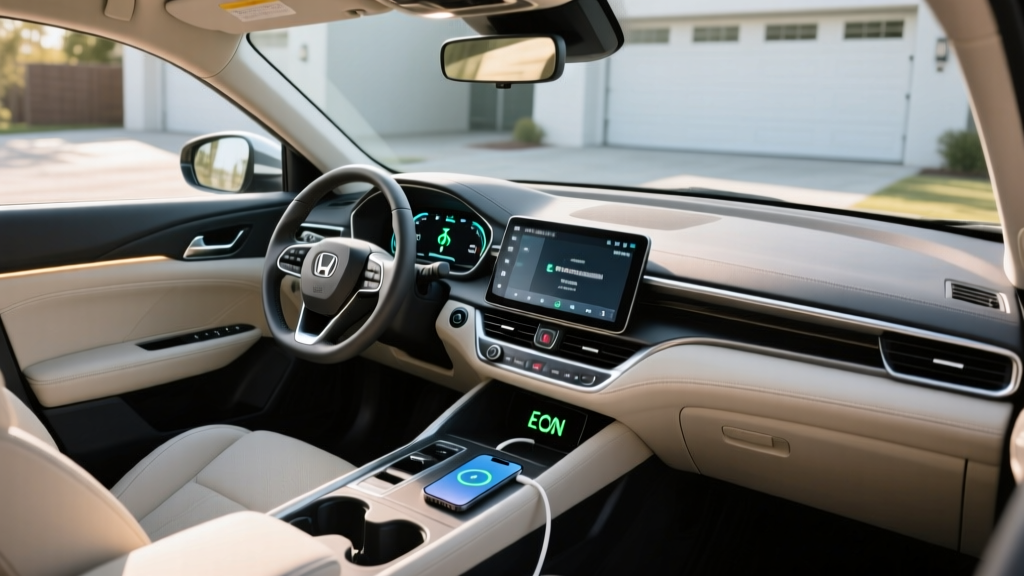
The 2025 Accord Hybrid interior carries forward the clean, horizontal dashboard design introduced with the 11th generation. Honda uses a honeycomb mesh trim strip across the dash that conceals the HVAC vents, giving the cabin an uncluttered look that distinguishes it from the screen-dominated layouts of competitors like the Hyundai Sonata Hybrid or Toyota Camry Hybrid.
Infotainment and Displays
Lower trims (Sport, Sport-L) receive a 7-inch touchscreen with wireless Apple CarPlay and Android Auto. The upper Sport-L Hybrid and EX-L Hybrid trims upgrade to a 12.3-inch touchscreen running Honda's latest interface, which includes a volume knob — a feature buyers consistently request. Wireless phone mirroring is standard on the larger screen. A 10.2-inch digital instrument cluster replaces analog gauges across all hybrid trims, showing real-time energy flow, battery state of charge, and hybrid system status.
Materials and Seating
The Sport Hybrid trim features cloth seating surfaces with a leather-wrapped steering wheel. Sport-L adds leather-trimmed seats with heated front seats as standard. EX-L, the top hybrid trim, includes ventilated front seats, a heated steering wheel, and a 12-speaker Bose premium audio system. Rear-seat legroom measures 40.8 inches — among the best in the midsize segment — and the trunk provides 16.7 cubic feet of cargo volume, identical to the gas-only Accord because the hybrid battery is packaged under the rear seats rather than intruding into the trunk.
Driver Assistance
Every 2025 Accord Hybrid comes with the Honda Sensing suite: adaptive cruise control with low-speed follow, lane-keeping assist, road departure mitigation, and traffic sign recognition. This is an SAE Level 2 driver-assistance system, meaning the driver must remain fully engaged with hands on the wheel and eyes on the road at all times. It is not autonomous driving.
Powertrain Specs and Fuel Economy
The 2025 Accord Hybrid uses Honda's fourth-generation two-motor hybrid system paired with a 2.0-liter Atkinson-cycle inline-4 engine. The combined system output is 204 horsepower and 247 lb-ft of torque, routed through an electronic continuously variable transmission (eCVT) to the front wheels. All-wheel drive is not available on the Accord Hybrid.
| Spec | Value |
|---|---|
| Combined Horsepower | 204 hp |
| Torque | 247 lb-ft |
| Engine | 2.0L Atkinson-cycle I-4 |
| Hybrid Battery | ~1.06 kWh lithium-ion |
| Transmission | eCVT |
| Drivetrain | FWD only |
| 0–60 mph | ~7.0 seconds (est.) |
| Cargo Volume | 16.7 cu ft |
| Rear Legroom | 40.8 in |
EPA Fuel Economy Breakdown
| Trim | City MPG | Highway MPG | Combined MPG |
|---|---|---|---|
| Sport Hybrid (19-inch wheels) | 46 | 41 | 44 |
| Sport-L Hybrid (19-inch wheels) | 46 | 41 | 44 |
| EX-L Hybrid (17-inch wheels) | 51 | 44 | 48 |
The difference between trims comes down to wheel size. The EX-L's 17-inch wheels with lower rolling-resistance tires deliver measurably better efficiency than the Sport trims' 19-inch alloys. According to fueleconomy.gov, the EX-L Hybrid achieves 51 MPG city — one of the highest city ratings of any non-plug-in midsize sedan sold in the U.S.
Real-World MPG: What to Actually Expect
Honda's hybrid system excels in stop-and-go city driving, where regenerative braking recovers energy and the electric motor handles low-speed propulsion. In real-world city testing, many Accord Hybrid owners report matching or slightly exceeding the EPA city estimate — 48–53 MPG is common in moderate climates with mixed urban driving.
Highway efficiency is a different story. At sustained 70–80 mph speeds, the gasoline engine does most of the work, and the hybrid advantage shrinks. Expect 38–42 MPG on long highway trips, particularly in cold weather or with roof cargo. For drivers who do 80%+ of their miles on the highway, the Accord Hybrid's advantage over a conventional gas Accord (EPA 29 city / 37 highway) narrows, though it still wins on combined cycles.
In cold weather (below 32°F), expect a 5–10% reduction in fuel economy due to increased engine runtime for cabin heat, denser air, and winter fuel blends. This is less severe than the 20–30% range loss a full EV experiences in winter, but it's worth factoring in for northern-climate buyers.
Pricing, Trims, and Tax Credit Eligibility
The 2025 Honda Accord Hybrid is available in three trims. Pricing below includes destination charges:
- Sport Hybrid: ~$33,655 MSRP
- Sport-L Hybrid: ~$35,990 MSRP
- EX-L Hybrid: ~$38,990 MSRP
Federal Tax Credit Status
The 2025 Accord Hybrid does not qualify for the federal §30D clean vehicle tax credit (up to $7,500). That credit applies only to plug-in electric vehicles — battery electric vehicles (BEVs) and plug-in hybrids (PHEVs) with at least 7 kWh of battery capacity. The Accord Hybrid's ~1.06 kWh battery falls far short of this threshold. As confirmed by IRS guidelines on the §30D credit, conventional hybrids are excluded from this incentive.
Some states may offer their own incentives for hybrid purchases, though these are increasingly rare as state programs shift focus to zero-emission vehicles. Check your state's energy office or DMV website for current programs.
Battery Warranty, Reliability, and Replacement Cost
Honda covers the Accord Hybrid's lithium-ion battery pack for 8 years / 100,000 miles (whichever comes first) under the hybrid system warranty. In California Air Resources Board (CARB) states — including California, New York, Massachusetts, Oregon, Washington, and several others — the warranty extends to 10 years / 150,000 miles as mandated by CARB emissions regulations.
Long-Term Reliability
Honda's hybrid system has a strong reliability track record. The two-motor eCVT design eliminates the conventional transmission entirely — there are no gears, belts, or friction clutches to wear out. The hybrid battery in the 11th-generation Accord uses a relatively small lithium-ion pack that operates within a narrow state-of-charge window (Honda's battery management system avoids full charges and deep discharges), which significantly extends cell longevity.
Based on data from earlier Honda hybrid systems, most Accord Hybrid battery packs last well beyond 150,000 miles with minimal capacity degradation. The hybrid system's small battery doesn't need to hold much energy — even 20% degradation would only marginally affect fuel economy, since the engine remains the primary power source.
Battery Replacement Cost
If the hybrid battery does fail outside of warranty, replacement costs typically range from $2,000 to $4,000 for a new OEM pack, including labor. Refurbished or aftermarket packs can reduce this to $1,000–$2,000. This is dramatically lower than a full EV battery replacement ($8,000–$20,000+) because the Accord Hybrid's pack is roughly 1/60th the size of a typical BEV battery. The inverter and electric motors are also covered under the hybrid system warranty and rarely require replacement.
How the Accord Hybrid Compares to Alternatives
The Accord Hybrid occupies a specific niche: maximum fuel efficiency for drivers who cannot or do not want to plug in. Here's how it stacks up against the most common alternatives midsize sedan buyers cross-shop:
| Vehicle | Type | EPA Combined | Starting MSRP | AWD Available? |
|---|---|---|---|---|
| Honda Accord Hybrid EX-L | HEV | 48 MPG | ~$38,990 | No |
| Toyota Camry Hybrid (FWD) | HEV | 52 MPG | ~$30,490 | Yes |
| Hyundai Sonata Hybrid | HEV | 47 MPG | ~$32,550 | No |
| Toyota Prius Prime (PHEV) | PHEV | 48 MPG + 44 mi EV | ~$34,070 | No |
The Camry Hybrid's slightly higher combined MPG and available AWD make it the efficiency-and-weather pick, but the Accord Hybrid counters with superior rear-seat space, a more refined ride, and Honda's reputation for long-term durability. The Sonata Hybrid offers strong value with a solar roof panel option on the Limited trim, though its interior materials lag behind Honda's.
- Class-leading rear-seat legroom (40.8 in)
- Up to 48 MPG combined (EX-L)
- No plug-in charging required
- Proven, reliable two-motor hybrid system
- Strong resale value and Honda Sensing standard
- 16.7 cu ft trunk — no hybrid battery intrusion
- No AWD option (Camry Hybrid offers it)
- No federal tax credit eligibility
- Higher starting price than Camry Hybrid base
- CVT drone under hard acceleration
- Only three trims — limited configuration options
- 19-inch wheels on Sport trims reduce MPG to 44
Who Should Buy the Accord Hybrid — And Who Shouldn't
- You lack access to home or workplace EV charging and can't install a Level 2 charger
- Your commute is a mix of city and highway driving with no single dominant pattern
- You want sedan comfort, rear-seat space, and a large trunk without range anxiety
- You plan to own the car 8+ years and value long-term reliability over cutting-edge tech
- You want 44–48 MPG without changing any driving habits
- You have home Level 2 charging and a short commute (under 40 miles) — a PHEV like the Prius Prime could eliminate gas use entirely on weekdays
- You want to qualify for the $7,500 federal tax credit — you'll need a BEV or qualifying PHEV
- You want to minimize your carbon footprint as much as possible — a BEV charged on a clean grid has lower lifetime emissions
- You need AWD for snow-belt winters — consider the Toyota Camry Hybrid AWD or a crossover like the RAV4 Hybrid
Frequently Asked Questions
How many MPG does the 2025 Honda Accord Hybrid get?
The EPA rates the 2025 Accord Hybrid EX-L at 51 city / 44 highway / 48 combined MPG. The Sport and Sport-L trims, equipped with larger 19-inch wheels, are rated at 46 city / 41 highway / 44 combined. Real-world city driving often matches or slightly exceeds the EPA city number, while sustained highway driving at 75+ mph typically yields 38–42 MPG.
Does the Accord Hybrid need to be plugged in?
No. The Accord Hybrid is a conventional hybrid (HEV), not a plug-in hybrid (PHEV). Its small lithium-ion battery recharges through regenerative braking and the gasoline engine. There is no charging port, and you fuel it exclusively at a gas station.
Does the 2025 Accord Hybrid qualify for a federal tax credit?
No. The federal §30D clean vehicle tax credit applies only to plug-in electric vehicles (BEVs and PHEVs) with battery capacities of at least 7 kWh. The Accord Hybrid's ~1.06 kWh battery does not meet this threshold. No federal tax incentive is available for conventional hybrids as of the 2025 tax year.
Is the Accord Hybrid battery reliable, and what does replacement cost?
Honda covers the hybrid battery for 8 years / 100,000 miles (10 years / 150,000 miles in CARB states). Honda's hybrid battery packs historically last well beyond 150,000 miles. If replacement is needed out of warranty, expect $2,000–$4,000 for a new OEM pack — significantly less than an EV battery replacement due to the small pack size.
How does the Accord Hybrid compare to the Toyota Camry Hybrid?
The Camry Hybrid achieves slightly better combined MPG (52 vs. 48 for the Accord EX-L), starts at a lower price, and offers available AWD. The Accord Hybrid counters with more rear-seat legroom (40.8 vs. ~38.0 inches), a larger trunk, and a more composed ride quality. Both are excellent choices; the decision often comes down to AWD needs and interior space priorities.
What is the 2025 Accord Hybrid's electric-only range?
The Accord Hybrid does not have a meaningful electric-only driving range. It can operate in EV mode at very low speeds (parking lots, stop-and-go traffic) for brief distances under 1 mile, but the gasoline engine engages frequently. If you want electric-only commuting, you need a PHEV (like the Prius Prime at 44 miles EV range) or a full BEV.
Sources: EPA fueleconomy.gov, IRS §30D Clean Vehicle Credit, Honda Newsroom specifications. Pricing and incentives are subject to change; verify current MSRP with your local dealer and tax eligibility with a qualified tax professional.