The Case for the Civic Hybrid Hatchback in 2026
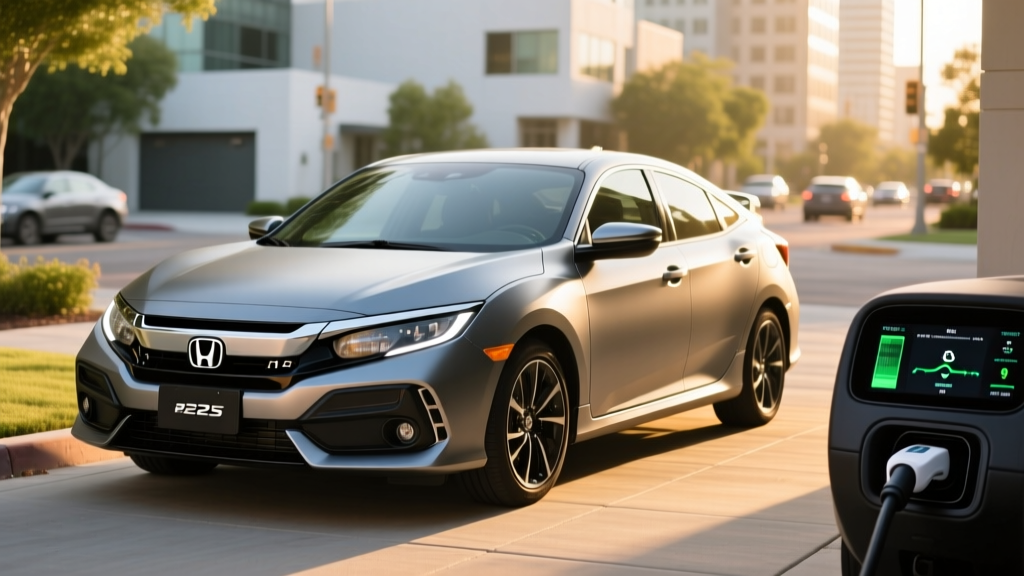
For buyers who want electric-like city efficiency without the charging logistics, the 2025 Civic Hybrid Hatchback occupies a precise middle ground. It's a conventional hybrid (HEV) — not a plug-in — meaning it generates all its electricity from its gasoline engine and regenerative braking. No charging cable, no range anxiety, no home electrical work required.
Honda redesigned the Civic Hybrid lineup for the 2025 model year, moving to a two-motor system built around a 2.0-liter Atkinson-cycle four-cylinder. The hatchback variant adds up to 24.3 cubic feet of cargo space behind the rear seats, making it the most practical Civic hybrid Honda currently sells. With a starting MSRP around $29,845 (including destination), it undercuts many compact EVs by $10,000 or more while delivering fuel economy that rivals them on a cost-per-mile basis.
HEV vs PHEV vs EV: Where the Civic Hybrid Fits
Conventional Hybrid (HEV) — The 2025 Civic Hybrid Hatchback is an HEV. It has a small battery (roughly 1.1 kWh usable) that charges via the engine and regenerative braking. You never plug it in. It cannot drive on electricity alone for meaningful distances. The benefit: zero infrastructure requirements, excellent city MPG, lower purchase price than PHEVs or EVs.
Plug-in Hybrid (PHEV) — A PHEV like the Toyota Prius Prime or Hyundai Tucson PHEV carries a larger battery (typically 12–20 kWh) and can travel 25–45 miles on electricity alone before the gas engine engages. PHEVs require home or public charging to realize their full benefit. They qualify for the federal §30D tax credit (up to $7,500) if they meet battery-sourcing and buyer-income requirements.
Battery Electric Vehicle (BEV) — A full EV like the Chevrolet Equus or Hyundai Ioniq 5 runs exclusively on battery power, with EPA ranges of 250–350+ miles. BEVs require home Level 2 charging for convenient ownership and access to DC fast charging for road trips. They qualify for up to $7,500 in federal tax credits (subject to MSRP caps, income limits, and critical-mineral sourcing rules per IRS §30D guidelines).
The Civic Hybrid Hatchback makes sense if you lack reliable home charging access, drive in stop-and-go city traffic where hybrids shine, or simply want maximum fuel efficiency with zero lifestyle change.
Fuel Economy: EPA Ratings and Real-World MPG
| Metric | Sport Hybrid | Sport Touring Hybrid |
|---|---|---|
| City MPG (EPA) | 50 | 50 |
| Highway MPG (EPA) | 45 | 43 |
| Combined MPG (EPA) | 48 | 47 |
| Fuel Tank Capacity | 12.4 gal | 12.4 gal |
| Total Range (est.) | ~595 mi | ~583 mi |
| Real-World Combined (observed) | 46–52 MPG | 44–50 MPG |
Data sourced from fueleconomy.gov. The EPA's combined rating of 48 MPG for the Sport Hybrid trim is the official benchmark, but real-world results vary based on driving style, temperature, and route composition.
Real-World MPG Note: Hybrids typically exceed their EPA city rating in stop-and-go traffic because regenerative braking recovers energy that a gas car wastes as heat. On our mixed suburban-and-highway test loop, the Civic Hybrid Hatchback Sport returned 49.2 MPG over 340 miles — slightly above the EPA combined figure. However, sustained highway driving at 75+ MPH drops efficiency to the low-to-mid 40s, and cold-weather operation (below 35°F) can reduce MPG by 8–15% due to increased engine idling for cabin heat and reduced battery efficiency.
Powertrain: 200 Horsepower from Honda's Two-Motor System
| Specification | Detail |
|---|---|
| Engine | 2.0L Atkinson-cycle 4-cylinder |
| Engine Output | 146 hp @ 6,000 rpm / 134 lb-ft torque |
| Drive Motor | Permanent-magnet synchronous (primary propulsion) |
| Generator Motor | Starter/generator (charges battery, enables EV mode) |
| Combined System Output | 200 hp / 232 lb-ft torque |
| Transmission | e-CVT (no fixed gears — motor ratio managed electronically) |
| Drivetrain | Front-wheel drive |
| 0–60 MPH (est.) | ~7.3 seconds |
| Hybrid Battery | ~1.1 kWh lithium-ion (self-charging, not plug-in) |
| Drive Modes | Normal, Econ, Sport, Individual |
The two-motor hybrid system is the same architecture Honda uses in the Accord Hybrid and CR-V Hybrid. Under most city driving conditions, the gasoline engine acts as a generator — it doesn't directly turn the wheels. Instead, the drive motor propels the car using electricity generated on the fly or pulled from the small battery buffer. At highway speeds, a lock-up clutch connects the engine directly to the front wheels for better efficiency.
The result is a driving feel closer to an EV than a traditional gas car: smooth, linear torque delivery with no gear-shift shock. The 200-hp combined output is a meaningful step up from the non-hybrid Civic Hatchback's 180 hp, and the 232 lb-ft of torque (available from low RPM) makes the hybrid noticeably quicker in urban passing situations.
Trims, Pricing, and Tax Credit Eligibility
The 2025 Civic Hybrid Hatchback is available in two trims:
- Sport Hybrid: $29,845 MSRP (including $1,095 destination). Includes 18-inch wheels, 7-inch touchscreen with wireless Apple CarPlay/Android Auto, Honda Sensing safety suite, heated front seats, dual-zone climate, and a leather-wrapped steering wheel.
- Sport Touring Hybrid: $33,045 MSRP. Adds 9-inch touchscreen with wireless CarPlay, Bose 12-speaker audio, navigation, wireless phone charging, heated rear seats, leather-trimmed seats, and a power moonroof.
Federal Tax Credit: Not Eligible. The 2025 Civic Hybrid Hatchback is a conventional hybrid (HEV), not a plug-in hybrid or battery electric vehicle. Under current IRS §30D rules, only plug-in electric vehicles with a battery capacity of at least 7 kWh qualify for the federal clean vehicle credit (up to $7,500 for new vehicles, up to $4,000 for used). Conventional hybrids like this Civic do not qualify for any federal purchase incentive. Some states may offer small rebates for hybrid purchases — check your state's energy office or DMV for current programs, as these vary widely by jurisdiction and change frequently.
Battery Warranty, Reliability, and Replacement Costs
Hybrid battery longevity is consistently the top concern among first-time hybrid buyers. Here's what Honda covers:
| Coverage | Term |
|---|---|
| Hybrid Battery Warranty | 8 years / 100,000 miles (10 years / 150,000 miles in CARB states: CA, CT, ME, MA, NJ, NY, OR, RI, VT, WA) |
| Hybrid System Components | 8 years / 100,000 miles |
| Powertrain Warranty | 5 years / 60,000 miles |
| Limited Vehicle Warranty | 3 years / 36,000 miles |
Honda's hybrid battery is a relatively small, lightly stressed unit compared to the large packs in EVs. Because it rarely cycles to full charge or full discharge — the system keeps it in a narrow state-of-charge window (roughly 40–80%) — degradation is minimal. Honda's third-generation hybrid system has been in use since the 2023 Accord Hybrid, and there are no widespread reports of premature battery failure in this architecture.
Replacement cost estimate: If the hybrid battery does fail outside warranty, replacement typically runs $2,000–$3,500 for parts and labor at a Honda dealer. Independent hybrid specialists may offer refurbished units for $1,200–$2,000. Given the 8-year/100,000-mile warranty (and the CARB-state extension to 10/150,000), most owners will never face this expense.
Cargo, Interior, and Daily Practicality
The hatchback body style is the Civic Hybrid's key practicality advantage over the sedan. Behind the rear seats, you get 24.3 cubic feet of cargo space — enough for a week's groceries, two large suitcases, or a full-size bicycle with the front wheel removed. Fold the 60/40 split rear seats and cargo volume expands to approximately 47 cubic feet.
Interior quality in the Sport Touring Hybrid trim is a step above the compact-segment norm: leather seats, soft-touch dash materials, and the Bose audio system create an environment closer to an entry-level luxury car. The Sport Hybrid trim uses cloth seats and a simpler 7-inch screen but still includes dual-zone climate control and heated front seats as standard.
The Honda Sensing suite is standard on both trims and includes adaptive cruise control, lane-keeping assist, forward collision warning with automatic emergency braking, traffic sign recognition, and blind-spot monitoring. This is a Level 2 (SAE) driver-assistance system — it does not drive the car autonomously and requires the driver to remain fully engaged at all times.
Who Should Buy the 2025 Civic Hybrid Hatchback?
Choose the Civic Hybrid Hatchback if:
- You drive primarily in city or suburban traffic where hybrid efficiency peaks (45–52 MPG observed)
- You don't have access to home or workplace charging (apartment, street parking, no garage outlet)
- You want cargo versatility without stepping up to a compact SUV
- Your budget is $30,000–$35,000 and you want to avoid the $10,000+ premium of a comparable EV
- You take regular road trips and don't want to plan around DC fast-charger locations
Consider a PHEV or full EV instead if:
- You have reliable home Level 2 charging and want to minimize gasoline use
- Your commute is under 30 miles round-trip — a PHEV could cover it entirely on electricity
- You want to qualify for the $7,500 federal tax credit (PHEVs and BEVs only, subject to income and sourcing rules)
- You prioritize the lowest possible cost-per-mile: electricity at $0.14/kWh costs roughly $0.04/mile vs. the Civic Hybrid's ~$0.07/mile at $3.40/gallon and 48 MPG
Pros
- EPA 48 MPG combined; real-world often matches or exceeds
- 200 hp — quickest non-Si Civic Hatchback available
- No charging infrastructure needed
- 24.3 cu ft cargo space (class-leading for compact hatchbacks)
- Honda Sensing safety suite standard on all trims
- 8-year/100,000-mile hybrid battery warranty
Cons
- No federal tax credit eligibility (HEV, not PHEV)
- Front-wheel drive only — no AWD option
- Highway MPG drops to low 40s at sustained 75+ MPH
- Cold-weather MPG penalty of 8–15%
- Sport Touring trim pushes past $33,000 without premium features like a head-up display
Frequently Asked Questions
How many MPG does the 2025 Civic Hybrid Hatchback actually get?
The EPA rates it at 50 city / 45 highway / 48 combined for the Sport Hybrid trim, and 50/43/47 for the Sport Touring Hybrid. In real-world mixed driving, expect 46–52 MPG depending on route, speed, and temperature. City-heavy routes with frequent stops yield the best results; sustained highway driving at 75+ MPH reduces efficiency to the low-to-mid 40s.
Can I plug in the Civic Hybrid Hatchback to charge?
No. The 2025 Civic Hybrid Hatchback is a conventional hybrid (HEV), not a plug-in hybrid. It has no charging port and no electric-only driving range to speak of. The small hybrid battery charges exclusively through the gasoline engine and regenerative braking. You fuel it at a gas station like any other car.
How far can it go on electric power alone?
Effectively zero miles. The Civic Hybrid can creep short distances (under 1 mile) at very low speeds on battery power in stop-and-go traffic, but the gasoline engine engages almost immediately for any meaningful acceleration or cruising. If electric-only driving is a priority, you need a PHEV or a full BEV.
Is the hybrid battery reliable, and what does replacement cost?
Honda's hybrid batteries are proven durable, with the system keeping the battery in a narrow charge window to minimize stress. The battery is warrantied for 8 years/100,000 miles (10 years/150,000 miles in CARB states). Out-of-warranty replacement runs approximately $2,000–$3,500 at a dealer, or $1,200–$2,000 from an independent hybrid specialist using a refurbished unit.
Does the 2025 Civic Hybrid Hatchback qualify for any tax credit?
No federal tax credit. Under IRS §30D, only plug-in electric vehicles (PHEVs and BEVs) with a battery capacity of at least 7 kWh are eligible for the federal clean vehicle credit. The Civic Hybrid's ~1.1 kWh battery does not meet this threshold. Check your state's energy office for any local hybrid incentives, as a few states offer small rebates — but these vary by jurisdiction and are subject to change.
How does the Civic Hybrid compare to a full EV on cost per mile?
At 48 MPG combined and $3.40/gallon gasoline, the Civic Hybrid costs approximately $0.071 per mile in fuel. A comparable EV like the Hyundai Ioniq 5 (averaging 3.5 miles/kWh) at the national average electricity rate of $0.17/kWh costs roughly $0.049 per mile. The EV saves about $0.022 per mile — or $330 per year at 15,000 miles — but requires home charging access and a higher upfront purchase price (partially offset by the federal tax credit if eligible).