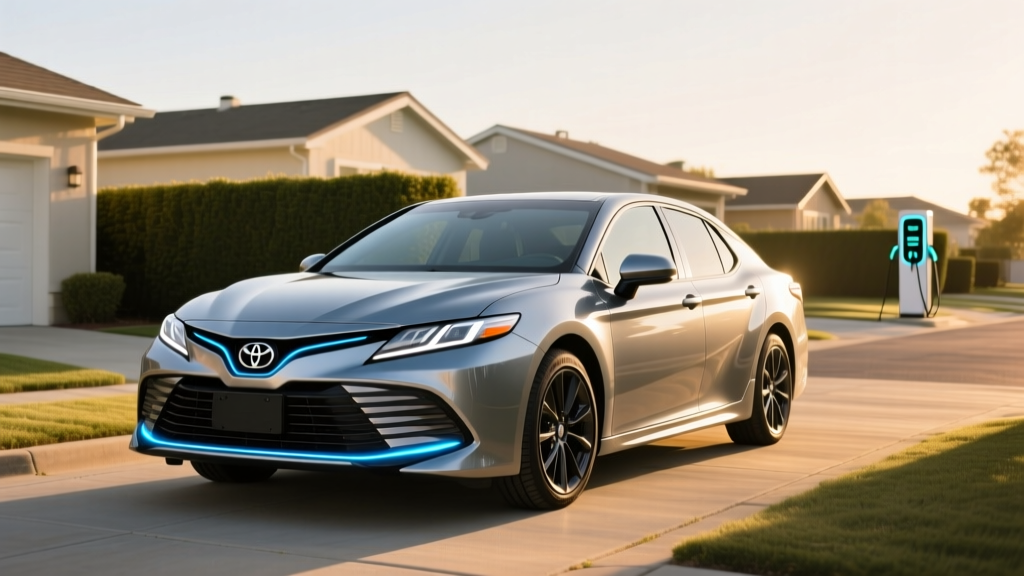
The 2026 Toyota Camry Hybrid occupies a specific lane in the midsize sedan market: it's a conventional hybrid electric vehicle (HEV) that requires no plug, no range planning, and no charging infrastructure — yet it returns fuel economy numbers that rival many plug-in hybrids on the combined cycle. For buyers searching for Camry Hybrid hp figures alongside real-world efficiency data, this guide breaks down exactly what Toyota's fifth-generation hybrid system delivers in the current model year.
Every 2026 Camry is a hybrid. Toyota eliminated the gas-only four-cylinder after the 2024 redesign, meaning the hybrid powertrain — built around a 2.5-liter Dynamic Force four-cylinder engine paired with electric motor-generators — is the only option. That decision simplified the lineup but also made understanding the hybrid system's output, efficiency, and long-term reliability more important than ever for prospective buyers.
2026 Camry Hybrid Horsepower and Powertrain Specs
The 2026 Camry Hybrid uses Toyota's fifth-generation Hybrid Synergy Drive, which pairs a 2.5L inline-four gasoline engine (A25A-FXS) with one or two electric motor-generators depending on drivetrain configuration. The result is a combined system output that varies by trim and whether you select front-wheel drive or all-wheel drive.
| Specification | FWD Models | AWD Models |
|---|---|---|
| Combined System Horsepower | 225 hp | 232 hp |
| Gas Engine Output | 184 hp @ 5,700 rpm | 184 hp @ 5,700 rpm |
| Gas Engine Torque | 163 lb-ft @ 5,200 rpm | 163 lb-ft @ 5,200 rpm |
| Front Electric Motor | 134 hp (100 kW) | 134 hp (100 kW) |
| Rear Electric Motor (AWD) | N/A | 54 hp (40 kW) |
| Hybrid Battery Type | Lithium-ion (Li-ion) | Lithium-ion (Li-ion) |
| Hybrid Battery Capacity | ~1.0 kWh (nominal) | ~1.0 kWh (nominal) |
| Transmission | eCVT | eCVT |
| 0–60 mph (est.) | ~7.2 seconds | ~6.9 seconds |
The AWD variant gains a dedicated rear electric motor that engages automatically under acceleration and in low-traction conditions. This isn't a mechanical all-wheel-drive system with a driveshaft — it's an electrically actuated rear axle, which adds 7 hp to the combined system output and improves launch traction. The AWD system can send up to 50% of available power rearward when needed, then disconnect entirely during steady-state cruising to preserve efficiency.
The eCVT (electronically controlled continuously variable transmission) is not a belt-and-pulley CVT like those found in some competitors. Toyota's system uses a planetary gearset that blends engine and motor power seamlessly. The result is linear acceleration without the rubber-band effect that traditional CVTs produce under hard throttle.
Fuel Economy: EPA Ratings and Real-World MPG
The Camry Hybrid's efficiency advantage is most pronounced in city driving, where regenerative braking recaptures energy and the electric motor handles low-speed propulsion. Here's the official EPA breakdown by drivetrain, per fueleconomy.gov:
| Configuration | City MPG | Highway MPG | Combined MPG |
|---|---|---|---|
| FWD (LE trim) | 51 | 44 | 48 |
| FWD (SE/XSE/XLE trims) | 48 | 41 | 44 |
| AWD (all trims) | 47 | 41 | 44 |
- City-heavy commuting: 48–53 MPG (regenerative braking maximizes electric motor usage)
- Highway cruising at 70–75 mph: 39–43 MPG (aerodynamic drag and sustained engine operation reduce the hybrid advantage)
- Cold weather (below 35°F): 38–44 MPG combined (engine runs more frequently for cabin heat and battery warming)
- Hot weather with A/C: 42–47 MPG combined
Hybrids tend to exceed their EPA city rating in stop-and-go traffic because regenerative braking is most effective at lower speeds. Highway efficiency is where the gap between sticker and reality widens.
The LE trim achieves its higher rating partly through lighter-weight 16-inch wheels, lower-rolling-resistance tires, and slightly different final-drive gearing. If fuel economy is the priority, the LE is the efficiency king of the lineup — but the SE, XSE, and XLE trims with 18- or 19-inch wheels still deliver class-leading numbers.
HEV vs PHEV: Is the Camry Hybrid the Right Electrified Choice?
A common question from shoppers cross-referencing the Camry Hybrid against vehicles like the Toyota RAV4 Prime or Hyundai Tucson PHEV is whether they should consider a plug-in hybrid instead. The distinction matters because the Camry Hybrid is a conventional hybrid (HEV) — it has no plug, no electric-only driving range to speak of, and a very small battery (~1.0 kWh) that serves as a buffer for regenerative energy capture and electric motor assist.
Conventional Hybrid (HEV) — Camry Hybrid
- No plug required — fueled exclusively by gasoline
- Small battery (~1.0 kWh) charged by regen + engine
- Electric motor assists engine; cannot drive on electric alone beyond very low speeds/short distances
- 44–48 MPG combined
- No federal tax credit for new purchases
- Lower purchase price; no charging infrastructure needed
Plug-In Hybrid (PHEV) — e.g., RAV4 Prime
- Requires plug-in charging for full benefit
- Larger battery (18.1 kWh) enabling 25–42 miles electric-only
- Can operate as a full EV for daily commuting, then as an HEV on longer trips
- 38–40 MPG combined (gas mode) + 94 MPGe (electric mode)
- May qualify for up to $7,500 federal tax credit (subject to §30D rules)
- Higher purchase price; benefits from home Level 2 charging
The Camry Hybrid is the right choice if you want maximum fuel efficiency without any behavioral change — no plugging in, no route planning, no charging-app management. It's also the right choice for apartment dwellers, street parkers, and anyone without reliable access to a Level 2 charger. A PHEV only unlocks its full value proposition when you can charge regularly at home or work.
Does the 2026 Camry Hybrid Qualify for Tax Credits?
No. The 2026 Toyota Camry Hybrid does not qualify for the federal §30D Clean Vehicle Credit. Under current IRS rules, only battery electric vehicles (BEVs) and plug-in hybrid electric vehicles (PHEVs) with a battery capacity of at least 7 kWh are eligible. The Camry Hybrid's ~1.0 kWh battery falls far below this threshold.
- ☐ Vehicle must be a BEV or PHEV (not a conventional HEV)
- ☐ Battery capacity ≥ 7 kWh
- ☐ MSRP cap: $55,000 (sedans) / $80,000 (SUVs, trucks, vans)
- ☐ Buyer income cap: $150,000 (single) / $300,000 (joint filing)
- ☐ Battery components and critical minerals must meet phased-in domestic sourcing requirements
- ☐ Final assembly in North America
- ☐ Camry Hybrid fails criterion #1 and #2 — it's an HEV with a ~1 kWh battery
Some states offer their own hybrid purchase incentives or HOV lane access for hybrids, but these vary significantly by jurisdiction. Check your state's DMV or energy office for current programs. The Camry Hybrid's value proposition rests on fuel savings and lower total cost of ownership rather than upfront tax incentives.
Pricing by Trim: 2026 Camry Hybrid MSRP Breakdown
| Trim | Drivetrain | Starting MSRP |
|---|---|---|
| LE | FWD | $29,990 |
| LE | AWD | $31,390 |
| SE | FWD | $31,490 |
| SE | AWD | $32,890 |
| XLE | FWD | $34,990 |
| XLE | AWD | $36,390 |
| XSE | FWD | $35,490 |
| XSE | AWD | $36,890 |
Destination and handling charges add approximately $1,195. At the LE FWD price point, the Camry Hybrid undercuts many competing midsize sedans — including non-hybrid options — while delivering dramatically better fuel economy. The value equation strengthens further when you factor in fuel savings: at 48 MPG combined versus a 30 MPG gas sedan, driving 15,000 miles per year at $3.40/gallon saves roughly $1,417 annually in fuel costs.
Hybrid Battery Warranty, Reliability, and Replacement Cost
Toyota provides a 10-year/150,000-mile hybrid battery warranty (whichever comes first) on the 2026 Camry Hybrid in all 50 states. This is an improvement from the previous 8-year/100,000-mile coverage and reflects Toyota's confidence in its lithium-ion hybrid battery packs. The warranty covers battery capacity loss below a specified threshold and any manufacturing defects.
- Hybrid Battery: 10 years / 150,000 miles
- Hybrid System Components (inverter, motor-generators, control module): 8 years / 100,000 miles
- Powertrain Warranty: 5 years / 60,000 miles
- Basic Warranty: 3 years / 36,000 miles
Toyota's hybrid battery track record is among the best in the industry. The Prius, which has used a similar hybrid architecture for over two decades, routinely sees original batteries lasting 150,000–200,000+ miles with gradual capacity degradation rather than sudden failure. Real-world data from fleet operators and long-term owners suggests the Camry Hybrid's battery should last the useful life of the vehicle for most original owners.
If replacement is needed out of warranty, a new OEM hybrid battery for the Camry Hybrid typically costs between $2,500 and $4,000 including labor. Third-party refurbished or reconditioned batteries are available for $1,500–$2,500. This is dramatically less expensive than a full EV battery replacement ($10,000–$20,000+) because the hybrid battery is small (~1 kWh) and operates within a narrow state-of-charge window that reduces stress on the cells.
Toyota's hybrid system reliability is well documented. According to NHTSA data and long-term durability tracking from sources like Consumer Reports, the Camry Hybrid powertrain has fewer failure points than a conventional gasoline powertrain — no traditional starter motor, no alternator, no accessory belt, and regenerative braking extends the life of the friction brake pads significantly (many owners report 80,000+ miles on original brake pads).
Pros, Cons, and Who Should Choose the Camry Hybrid
Pros
- Up to 51 MPG city (LE FWD) — best-in-class for midsize sedans
- No plug, no charging — works with existing fueling habits
- 225–232 hp is adequate for merging and passing
- AWD available across all trims for $1,400 premium
- 10-year/150,000-mile hybrid battery warranty
- Starting MSRP under $30,000 (LE FWD)
- Toyota Safety Sense 3.0 standard (adaptive cruise, lane-keeping, auto emergency braking)
- Proven long-term reliability with minimal maintenance needs
Cons
- No federal tax credit (HEV, not PHEV/BEV)
- No electric-only driving mode for zero-emission commuting
- eCVT can feel unexciting under hard acceleration
- AWD adds weight, reducing fuel economy by 3–4 MPG
- Higher trims (XSE AWD) push past $38,000 before options
- Infotainment system still lags some competitors in responsiveness
- Cargo space unchanged from gas predecessor but less than some rivals
Choose the Camry Hybrid If:
- You want maximum MPG without changing your fueling routine
- You don't have reliable access to home or workplace charging
- You drive 12,000–20,000 miles per year and want to minimize fuel spend
- You prioritize long-term reliability and low maintenance costs
- You want AWD capability without the fuel penalty of a conventional AWD sedan
Consider a PHEV or Full EV Instead If:
- You have home Level 2 charging and a short commute (a PHEV's 25–42 electric miles covers most daily driving)
- You want to eliminate tailpipe emissions during daily commuting
- You qualify for the §30D tax credit (income, MSRP, and sourcing requirements met)
- You drive fewer than 10,000 miles per year (fuel savings may not offset a higher EV/PHEV purchase price)
Frequently Asked Questions
How many MPG does the 2026 Camry Hybrid get?
The FWD LE trim achieves 51 city / 44 highway / 48 combined MPG. Other FWD trims (SE, XLE, XSE) get 48 city / 41 highway / 44 combined. AWD models across all trims achieve 47 city / 41 highway / 44 combined. In real-world city driving, many owners report exceeding the EPA city rating thanks to regenerative braking.
How much horsepower does the Camry Hybrid have?
The 2026 Camry Hybrid produces 225 combined horsepower in FWD configuration and 232 hp with AWD. The gasoline 2.5L engine contributes 184 hp, while the front electric motor adds 134 hp. AWD models include an additional 54 hp rear electric motor. Combined output is not a simple sum because peak engine and motor outputs occur at different RPM ranges.
Does the Camry Hybrid need to be plugged in?
No. The Camry Hybrid is a conventional hybrid (HEV), not a plug-in hybrid (PHEV). Its small lithium-ion battery charges through regenerative braking and the gasoline engine. You fuel it exclusively at a gas station — there is no charging port and no electric-only driving range.
Is the Camry Hybrid reliable, and what does a battery replacement cost?
Toyota's hybrid powertrains have an exceptional reliability track record spanning over 20 years of Prius production. The hybrid battery is warrantied for 10 years/150,000 miles. Out-of-warranty replacement costs $2,500–$4,000 for a new OEM battery or $1,500–$2,500 for a refurbished unit. Most original batteries last 150,000+ miles.
Does the 2026 Camry Hybrid qualify for any tax credit?
No. The federal §30D Clean Vehicle Credit applies only to plug-in hybrids (PHEVs) and battery electric vehicles (BEVs) with at least 7 kWh of battery capacity. The Camry Hybrid's ~1.0 kWh battery makes it ineligible. Some states may offer separate hybrid incentives — check your local DMV or energy office.
How does the Camry Hybrid compare to a full EV like the Tesla Model 3 or Hyundai Ioniq 6?
A full EV eliminates fuel costs entirely (charging at home at $0.13/kWh costs roughly $0.04/mile versus $0.07/mile for the Camry Hybrid at 48 MPG and $3.40/gallon). However, EVs require home charging access, cost more upfront ($38,000–$45,000+ before credits), and involve route planning on long road trips. The Camry Hybrid is the pragmatic choice for buyers who want efficiency without infrastructure dependency or who drive frequently in areas with sparse public charging.
Is AWD worth the fuel economy trade-off?
AWD costs $1,400 more and reduces combined fuel economy from 48 to 44 MPG (on the LE trim) — a difference of roughly $125 per year in additional fuel cost at 15,000 miles driven. If you live in a region with regular snow, ice, or heavy rain, the traction benefit justifies the cost. In mild climates, FWD provides ample grip and better efficiency.
The 2026 Camry Hybrid doesn't try to be everything to everyone. It's a focused efficiency play: proven hybrid technology, competitive horsepower for the segment, and fuel economy that costs pennies per mile to operate — all without requiring a single change to how you refuel. For the buyer who wants electrified efficiency on their own terms, it remains the benchmark midsize sedan.