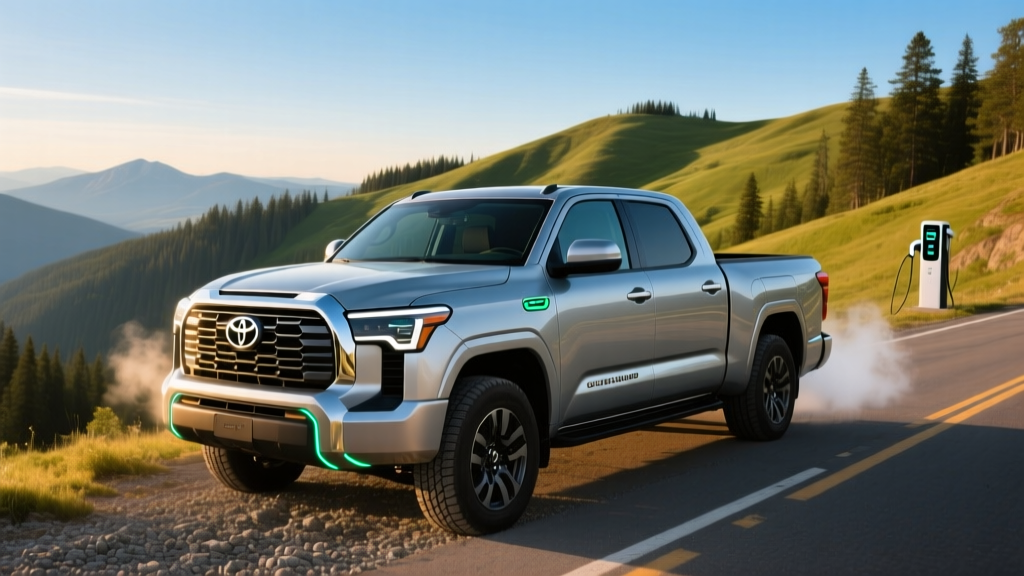
The full-size pickup segment is not where you go looking for fuel-sipping heroes, but the 2024 Toyota Tundra i-FORCE MAX hybrid makes a credible case that a 5,800-pound truck can be both capable and reasonably efficient. If you have been searching for 2024 Toyota Tundra Hybrid MPG data, the short answer is 20 MPG combined according to the EPA — but real-world numbers vary significantly depending on how and where you drive. This guide breaks down exactly what the i-FORCE MAX powertrain delivers, how it compares to the non-hybrid Tundra and rival trucks, and whether the hybrid premium pays for itself.
HEV vs PHEV: The Tundra Hybrid Is a Conventional Hybrid (HEV)
Before diving into numbers, a critical distinction that trips up many truck shoppers:
- Conventional Hybrid (HEV): The Tundra i-FORCE MAX is a self-charging hybrid. It captures energy through regenerative braking and the gasoline engine to charge a small battery. You never plug it in. There is no electric-only driving range.
- Plug-in Hybrid (PHEV): A PHEV like the Ford F-150 PowerBoost (not currently offered as a PHEV) or a Toyota RAV4 Prime has a larger battery you charge via a plug, giving 20-40 miles of electric-only range before the gas engine kicks in. The Tundra does not offer a PHEV variant.
This matters for your expectations: the Tundra Hybrid will not let you commute on electricity alone. What it will do is reduce fuel consumption by roughly 10-15% compared to the non-hybrid V6, while actually increasing horsepower and torque. That is the trade-off Toyota engineered for.
2024 Toyota Tundra Hybrid MPG: EPA Ratings and Real-World Numbers
The EPA rates the 2024 Tundra i-FORCE MAX hybrid differently depending on cab configuration and drivetrain. Here is the official breakdown from fueleconomy.gov:
| Configuration | City MPG | Highway MPG | Combined MPG |
|---|---|---|---|
| 4x2 CrewMax (SR5, Limited) | 20 | 24 | 22 |
| 4x4 CrewMax (SR5, Limited, Platinum) | 19 | 22 | 20 |
| 4x4 CrewMax (TRD Pro, Capstone) | 19 | 22 | 20 |
For context, the non-hybrid 2024 Tundra with the i-FORCE 3.5L twin-turbo V6 (the only other engine option) is rated at 17 city / 22 highway / 19 combined for 4x4 models. The hybrid gains 2 MPG combined — a roughly 10% improvement — while delivering significantly more power.
Real-World MPG vs. EPA Sticker
Hybrid powertrains typically exceed their EPA city ratings because regenerative braking recaptures energy during stop-and-go driving, where conventional engines waste the most fuel. The Tundra Hybrid follows this pattern:
- City driving: Expect 20-23 MPG in mixed urban and suburban driving. The electric motor handles low-speed acceleration, keeping the V6 from its least efficient operating range. Short trips with frequent stops are where this truck shines relative to its size.
- Highway driving: Expect 19-22 MPG at 70-75 mph. At sustained highway speeds, the hybrid advantage diminishes because there is little regenerative braking. Aerodynamic drag dominates, and 5,800 pounds of truck requires significant energy to push through the air. Towing drops highway economy to 12-15 MPG depending on trailer weight.
- Cold weather: Expect a 1-3 MPG reduction in winter months. The engine runs more often to provide cabin heat and maintain operating temperature, reducing the hybrid system's ability to shut the engine off at stops.
- Combined real-world: Most owners report 18-21 MPG combined in mixed driving. If your commute is primarily city, you will trend toward the higher end. If you tow or drive highway-heavy routes, expect the lower end.
i-FORCE MAX Powertrain: Specs and How the Hybrid System Works
| Specification | 2024 Tundra i-FORCE MAX (Hybrid) | 2024 Tundra i-FORCE (Non-Hybrid) |
|---|---|---|
| Engine | 3.5L twin-turbo V6 + electric motor | 3.5L twin-turbo V6 |
| Combined Horsepower | 437 hp | 389 hp (standard) / 348 hp (base SR) |
| Combined Torque | 583 lb-ft | 479 lb-ft (standard) / 405 lb-ft (base SR) |
| Hybrid Battery | 1.87 kWh nickel-metal hydride (NiMH) | N/A |
| Transmission | 10-speed automatic | 10-speed automatic |
| Max Towing Capacity | 12,000 lbs (4x2 CrewMax) | 12,000 lbs (4x2 CrewMax) |
| Max Payload | 1,680 lbs | 1,940 lbs |
| 0-60 mph | ~5.7 seconds | ~6.1 seconds |
The i-FORCE MAX places a 48-hp electric motor-generator between the engine and transmission, housed in the bell housing. This motor provides instant torque fill at low RPM — eliminating the turbo lag that plagues many twin-turbo engines from a stop. The result is a truck that feels noticeably more responsive than the non-hybrid version, especially in the 0-30 mph range where trucks spend most of their city driving time.
The 1.87 kWh NiMH battery pack is mounted under the rear seats. It is small by EV standards — roughly 2% the size of a Tesla Model Y battery — because it only needs to store enough energy for brief electric assist and engine-off coasting. Toyota chose NiMH chemistry over lithium-ion for its proven durability in hybrid applications; the Prius has used similar chemistry for over two decades with exceptional longevity.
Pricing: 2024 Tundra Hybrid Trim Levels and MSRP
The i-FORCE MAX hybrid powertrain is not available on the base SR or SR5 trims as a standalone option. For 2024, Toyota structures hybrid availability as follows:
- SR5 (with i-FORCE MAX option): ~$57,600 (4x4 CrewMax) — hybrid is a $3,865 option package on this trim
- Limited (standard i-FORCE MAX): ~$62,500 (4x4 CrewMax) — hybrid is standard equipment
- Platinum: ~$69,500 (4x4 CrewMax)
- TRD Pro: ~$73,500 (4x4 CrewMax)
- Capstone: ~$80,500 (4x4 CrewMax)
The hybrid premium over a comparably equipped non-hybrid SR5 is approximately $3,865. Whether that pays for itself depends entirely on your driving profile. At 20 MPG combined vs 19 MPG combined, saving 1 gallon per ~380 miles driven, you recoup the premium in fuel savings after roughly 144,000 miles at $3.50/gallon. The hybrid's real financial value comes from higher resale demand and the power advantage, not fuel savings alone.
Tax Credit Eligibility
The 2024 Tundra Hybrid does not qualify for the federal §30D clean vehicle tax credit. That credit applies only to plug-in electric vehicles (BEVs and PHEVs) with battery capacity of at least 7 kWh and external charging capability, per IRS guidelines. Conventional hybrids like the Tundra i-FORCE MAX, which cannot be plugged in, are excluded from the federal credit.
Some states offer their own incentives for hybrid vehicles, though these are increasingly rare as policy shifts toward full electrification. Check your state's energy or environmental agency website for current programs. As of 2024, no major state rebate programs specifically target conventional hybrids.
Hybrid Battery Warranty, Reliability, and Replacement Cost
Toyota Hybrid Battery Warranty: 10 years / 150,000 miles (whichever comes first) for 2020 and newer models. This covers the hybrid battery pack against defects and capacity loss below a specified threshold. Previous model years carry an 8-year / 100,000-mile warranty.
Toyota's hybrid system reliability is among the best-documented in the automotive industry. The Prius, Camry Hybrid, and RAV4 Hybrid have collectively accumulated billions of real-world miles with the same fundamental architecture used in the Tundra. The NiMH battery chemistry is less energy-dense than lithium-ion but significantly more tolerant of heat and deep cycling — the two factors that accelerate battery degradation.
Expected battery lifespan: Based on data from Toyota's hybrid fleet, the 1.87 kWh pack in the Tundra should last 150,000-200,000+ miles before capacity loss becomes meaningful. Because the battery is small and the system never fully depletes or fully charges it (operating in a 40-80% state-of-charge window), stress on the cells is minimal.
Replacement cost: If the hybrid battery does require replacement outside of warranty, expect $2,500-$4,000 for a new OEM battery pack including labor. Refurbished packs are available for $1,500-$2,500. This is far less than an EV traction battery replacement ($10,000-$20,000+) because the pack is small and accessible under the rear seat rather than spanning the vehicle floor.
Other hybrid components: The inverter, electric motor-generator, and related electronics carry the same 10-year / 150,000-mile warranty. The 10-speed automatic transmission is shared with the non-hybrid Tundra and carries Toyota's standard 5-year / 60,000-mile powertrain warranty.
Tundra Hybrid vs. Competition: MPG and Power Compared
The full-size truck segment offers several hybrid and mild-hybrid options. Here is how the Tundra stacks up against its direct rivals for the 2024 model year, with EPA data sourced from fueleconomy.gov:
| Truck (4x4) | Powertrain | City MPG | Highway MPG | Combined MPG | Horsepower | Torque (lb-ft) |
|---|---|---|---|---|---|---|
| Toyota Tundra i-FORCE MAX | HEV (3.5L TT V6 + motor) | 19 | 22 | 20 | 437 | 583 |
| Ford F-150 PowerBoost | HEV (3.5L TT V6 + motor) | 22 | 24 | 23 | 430 | 570 |
| Chevrolet Silverado 1500 (2.7L Turbo) | Gas (I4 turbo) | 18 | 21 | 19 | 310 | 430 |
| Ram 1500 (5.7L HEMI eTorque) | Mild Hybrid (V8 + 48V) | 15 | 22 | 17 | 395 | 410 |
The Ford F-150 PowerBoost leads the segment with 23 MPG combined, beating the Tundra Hybrid by 3 MPG. However, the Tundra counters with slightly more torque (583 vs 570 lb-ft) and Toyota's long-term hybrid reliability reputation. The Ram 1500's eTorque system is a mild hybrid — its 48-volt system assists with start-stop and brief torque fill but provides no meaningful electric-only propulsion, resulting in the lowest efficiency of the group.
Who Should Choose the Tundra Hybrid vs. a Gas Truck or Full EV?
Choose the Tundra i-FORCE MAX Hybrid if:
- You need a full-size truck for towing (up to 12,000 lbs) and payload but want marginally better fuel economy and significantly more low-end torque than the non-hybrid V6
- Your driving is primarily city and suburban, where regenerative braking maximizes the hybrid advantage
- You plan to own the truck 8-10+ years and want the hybrid battery warranty as long-term peace of mind
- You are not ready for EV charging logistics but want to reduce fuel consumption without changing your driving habits
Stick with the non-hybrid Tundra i-FORCE if:
- You drive predominantly highway miles where the hybrid advantage shrinks to 1-2 MPG
- You are budget-constrained and the $3,865 hybrid premium would strain your finances
- Maximum payload capacity matters (non-hybrid models carry up to 260 lbs more payload due to lower curb weight)
Consider a full EV truck (Ford F-150 Lightning, Rivian R1T, Chevrolet Silverado EV) if:
- You have reliable home Level 2 charging access (a 240V outlet or hardwired charger)
- Your daily driving is under 250 miles round-trip, fitting within EV range
- You want to eliminate fuel costs entirely and qualify for the §30D federal tax credit (up to $7,500, subject to MSRP, income, and battery sourcing requirements)
- You do not regularly tow heavy loads — EV trucks lose 30-50% of range when towing near max capacity
The honest truth: the Tundra Hybrid is not a fuel-economy play. The 2 MPG combined improvement over the non-hybrid saves roughly $120-$150 per year in fuel for a driver covering 15,000 miles annually. The real reasons to choose the i-FORCE MAX are the 48 extra horsepower, 104 extra lb-ft of torque, and the responsiveness the electric motor provides at low speeds. It is a performance upgrade that happens to be slightly more efficient — not an efficiency upgrade that happens to be more powerful.
Ownership Costs: 5-Year Cost Comparison
To put the Tundra Hybrid's economics in perspective, here is a 5-year / 75,000-mile ownership estimate comparing the hybrid and non-hybrid 4x4 CrewMax models at $3.50/gallon:
| Cost Factor | Tundra Hybrid (4x4, 20 MPG) | Tundra Non-Hybrid (4x4, 19 MPG) |
|---|---|---|
| Fuel (75,000 miles) | $13,125 (3,750 gallons) | $13,816 (3,947 gallons) |
| Hybrid Premium at Purchase | +$3,865 | $0 |
| Fuel Savings (5 years) | $691 saved | Baseline |
| Net Cost After 5 Years | +$3,174 more than non-hybrid | Baseline |
The hybrid does not pay for itself in fuel savings alone within 5 years. However, Kelley Blue Book and industry data consistently show that Toyota hybrid trucks command a resale premium of $2,000-$4,000 over non-hybrid equivalents, which largely offsets the initial premium. Factor in the stronger powertrain and the hybrid becomes roughly cost-neutral over a typical ownership cycle while delivering better performance.
Frequently Asked Questions
How many MPG does the 2024 Toyota Tundra Hybrid actually get?
The EPA rates the 4x4 Tundra i-FORCE MAX at 19 city / 22 highway / 20 combined. Real-world results typically range from 18-21 MPG combined depending on driving mix. City-heavy drivers often see 21-23 MPG, while highway and towing-heavy use drops to 16-19 MPG.
Does the Tundra Hybrid need to be plugged in?
No. The Tundra i-FORCE MAX is a conventional hybrid (HEV), not a plug-in hybrid. It charges its battery through regenerative braking and the gasoline engine. You fuel it exactly like any other truck — at a gas station.
Can the Tundra Hybrid drive on electric power alone?
Only at very low speeds for very short distances (under 1 mile at under 15 mph, such as creeping through a parking lot). The 1.87 kWh battery is too small for meaningful electric-only driving. This is by design — the hybrid system is built for torque assist and efficiency, not electric range.
Does the 2024 Tundra Hybrid qualify for any tax credits?
No. The federal §30D clean vehicle credit requires a plug-in vehicle with at least 7 kWh of battery capacity. The Tundra Hybrid's 1.87 kWh NiMH battery and lack of a plug make it ineligible. Check your state's energy office for any local hybrid incentives, though these are uncommon.
Is the Tundra Hybrid reliable? What about battery replacement?
Toyota's hybrid system has an exceptional reliability track record spanning 25+ years and millions of vehicles. The hybrid battery is warranted for 10 years / 150,000 miles. Based on fleet data, expect 150,000-200,000+ miles of battery life. Replacement costs $2,500-$4,000 if needed outside warranty — far less than an EV battery.
How does the Tundra Hybrid compare to the Ford F-150 PowerBoost hybrid?
The F-150 PowerBoost achieves 23 MPG combined (3 MPG better than the Tundra) and offers 430 hp / 570 lb-ft. The Tundra Hybrid produces 437 hp / 583 lb-ft. Both are conventional hybrids that do not plug in. The Ford edges on efficiency; the Toyota edges on torque and long-term hybrid reliability reputation. The F-150 PowerBoost also offers Pro Power Onboard, a built-in generator feature the Tundra lacks.
Is the hybrid Tundra worth the extra cost?
If you value the 48 extra horsepower and 104 extra lb-ft of torque, yes. If you are buying strictly for fuel savings, no — the $3,865 hybrid premium takes 10+ years to recoup at the pump. Most buyers choose the i-FORCE MAX for the power and responsiveness, with the modest MPG improvement as a bonus.
Pros
- 437 hp and 583 lb-ft — most powerful Tundra available
- 10-year / 150,000-mile hybrid battery warranty
- 2-3 MPG improvement over non-hybrid in city driving
- Instant electric torque fill eliminates turbo lag
- Strong resale value typical of Toyota hybrids
- No plug-in charging required — no lifestyle change
Cons
- Hybrid premium of ~$3,865 does not pay back in fuel savings alone
- 20 MPG combined is not exceptional — F-150 PowerBoost achieves 23
- Reduced payload capacity (up to 260 lbs less than non-hybrid)
- Not eligible for federal or most state tax credits
- No electric-only driving capability
- Highway MPG barely improves over non-hybrid