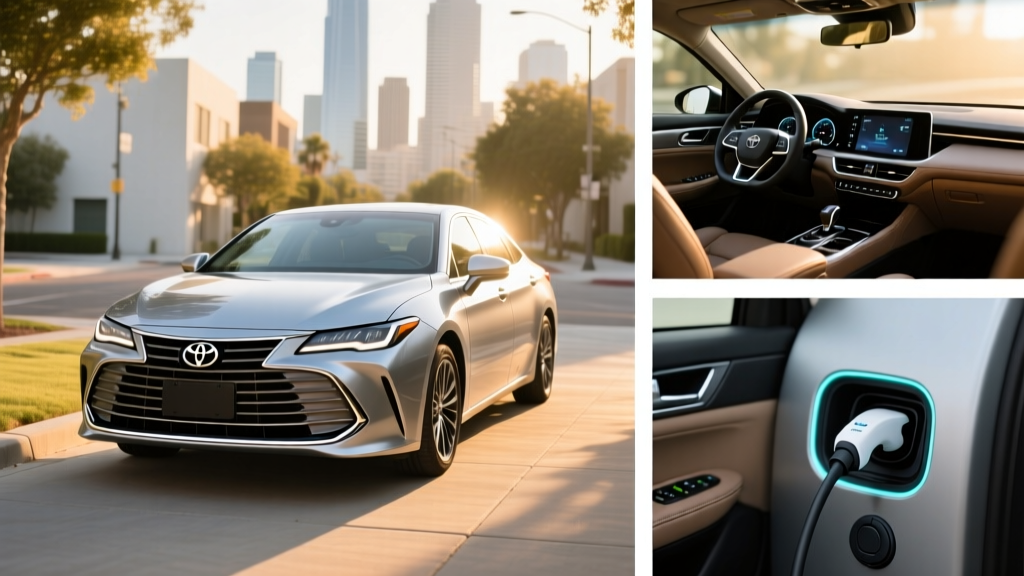
The Toyota Avalon Hybrid occupies a specific niche that has largely evaporated from the new-car market: a full-size, five-passenger sedan that sips fuel like a compact. Toyota discontinued the Avalon after the 2022 model year, but the hybrid variant remains one of the most sought-after vehicles on the used market in 2026 — and for good reason. With an EPA-estimated 44 MPG combined, a proven hybrid powertrain, and Toyota's long-standing hybrid battery warranty, the Avalon Hybrid continues to deliver real value for buyers who want sedan comfort without the fuel bill.
This guide covers everything a 2026 buyer needs to know: exact MPG figures, powertrain specs, real-world fuel economy expectations, hybrid battery longevity and replacement cost, and how the Avalon Hybrid stacks up against plug-in hybrids and full EVs for different driving lifestyles.
Toyota Avalon Hybrid Fuel Economy: EPA Numbers and Real-World MPG
The Avalon Hybrid's headline number is its fuel efficiency. Toyota offered the hybrid powertrain across multiple trims, and the EPA ratings vary slightly depending on wheel size and equipment:
| Trim | City MPG | Highway MPG | Combined MPG |
|---|---|---|---|
| XLE Hybrid | 43 | 44 | 44 |
| XSE Hybrid | 43 | 43 | 43 |
| Limited Hybrid | 43 | 43 | 43 |
| Touring Hybrid | 43 | 43 | 43 |
Source: fueleconomy.gov — 2022 Toyota Avalon Hybrid
Powertrain Specs: Engine, Motors, and Combined Output
The Avalon Hybrid uses Toyota's fourth-generation hybrid synergy drive, pairing a 2.5-liter four-cylinder Atkinson-cycle engine with two electric motor-generators and a nickel-metal hydride (NiMH) traction battery. Here is the full breakdown:
| Specification | Value |
|---|---|
| Engine | 2.5L 4-cylinder Atkinson-cycle |
| Engine horsepower | 176 hp @ 5,700 rpm |
| Engine torque | 163 lb-ft @ 5,200 rpm |
| Electric motor (MG2) | 88 kW (118 hp) / 149 lb-ft |
| Combined net horsepower | 215 hp |
| Transmission | eCVT (planetary gearset) |
| Drivetrain | Front-wheel drive |
| Traction battery | 1.6 kWh NiMH (sealed) |
| 0–60 mph (est.) | ~7.7 seconds |
The eCVT is not a belt-driven CVT — it uses a planetary gearset that seamlessly blends engine and motor power with no shifting. The result is smooth, linear acceleration with zero shift shock. The 215 combined horsepower is adequate for highway merging and passing, though this is a comfort-oriented sedan, not a performance machine.
HEV vs. PHEV: The Avalon Hybrid Is a Conventional Hybrid
A common question from shoppers unfamiliar with Toyota's lineup: does the Avalon Hybrid need to be plugged in? No. The Avalon Hybrid is a conventional hybrid electric vehicle (HEV), not a plug-in hybrid (PHEV). It generates all of its electricity internally through regenerative braking and the gasoline engine — there is no charging port.
- HEV (Avalon Hybrid): Small battery (~1.6 kWh), no plug, battery charges via regen and engine. You never change your fueling routine — just fill up at gas stations.
- PHEV (e.g., Toyota RAV4 Prime): Larger battery (~18 kWh), plug-in capable, 25–42 miles of electric-only range before the engine engages. Requires home or public charging access to maximize value.
- BEV (e.g., Tesla Model 3): Large battery (60–82 kWh), no gas engine, 250–350+ miles of electric range. Requires regular charging; zero gasoline use.
Toyota never produced a plug-in hybrid version of the Avalon. If you want a Toyota PHEV sedan, the closest option was the Prius Prime (now updated for 2024+ with 44 miles of EV range). The Avalon was offered exclusively as a conventional hybrid or a standard 3.5L V6 gasoline model.
Pricing in 2026: Used Market Values and Tax Credit Reality
Because the Avalon Hybrid was discontinued after 2022, all 2026 purchases will be on the used or certified pre-owned (CPO) market. Original MSRP for the final model year ranged from approximately $37,350 (XLE Hybrid) to $43,550 (Limited Hybrid), including destination.
As of early 2026, used Avalon Hybrid pricing typically falls in these ranges:
| Model Year | Typical Price Range | Typical Mileage |
|---|---|---|
| 2022 | $28,000–$35,000 | 15,000–40,000 mi |
| 2021 | $25,000–$31,000 | 30,000–55,000 mi |
| 2019–2020 | $21,000–$27,000 | 45,000–75,000 mi |
Federal tax credit: The Avalon Hybrid does not qualify for the federal §30D new clean vehicle credit — that credit applies only to new plug-in vehicles (BEVs and PHEVs) meeting battery sourcing and MSRP requirements, per IRS guidelines. However, if you purchase a used Avalon Hybrid from a dealer for $25,000 or less, you may qualify for the Used Clean Vehicle Credit (§25E) — up to $4,000 or 30% of the sale price, whichever is less. Income caps apply ($75,000 single / $150,000 joint), and the vehicle must be at least two model years old. Consult a tax professional for eligibility specifics.
Hybrid Battery Longevity, Warranty, and Replacement Cost
Hybrid battery lifespan is the single most common concern for used hybrid buyers. Here are the facts for the Avalon Hybrid:
Real-world longevity: Toyota's NiMH hybrid batteries have an exceptional track record. Data from fleet operators and long-term owners suggests these batteries routinely last 150,000–200,000+ miles before significant degradation. The Avalon Hybrid's battery is relatively small (1.6 kWh) and never deeply cycled — Toyota's hybrid system keeps the state of charge between roughly 40% and 80%, which minimizes stress on the cells.
Replacement cost if out of warranty: A new OEM hybrid battery pack for the Avalon Hybrid costs approximately $2,500–$4,000 installed at a Toyota dealer. Refurbished or aftermarket packs are available for $1,500–$2,500 installed. Independent hybrid specialists in most metro areas can perform the swap. Individual module replacement (only the degraded cells) can reduce cost to $500–$1,200.
Reliability and Ownership Costs
The Avalon Hybrid benefits from one of the most proven hybrid powertrains in the industry. Toyota's hybrid synergy drive has been in continuous production since 1997, and the 2.5L four-cylinder hybrid system (introduced in 2018 for the Camry, 2019 for the Avalon) has demonstrated excellent reliability.
Key ownership cost advantages:
- No plug-in charging cost — fuel only, at roughly $1,100–$1,300/year at 15,000 miles and $3.50/gallon
- Brake pad longevity — regenerative braking significantly reduces wear; many owners report 80,000+ miles on original pads
- No traditional transmission — the eCVT planetary gearset has no belts, clutches, or torque converter to fail
- Routine maintenance — oil changes every 10,000 miles, standard cabin air and engine air filters
The IIHS rated the 2022 Avalon as a Top Safety Pick+, the organization's highest honor, with Good ratings across all crashworthiness tests. Standard Toyota Safety Sense 2.5+ includes automatic emergency braking, lane-keeping assist, adaptive cruise control, and road sign assist.
Avalon Hybrid vs. PHEV vs. EV: Which Powertrain Fits You?
- You don't have access to home or workplace charging
- You want maximum range flexibility (500+ miles per tank) for road trips
- You prefer a large, quiet sedan over an SUV or crossover
- You want low fuel costs without changing your fueling routine
- You're buying used and want proven long-term reliability
- You have home Level 2 charging and a commute under 30–40 miles
- You want electric-only daily driving with gas-engine backup for road trips
- You want to qualify for the federal §30D tax credit (new vehicles only)
- You want the lowest possible fuel cost for short trips without range anxiety
- You have reliable home charging (Level 2, 240V)
- Your daily driving is under 200 miles and you rarely tow
- You want zero tailpipe emissions and the lowest per-mile energy cost
- You want to eliminate oil changes and engine maintenance entirely
Pros and Cons of the Toyota Avalon Hybrid
- 44 MPG combined EPA — among the best for any full-size sedan ever sold
- Spacious cabin with 16.1 cu-ft trunk; genuine five-adult comfort
- Proven hybrid system with 10yr/150k-mile battery warranty
- Standard Toyota Safety Sense 2.5+ (IIHS Top Safety Pick+)
- Smooth, quiet ride quality rivaling entry-level luxury sedans
- Low annual fuel cost (~$1,200/year at 15k miles)
- Discontinued after 2022 — no new models available
- No plug-in option; cannot drive on electric-only power for meaningful distance
- eCVT drone under hard acceleration (common hybrid complaint)
- FWD only — no all-wheel-drive hybrid variant
- Infotainment system dated by 2026 standards (no wireless CarPlay on early years)
- No federal new-vehicle tax credit eligibility
Frequently Asked Questions
How many MPG does the Toyota Avalon Hybrid get?
The EPA rates the Avalon Hybrid XLE at 43 city / 44 highway / 44 combined MPG. Sportier trims (XSE, Limited, Touring) are rated at 43/43/43 MPG. In real-world driving, expect 42–48 MPG depending on conditions — city driving often exceeds the EPA estimate thanks to regenerative braking, while sustained highway speeds above 75 mph may drop to 38–41 MPG.
Does the Toyota Avalon Hybrid need to be plugged in?
No. The Avalon Hybrid is a conventional hybrid (HEV), not a plug-in hybrid. It charges its 1.6 kWh battery entirely through regenerative braking and the gasoline engine. You fuel it exclusively at gas stations, just like a traditional car.
How far can the Avalon Hybrid go on a full tank?
With a 13.2-gallon fuel tank and 44 MPG combined, the Avalon Hybrid can travel approximately 580 miles between fill-ups under mixed driving conditions. Conservative highway-heavy driving may yield 500–520 miles; city-dominant driving can push past 600 miles.
Is the Avalon Hybrid reliable, and what does a battery replacement cost?
Yes — Toyota's hybrid powertrain is among the most reliable in the industry. The NiMH traction battery is covered by a 10-year/150,000-mile warranty that transfers to used-car owners. Out-of-warranty replacement costs $2,500–$4,000 for a new OEM pack, or $1,500–$2,500 for a refurbished unit. Most batteries last 150,000–200,000+ miles based on fleet and long-term owner data.
Does the Toyota Avalon Hybrid qualify for any tax credit?
Not the new-vehicle §30D credit — that applies only to plug-in vehicles (BEVs and PHEVs). However, if you buy a used Avalon Hybrid from a dealer for $25,000 or less, the Used Clean Vehicle Credit (§25E) may provide up to $4,000 (or 30% of the sale price). Income limits apply: $75,000 single / $150,000 joint filers. Verify current eligibility with a tax professional or the IRS used vehicle credit page.
Is the Avalon Hybrid better than the Camry Hybrid?
They share the same 2.5L hybrid powertrain and similar EPA ratings (the Camry Hybrid LE achieves 52 MPG combined). The Avalon Hybrid offers a larger cabin, more trunk space (16.1 vs. 15.1 cu-ft), a quieter ride, and more rear legroom. The Camry Hybrid is more fuel-efficient, less expensive, and still available new. Choose the Avalon for space and comfort; choose the Camry for efficiency and new-car availability.