What Is a Hybrid Drivetrain, Exactly?
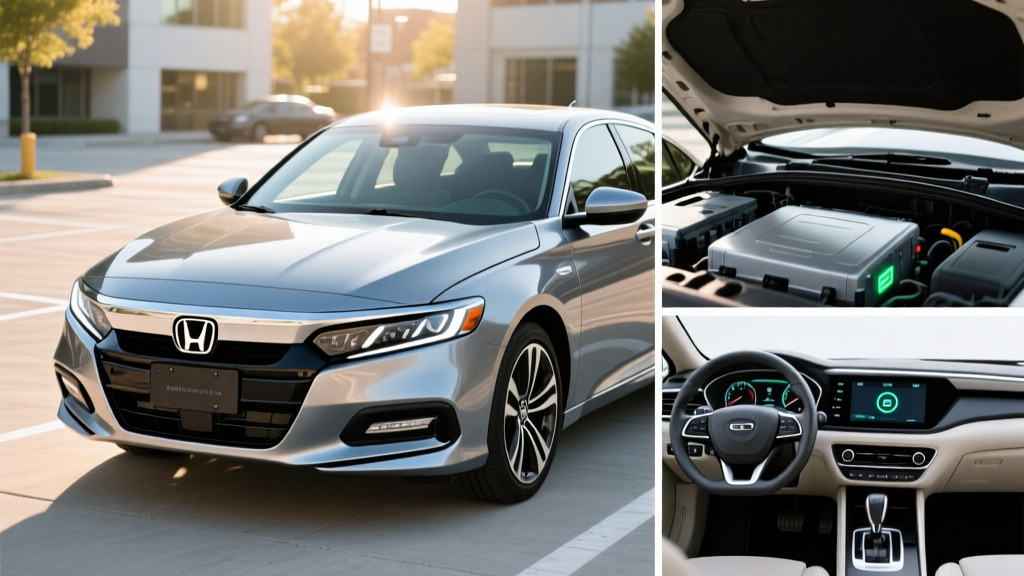
A hybrid drivetrain pairs a gasoline internal combustion engine with one or more electric motors and a battery pack. The electric motor assists during acceleration, recovers energy during braking (regenerative braking), and in some configurations can drive the vehicle on electricity alone. The result is significantly better fuel economy than a gas-only equivalent — without requiring any change to your fueling habits, at least for conventional hybrids.
In 2026, the hybrid market has matured into two distinct categories, and confusing them is the single most common mistake buyers make. Let's separate them clearly before diving into specs.
HEV vs PHEV — The Core Difference
Conventional Hybrid (HEV): Small battery (typically 1.0–2.0 kWh). Charges itself via regenerative braking and the engine. You never plug it in. The electric motor assists the engine but cannot drive the car on electricity alone for meaningful distances. Example: Toyota Prius, Honda CR-V Hybrid.
Plug-in Hybrid (PHEV): Larger battery (typically 13–25 kWh). You plug it in to charge. It can drive 25–50+ miles on electricity alone before the gas engine kicks in. Once the battery depletes, it operates like a conventional hybrid. Example: Toyota RAV4 Prime, Jeep Wrangler 4xe.
How the Hybrid Drivetrain Actually Delivers Better MPG
Gasoline engines are least efficient at low speeds and during stop-and-go driving — exactly the conditions of city commuting. A hybrid drivetrain exploits three mechanisms to close this gap:
- Regenerative braking: The electric motor reverses direction during deceleration, converting kinetic energy into electricity stored in the battery rather than wasting it as heat through brake pads.
- Engine-off electric driving: At low speeds or light loads, the engine shuts off entirely and the electric motor propels the vehicle. This is why hybrids dramatically outperform their EPA highway numbers in city driving.
- Engine load optimization: When the engine does run, the electric motor handles peak power demands (acceleration), allowing the engine to operate in its most efficient RPM range more consistently.
These mechanisms explain a counterintuitive reality: many hybrids achieve higher MPG in the city than on the highway — the opposite of a conventional gas car.
2026 Hybrid MPG: What the EPA Numbers Actually Look Like
Below are EPA-rated figures for some of the highest-volume hybrid drivetrains on the market in the 2026 model year. Data sourced from fueleconomy.gov.
| Vehicle (2026 MY) | Type | City MPG | Hwy MPG | Combined | Elec. Range (mi) |
|---|---|---|---|---|---|
| Toyota Prius | HEV | 57 | 56 | 57 | — |
| Toyota Prius Prime | PHEV | — | — | 52 (hybrid mode) | 44 |
| Honda CR-V Hybrid | HEV | 43 | 36 | 40 | — |
| Toyota RAV4 Prime | PHEV | — | — | 38 (hybrid mode) | 42 |
| Hyundai Tucson PHEV | PHEV | — | — | 35 (hybrid mode) | 33 |
| Ford Maverick Hybrid | HEV | 42 | 33 | 37 | — |
PHEV Battery, Charging, and Electric-Only Range Explained
For plug-in hybrids, the battery is the component that defines the ownership experience. Here's what you need to know about the numbers:
| PHEV Model | Battery (kWh) | Elec. Range (mi) | L2 Charge Time | DC Fast Charge | Combined HP |
|---|---|---|---|---|---|
| Toyota Prius Prime | 13.6 kWh | 44 | ~4 hr (Level 2) | No | 220 hp |
| Toyota RAV4 Prime | 18.1 kWh | 42 | ~2.5 hr (Level 2) | No | 302 hp |
| Jeep Wrangler 4xe | 17.3 kWh | 21 | ~3.5 hr (Level 2) | No | 375 hp |
| Hyundai Tucson PHEV | 13.8 kWh | 33 | ~3 hr (Level 2) | No | 261 hp |
Critical detail: The vast majority of PHEVs on the market do not support DC fast charging. You charge them on a standard 120V household outlet (Level 1, ~12 hours for a full charge) or a 240V Level 2 home charger. This is because PHEV batteries are small enough that overnight Level 2 charging fully replenishes them — DC fast charging adds cost and weight without a compelling use case for a 13–18 kWh pack.
A notable exception: the Chrysler Pacifica PHEV has historically offered DC fast charge capability on certain trims, but most buyers rely on Level 2 overnight charging regardless.
Hybrid Drivetrain Powertrain Configurations: Series, Parallel, and Series-Parallel
Not all hybrid drivetrains are engineered the same way. The three architectures determine how power flows from the engine and motor to the wheels:
Series Hybrid
The gasoline engine never drives the wheels directly. It acts solely as a generator to charge the battery or power the electric motor. This is the architecture used in some range-extended EVs and was used in the now-discontinued BMW i3 REx. It's uncommon in mainstream 2026 models.
Parallel Hybrid
Both the engine and the electric motor can drive the wheels independently or together. This is simpler and lighter but offers less flexibility in optimizing engine efficiency. Honda's earlier IMA system used this approach.
Series-Parallel (Power-Split) Hybrid
The most common and sophisticated architecture in 2026. A planetary gearset allows the system to operate as a series hybrid, a parallel hybrid, or any blend of both — continuously optimizing for the driving condition. Toyota's Hybrid Synergy Drive (used in the Prius, RAV4 Hybrid, Camry Hybrid) is the benchmark implementation. Hyundai and Kia use a similar power-split design in their hybrid lineup.
This architecture is why Toyota hybrids consistently deliver such strong real-world efficiency — the system seamlessly shifts between modes dozens of times per minute without driver input.
Hybrid Battery Warranty, Lifespan, and Replacement Cost
Hybrid Battery Warranty — What's Standard
Federal regulations mandate that hybrid and EV battery packs carry a minimum warranty of 8 years / 100,000 miles (10 years / 150,000 miles in California and states that follow CARB emissions standards). Most manufacturers meet or exceed this baseline:
- Toyota: 10 years / 150,000 miles on hybrid battery (all 50 states for 2026 MY)
- Honda: 8 years / 100,000 miles (10/150k in CARB states)
- Hyundai/Kia: 10 years / 100,000 miles
- Ford: 8 years / 100,000 miles
The warranty typically covers the battery if capacity drops below ~60–70% of original capacity, though exact thresholds vary by manufacturer.
How long do hybrid batteries actually last? Real-world data from fleets and high-mileage owners shows that modern nickel-metal hydride (NiMH) and lithium-ion hybrid battery packs routinely last 150,000–200,000+ miles before significant degradation. The Toyota Prius, with over two decades on the road, has the most extensive longevity track record — many examples exceed 200,000 miles on the original battery pack.
Replacement cost if out of warranty: A hybrid battery replacement runs between $2,000 and $4,000 for most mainstream models (parts and labor). Toyota Prius replacements tend toward the lower end (~$2,000–$2,500 at a dealer), while larger packs in SUVs like the RAV4 Hybrid can approach $3,500–$4,500. Independent hybrid specialists and refurbished packs can reduce this cost by 30–50%. This is substantially less than full EV battery replacement ($8,000–$20,000+) because hybrid packs are much smaller.
Pricing and Tax Credit Eligibility for Hybrids and PHEVs
Hybrid vehicles carry a price premium over their gas-only counterparts, typically $1,500–$5,000 depending on the model and trim. Here's where the 2026 lineup sits:
| Model | Base MSRP | Federal Tax Credit | Type |
|---|---|---|---|
| Toyota Prius (HEV) | ~$29,500 | None | HEV |
| Toyota Prius Prime (PHEV) | ~$34,000 | Up to $3,750* | PHEV |
| Toyota RAV4 Prime (PHEV) | ~$44,500 | Up to $7,500* | PHEV |
| Hyundai Tucson PHEV | ~$39,000 | Up to $3,750* | PHEV |
| Ford Maverick Hybrid | ~$28,500 | None | HEV |
*Federal tax credit rules (IRS §30D) for PHEVs in 2026: Conventional hybrids (HEVs) do not qualify for the federal plug-in vehicle tax credit — they have no plug. PHEVs may qualify, but the credit amount depends on battery capacity (minimum 7 kWh for full credit eligibility) and is subject to critical mineral and battery component sourcing requirements that phase the credit amount. The credit is also subject to:
- MSRP caps: $80,000 for vans/SUVs/pickups; $55,000 for sedans
- Buyer income caps: $300,000 joint / $225,000 head of household / $150,000 individual (modified AGI)
- Point-of-sale transfer: As of 2024, qualifying buyers can transfer the credit to the dealer for an immediate price reduction rather than waiting to claim it on their tax return
Always verify current eligibility on the IRS Clean Vehicle Credit page and at fueleconomy.gov, as sourcing requirements change and can reduce or eliminate the credit for specific models mid-year. Consult a tax professional for your specific situation.
Hybrid vs PHEV vs Full EV: Which Drivetrain Fits You?
Choose a Conventional Hybrid (HEV) If:
- You cannot install a home charger (apartment, street parking, no garage)
- You want maximum MPG with zero behavior change — just fill up with gas
- Your budget is tighter and you want the lowest purchase price among electrified options
- You drive in heavy stop-and-go city traffic where the hybrid advantage is greatest
Choose a Plug-in Hybrid (PHEV) If:
- You can charge at home (even a standard 120V outlet works overnight for most PHEVs)
- Your daily commute is under 40 miles round-trip — you could drive mostly on electricity
- You take regular road trips and don't want to plan around charging infrastructure
- You want EV-like daily driving with gas-engine backup for longer trips
Choose a Full Battery EV (BEV) If:
- You can install a Level 2 home charger and your daily driving is within the vehicle's range
- You want the lowest per-mile fuel cost and minimal maintenance (no oil changes, fewer brake replacements)
- You want access to the full $7,500 federal tax credit (subject to eligibility rules)
- You're ready to use public DC fast charging for road trips
Pros and Cons of the Hybrid Drivetrain
✓ Pros
- Significantly better fuel economy than gas-only equivalents (30–60% improvement)
- No range anxiety — refuel at any gas station in 3 minutes
- Conventional hybrids require no charging infrastructure
- Proven long-term reliability with extensive real-world data (Prius: 25+ years)
- Lower battery replacement cost than full EVs ($2,000–$4,500 vs $8,000–$20,000+)
- PHEVs offer daily electric-only commuting with road-trip flexibility
- Regenerative braking extends brake pad life significantly
✗ Cons
- Higher purchase price than gas-only equivalents ($1,500–$5,000 premium)
- Conventional hybrids get no federal tax credit
- Still dependent on gasoline — fuel costs and emissions remain
- Two powertrains means two systems that can require maintenance
- PHEVs have limited electric-only range (21–50 mi) — less useful for long commutes
- Most PHEVs lack DC fast charging — road-trip electric driving is impractical
- Hybrid efficiency advantage shrinks at sustained highway speeds
Frequently Asked Questions
How many MPG does a hybrid drivetrain get compared to a gas car?
It varies by model, but the improvement is substantial. The 2026 Toyota Prius achieves 57 MPG combined vs. a comparable gas-only compact sedan at roughly 30–33 MPG combined — a 72–90% improvement. In SUVs, the Honda CR-V Hybrid delivers 40 MPG combined vs. the gas CR-V's ~28 MPG combined. The hybrid advantage is most pronounced in city driving, where regenerative braking and engine-off electric propulsion do the most work.
How far can a PHEV go on electric power only?
Current 2026 PHEVs offer between 21 and 50 miles of electric-only range, depending on battery size and vehicle weight. The Toyota Prius Prime leads at 44 miles, the RAV4 Prime delivers 42 miles, and the Hyundai Tucson PHEV provides 33 miles. Heavier vehicles like the Jeep Wrangler 4xe manage 21 miles. For most commuters with a sub-40-mile round trip and home charging, a PHEV can cover daily driving entirely on electricity — but expect a 15–25% range reduction in cold weather.
Do conventional hybrids need to be plugged in?
No. A conventional hybrid (HEV) charges its small battery entirely through regenerative braking and the gasoline engine. You never plug it in — you simply refuel at a gas station as you would with any other car. Only plug-in hybrids (PHEVs) require or benefit from being plugged in.
Is the hybrid drivetrain reliable long-term?
Yes. The Toyota hybrid system, in particular, has over 25 years of real-world data supporting its durability. Hybrid battery packs routinely last 150,000–200,000+ miles. The power-split architecture used by Toyota and others has fewer wear components than a traditional automatic transmission (no torque converter, no clutch packs). The hybrid battery warranty of 8–10 years / 100,000–150,000 miles provides a strong backstop, and out-of-warranty replacement costs $2,000–$4,500 — far less than a full EV battery.
Does a hybrid qualify for a federal tax credit?
Conventional hybrids (HEVs) do not qualify for the federal §30D Clean Vehicle tax credit — they have no plug and do not meet the definition of a clean vehicle under the statute. Plug-in hybrids (PHEVs) may qualify for up to $7,500, but the actual amount depends on battery capacity, critical mineral sourcing, battery component sourcing, MSRP caps, and buyer income limits. Many PHEVs qualify for a partial credit ($3,750) rather than the full amount. Always check the IRS guidelines before purchasing.
What happens when the hybrid battery dies?
Hybrid battery failure is relatively rare and usually occurs gradually (reduced capacity, lower MPG) rather than catastrophically. If the battery fails within the warranty period (8–10 years / 100,000–150,000 miles), replacement is covered. Out of warranty, expect $2,000–$4,500 for a dealer replacement. Independent hybrid shops and refurbished battery options can reduce this to $1,200–$2,500. In most cases, the rest of the vehicle is still in excellent shape, making the replacement economically worthwhile.
Is a hybrid better than a full EV for me?
If you can charge at home, your daily driving is under 250 miles, and you're comfortable planning road-trip charging stops, a full EV will give you lower operating costs and zero tailpipe emissions. If you lack home charging access, frequently drive beyond EV range, live in an area with sparse charging infrastructure, or simply want the lowest-risk transition from a gas car, a hybrid (HEV or PHEV) is the pragmatic choice. PHEVs split the difference — offering EV-like daily commuting with gas-engine freedom for longer trips.