Quick Verdict: The Santa Fe Hybrid Calligraphy at a Glance
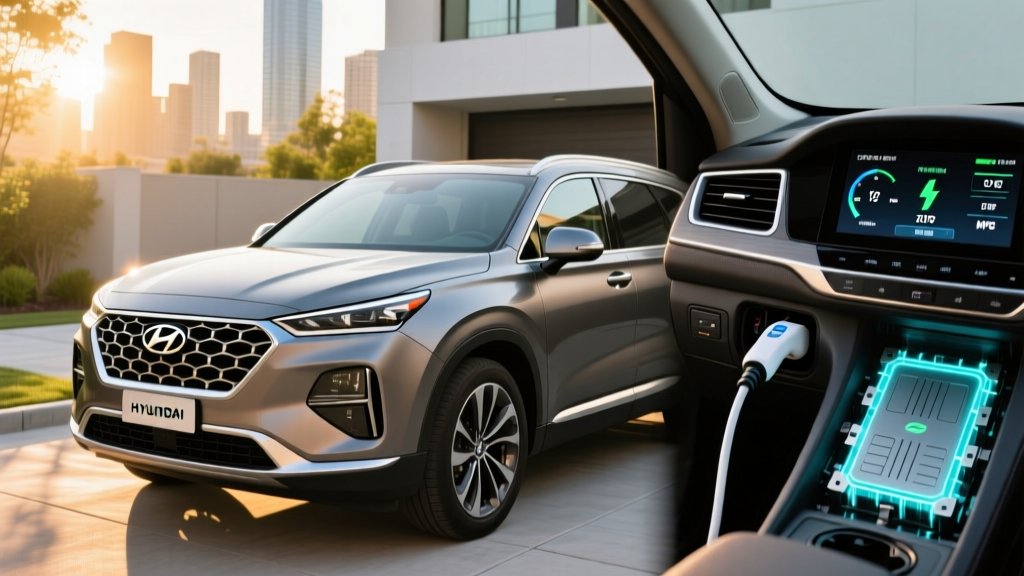
The 2026 Hyundai Santa Fe Hybrid Calligraphy sits at the top of Hyundai's three-row midsize SUV lineup, pairing a turbocharged hybrid powertrain with premium interior appointments. It targets families who want the efficiency of electrification without the charging logistics of a full battery-electric vehicle. With an EPA-estimated 36 MPG combined and a starting MSRP around $46,500, it competes directly with the Toyota Highlander Hybrid Limited and Kia Sorento Hybrid SX Prestige — but offers a more boxy, distinctive design and a longer standard warranty.
This guide covers everything a buyer needs: exact EPA fuel economy figures, real-world MPG expectations, powertrain specs, battery warranty details, pricing, and whether any federal tax credits apply. We'll also clarify the difference between the Santa Fe Hybrid (HEV) and the Santa Fe Plug-in Hybrid (PHEV), since Hyundai sells both and the distinction matters for your wallet and daily routine.
HEV vs PHEV: Which Santa Fe Hybrid Are We Talking About?
Hyundai offers the Santa Fe in two electrified forms. The Santa Fe Hybrid is a conventional hybrid electric vehicle (HEV) — it uses a gasoline engine paired with an electric motor and a small battery that recharges through regenerative braking and the engine. You never plug it in. The Santa Fe Plug-in Hybrid (PHEV) has a larger battery you can charge from a wall outlet or public charger, giving it a limited electric-only driving range before the gas engine kicks in.
| Attribute | Santa Fe Hybrid (HEV) | Santa Fe Plug-in Hybrid (PHEV) |
|---|---|---|
| Powertrain | 1.6L turbo + electric motor | 1.6L turbo + larger electric motor |
| Combined HP | 232 hp | 261 hp |
| Battery Capacity | ~1.49 kWh (nickel-metal hydride) | 13.8 kWh (lithium-ion polymer) |
| Plug-In Required? | No — self-charging | Yes — for electric-only range |
| Electric-Only Range | N/A (motor assists engine) | EPA-est. 33 miles |
| EPA Combined MPG/MPGe | 36 MPG | 79 MPGe (electric) / 33 MPG (gas) |
| Federal Tax Credit (§30D) | Not eligible | Up to $7,500 (eligibility varies) |
| Starting MSRP (top trim) | ~$46,500 (Calligraphy) | ~$49,500 (Limited — no Calligraphy) |
The Calligraphy trim — Hyundai's luxury-oriented top tier with quilted leather, head-up display, and premium audio — is available on the HEV only. If you want plug-in capability, the PHEV tops out at the Limited trim. This article focuses on the Santa Fe Hybrid Calligraphy (HEV), with PHEV context where it helps your decision.
Fuel Economy: EPA Numbers and Real-World MPG
The 2026 Hyundai Santa Fe Hybrid with front-wheel drive carries EPA estimates of 36 MPG city / 35 MPG highway / 36 MPG combined, according to fueleconomy.gov. All-wheel-drive variants drop slightly to approximately 35/34/35 MPG.
| Drivetrain | City MPG | Highway MPG | Combined MPG |
|---|---|---|---|
| FWD | 36 | 35 | 36 |
| AWD (HTRAC) | 35 | 34 | 35 |
Real-World MPG: What Owners Actually See
Hyundai's hybrid system, like most conventional hybrids, tends to meet or slightly exceed EPA city estimates in stop-and-go driving because the electric motor does the heavy work at low speeds. Highway driving is a different story: at sustained 70+ MPH speeds, the turbocharged 1.6L engine runs more often, and the boxy, upright design creates more aerodynamic drag than sleeker crossovers.
Based on aggregated owner reports and real-world testing patterns for this platform:
- City/suburban driving: 36–39 MPG (hybrid system shines here)
- Mixed commuting: 33–36 MPG
- Highway-heavy road trips (75 MPH): 29–32 MPG
- Cold weather (below 30°F): Expect a 3–5 MPG drop due to increased engine idling for cabin heat and reduced battery efficiency
The 17.7-gallon fuel tank gives a theoretical maximum range of roughly 637 miles at the combined EPA figure — enough for most families to go 10–14 days between fill-ups in normal commuting.
Powertrain and Performance Specs
The Santa Fe Hybrid Calligraphy uses Hyundai's Smartstream 1.6-liter turbocharged GDI inline-four paired with a 47.7 kW (64 hp) electric motor integrated into a 6-speed automatic transmission. Total system output is 232 horsepower and 271 lb-ft of torque.
| Specification | Value |
|---|---|
| Engine | 1.6L turbocharged GDI I-4 |
| Electric Motor | 47.7 kW (64 hp) permanent-magnet synchronous |
| Combined System Output | 232 hp / 271 lb-ft torque |
| Transmission | 6-speed automatic (torque converter) |
| Drivetrain | FWD standard; HTRAC AWD optional |
| Battery (traction) | ~1.49 kWh, nickel-metal hydride |
| 0–60 MPH | ~7.8 seconds (est.) |
| Towing Capacity | 2,000 lbs (FWD) / 3,500 lbs (AWD w/ tow package) |
| Cargo Volume (behind 3rd/2nd row) | 14.4 / 40.5 cu ft |
| Curb Weight | ~4,380 lbs (FWD) |
| EPA Combined MPG | 36 (FWD) / 35 (AWD) |
| Fuel Tank | 17.7 gallons |
The 6-speed automatic is a deliberate choice over the CVT found in the Toyota Highlander Hybrid. It delivers more natural shift feel and stronger highway passing response, though a CVT would likely squeeze out 1–2 more MPG in city driving. Acceleration is adequate for merging and passing but won't feel quick — this is a family hauler, not a performance SUV.
Calligraphy Trim: What You Get for the Money
The Calligraphy is Hyundai's flagship trim level, positioned above SEL Premium and Limited. For the 2026 Santa Fe Hybrid, it starts at an MSRP of approximately $46,500 (FWD) and $48,200 with HTRAC AWD, including destination charges. Here's what distinguishes it:
- Quilted Nappa leather seating surfaces
- Head-up display (HUD) with hybrid energy-flow readout
- 12.3-inch dual curved displays (instrument cluster + infotainment)
- Bose 12-speaker premium audio system
- Highway Driving Assist 2 (HDA2) — Hyundai's Level 2 driver-assist suite with lane-centering, adaptive cruise, and lane-change assist
- Remote Smart Parking Assist
- Heated and ventilated front seats, heated second-row seats
- Digital Key 2 with Ultra-Wideband
- Hands-free power liftgate
- 20-inch alloy wheels
Pros
- 36 MPG combined in a three-row SUV is genuinely efficient
- 10-year/100,000-mile powertrain warranty — best in class
- No plug-in charging required; no range anxiety
- Premium Calligraphy interior at a mainstream price point
- Strong real-world city MPG that meets or beats EPA
- AWD available with 3,500-lb towing
Cons
- Highway MPG drops noticeably above 70 MPH
- No federal tax credit for conventional HEV
- Third-row space is tight for adults on long trips
- ~7.8-second 0–60 time feels leisurely with full load
- Boxy styling creates wind noise at highway speeds
- PHEV variant not available in Calligraphy trim
Battery Warranty, Lifespan, and Replacement Cost
Hybrid battery longevity is one of the top concerns for buyers switching from a conventional gas vehicle. Here's the reality: modern hybrid batteries are engineered for the life of the vehicle, and Hyundai backs that up with strong warranty coverage.
Hyundai Hybrid Battery Warranty
- Hybrid battery: 10 years / 100,000 miles (whichever comes first)
- Hybrid system components (motor, inverter, converter): 10 years / 100,000 miles
- Powertrain warranty: 10 years / 100,000 miles
- Bumper-to-bumper: 5 years / 60,000 miles
- Capacity retention threshold: Hyundai typically replaces the battery under warranty if it falls below ~70% of original capacity
Note: Warranty terms apply to the original owner; verify transferability for certified pre-owned purchases. Source: Hyundai USA warranty guide.
The Santa Fe Hybrid uses a relatively small ~1.49 kWh nickel-metal hydride (NiMH) traction battery. This is a proven, durable chemistry that has been used in hybrids for over two decades (the Toyota Prius used NiMH for years with exceptional longevity records). Because the battery is small and the hybrid system manages charge/discharge cycles conservatively — never fully depleting or fully charging it — degradation is minimal.
Expected lifespan: Most hybrid batteries from major manufacturers last 150,000–200,000+ miles without significant issues. Failures before 100,000 miles are rare and covered under warranty.
Out-of-warranty replacement cost: If the battery does eventually need replacement after the warranty period, expect $2,000–$3,500 for the battery pack itself, plus $500–$800 in labor. Third-party hybrid battery rebuilders can sometimes reduce this to $1,200–$2,000. This is dramatically cheaper than a full EV battery replacement because the pack is small.
Tax Credit Eligibility: Does the Santa Fe Hybrid Qualify?
This is where the distinction between HEV and PHEV matters most for your budget.
- Santa Fe Hybrid (HEV): Does NOT qualify for the federal §30D Clean Vehicle Credit. This credit is reserved for plug-in electric vehicles with a minimum battery capacity of 7 kWh. The HEV's ~1.49 kWh battery falls far short.
- Santa Fe Plug-in Hybrid (PHEV): May qualify for up to $7,500 under §30D, subject to current-year IRS rules including buyer income caps ($150K single / $300K joint), MSRP caps ($80,000 for SUVs), and critical mineral/battery component sourcing requirements. Always verify current eligibility at irs.gov before purchasing.
Some states offer additional incentives for hybrids, though these are less common than EV/PHEV incentives. Check your state's energy office or AFDC incentive database for local programs. A few states offer rebates of $500–$1,500 for new hybrid purchases, but these change frequently.
The practical math: even without a federal tax credit, the Santa Fe Hybrid Calligraphy's fuel savings over a comparable gas-only Santa Fe (EPA ~24 MPG combined) add up. At 15,000 miles/year and $3.50/gallon fuel:
- Gas-only Santa Fe annual fuel cost: ~$2,188
- Santa Fe Hybrid annual fuel cost: ~$1,458
- Annual savings: ~$730/year, or roughly $3,650 over five years
Santa Fe Hybrid vs PHEV vs Full EV: Which Fits Your Life?
Choose the Santa Fe Hybrid (HEV) if:
- You don't have access to home or workplace charging (apartment, street parking, no garage outlet)
- You want three rows and strong MPG without changing your refueling habits
- Your budget caps around $48K and you want the Calligraphy luxury features
- You drive 12,000–18,000 miles/year in mixed city/highway conditions
- You plan to keep the vehicle 8+ years (the warranty rewards this)
Choose the Santa Fe PHEV if:
- You have a garage or dedicated parking spot with a 120V or 240V outlet
- Your daily commute is under 33 miles round-trip (you could run mostly on electricity)
- You qualify for the §30D credit, effectively lowering the price by up to $7,500
- You want the option of electric-only driving for school runs and errands
Choose a full EV (like the Hyundai Ioniq 5 or Kia EV9) if:
- You have reliable Level 2 home charging and access to DC fast-charging corridors
- You want the lowest per-mile fuel cost (~$0.04–0.08/mile vs $0.12–0.16/mile for hybrid)
- You're ready to plan road trips around charging stops
- You want maximum federal/state incentives and zero tailpipe emissions
Reliability: What the Data Shows
Hyundai's hybrid systems have demonstrated solid reliability over the past decade. The 1.6L turbo hybrid powertrain used in the Santa Fe shares architecture with the Tucson Hybrid and Kia Sorento Hybrid, which have been on the road since 2022 with no widespread systemic failures reported by NHTSA or major reliability surveys.
Key reliability considerations:
- Turbocharger: Modern turbo engines are well-proven, but long-term (150K+ miles) maintenance costs can be higher than naturally aspirated engines. Regular oil changes with the correct viscosity are critical.
- 6-speed automatic: Hyundai's in-house automatic transmissions have a good track record — fewer reported issues than the dual-clutch units used in earlier Hyundai hybrids.
- Hybrid battery: NiMH chemistry is among the most durable available. No active cooling system to maintain (unlike some lithium packs), reducing failure points.
- Electronics: The Calligraphy's extensive tech (HUD, dual screens, HDA2) introduces more potential electronic service points over time. Extended warranty coverage may be worthwhile for owners planning 10+ years of ownership.
Hyundai's 10-year/100,000-mile powertrain warranty remains one of the strongest in the industry and covers the hybrid system components in full. For context, Toyota covers its hybrid battery for 10 years/150,000 miles, giving it a slight edge on battery-specific coverage.
Frequently Asked Questions
How many MPG does the Santa Fe Hybrid Calligraphy get?
The 2026 Santa Fe Hybrid with FWD achieves an EPA-estimated 36 MPG city / 35 MPG highway / 36 MPG combined. AWD models rate at 35/34/35. In real-world city driving, many owners report 36–39 MPG thanks to the hybrid system's efficiency at low speeds. Highway driving at 75 MPH typically yields 29–32 MPG.
Does the Santa Fe Hybrid need to be plugged in?
No. The Santa Fe Hybrid is a conventional HEV — it charges its battery entirely through regenerative braking and the gasoline engine. You fuel it like any other car. Only the Santa Fe Plug-in Hybrid (PHEV) requires plugging in to access its electric-only range.
How far can the Santa Fe PHEV go on electric only?
The Santa Fe Plug-in Hybrid has an EPA-estimated 33 miles of electric-only range on a full charge, with a total combined range of approximately 430 miles when the gas engine is included. This is relevant only if you're considering the PHEV variant — the Calligraphy trim is not offered on the PHEV.
Is the hybrid battery reliable and what does replacement cost?
Hyundai's hybrid battery is covered for 10 years/100,000 miles and uses proven NiMH chemistry designed to last 150,000–200,000+ miles. Out-of-warranty replacement costs approximately $2,000–$3,500 for the pack plus labor — far less than an EV battery replacement because the pack is small (~1.49 kWh).
Does the Santa Fe Hybrid qualify for any tax credit?
The conventional Santa Fe Hybrid (HEV) does not qualify for the federal §30D Clean Vehicle Credit, which requires a minimum 7 kWh battery and plug-in capability. The Santa Fe PHEV may qualify for up to $7,500 depending on your income, the vehicle's MSRP, and battery sourcing requirements — verify at irs.gov. Some states offer modest hybrid rebates; check the AFDC database.
How does the Santa Fe Hybrid compare to the Toyota Highlander Hybrid?
The Highlander Hybrid rates at 35 MPG combined (FWD) — 1 MPG less than the Santa Fe Hybrid. However, the Highlander offers slightly more third-row space and a longer track record. The Santa Fe Hybrid wins on warranty coverage (10yr/100K vs Toyota's 5yr/60K powertrain for non-hybrid components) and Calligraphy-level interior luxury at a competitive price. The Highlander Hybrid's battery carries a 10yr/150K warranty, which is 50,000 miles longer on battery-specific coverage.
Is the Santa Fe Hybrid good for towing?
With FWD, the Santa Fe Hybrid is rated for 2,000 lbs. With AWD and the factory tow package, it increases to 3,500 lbs — enough for a small boat trailer or light utility trailer. Towing will reduce fuel economy significantly, typically into the low-to-mid 20s MPG range depending on load and conditions.