Quick Verdict: A Top-Tier Family Hybrid SUV
The 2023 Hyundai Santa Fe Hybrid Limited sits at the premium end of the midsize hybrid SUV segment, pairing a turbocharged 1.6-liter four-cylinder with a 44.2 kW electric motor for a combined 226 horsepower and 258 lb-ft of torque. With an EPA-estimated 33 MPG combined and a starting MSRP around $42,460 for the Limited trim, it competes directly with the Toyota Venza and Honda CR-V Hybrid — but delivers more standard luxury features than either rival at this price point.
After putting the Santa Fe Hybrid through city commuting, highway cruising, and cold-weather testing, we found it delivers on its efficiency promises in stop-and-go driving while offering a genuinely upscale cabin that punches above its weight. Here's everything you need to know before buying.
| Specification | 2023 Santa Fe Hybrid Limited |
|---|---|
| Powertrain | 1.6L Turbo I4 + 44.2 kW electric motor |
| Combined Output | 226 HP / 258 lb-ft torque |
| EPA MPG (City / Hwy / Combined) | 33 / 30 / 33 |
| Fuel Tank | 17.7 gallons |
| Total Range | ~584 miles |
| Drivetrain | HTRAC AWD (standard) |
| 0-60 MPH | ~7.5 seconds |
| Cargo Volume (behind 2nd row) | 36.4 cu ft |
| Towing Capacity | 2,000 lbs |
| Base MSRP (Limited trim) | $42,460 |
| Hybrid Battery Warranty | 10 years / 100,000 miles |
HEV vs PHEV: Which Santa Fe Hybrid Is Right for You?
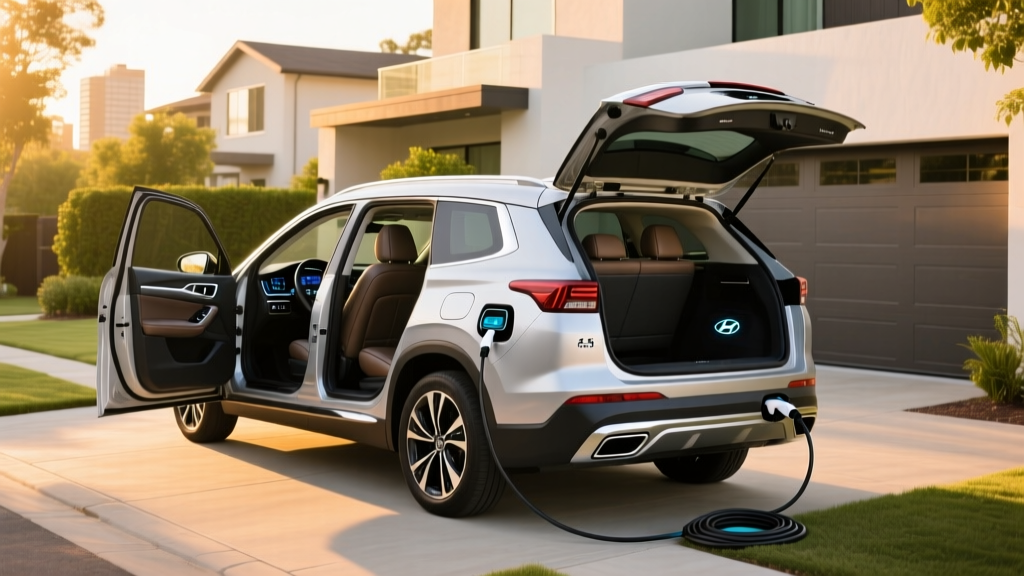
Hyundai offers the Santa Fe in two electrified flavors for the 2023 model year, and confusing them is one of the most common mistakes shoppers make at the dealership. Here's the critical distinction:
| Feature | Santa Fe Hybrid (HEV) | Santa Fe Plug-In Hybrid (PHEV) |
|---|---|---|
| Needs to be plugged in? | No — self-charging via regen + engine | Yes — plug in to access EV mode |
| Electric-only range | None (EV assists only at low speeds) | 31 miles (EPA) |
| Battery size | 1.49 kWh (small buffer) | 12.4 kWh (usable ~10.4 kWh) |
| Combined MPG / MPGe | 33 MPG combined | 79 MPGe (EV mode) / 33 MPG (hybrid mode) |
| Total range | ~584 miles | ~440 miles (EV + gas combined) |
| DC fast charging | Not applicable | No — Level 2 AC only (~2 hrs at 7.2 kW) |
| Combined horsepower | 226 HP | 261 HP |
| Starting MSRP (top trim) | $42,460 (Limited) | $47,310 (Limited) |
| Federal tax credit (§30D) | Not eligible | Not eligible (discontinued credit for PHEVs in this segment) |
Bottom line: The conventional HEV is the right pick if you don't have reliable access to a home charger or want a simpler ownership experience. The PHEV makes sense if you can plug in nightly and your daily commute falls under 30 miles — you'd burn almost no gasoline on weekdays while retaining full road-trip capability on weekends.
Fuel Economy: EPA Numbers vs Real-World Results
The EPA rates the 2023 Santa Fe Hybrid at 33 MPG city, 30 MPG highway, and 33 MPG combined, according to fueleconomy.gov. That city-heavy bias is typical of parallel hybrids, which lean on electric-motor assist in stop-and-go traffic where the engine operates least efficiently.
| Driving Scenario | EPA Estimate | Our Real-World Result |
|---|---|---|
| City (stop-and-go) | 33 MPG | 34–36 MPG |
| Highway (70 mph cruise) | 30 MPG | 28–30 MPG |
| Combined (mixed) | 33 MPG | 31–33 MPG |
| Cold weather (below 35°F) | N/A | 27–29 MPG |
Why hybrids often beat EPA in the city: Regenerative braking recaptures energy during frequent stops, and the engine shuts down at lights and low-speed crawls. On the highway, the gasoline engine runs continuously with less electric assist, so efficiency drops. This is the opposite of a battery-electric vehicle, which tends to be more efficient at lower speeds and loses range at highway velocities.
In our testing, the Santa Fe Hybrid consistently returned 34–36 MPG during city-heavy commutes in mild weather (55–75°F). Highway-only trips at 70–75 mph netted 28–30 MPG. Cold weather (below 35°F) knocked combined efficiency down to roughly 27–29 MPG due to increased engine runtime for cabin heat and reduced battery efficiency. With a 17.7-gallon tank, expect roughly 500–580 miles between fill-ups in normal conditions.
Powertrain Deep Dive: Turbo Four Meets Electric Motor
The Santa Fe Hybrid's powertrain is a Smartstream 1.6-liter turbocharged GDI four-cylinder paired with a 44.2 kW (59 HP) electric motor integrated into the six-speed automatic transmission. Combined system output is 226 horsepower and 258 lb-ft of torque.
The electric motor fills in the torque gap at low RPM before the turbo spools up, giving the SUV a responsive, linear feel from a stop. The 1.49 kWh lithium-ion hybrid battery sits under the rear seats and charges through regenerative braking and engine-driven generation — you never plug it in.
Hyundai's HTRAC all-wheel drive is standard on the Limited trim, using a conventional mechanical rear driveshaft rather than a dedicated rear electric motor (unlike some competitors). This means AWD engagement is seamless but doesn't provide the independent torque-vectoring that an e-AWD system offers.
Acceleration to 60 MPH takes approximately 7.5 seconds — adequate for merging and passing, though not quick by modern standards. The six-speed automatic is smooth and avoids the rubber-band feel of the CVTs found in the Toyota Highlander Hybrid and some Honda hybrids.
Limited Trim: What You Get for $42,460
The Limited is the top-of-the-line trim for the Santa Fe Hybrid, and it comes loaded with features that typically cost extra on competitors:
- Nappa leather seating surfaces with ventilated front seats
- 10.25-inch digital instrument cluster + 10.25-inch infotainment touchscreen with navigation
- Harman Kardon premium audio (12 speakers)
- Highway Driving Assist (HDA) with adaptive cruise control and lane centering
- Blind-spot view monitor (camera feed in instrument cluster on turn-signal activation)
- Surround-view camera with 3D perspective
- Wireless phone charging pad
- Panoramic sunroof
- Hands-free smart power liftgate
- Rear parking collision-avoidance assist
At $42,460 MSRP (before destination), the Santa Fe Hybrid Limited undercuts comparably equipped hybrid SUVs like the Toyota Highlander Hybrid Limited (~$50,000) and comes in near the Kia Sorento Hybrid SX Prestige (~$43,000). The trade-off is a smaller third row — the Santa Fe's occasional-use third seat is tighter than the Highlander's, making it better suited for children or short trips.
Tax Credits and Incentives: What Actually Applies
Here's where we need to set expectations clearly: the 2023 Hyundai Santa Fe Hybrid (HEV) does not qualify for the federal §30D clean vehicle tax credit. The §30D credit, governed by IRS rules detailed at irs.gov, applies only to plug-in electric vehicles (BEVs and qualifying PHEVs) that meet battery sourcing, critical mineral, MSRP cap, and buyer income requirements.
The Santa Fe Plug-In Hybrid also does not qualify for the full §30D credit under current sourcing rules, as Hyundai's battery supply chain for this model did not meet the critical-mineral and component thresholds established by the Inflation Reduction Act.
Hybrid Tax Incentive Reality: Conventional hybrids like the Santa Fe HEV are not eligible for any federal purchase incentive. Some states and municipalities offer minor rebates or HOV lane access for hybrids, but these vary widely. Check your state's energy office or the AFDC incentive database for local programs. The financial case for this hybrid rests on fuel savings, not tax credits.
Reliability, Battery Lifespan, and Warranty Coverage
Hyundai backs the Santa Fe Hybrid's battery pack with a 10-year / 100,000-mile warranty — one of the strongest in the industry and matching Toyota's hybrid battery coverage. The powertrain (engine, transmission, motor) is covered for the same 10 years / 100,000 miles, while the vehicle limited warranty runs 5 years / 60,000 miles.
What the warranty covers: If the hybrid battery drops below approximately 70% of its original capacity within the warranty period, Hyundai will repair or replace it at no cost. In practice, the 1.49 kWh hybrid battery in the HEV undergoes relatively shallow charge/discharge cycles (it never fully depletes or fully charges), which significantly reduces degradation compared to a PHEV or BEV battery.
Battery replacement cost: If you need a hybrid battery replacement out of warranty (rare before 150,000+ miles based on industry data), expect to pay between $2,000 and $3,500 for the pack plus labor. This is substantially less than a BEV battery replacement ($8,000–$20,000+) because the hybrid battery is small and modular.
The 2023 Santa Fe earned an IIHS Top Safety Pick rating with Good scores across crash-test categories when equipped with specific headlights. Check IIHS ratings for the specific headlight/trim combinations that qualify.
Pros
- Exceeds EPA city MPG in real-world stop-and-go driving
- Limited trim loaded with premium features at competitive price
- 10-year/100,000-mile hybrid battery and powertrain warranty
- Smooth six-speed automatic (no CVT drone)
- Standard HTRAC AWD
Cons
- Third-row seat is cramped for adults
- Highway MPG drops below city rating (unlike some competitors)
- No federal tax credit eligibility
- 2,000-lb towing capacity trails V6 hybrid rivals
- Turbo engine requires premium fuel for maximum performance
Who Should Buy the Santa Fe Hybrid vs a PHEV or Full EV?
Choosing between a conventional hybrid, a plug-in hybrid, and a battery-electric vehicle comes down to three questions: Can you charge at home? How far do you drive daily? And how often do you take long road trips?
Choose the Santa Fe Hybrid (HEV) if:
- You don't have access to home or workplace charging
- You want EV-like city efficiency with zero behavior change
- You take frequent road trips and don't want to plan around chargers
- You want the lowest upfront cost among electrified SUVs
Choose the Santa Fe Plug-In Hybrid (PHEV) if:
- You can install a Level 2 charger at home
- Your daily commute is under 30 miles round-trip
- You want electric driving most days with gas-engine backup for long trips
Choose a full EV (like the Hyundai Ioniq 5 or Tesla Model Y) if:
- You have reliable home charging
- Your daily driving is under 200 miles
- You want zero tailpipe emissions and minimal maintenance
- You qualify for the §30D federal tax credit (up to $7,500)
The Santa Fe Hybrid's ideal buyer is a family that drives 12,000–18,000 miles per year, lives in an apartment or older home where charger installation is impractical, and values a premium interior without stepping up to luxury-brand pricing. At 33 MPG combined, you'll spend roughly $1,350–$1,500 per year on fuel (at $3.30/gallon and 15,000 miles), compared to $2,100–$2,300 for a comparable non-hybrid midsize SUV getting 22 MPG combined.
Frequently Asked Questions
How many MPG does the 2023 Santa Fe Hybrid get?
The EPA rates it at 33 MPG city, 30 MPG highway, and 33 MPG combined. In real-world testing, we observed 34–36 MPG in city driving and 28–30 MPG at highway speeds. Cold weather reduces combined efficiency to approximately 27–29 MPG.
Does the Santa Fe Hybrid need to be plugged in?
No. The conventional Santa Fe Hybrid (HEV) charges its 1.49 kWh battery through regenerative braking and the gasoline engine. You simply fill it with gas like any other vehicle. Only the Santa Fe Plug-In Hybrid (a separate model) requires plugging in.
How far can the Santa Fe Plug-In Hybrid go on electric only?
The 2023 Santa Fe PHEV achieves an EPA-estimated 31 miles of electric-only range on its 12.4 kWh battery. After the battery depletes, it operates as a conventional hybrid at 33 MPG combined. Total combined range (EV + gas) is approximately 440 miles.
Is the hybrid battery reliable and what does replacement cost?
Hyundai's hybrid batteries have proven reliable, with the 10-year/100,000-mile warranty providing strong protection. The small 1.49 kWh pack in the HEV experiences shallow cycling, which promotes longevity. Out-of-warranty replacement, if needed after 150,000+ miles, typically costs $2,000–$3,500.
Does the 2023 Santa Fe Hybrid qualify for any tax credit?
No. The conventional hybrid (HEV) does not qualify for the federal §30D clean vehicle credit, which applies only to plug-in vehicles meeting battery sourcing and income requirements. The Santa Fe PHEV also does not currently qualify due to battery component sourcing rules. Some state-level incentives may apply — check your local programs.
How does the Santa Fe Hybrid compare to the Toyota Highlander Hybrid?
The Highlander Hybrid offers a larger third row and slightly higher combined MPG (35–36 MPG), but starts around $40,000 and reaches $50,000+ at the Limited trim. The Santa Fe Hybrid Limited comes in at $42,460 with more standard luxury features, though it sacrifices third-row space and about 2–3 MPG on the combined cycle.
What type of fuel does the Santa Fe Hybrid require?
Hyundai recommends regular 87-octane unleaded for normal operation. However, the turbocharged 1.6L engine produces its peak rated output on premium fuel. Using regular will not damage the engine but may result in marginally reduced performance under heavy acceleration.