Quick Verdict: The 2026 Santa Fe Hybrid at a Glance
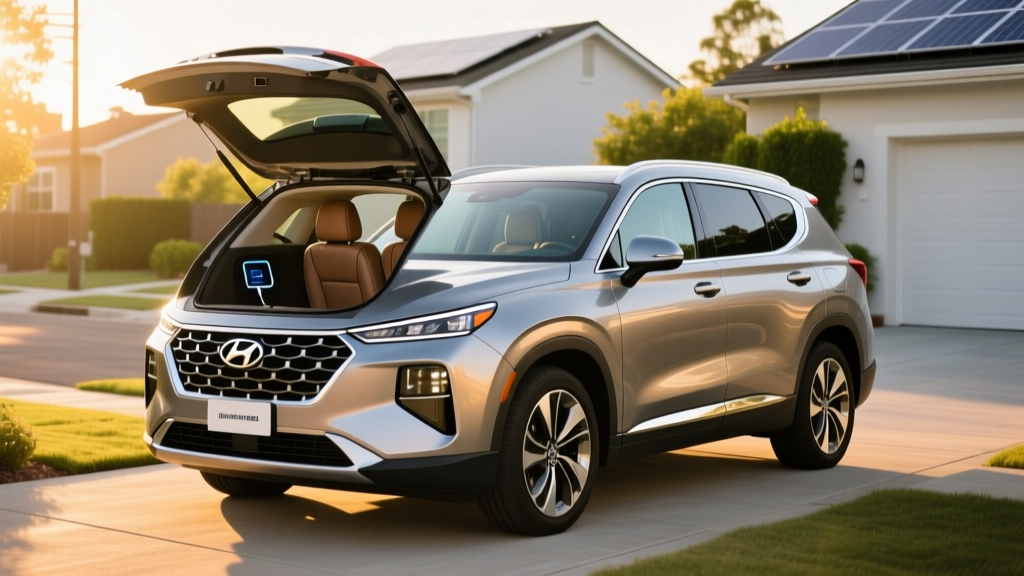
The 2026 Hyundai Santa Fe Hybrid slots into a narrow but valuable space in the midsize SUV market: a three-row family hauler that sips fuel without demanding you change how you drive. Unlike a full EV, it requires zero charging infrastructure. Unlike a conventional gas SUV, it returns up to 36 MPG combined in the standard hybrid (HEV) and offers an optional plug-in hybrid (PHEV) variant capable of roughly 33 miles of electric-only driving before the gas engine kicks in.
Hyundai pairs a turbocharged 1.6-liter four-cylinder engine with an electric motor integrated into a 6-speed automatic transmission — no CVT drone, no range anxiety. For 2026, the Santa Fe retains the boxy, Land Rover-esque redesign introduced for the 2024 model year, with updated infotainment and revised driver-assistance tuning.
The conventional hybrid (HEV) charges its small battery through regenerative braking and the gas engine. You never plug it in. The plug-in hybrid (PHEV) has a larger battery you charge via a wall outlet or public charger, giving you a meaningful electric-only range before the engine starts. This guide covers both, with clear specs for each.
Fuel Economy: EPA MPG Breakdown (HEV and PHEV)
The headline number for the 2026 Santa Fe Hybrid is its efficiency relative to its size. Here's what the EPA estimates for each powertrain, sourced from fueleconomy.gov:
| Powertrain | City MPG | Highway MPG | Combined MPG | Total Range |
|---|---|---|---|---|
| Santa Fe Hybrid (HEV) | 35 MPG | 35 MPG | 36 MPG | ~605 mi |
| Santa Fe Plug-in Hybrid (PHEV) — gas only | 33 MPG | 30 MPG | 32 MPG | ~400 mi (gas) + 33 mi (EV) |
| Santa Fe Plug-in Hybrid (PHEV) — MPGe combined | 79 MPGe (charge-depleting mode) | — | ||
Real-world MPG vs. EPA sticker: Hyundai's hybrid system favors city driving where regenerative braking recaptures energy at every stoplight. In mixed suburban driving, owners commonly report matching or slightly exceeding the 36 MPG combined EPA figure — often landing between 34–38 MPG depending on terrain and climate. Highway-only trips at 75+ MPH tend to drop to the low 30s. The PHEV's gas-only MPG drops to 32 combined once the battery is depleted because of the added weight of the larger battery pack.
Electric-Only Range and Charging (PHEV Only)
The 2026 Santa Fe Plug-in Hybrid carries a 13.8 kWh lithium-ion battery pack (usable capacity approximately 11.5 kWh). The EPA rates its electric-only range at 33 miles, enough to cover most daily commutes and school runs without burning a drop of gasoline.
Charging the PHEV
| Level | Power (kW) | 0–100% Time | Connector |
|---|---|---|---|
| Level 1 (120V household outlet) | ~1.4 kW | ~11 hours | J1772 |
| Level 2 (240V home/public charger) | 7.2 kW | ~2 hours | J1772 |
| DC Fast Charging | Not supported — PHEV battery is too small to warrant DCFC hardware | ||
A Level 2 home charger is the practical sweet spot for the PHEV. Plugging in overnight on a standard 240V circuit fully replenishes the battery by morning. The PHEV does not support DC fast charging — a deliberate omission common across nearly all plug-in hybrids, since the small battery doesn't benefit from high-power charging infrastructure.
Powertrain Specs: Horsepower, Engine, and Drivetrain
Both the HEV and PHEV share Hyundai's Smartstream turbocharged 1.6-liter inline-four, but the electric motor output differs between them.
| Spec | HEV | PHEV |
|---|---|---|
| Engine | 1.6L turbo I-4 | 1.6L turbo I-4 |
| Engine HP | 178 hp | 178 hp |
| Electric Motor HP | 54 hp (44 kW) | 97 hp (72 kW) |
| Combined System Output | 232 hp | 261 hp |
| Transmission | 6-speed automatic | 6-speed automatic |
| Drivetrain | AWD standard | AWD standard |
| 0–60 MPH (est.) | ~7.6 sec | ~7.1 sec |
| Towing Capacity | 2,000 lbs | 2,000 lbs |
The PHEV's more powerful electric motor gives it a meaningful acceleration advantage and smoother electric-only driving. The 6-speed automatic is a deliberate choice over the CVTs used in competitors like the Toyota Highlander Hybrid — shifts are perceptible but the powertrain avoids the rubber-band drone associated with continuously variable transmissions.
Pricing, Trims, and Tax Credit Eligibility
The 2026 Santa Fe Hybrid lineup starts in the low $40,000s and climbs with higher trims and the PHEV powertrain.
| Trim | Powertrain | MSRP (est.) |
|---|---|---|
| SEL Premium | HEV | $40,250 |
| Limited | HEV | $44,500 |
| Calligraphy | HEV | $47,500 |
| SEL Premium | PHEV | $45,250 |
| Limited | PHEV | $49,750 |
Federal Tax Credit: Does the Santa Fe PHEV Qualify?
Under the current IRS §30D Clean Vehicle Credit rules, the Santa Fe PHEV may qualify for up to $3,750 — not the full $7,500 — depending on whether its battery meets the critical minerals and battery component sourcing requirements. The HEV (conventional hybrid) does not qualify for any federal EV tax credit because it lacks plug-in capability.
- MSRP cap: SUVs must be under $80,000 — all Santa Fe PHEV trims qualify ✓
- Buyer income cap: AGI ≤ $150,000 (single) / $300,000 (joint) — check your tax return
- Battery sourcing: Must meet critical minerals + component requirements (partial credit of $3,750 if only one threshold met)
- Point-of-sale transfer: You can transfer the credit to the dealer for an upfront price reduction at purchase
- Assembly: Final assembly must be in North America — verify via the NHTSA VIN decoder
Credit rules change frequently. Consult a tax professional and verify current sourcing compliance on IRS.gov before relying on credit eligibility.
Battery Warranty, Lifespan, and Replacement Cost
- Hybrid battery: 10 years / 100,000 miles (whichever comes first)
- Hybrid system components: 10 years / 100,000 miles
- New vehicle limited warranty: 5 years / 60,000 miles
- Powertrain warranty: 10 years / 100,000 miles
Hyundai's 10-year/100,000-mile hybrid battery warranty is among the strongest in the segment, matching Toyota and exceeding most competitors. The lithium-ion hybrid battery (1.5 kWh usable in the HEV, 13.8 kWh total in the PHEV) is designed to retain at least 70% of its original capacity over the warranty period. If degradation exceeds that threshold, Hyundai replaces or reconditions the battery at no cost.
Out-of-warranty replacement cost: Based on current Hyundai hybrid battery pricing, expect a replacement to run between $2,500–$4,500 for the HEV battery and $5,000–$8,000 for the PHEV battery pack, including labor. In practice, hybrid batteries from Hyundai's current generation have shown strong longevity — many first-generation Hyundai hybrid taxis and fleet vehicles have exceeded 150,000 miles without battery replacement. The PHEV battery, being larger and subject to deeper daily cycling, may see more noticeable degradation over a decade, but the warranty provides substantial coverage.
Reliability and Ownership Costs
The 2026 Santa Fe Hybrid builds on a powertrain architecture Hyundai has refined since the 2024 redesign. The 1.6L turbo hybrid system has been deployed across the Tucson, Sonata, and Santa Fe lineups, giving Hyundai substantial field data on long-term reliability. IIHS has awarded the Santa Fe strong crash-test ratings, and Hyundai's suite of driver-assistance features (lane-keeping, adaptive cruise, blind-spot monitoring) comes standard on all trims.
Five-year estimated cost of ownership for the HEV variant is approximately $38,000–$42,000 (including depreciation, fuel, insurance, and maintenance), based on 15,000 miles/year at $3.50/gallon regular unleaded. The PHEV's cost of ownership depends heavily on how often you charge — if you commute within the 33-mile EV range and charge nightly, your effective fuel cost drops significantly. Electricity at the national average of ~$0.16/kWh costs roughly $2.21 to fully charge the PHEV battery, equating to about $0.07/mile on electric versus ~$0.10/mile on gasoline.
Who Should Choose the Santa Fe Hybrid vs. a Full EV or Gas SUV?
✓ Choose the Santa Fe HEV if:
- You want three rows and AWD without plugging in
- You don't have reliable home or workplace charging
- You drive 300+ miles regularly without wanting to plan charging stops
- You want 36 MPG combined in a midsize SUV at ~$40K
✓ Choose the Santa Fe PHEV if:
- Your daily commute is under 30 miles round-trip
- You have a garage or driveway for overnight Level 2 charging
- You want EV-like daily driving with gas-engine freedom for road trips
- You can benefit from the partial §30D tax credit
✓ Choose a full EV instead if:
- You have reliable Level 2 home charging
- You rarely drive more than 250 miles in a single day
- You want zero tailpipe emissions and minimal maintenance
- You qualify for the full $7,500 federal EV credit on a BEV
Pros and Cons
Pros
- 36 MPG combined in a 3-row AWD SUV
- 10-year/100,000-mile hybrid battery warranty
- Real 6-speed automatic (no CVT drone)
- PHEV offers 33 miles of daily EV driving
- Standard AWD across all trims
- Spacious cargo area with usable third row
Cons
- PHEV does not support DC fast charging
- Third row is tight for adults on long trips
- PHEV premium over HEV is ~$5,000 (hard to recoup via fuel savings alone)
- Only partial ($3,750 max) federal tax credit for PHEV
- Towing limited to 2,000 lbs
- Hybrid trims start at SEL Premium — no base hybrid option
Frequently Asked Questions
How many MPG does the 2026 Santa Fe Hybrid get?
The conventional hybrid (HEV) achieves an EPA-estimated 35 city / 35 highway / 36 combined MPG. The plug-in hybrid (PHEV) returns 33 MPG combined once the battery is depleted, and 79 MPGe when operating in electric-assisted charge-depleting mode.
How far can the Santa Fe PHEV go on electric only?
The EPA rates the 2026 Santa Fe PHEV at 33 miles of electric-only range. In mild weather with moderate speeds, some drivers report stretching this to 35–37 miles. In cold weather (below freezing) or at sustained highway speeds, expect the electric range to drop to 25–28 miles.
Does the Santa Fe Hybrid need to be plugged in?
The conventional hybrid (HEV) does not plug in. It charges its small battery through regenerative braking and the gas engine. Only the PHEV variant requires plugging in to access its electric-only range — if you never plug in a PHEV, it simply operates as a slightly less efficient conventional hybrid.
Is the Santa Fe Hybrid reliable?
Hyundai's 1.6L turbo hybrid system has been in production since 2022 across multiple models, with no widespread failure patterns reported. The 10-year/100,000-mile hybrid battery warranty provides strong long-term protection. Hyundai as a brand has improved significantly in reliability rankings over the past five years.
What does it cost to replace the hybrid battery?
Out-of-warranty, the HEV battery replacement runs approximately $2,500–$4,500 and the PHEV battery $5,000–$8,000 including labor. However, Hyundai's 10-year/100,000-mile warranty covers battery degradation below 70% capacity, and real-world data suggests these batteries typically last well beyond the warranty period.
Does the 2026 Santa Fe Hybrid qualify for a tax credit?
The conventional HEV does not qualify for any federal tax credit. The PHEV may qualify for up to $3,750 under the IRS §30D Clean Vehicle Credit, subject to buyer income limits ($150K single / $300K joint AGI), MSRP caps (under $80K for SUVs), and battery sourcing requirements. The credit can be transferred to the dealer at point of sale for an immediate price reduction. Verify current eligibility on IRS.gov before purchasing.
How does the Santa Fe Hybrid compare to the Toyota Highlander Hybrid?
The Highlander Hybrid achieves 35 MPG combined (slightly less than the Santa Fe's 36 MPG) and offers a more spacious third row, but it uses a CVT and lacks a plug-in hybrid option. The Santa Fe PHEV provides 33 miles of EV range that the Highlander cannot match. If third-row space is your top priority, the Highlander wins; if fuel efficiency and PHEV flexibility matter more, the Santa Fe is the stronger pick.