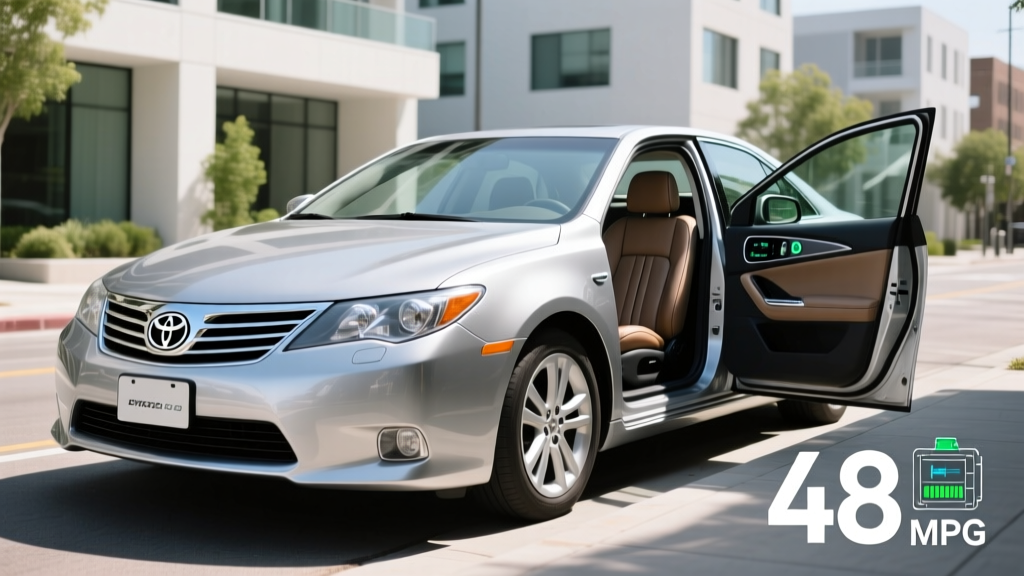
The 2007 Toyota Camry Hybrid was one of the first mainstream midsize sedans to pair a four-cylinder engine with an electric motor and a nickel-metal hydride (NiMH) battery pack. Nearly two decades later, it remains a fixture on the used market, prized for low running costs and Toyota's hybrid reliability reputation. If you're researching the 2007 Camry Hybrid MPG figures before buying or keeping one on the road, this guide covers the exact EPA numbers, real-world fuel economy expectations, battery health considerations, and how this first-generation hybrid stacks up against modern HEVs, PHEVs, and full EVs in 2026.
2007 Camry Hybrid MPG: The Official EPA Numbers
When the EPA tested the 2007 Camry Hybrid (2.4L 4-cylinder + electric motor, CVT transmission), the results placed it among the most efficient midsize sedans of its era. Here is the official breakdown from fueleconomy.gov:
| Metric | Value |
|---|---|
| City MPG | 33 MPG |
| Highway MPG | 28 MPG |
| Combined MPG | 34 MPG* |
| Annual Fuel Cost (est.) | ~$1,450 (15,000 mi/yr @ $3.20/gal) |
| Gallons per 100 miles | 3.0 gal |
| Total Range | ~558 miles (16.5-gal tank) |
*Note: The EPA revised its testing methodology for the 2008 model year. The 2007 Camry Hybrid's original window sticker listed higher numbers (approximately 40 city / 38 highway under the pre-2008 test cycle). The figures above reflect the current EPA-adjusted values that allow apples-to-apples comparison with modern vehicles.
Real-World MPG: What Owners Actually Report
Hybrid fuel economy is notoriously sensitive to driving style, temperature, and trip length. The 2007 Camry Hybrid's regenerative braking system recovers more energy in stop-and-go traffic, which is why its city MPG exceeds its highway rating — the opposite of most gas-only cars.
Real-World MPG Expectations (2026)
- City / suburban driving: 30–35 MPG (short trips, traffic, regenerative braking active)
- Highway (65–75 mph): 26–30 MPG (less regen benefit, higher aero drag)
- Cold weather (below 35°F): 24–28 MPG combined (engine runs more for cabin heat, battery efficiency drops)
- Owner-reported average (Fuelly): ~30–32 MPG combined across all conditions
If your commute is mostly city driving under 45 mph, you'll likely meet or slightly exceed the EPA city figure. Sustained highway driving at 75+ mph will drop you below the EPA highway estimate. This is normal hybrid behavior — the electric assist provides the greatest benefit at lower speeds where the gas engine is least efficient.
HEV vs. PHEV vs. EV: Understanding What the 2007 Camry Hybrid Is
The 2007 Camry Hybrid is a conventional hybrid electric vehicle (HEV). It cannot be plugged in. It has no electric-only driving range to speak of (the battery provides assist for low-speed maneuvers and acceleration, but the gas engine is always available). Understanding this distinction is critical for used-car shoppers comparing it to modern alternatives.
| Feature | HEV (2007 Camry Hybrid) | PHEV (e.g., 2026 RAV4 Prime) | BEV (e.g., 2026 Tesla Model 3) |
|---|---|---|---|
| Plugs in? | No | Yes | Yes |
| Electric-only range | ~0.5 mi (low-speed assist) | 25–42 mi | 250–360 mi |
| Battery size | 1.0 kWh (NiMH, usable ~0.4 kWh) | 14–18 kWh (Li-ion) | 55–82 kWh (Li-ion) |
| Fuel/energy source | Gasoline only | Gasoline + electricity | Electricity only |
| Federal tax credit (2026) | None | Up to $7,500 (§30D, if eligible) | Up to $7,500 (§30D, if eligible) |
| Home charging needed? | No | Recommended (Level 2) | Required (Level 2) |
The 2007 Camry Hybrid is ideal if you want better fuel economy without changing your refueling habits. You never need to install a charger, plan around charging stations, or worry about electric range. You simply fill up at any gas station and drive.
Powertrain and Performance Specs
| Specification | Detail |
|---|---|
| Engine | 2.4L DOHC 4-cylinder (2AZ-FXE, Atkinson cycle) |
| Engine horsepower | 147 HP @ 6,000 RPM |
| Electric motor | Permanent magnet synchronous, 40 HP (30 kW) |
| Combined net horsepower | 192 HP |
| Transmission | eCVT (electronically controlled continuously variable) |
| Drivetrain | Front-wheel drive |
| 0–60 mph | ~7.3 seconds |
| Hybrid battery | NiMH, 244.8V nominal, ~1.0 kWh gross capacity |
| Curb weight | ~3,680 lbs |
The Atkinson-cycle engine sacrifices some peak power for greater thermal efficiency, while the electric motor fills in torque at low RPMs where the four-cylinder is weakest. The result is smooth, adequate acceleration that still feels competitive in modern traffic. The eCVT is a planetary gearset (not a belt-driven CVT), which contributes to Toyota's reputation for hybrid powertrain longevity.
Battery Health, Warranty, and Replacement Cost in 2026
For a 19-year-old hybrid, the battery is the single biggest ownership question. Here's what you need to know:
Original Battery Warranty
Toyota originally warranted the 2007 Camry Hybrid battery for 8 years / 100,000 miles (10 years / 150,000 miles in California-emission states: CA, CT, ME, MA, NJ, NY, OR, RI, VT, WA). This warranty has expired for all original batteries as of 2017 at the latest.
Real-World Battery Longevity
Toyota's NiMH hybrid batteries have an exceptional track record. Many 2007 Camry Hybrids are still running on their original battery packs at 180,000+ miles. The NiMH chemistry is less energy-dense than modern lithium-ion but degrades more gracefully — you'll notice a gradual MPG decline (perhaps dropping from 33 to 28–30 combined) rather than a sudden failure.
Replacement Cost (2026 Pricing)
| Option | Cost Range | Notes |
|---|---|---|
| New OEM Toyota battery | $2,500–$3,500 (installed) | Dealership; includes labor and programming |
| Remanufactured battery | $1,200–$2,000 (installed) | Third-party refurbishers (e.g., Green Bean Battery); typically 1–3 year warranty |
| Used/salvage battery | $400–$800 + install | Junkyard pull; high risk, no warranty; not recommended |
| Individual cell replacement | $300–$600 (DIY or indie shop) | Replace only degraded modules; requires hybrid expertise |
If you're buying a 2007 Camry Hybrid in 2026, ask whether the battery has been replaced. A recent OEM or quality remanufactured replacement is actually a plus — it means another 8–12 years of hybrid operation. If it's the original battery, budget $1,500–$2,500 for eventual replacement and factor that into your purchase price negotiation.
Signs of Battery Degradation
- Noticeable MPG drop (5+ MPG below expected)
- Battery charge indicator fluctuates rapidly on the dash display
- Gas engine runs more frequently, even at low speeds or stops
- Check engine light with hybrid system codes (P0A80, P0A7F)
- Reduced regenerative braking feel
Tax Credits, Insurance, and Total Cost of Ownership
The 2007 Camry Hybrid does not qualify for any federal tax credit. The IRS §30D Clean Vehicle Credit applies only to new plug-in electric vehicles (PHEVs and BEVs) meeting battery-sourcing and MSRP requirements. Conventional hybrids have not been eligible for the federal credit since the original Hybrid Tax Credit expired for Toyota in 2007 after reaching the 60,000-vehicle manufacturer cap.
State and Local Incentives
A handful of states offer modest incentives for used hybrid purchases or hybrid vehicle registration, but these vary widely and change frequently. Check your state's energy office or department of revenue for current programs. Some states offer HOV lane access for hybrids — though many have sunset these perks for conventional (non-plug-in) hybrids.
Ownership Cost Snapshot (2026)
| Category | Annual Estimate |
|---|---|
| Fuel (15,000 mi @ 31 MPG avg, $3.20/gal) | ~$1,550 |
| Insurance | $900–$1,400 (varies by state/driver) |
| Maintenance (oil, tires, brakes) | $400–$700 |
| Registration/taxes | $50–$200 |
| Total (excl. purchase price) | $2,900–$3,850/year |
For comparison, a 2007 Camry with the 2.4L gas-only engine gets about 24 MPG combined, costing roughly $2,000/year in fuel — about $450 more annually. The hybrid premium is recovered within a few years of ownership, and the hybrid's regenerative braking significantly extends brake pad life (many owners report 80,000+ miles on original pads).
Who Should Buy the 2007 Camry Hybrid in 2026?
Pros
- Proven, durable powertrain — many examples exceed 250,000 miles
- No charging infrastructure needed — refuel at any gas station
- 33 MPG combined (EPA); often exceeds this in city driving
- Low purchase price on the used market ($4,000–$8,000 depending on mileage/condition)
- Comfortable midsize sedan with good cargo space (16.7 cu ft trunk)
- Regenerative braking extends brake life significantly
- eCVT planetary gearset has no belts or clutches to wear
Cons
- Original battery warranty expired — replacement is an eventual $1,200–$3,500 cost
- No electric-only driving; not eligible for any federal tax credit
- Dated infotainment and safety tech (no backup camera standard, no Apple CarPlay/Android Auto)
- NiMH battery is heavier and less energy-dense than modern Li-ion
- Highway MPG (28 EPA) is less impressive than modern hybrids (e.g., 2026 Camry Hybrid: 52 combined)
- Some interior materials haven't aged well at high mileage
Choose the 2007 Camry Hybrid If:
- You want a cheap, reliable daily driver with strong city fuel economy
- You don't have access to home or workplace charging (apartment, street parking)
- Your budget is under $8,000 and you want to minimize fuel costs
- You drive primarily in urban/suburban conditions under 50 mph
Consider a Modern PHEV or BEV Instead If:
- You have home charging access and want to drive partially or fully on electricity
- You qualify for the §30D federal tax credit (up to $7,500 on eligible new PHEVs/BEVs)
- You want modern ADAS features (automatic emergency braking, lane-keeping, adaptive cruise)
- Your highway-heavy commute would benefit from newer hybrid efficiency (2026 Camry Hybrid gets 52 MPG combined)
Frequently Asked Questions
How many MPG does the 2007 Camry Hybrid get?
The EPA rates the 2007 Camry Hybrid at 33 city / 28 highway / 34 combined MPG (under current EPA testing methodology). Real-world owners typically report 28–34 MPG combined depending on driving conditions, with city driving often exceeding the EPA estimate thanks to regenerative braking.
Does the 2007 Camry Hybrid need to be plugged in?
No. The 2007 Camry Hybrid is a conventional HEV (hybrid electric vehicle). It charges its small NiMH battery through regenerative braking and the gasoline engine. There is no plug, no charging port, and no electric-only driving range. You fuel it exclusively with gasoline.
How long does the 2007 Camry Hybrid battery last?
Toyota's NiMH hybrid batteries routinely last 150,000–200,000+ miles before significant degradation. Many 2007 Camry Hybrids are still on original batteries at nearly 20 years old, though with some MPG loss. A replacement OEM battery costs $2,500–$3,500 installed; remanufactured options run $1,200–$2,000.
Is the 2007 Camry Hybrid reliable?
Yes. The 2007 Camry Hybrid is widely regarded as one of the most reliable vehicles Toyota has built. The eCVT transmission uses a simple planetary gearset with no friction bands or clutches to wear. The 2AZ-FXE engine is under-stressed thanks to electric motor assist. Common non-hybrid issues (power window switches, dashboard cracking) may apply, but the hybrid-specific components have an excellent track record.
Does the 2007 Camry Hybrid qualify for any tax credit?
No. The 2007 Camry Hybrid does not qualify for the federal §30D Clean Vehicle Credit, which applies only to new plug-in vehicles (PHEVs and BEVs). The original hybrid tax credit that was available when the car was new expired for Toyota in 2007 after the manufacturer reached the 60,000-vehicle cap. No current state or federal credits apply to used conventional hybrid purchases in most jurisdictions.
How does the 2007 Camry Hybrid compare to the 2026 Camry Hybrid?
The 2026 Toyota Camry Hybrid achieves an EPA-estimated 52 MPG combined (53 city / 50 highway with FWD), a massive 58% improvement over the 2007 model. It uses a lithium-ion battery, a 2.5L Dynamic Force engine, and offers available AWD. The generational leap in hybrid efficiency is substantial — if fuel economy is your top priority and budget allows, a newer Camry Hybrid is significantly more efficient.
What should I check before buying a used 2007 Camry Hybrid?
Request a hybrid battery health check (a dealer or hybrid specialist can read State of Health data via OBD-II). Look for uneven tire wear (alignment issues), check that the inverter coolant has been serviced, and verify that the hybrid system warning lights are absent. A pre-purchase inspection by a technician familiar with Toyota hybrids is strongly recommended.