Quick Verdict: What SAIC LDV Offers Electrified Buyers in 2026
SAIC Motor's LDV (Leyland DAF Vans) brand is primarily known outside the United States for its commercial electric vans — the eDeliver 7, eDeliver 9, and the electric MIFA 9 people mover. While SAIC has expanded its electrified lineup globally through the MG and Maxus badges, the LDV-branded hybrid electric vehicle types available or announced for export markets center on two categories: battery-electric commercial vans (BEVs) and a plug-in hybrid (PHEV) variant of the MIFA 9 luxury MPV. Conventional hybrid (HEV) options under the LDV badge remain limited as of early 2026.
This guide breaks down the SAIC LDV hybrid electric vehicle types by powertrain, efficiency, battery specs, pricing, and which buyer profile each model serves. If you're evaluating these vehicles for fleet purchase or personal import, understanding the distinction between the HEV, PHEV, and BEV offerings is essential before committing capital.
HEV vs PHEV vs BEV — How LDV Classifies Its Lineup
HEV (Conventional Hybrid): Charges its small battery via regenerative braking and the engine. No plug. Typically 1-2 kWh battery. LDV has minimal HEV offerings under this badge as of 2026.
PHEV (Plug-in Hybrid): Larger battery (10-40 kWh) that charges via plug. Offers 20-50 miles of electric-only driving before the gas engine engages. The MIFA 9 PHEV (sold as Maxus MIFA 9 in some markets) fits this category.
BEV (Battery Electric): No engine at all. Runs entirely on a large battery pack (60-100+ kWh). The eDeliver 7, eDeliver 9, and MIFA 9 electric are BEVs — not hybrids.
SAIC LDV Electrified Models: Side-by-Side Spec Table
The table below compares the key electrified models under the LDV/Maxus umbrella. Note that availability varies significantly by market — most LDV-badged vehicles are sold in Australia, New Zealand, the UK, and select Asian markets. US availability is effectively nonexistent as of 2026.
| Spec | MIFA 9 PHEV | eDeliver 7 (BEV) | eDeliver 9 (BEV) |
|---|---|---|---|
| Powertrain | 1.5T turbo + electric motor | Single electric motor | Single electric motor |
| Combined HP | ~245 hp (combined) | ~201 hp (150 kW) | ~201 hp (150 kW) |
| Battery (usable) | ~20 kWh (NMC) | 77 kWh (LFP) | 88.55 kWh (LFP) |
| Electric-Only Range | ~50 mi (WLTP) / ~40 mi real | N/A (full EV) | N/A (full EV) |
| Total Range | ~500 mi combined | ~198 mi (WLTP) | ~217 mi (WLTP) |
| Fuel Economy (PHEV) | ~40 MPG combined (gas mode) | ~2.0 kWh/mi | ~2.2 kWh/mi |
| DC Fast Charge | No (AC only, ~6.6 kW) | Yes, up to 80 kW | Yes, up to 80 kW |
| 10-80% DC Time | N/A | ~45 min | ~45 min |
| Level 2 AC Charge | ~3.5 hours (full) | ~11 hours (full) | ~13 hours (full) |
| Base Price (AUD) | ~A$75,000 | ~A$72,000 | ~A$90,000 |
| US Availability | Not sold in US | Not sold in US | Not sold in US |
The MIFA 9 PHEV: LDV's Plug-In Hybrid Flagship
The MIFA 9 (also badged as Maxus MIFA 9 or MG Maxus in certain markets) is the only true plug-in hybrid in SAIC's LDV-adjacent lineup. It's a seven-seat luxury MPV aimed at executive transport and large families — think of it as a Pacifica Hybrid competitor in markets where it's sold.
Powertrain and Performance
The MIFA 9 PHEV pairs a 1.5-liter turbocharged four-cylinder engine with a front-mounted electric motor for a combined output of approximately 245 horsepower. The engine alone produces around 163 hp, while the electric motor adds roughly 82 hp. Power is routed through a dedicated hybrid transmission (DHT) to the front wheels.
In real-world driving, the PHEV system prioritizes electric propulsion at low speeds and in city traffic, engaging the engine primarily during highway cruising or under hard acceleration. The transition between electric and gas modes is generally smooth, though the engine note becomes noticeable above 70 mph.
Electric-Only Range and Efficiency
The MIFA 9 PHEV carries a roughly 20 kWh NMC (nickel manganese cobalt) battery pack. Under WLTP testing, it achieves approximately 50 miles (81 km) of electric-only range. In real-world conditions — accounting for climate control use, passenger load, and highway speeds — expect closer to 35-42 miles of usable electric range before the engine kicks in.
When operating in hybrid (gas+electric) mode after the battery is depleted, the MIFA 9 PHEV returns approximately 38-42 MPG combined in real-world testing. City driving tends to yield slightly higher figures thanks to regenerative braking and electric assist at low speeds — a common trait of PHEVs.
Charging the MIFA 9 PHEV
Unlike the BEV eDeliver models, the MIFA 9 PHEV does not support DC fast charging. It charges exclusively via AC:
- Level 1 (120V household outlet): ~1.4 kW, full charge in approximately 14 hours
- Level 2 (240V home charger): ~6.6 kW, full charge in approximately 3.5 hours
For daily use, a Level 2 home charger is strongly recommended. Plug in overnight and the battery is fully replenished by morning, covering most commutes on electric power alone.
The eDeliver Vans: Full Electric, Not Hybrid
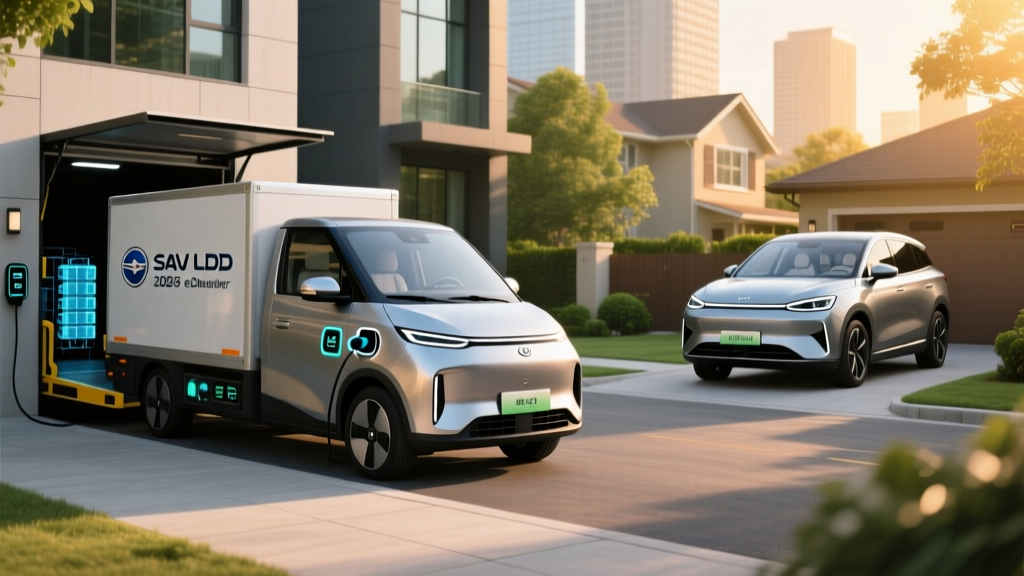
It's important to clarify a common misconception: the SAIC LDV eDeliver 7 and eDeliver 9 are battery-electric vehicles (BEVs), not hybrids. They have no internal combustion engine and no fuel tank. They're included here because buyers searching for "SAIC LDV hybrid electric vehicle types" often encounter these models and assume they have hybrid variants.
eDeliver 7
The eDeliver 7 is a mid-size electric commercial van with a 77 kWh LFP (lithium iron phosphate) battery. LFP chemistry offers longer cycle life and better thermal stability than NMC, though at a slight weight and energy-density penalty. WLTP range is approximately 198 miles (319 km); real-world loaded range drops to roughly 140-165 miles depending on payload and ambient temperature.
DC fast charging peaks at 80 kW, taking the battery from 10-80% in approximately 45 minutes. The charge curve tapers significantly above 80%, so charging to full on DC is rarely practical — plan to top off the last 20% on Level 2 overnight.
eDeliver 9
The larger eDeliver 9 uses an 88.55 kWh LFP pack with WLTP range up to 217 miles (349 km). Real-world range under typical commercial loads is approximately 155-180 miles. DC fast charging also peaks at 80 kW with a similar 10-80% time of ~45 minutes.
Both eDeliver models are aimed at last-mile delivery fleets, tradespeople, and commercial operators who can depot-charge overnight. They are not hybrids and cannot extend range with gasoline.
Pricing, Tax Credits, and Import Considerations
As of 2026, no SAIC LDV-badged vehicle is sold in the United States. This means US federal tax credits under IRS §30D do not apply, and there is no domestic dealer network for purchase, service, or warranty claims. Pricing below reflects Australian market figures (AUD), where LDV has the strongest presence:
| Model | Base Price (AUD) | Approx. USD Equivalent | US Tax Credit |
|---|---|---|---|
| MIFA 9 PHEV | ~A$75,000 | ~$48,000 | Not eligible |
| eDeliver 7 | ~A$72,000 | ~$46,000 | Not eligible |
| eDeliver 9 | ~A$90,000 | ~$58,000 | Not eligible |
For buyers in Australia, the federal government's Electric Car Discount (FBT exemption) applies to eligible BEVs and PHEVs below the luxury car tax threshold. Check the Australian Taxation Office for current eligibility rules. In the UK, where some models are badged as Maxus, the plug-in van grant and company-car tax benefits may apply — consult the UK government portal for up-to-date incentive details.
Battery Warranty, Reliability, and Replacement Costs
SAIC provides a battery warranty across its LDV/Maxus electrified lineup that is broadly competitive with industry norms:
- Traction battery: 8 years / 160,000 km (~100,000 mi), whichever comes first
- Capacity retention guarantee: Battery warranted to retain at least 70% of original capacity during the warranty period
- Powertrain (engine + motor + DHT on PHEV): 5 years / 130,000 km (~80,000 mi)
- Vehicle bumper-to-bumper: 5 years / 130,000 km
How Reliable Are SAIC LDV Hybrids?
SAIC is China's largest automaker by volume and has decades of joint-venture manufacturing experience with Volkswagen and General Motors. The MIFA 9 PHEV's powertrain uses proven components — the 1.5T engine is a carryover design, and the DHT hybrid transmission is shared across several SAIC models. Early reliability data from Australian and UK fleets (where the vehicles have been on sale since 2023-2024) shows no systemic powertrain failures, though some owners report minor software glitches with the infotainment system and charge-scheduling features.
Battery Replacement Cost
If the traction battery falls below the 70% capacity threshold outside the warranty period, replacement costs vary by model:
- MIFA 9 PHEV (~20 kWh): Estimated A$8,000–12,000 (~$5,200–$7,800 USD) for the battery module
- eDeliver 7 (77 kWh LFP): Estimated A$18,000–25,000 (~$11,700–$16,200 USD)
- eDeliver 9 (88.55 kWh LFP): Estimated A$22,000–30,000 (~$14,300–$19,500 USD)
LFP batteries (used in the eDeliver vans) generally degrade more slowly than NMC chemistry and can endure 3,000+ full charge cycles before reaching 80% capacity. The MIFA 9's NMC pack is rated for approximately 1,500-2,000 cycles. In practical terms, this means the eDeliver batteries should outlast the vehicle's useful commercial life under normal use, while the MIFA 9 PHEV battery may see noticeable range reduction after 8-12 years of daily cycling.
Who Should Choose an SAIC LDV Electrified Vehicle?
✓ Good Fit For
- Fleet operators in Australia, NZ, or UK needing electric commercial vans with depot charging
- Executive transport services wanting a PHEV luxury MPV with electric city driving
- Buyers who want LFP battery longevity in a commercial application
- Businesses eligible for local EV incentives (FBT exemption, plug-in van grants)
✗ Not Ideal For
- US-based buyers — no sales network, no parts, no tax credits
- Drivers needing DC fast charging on the PHEV model
- Those wanting a conventional (non-plug) hybrid — LDV doesn't offer one in most markets
- Long-range interstate commercial routes exceeding 180 miles without charging stops
Hybrid vs PHEV vs Full EV — Which Fits You?
Choose the MIFA 9 PHEV if: You need a seven-seat people mover, have home/workplace charging for daily top-ups, drive mostly under 40 miles per day but occasionally take longer trips where you want gas-engine range security.
Choose the eDeliver 7 or 9 (BEV) if: You operate a commercial fleet with predictable daily routes under 150 miles, can install depot Level 2 chargers, and want zero tailpipe emissions with minimal drivetrain maintenance.
Look elsewhere if: You're a US buyer — none of these vehicles are sold stateside. Consider the Chrysler Pacifica Hybrid (PHEV minivan) or the Ford E-Transit (electric commercial van) as domestic alternatives.
Frequently Asked Questions
How many MPG does the SAIC LDV MIFA 9 PHEV get?
When the battery is depleted and the vehicle operates in hybrid mode, the MIFA 9 PHEV returns approximately 38-42 MPG combined in real-world driving. City driving can yield slightly higher numbers (43-46 MPG) due to regenerative braking and electric assist at low speeds. Highway cruising at 70+ mph typically returns 34-37 MPG. These figures are based on owner reports and independent testing in Australian and UK markets — the vehicle does not have an EPA rating as it is not sold in the US.
How far can the MIFA 9 PHEV go on electric only?
The official WLTP rating is approximately 50 miles (81 km). Real-world electric-only range is closer to 35-42 miles in mixed driving conditions, and 28-35 miles in cold weather. Once the battery is depleted, the 1.5T engine takes over seamlessly, giving a total combined range of approximately 500 miles.
Does the SAIC LDV MIFA 9 PHEV qualify for any tax credit?
In the United States, no — the vehicle is not sold there and does not qualify for the federal §30D tax credit. In Australia, the MIFA 9 PHEV may qualify for the Electric Car Discount (FBT exemption for employer-provided vehicles below the luxury car tax threshold). In the UK, company-car tax benefits and potential plug-in grants may apply. Always verify current incentive rules with your local tax authority, as these programs change frequently.
Are SAIC LDV hybrid and electric vehicles reliable?
Early reliability data is positive. SAIC is China's largest automaker with deep joint-venture experience with VW and GM. The MIFA 9 PHEV uses proven powertrain components shared across multiple SAIC models. The 8-year/160,000 km battery warranty with a 70% capacity retention guarantee is competitive. LFP batteries in the eDeliver vans offer particularly strong longevity — rated for 3,000+ charge cycles. The main risk for buyers outside SAIC's primary markets is parts availability and service network coverage, not mechanical reliability.
What is the battery replacement cost for an SAIC LDV hybrid?
For the MIFA 9 PHEV (~20 kWh NMC pack), estimated replacement cost is A$8,000–12,000 (~$5,200–$7,800 USD) outside warranty. For the eDeliver BEV models, LFP battery replacement ranges from A$18,000–30,000 depending on pack size. However, LFP chemistry degrades slowly — most eDeliver batteries should retain 80%+ capacity well beyond the 8-year warranty period under normal commercial use.
Does SAIC LDV make a conventional (non-plug) hybrid?
As of early 2026, SAIC LDV does not offer a conventional self-charging hybrid (HEV) in its primary export markets. The electrified lineup consists of the MIFA 9 PHEV (plug-in hybrid) and the eDeliver 7/9 (full battery electric). If you need a conventional hybrid that never requires plugging in, you'll need to look at competitors like the Toyota Sienna Hybrid or Chrysler Pacifica Hybrid (in markets where they're available).
Can the eDeliver 7 or eDeliver 9 be charged at home?
Yes, both support Level 2 AC home charging (240V), though a full charge takes 11-13 hours due to the large battery packs. Most fleet operators install depot Level 2 chargers and charge overnight. DC fast charging at up to 80 kW is also supported for mid-day top-ups, taking the battery from 10-80% in approximately 45 minutes. A dedicated 40-amp or 50-amp Level 2 circuit is recommended — consult a licensed electrician for installation specifics and potential panel upgrades.
Sources: SAIC LDV/Maxus official specifications (ldv.com.au), Australian market pricing via Drive.com.au, LFP vs NMC battery degradation data from peer-reviewed lifecycle studies. Tax incentive information is current as of early 2026 and subject to change — verify with local authorities before purchasing. US buyers should consult fueleconomy.gov for EPA-rated alternatives available domestically.