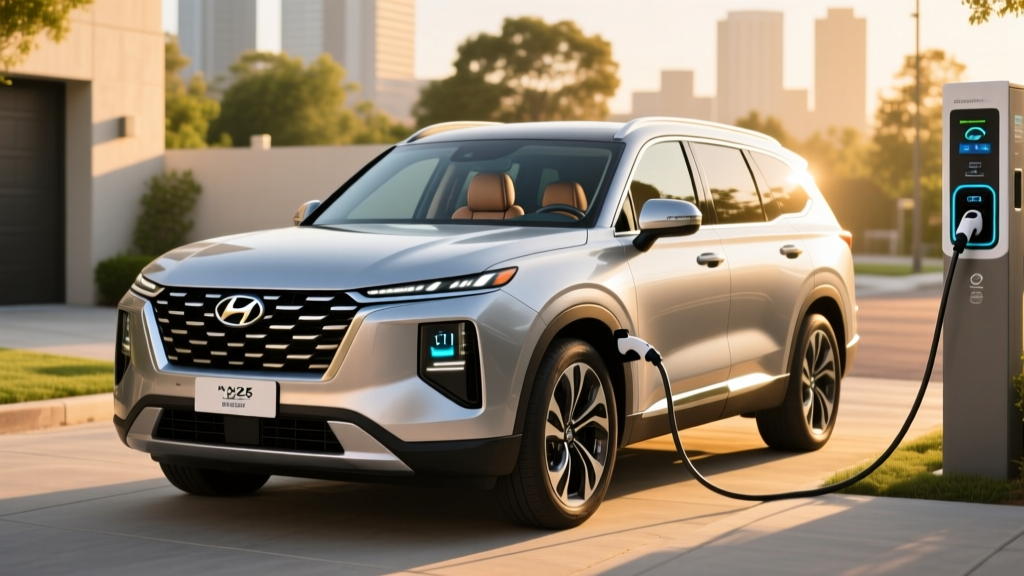
The three-row SUV segment has been slow to electrify, but the 2026 Hyundai Palisade Hybrid aims to change that by pairing a turbocharged four-cylinder engine with an electric motor to target class-leading efficiency. For families weighing a large SUV against rising fuel costs, the Palisade Hybrid's miles per gallon figure is often the first spec they check — and it doesn't disappoint on paper. But how does it perform in real-world driving, and how does it compare to a plug-in hybrid or a full battery-electric alternative?
This guide covers the 2026 Palisade Hybrid's EPA fuel economy, real-world MPG expectations, powertrain details, pricing, tax-credit eligibility, and battery longevity — everything you need to decide whether this hybrid three-row SUV fits your driveway.
Hyundai Palisade Hybrid Miles Per Gallon: EPA and Real-World Numbers
The 2026 Hyundai Palisade Hybrid is a conventional hybrid electric vehicle (HEV), meaning it uses a small battery and electric motor to assist the gasoline engine but does not plug in to charge. It recovers energy through regenerative braking and engine-driven charging, so you simply fill up at the gas station as you would with any other vehicle.
| Metric | EPA Estimate |
|---|---|
| City MPG | 28 MPG |
| Highway MPG | 27 MPG |
| Combined MPG | 27 MPG |
Source: fueleconomy.gov
Real-World MPG vs. EPA Sticker
Conventional hybrids often exceed their EPA city estimate because stop-and-go traffic maximizes regenerative braking and electric-motor assist. In mixed suburban driving, owners of similar Hyundai/Kia hybrid platforms (like the Sorento Hybrid) routinely report 29–32 MPG in city-heavy commutes. Highway driving at 75+ MPH, however, tends to drop fuel economy to 24–26 MPG due to aerodynamic drag on a large, boxy SUV. Expect a blended real-world average of roughly 26–29 MPG depending on your driving mix, terrain, and climate.
Compared to the gasoline-only 2026 Palisade (rated around 22 MPG combined with its V-6), the hybrid represents a roughly 20–25% improvement in fuel economy — a meaningful savings for families racking up 15,000+ miles per year.
HEV vs. PHEV: Understanding What the Palisade Hybrid Is (and Isn't)
Hyundai sells both conventional hybrid (HEV) and plug-in hybrid (PHEV) versions across its lineup, and the distinction matters for your wallet and your routine.
| Feature | Palisade Hybrid (HEV) | Typical 3-Row PHEV (e.g., Sorento PHEV) |
|---|---|---|
| Plugs in to charge? | No — self-charging via regen and engine | Yes — Level 1 or Level 2 |
| Electric-only range | ~1 mile at low speed (motor assist only) | 30–35 miles (EPA est.) |
| Battery size | ~1.5 kWh (small buffer) | ~13.8 kWh (usable) |
| Combined MPG / MPGe | 27 MPG combined | 79 MPGe (electric) / 34 MPG (gas-only) |
| Federal tax credit (§30D) | Not eligible | Up to $7,500 (subject to sourcing, income, MSRP caps) |
| Starting MSRP (est.) | ~$43,500 | ~$52,000 |
The Palisade Hybrid is an HEV: no plug, no range anxiety, no change to your fueling habits. You trade the higher upfront cost and plug-in requirement of a PHEV for simplicity and a lower purchase price. If Hyundai introduces a Palisade PHEV variant in future model years, it would add roughly 30 miles of electric-only range and potential tax-credit eligibility — but as of the 2026 model year, the Palisade Hybrid is HEV only.
Powertrain Specs: Horsepower, Engine, and Drivetrain
| Specification | Detail |
|---|---|
| Engine | 1.6L turbocharged 4-cylinder |
| Electric Motor | 47.7 kW (64 HP) permanent-magnet synchronous |
| Combined System Output | 258 HP / 277 lb-ft torque |
| Transmission | 6-speed automatic (hybrid-optimized) |
| Drivetrain | HTRAC AWD (standard on Hybrid trims) |
| Battery (traction) | ~1.5 kWh lithium-ion polymer |
| Towing Capacity | 4,000 lbs (est., with towing prep) |
| 0–60 MPH | ~7.5 seconds (est.) |
The 1.6L turbo four-cylinder may sound undersized for a three-row SUV, but Hyundai's hybrid system fills in the torque gap with the electric motor's instant response. The combined 258 HP is competitive with the outgoing V-6 and delivers confident highway merging and passing. The HTRAC all-wheel-drive system is standard on Hybrid trims, which is a practical advantage for buyers in snow-belt states.
The 6-speed automatic transmission is a deliberate choice over a CVT. Hyundai's hybrid-optimized automatic avoids the rubber-band feel that some drivers dislike in CVT-equipped competitors, though it sacrifices a marginal amount of low-speed efficiency.
Pricing, Trims, and Tax Credit Eligibility
The 2026 Palisade Hybrid is offered across multiple trims, generally starting around the mid-$40,000 range. Here's an approximate pricing breakdown:
- SEL Premium Hybrid: ~$43,500 MSRP
- Limited Hybrid: ~$48,000 MSRP
- Calligraphy Hybrid: ~$52,500 MSRP
Pricing is estimated based on Hyundai's announced 2026 lineup and may vary by dealer and region.
Does the Palisade Hybrid Qualify for a Federal Tax Credit?
No. The 2026 Palisade Hybrid is a conventional HEV and does not qualify for the IRS §30D Clean Vehicle Credit, which requires a plug-in electric vehicle with a minimum battery capacity of 7 kWh and compliance with critical-mineral and battery-component sourcing rules. The IRS §30D guidelines are explicit: conventional hybrids without plug-in capability are excluded.
Some states offer separate incentives for high-efficiency hybrids, but these vary by jurisdiction. Check your state's energy office or DMV for current programs. At the federal level, the Palisade Hybrid's value proposition rests on fuel savings, not tax credits.
Battery Warranty, Reliability, and Replacement Cost
Hyundai Hybrid Battery Warranty
- Hybrid Battery: 10 years / 100,000 miles (whichever comes first)
- Hybrid System Components: 10 years / 100,000 miles
- New Vehicle Limited Warranty: 5 years / 60,000 miles
- Powertrain Warranty: 10 years / 100,000 miles
Hyundai's hybrid battery warranty is among the longest in the industry, matching or exceeding Toyota, Kia, and Honda. The 10-year/100,000-mile coverage provides substantial peace of mind for buyers concerned about long-term battery reliability.
Is the Palisade Hybrid Reliable?
Hyundai's 1.6L turbo hybrid powertrain has been in service since the 2021 model year across the Tucson Hybrid, Sorento Hybrid, and Santa Fe Hybrid. Early-production units (2021–2022) had some reported issues with hybrid control module software and occasional transmission shudder, but Hyundai addressed these through software updates and revised calibration. By the 2024–2026 model years, the powertrain has matured considerably.
The Palisade Hybrid's ~1.5 kWh traction battery is small compared to a full EV's pack (which can be 75–100 kWh). Smaller batteries in HEVs experience less stress per cycle because they operate within a narrow state-of-charge window — typically 40–60% — which significantly extends cell life. Industry data suggests conventional hybrid batteries routinely last 150,000–200,000 miles before notable degradation.
Battery Replacement Cost
If the hybrid battery does fail outside warranty, replacement cost for a Hyundai HEV battery pack typically ranges from $2,500 to $4,500 including parts and labor. This is far less than a full EV battery replacement ($10,000–$20,000+) because the HEV pack is much smaller. Third-party remanufactured packs are increasingly available at lower cost as the hybrid fleet ages.
Real-World Ownership: Fuel Cost Savings vs. Gas-Only Palisade
Let's put the Palisade Hybrid's efficiency into financial context. Assuming 15,000 miles per year and a national average gas price of $3.40 per gallon (regular unleaded):
| Model | Combined MPG | Gallons/Year | Annual Fuel Cost |
|---|---|---|---|
| Palisade Hybrid (AWD) | 27 MPG | 556 | $1,890 |
| Palisade Gas (AWD V-6) | 22 MPG | 682 | $2,319 |
| Annual Savings | — | 126 gal | ~$429 |
Over a 5-year ownership period, the Palisade Hybrid saves roughly $2,100–$2,500 in fuel compared to its gas-only counterpart (depending on actual gas prices and driving patterns). That doesn't fully offset the hybrid's higher MSRP premium (typically $2,000–$3,000 over a comparably equipped gas model), but it narrows the gap — and the hybrid's stronger resale value may close it further.
Palisade Hybrid vs. Full EV vs. PHEV: Which Fits You?
Choose the Palisade Hybrid (HEV) if:
- You want a three-row SUV with better MPG but don't want to change your fueling routine
- You lack access to home or workplace charging (apartment, street parking)
- You regularly take long road trips and don't want to plan around charging stops
- You want a lower purchase price than a PHEV or EV alternative
- Towing capacity matters (hybrids maintain towing ratings better than many EVs at this price)
Choose a PHEV (e.g., Kia Sorento PHEV, Toyota Grand Highlander Hybrid Max) if:
- You can install a Level 2 charger at home and have a commute under 30 miles
- You want to drive mostly on electricity during the week but need gas flexibility for weekend trips
- You qualify for the §30D federal tax credit (up to $7,500) and want to offset a higher MSRP
Choose a Full EV (e.g., Kia EV9, Hyundai Ioniq 9) if:
- You have reliable home Level 2 charging and want to eliminate gas entirely
- Your daily driving is under 250 miles and you're comfortable with DC fast charging on road trips
- You want the lowest per-mile energy cost and minimal maintenance (no oil changes, fewer moving parts)
- You qualify for the full §30D credit and your state offers additional EV incentives
Pros and Cons of the 2026 Palisade Hybrid
Pros
- Strong combined MPG (27) for a 3-row AWD SUV
- No plug-in required — zero lifestyle change from gas
- Industry-leading 10-year/100,000-mile hybrid battery warranty
- 258 HP with instant electric torque fills turbo lag
- Standard HTRAC AWD across Hybrid trims
- Spacious cabin with 3 rows and competitive cargo volume
Cons
- No federal tax credit (HEV excluded from §30D)
- Highway MPG drops to ~24–26 at 75+ MPH (aerodynamic penalty)
- Higher MSRP than gas-only Palisade (~$2,000–$3,000 premium)
- No electric-only driving mode for short trips (unlike PHEV)
- 1.6L turbo four-cylinder may feel underwhelming to V-6 loyalists at low RPM
Frequently Asked Questions
How many MPG does the 2026 Hyundai Palisade Hybrid get?
The EPA rates the 2026 Palisade Hybrid at 28 MPG city, 27 MPG highway, and 27 MPG combined. In real-world driving, expect 26–29 MPG depending on your city/highway mix, with city-heavy commutes often exceeding the EPA estimate thanks to regenerative braking.
Does the Palisade Hybrid plug in?
No. The Palisade Hybrid is a conventional HEV — it charges its small battery through regenerative braking and the gasoline engine. You never need to plug it in. If you want plug-in capability with electric-only range, look at a PHEV like the Kia Sorento PHEV or wait for a potential future Palisade PHEV variant.
Is the Palisade Hybrid's battery reliable, and what does replacement cost?
Hyundai's hybrid batteries have a strong reliability track record, and the Palisade Hybrid is backed by a 10-year/100,000-mile hybrid battery warranty. Out-of-warranty replacement typically costs $2,500–$4,500, which is relatively modest because the HEV battery pack is small (~1.5 kWh). Most hybrid batteries last 150,000–200,000 miles before significant degradation.
Does the Palisade Hybrid qualify for any tax credits?
Not at the federal level. The IRS §30D Clean Vehicle Credit requires a plug-in vehicle with at least 7 kWh of battery capacity, plus compliance with battery-sourcing and critical-mineral rules. The Palisade Hybrid, as a conventional HEV, does not qualify. Some states may offer separate incentives for high-efficiency vehicles — check your state's energy office for current programs.
How does the Palisade Hybrid compare to the Kia EV9 or Hyundai Ioniq 9?
The Kia EV9 and Hyundai Ioniq 9 are fully electric three-row SUVs with 270–310 miles of EPA range. They offer dramatically lower per-mile energy costs and qualify for the §30D federal tax credit (subject to eligibility), but they require home charging infrastructure and road-trip planning around DC fast chargers. The Palisade Hybrid is the pragmatic choice if you need three rows today without any charging lifestyle change.
Can the Palisade Hybrid tow?
Yes. The Palisade Hybrid is estimated to tow up to 4,000 pounds when properly equipped with the factory towing prep package. That's competitive with many V-6 midsize SUVs and sufficient for a small boat, utility trailer, or a pair of personal watercraft. Hybrid powertrains handle towing well because the electric motor provides instant low-RPM torque.
Specifications and pricing in this article are based on Hyundai's announced 2026 model-year information and EPA data available at time of publication. Always verify current specs and incentive eligibility with Hyundai's official site, fueleconomy.gov, and the IRS before purchasing.