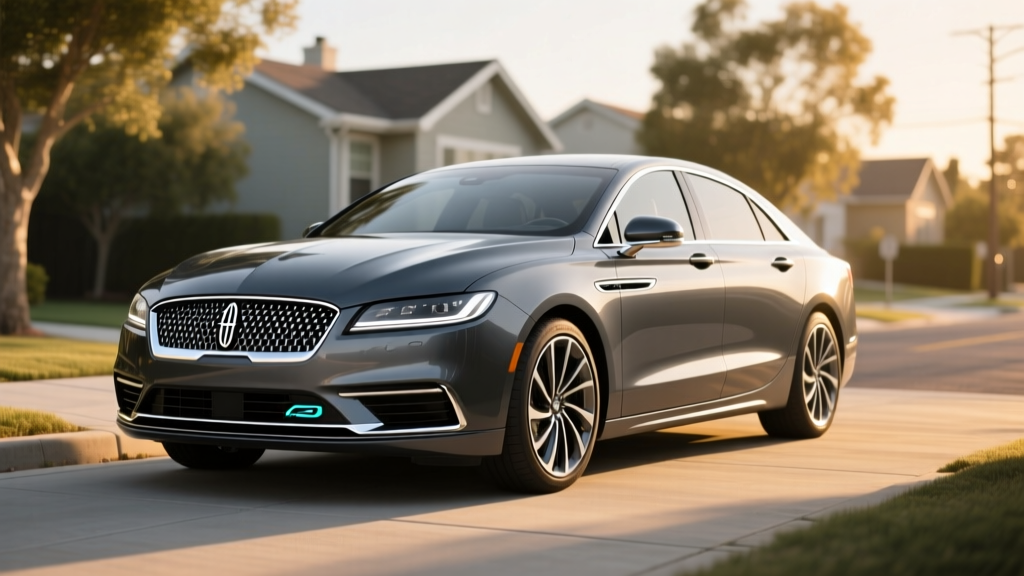
The Lincoln MKZ Hybrid occupies a specific niche in the used luxury-sedan market: a midsize, premium-badged conventional hybrid (HEV) that prioritizes comfort and fuel efficiency over sportiness. Discontinued after the 2020 model year when Lincoln restructured its lineup around SUVs, the MKZ Hybrid remains a compelling option for buyers seeking a quiet, efficient luxury sedan without the commitment of a plug-in hybrid or full electric vehicle. This guide covers everything a prospective used buyer needs to know — from EPA MPG and real-world efficiency to battery longevity and ownership costs.
What Is the Lincoln MKZ Hybrid? HEV vs PHEV Explained
The Lincoln MKZ Hybrid is a conventional hybrid (HEV), not a plug-in hybrid (PHEV). This distinction matters enormously for ownership expectations:
HEV (Conventional Hybrid) — Lincoln MKZ Hybrid
- No plug required: The battery recharges through regenerative braking and the gasoline engine
- No electric-only range to manage: The electric motor assists the engine but cannot drive the car independently for meaningful distances
- No home charging setup needed: Operates exactly like a conventional gas car from an infrastructure standpoint
- Battery is small (~1.4 kWh usable): Designed for assist, not standalone propulsion
PHEV (Plug-In Hybrid) — For Comparison
- Requires plugging in to access electric-only range (typically 20-40 miles)
- Larger battery (typically 10-20 kWh)
- May qualify for federal §30D tax credits when purchased new
- Higher upfront cost, but lower operating costs if charged regularly
The MKZ Hybrid was never offered as a PHEV. Lincoln's parent company Ford offered PHEV variants on the Fusion (the MKZ's platform-mate), but the Lincoln version stuck with the simpler HEV powertrain throughout its production run. If you're looking for a plug-in Lincoln, you'd need to look at the newer Lincoln Corsair Grand Touring PHEV instead.
Lincoln MKZ Hybrid MPG: EPA Ratings and Real-World Numbers
The MKZ Hybrid's fuel economy is one of its strongest selling points. Here are the official EPA ratings across the final model years:
| Model Year | City MPG | Highway MPG | Combined MPG |
|---|---|---|---|
| 2020 | 42 | 39 | 41 |
| 2019 | 42 | 39 | 41 |
| 2017-2018 | 42 | 38 | 40 |
| 2013-2016 | 41 | 38 | 39 |
Source: EPA Fuel Economy (fueleconomy.gov)
Real-World MPG: What Owners Actually Report
Conventional hybrids like the MKZ often exceed EPA city estimates in stop-and-go driving, where regenerative braking and electric-motor assist are most effective. However, highway mileage may fall slightly short of EPA estimates at sustained speeds above 70 mph.
- City driving (real-world): 40-45 MPG — many owners report matching or beating the 42 MPG EPA city figure
- Highway driving (real-world): 35-39 MPG — aerodynamic drag and reduced regen opportunity lower efficiency
- Mixed commuting (real-world): 38-42 MPG combined is typical for most owners
- Cold weather penalty: Expect a 5-10% drop in winter months (engine runs more often for cabin heat, battery efficiency drops)
For context, the non-hybrid MKZ with the 2.0L EcoBoost engine was rated at roughly 21 city / 31 highway / 25 combined — meaning the hybrid delivers approximately 64% better combined fuel economy.
Powertrain Specs: Engine, Motor, and Combined Output
The MKZ Hybrid uses Ford's well-proven hybrid powertrain architecture, shared with the Ford Fusion Hybrid. Here are the key specifications for the 2017-2020 generation (the most commonly available used examples):
| Specification | Detail |
|---|---|
| Engine | 2.0L Atkinson-cycle 4-cylinder |
| Engine horsepower | 141 hp @ 6,000 rpm |
| Engine torque | 129 lb-ft @ 4,000 rpm |
| Electric motor | Permanent-magnet AC synchronous |
| Electric motor output | 120 hp / 166 lb-ft |
| Combined system horsepower | 188 hp |
| Transmission | eCVT (planetary gearset, not a belt-driven CVT) |
| Hybrid battery | ~1.4 kWh lithium-ion (2017+); earlier models used NiMH |
| Drivetrain | Front-wheel drive (FWD only) |
| 0-60 mph | ~8.4 seconds |
| Fuel tank | 13.5 gallons |
| Total range (est.) | ~540 miles per tank |
The Atkinson-cycle engine sacrifices low-RPM torque in exchange for higher thermal efficiency — exactly the right tradeoff in a hybrid where the electric motor fills in the torque gap off the line. The eCVT is a planetary gearset design (Ford's "HF35" hybrid transaxle), not the rubber-band-feel belt CVTs found in some competitors. It's smooth, reliable, and largely maintenance-free.
Acceleration is adequate rather than quick. The 188 combined horsepower moves the ~3,700-lb sedan competently in city traffic and highway merging, but this is not a performance-oriented vehicle. Lincoln tuned the MKZ Hybrid for quietness and ride comfort, not 0-60 times.
Battery Reliability, Warranty, and Replacement Cost
Hybrid battery longevity is consistently the top concern for used hybrid buyers. Here's what the data shows for the MKZ Hybrid:
Factory Hybrid Battery Warranty
- Coverage: 8 years / 100,000 miles (whichever comes first)
- Extended in CARB states: 10 years / 150,000 miles in California and states adopting California emissions standards (check your state's designation)
- What's covered: Hybrid battery pack, hybrid control module, and related hybrid-system components
- Capacity threshold: Warranty typically triggers if battery capacity drops below ~60-70% of original, causing measurable fuel-economy degradation
Real-World Battery Longevity
The Ford/Lincoln hybrid system has proven to be one of the more durable on the market. Key data points:
- Ford's hybrid powertrain (shared with Fusion Hybrid, C-Max Hybrid) has been in production since 2005 (Escape Hybrid), giving it a long track record
- Taxi fleets running Ford Fusion Hybrids have logged 200,000+ miles on original battery packs with manageable degradation
- The lithium-ion packs in 2017+ MKZ Hybrids are more degradation-resistant than the earlier NiMH packs
- Most hybrid battery failures before 100,000 miles are covered under warranty
- Out-of-warranty replacement is relatively affordable compared to full EV batteries
Battery Replacement Cost
If you're buying a used MKZ Hybrid outside warranty coverage, here's what replacement looks like:
- New OEM battery pack: $2,000 - $3,500 (parts) + $500 - $1,000 (labor) = $2,500 - $4,500 total
- Refurbished/reconditioned pack: $1,200 - $2,000 installed
- Individual cell/module replacement: Some hybrid specialists can replace only the degraded modules for $500 - $1,200
For comparison, a full EV battery replacement can run $8,000 - $20,000+. The MKZ Hybrid's small ~1.4 kWh pack keeps replacement costs manageable. Many owners will never need a replacement — the pack is designed to outlast the vehicle's typical ownership life.
Pricing and Tax Credit Eligibility
Because the MKZ Hybrid was discontinued after 2020, all available examples are on the used market. Here's what pricing looks like as of early 2026:
| Model Year Range | Typical Used Price Range | Notes |
|---|---|---|
| 2017-2020 (final gen) | $16,000 - $26,000 | Depends on mileage, condition, trim (Premiere, Select, Reserve, Black Label) |
| 2013-2016 (prior gen) | $9,000 - $16,000 | Higher mileage examples; earlier NiMH battery |
Tax Credit Status
The Lincoln MKZ Hybrid does not qualify for the federal §30D new clean vehicle tax credit — that credit applies only to new PHEVs and BEVs meeting battery-sourcing, MSRP, and buyer-income requirements. As a conventional HEV, it was never eligible even when sold new.
However, if you purchase a used MKZ Hybrid from a dealer for $25,000 or less, you may qualify for the Used Clean Vehicle Credit (§25E), which provides up to $4,000 (30% of sale price, capped at $4,000). Key requirements per IRS guidelines:
- Sale price must be $25,000 or less
- Buyer income limits: $75,000 (single) / $112,500 (head of household) / $150,000 (joint)
- Vehicle must be at least 2 model years old
- Must purchase from a licensed dealer (private-party sales excluded)
- The vehicle's original MSRP when new must have been under $25,000 — this disqualifies most MKZ Hybrids, as the original MSRP was approximately $37,000-$45,000 depending on year and trim
In practice, the MKZ Hybrid's original MSRP being well above $25,000 means it does not qualify for the used EV credit either. Buyers should budget the full purchase price without expecting federal incentive offsets. Some states offer their own used hybrid incentives — check your state's energy office for current programs.
MKZ Hybrid vs Full EV vs Gas Car: Which Fits You?
Choose the Lincoln MKZ Hybrid (HEV) if:
- You want luxury-sedan comfort with 40+ MPG and zero behavior change
- You don't have access to home or workplace charging
- You take frequent long road trips and don't want to plan around charging stops
- You want lower upfront cost than a comparable EV or PHEV
- You drive 10,000-15,000 miles/year in mixed city/highway conditions
Choose a Plug-In Hybrid (PHEV) instead if:
- You have reliable home Level 2 charging and a commute under 30 miles
- You want some electric-only driving but still need gas-engine range for road trips
- You want to reduce (but not eliminate) gas consumption — a PHEV can run 70-80% electric on short commutes
- Consider: Used BMW 330e, Chrysler Pacifica Hybrid, or newer Lincoln Corsair Grand Touring PHEV
Choose a Full EV (BEV) instead if:
- You have home charging and want zero tailpipe emissions and minimal maintenance
- Your daily driving is under 250 miles and you're comfortable with road-trip charging planning
- You want the lowest per-mile fuel cost (electricity at $0.14/kWh ≈ $4.50/gallon equivalent)
- Consider: Used Tesla Model 3, Hyundai Ioniq 6, or Chevrolet Bolt for value; new models may qualify for §30D credits up to $7,500
Cost-per-Mile Comparison (Estimates)
| Vehicle Type | Fuel Cost per Mile | Annual Fuel Cost (12,000 mi) |
|---|---|---|
| MKZ Hybrid (41 MPG combined, $3.30/gal) | $0.080 | $966 |
| MKZ Gas 2.0T (25 MPG combined, $3.30/gal) | $0.132 | $1,584 |
| PHEV (charged daily, 30 mi electric) | $0.045 (blended) | $540 |
| Full EV (3.5 mi/kWh, $0.14/kWh) | $0.040 | $480 |
The MKZ Hybrid saves roughly $600/year vs its gas counterpart in fuel costs. A full EV saves slightly more, but requires charging infrastructure and a higher purchase price. The hybrid hits a practical middle ground for buyers without home charging access.
Pros and Cons of the Used MKZ Hybrid
Pros
- 41 MPG combined EPA — excellent for a luxury midsize sedan
- Real-world city MPG often exceeds EPA estimates
- Quiet, comfortable ride quality; strong NVH isolation
- Proven Ford hybrid powertrain with extensive service network
- Affordable hybrid battery replacement ($2,500-$4,500) vs EV batteries
- No charging infrastructure required
- Lincoln luxury amenities: heated/cooled seats, Revel audio, adaptive suspension (on higher trims)
- FWD is adequate for most climates; predictable handling
Cons
- Discontinued — no new examples available; parts supply may narrow long-term
- FWD only — no AWD option for snow-belt buyers
- 188 hp combined is adequate, not quick (8.4s 0-60)
- No federal tax credit eligibility (new or used)
- Infotainment system (SYNC 3) feels dated vs 2026 standards
- Rear-seat headroom is tight due to sloping roofline
- Trunk space reduced slightly by hybrid battery placement (~11.1 cu ft vs 15.4 cu ft in gas model)
- No DC fast charging capability (HEV — irrelevant, but noted for completeness)
Frequently Asked Questions
How many MPG does the hybrid Lincoln MKZ get?
The 2017-2020 Lincoln MKZ Hybrid is EPA-rated at 42 city / 39 highway / 41 combined MPG. Real-world owners typically report 38-42 MPG combined, with city driving sometimes exceeding the EPA estimate thanks to regenerative braking. Cold weather can reduce efficiency by 5-10%.
Does the Lincoln MKZ Hybrid need to be plugged in?
No. The MKZ Hybrid is a conventional hybrid (HEV), not a plug-in hybrid. It charges its small battery pack through regenerative braking and the gasoline engine. You fuel it exactly like a standard gas car — just with fewer stops thanks to 41 MPG combined.
How far can the MKZ Hybrid go on electric only?
The MKZ Hybrid cannot drive on electric power alone for meaningful distances. The electric motor assists the gas engine during acceleration and low-speed maneuvering, but the car cannot sustain highway speeds or travel more than a fraction of a mile in EV mode. If you want electric-only range, you need a PHEV or BEV.
Is the Lincoln MKZ Hybrid reliable?
Yes. The Ford/Lincoln hybrid powertrain has been in production since 2005 (Escape Hybrid) and is one of the most proven hybrid systems on the market. The eCVT planetary transaxle has no belts or clutches to wear. Common non-hybrid issues include standard suspension wear, SYNC infotainment glitches, and occasional water-pump leaks on the 2.0L engine. The hybrid-specific components have a strong reliability record.
What does a Lincoln MKZ Hybrid battery replacement cost?
A new OEM hybrid battery pack runs $2,500-$4,500 installed. Refurbished packs are available for $1,200-$2,000 installed, and individual module replacement can cost as little as $500-$1,200 at a hybrid specialist. The factory warranty covers the battery for 8 years/100,000 miles (10 years/150,000 miles in CARB states).
Does the MKZ Hybrid qualify for any tax credit?
Not at the federal level. As a conventional HEV, it was never eligible for the §30D new vehicle credit. The used-vehicle credit (§25E) also excludes it because the original MSRP exceeded $25,000. Some state-level programs may offer incentives for used hybrid purchases — check with your state energy office or the Alternative Fuels Data Center.
Should I buy the MKZ Hybrid or a newer Lincoln hybrid?
If you want a current-production Lincoln hybrid, your options are the Lincoln Corsair PHEV (Grand Touring trim, ~28 miles electric-only range, ~$51,000 new) or wait for Lincoln's upcoming electrified models. The used MKZ Hybrid makes sense if you want a luxury sedan at $16,000-$26,000 with strong fuel economy and no charging hassle. The tradeoff is older tech, no AWD, and discontinued status.
What's the difference between the MKZ Hybrid and the Ford Fusion Hybrid?
They share the same hybrid powertrain, platform, and 188 combined horsepower. The MKZ adds Lincoln luxury touches: more sound insulation, premium leather, available Revel audio, available adaptive suspension, and Lincoln's design language. The Fusion Hybrid was slightly more affordable when new but offered similar efficiency. Either is a solid used hybrid choice; the MKZ simply wears a more premium badge with corresponding interior refinement.
Note: All specifications reference the 2017-2020 Lincoln MKZ Hybrid unless otherwise stated. Used vehicle condition and maintenance history vary — always obtain a pre-purchase inspection and vehicle history report. Tax credit rules referenced are current as of early 2026 per IRS.gov and are subject to legislative change. Consult a tax professional for eligibility confirmation.