If you've been searching for a Ram hybrid 1500 for sale, the 2026 lineup demands a closer look — but it also demands that you understand exactly what you're buying. Ram has taken an unconventional path to truck electrification. Rather than offering a conventional hybrid (HEV) like the Ford F-150 PowerBoost or a plug-in hybrid (PHEV) in the traditional sense, Ram's 2026 lineup splits into two distinct vehicles: the fully electric Ram 1500 REV and the Ram 1500 Ramcharger, a series-hybrid extended-range electric vehicle (EREV). Neither is a traditional hybrid, and confusing the two will lead to a very different ownership experience than you expect.
This guide breaks down both powertrains with exact specs, real-world range expectations, charging capabilities, pricing, and federal tax credit eligibility — so you can decide which Ram 1500 actually fits your driving pattern.
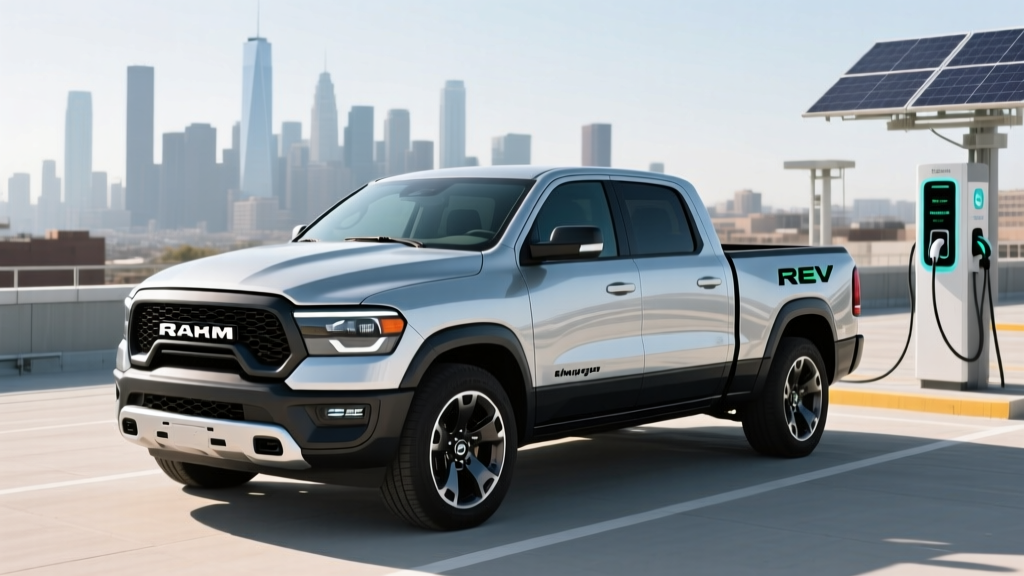
Understanding the 2026 Ram 1500 Electrified Lineup: REV vs. Ramcharger
Before we get to numbers, let's clear up the terminology. When buyers search for a "Ram hybrid 1500," they're usually looking for a truck that blends electric and gas power. Ram offers that — but in a configuration most shoppers don't anticipate.
Ram 1500 REV (Battery Electric)
- Type: Battery Electric Vehicle (BEV) — no gasoline engine
- Drivetrain: Dual-motor AWD, battery-only propulsion
- Refueling: Plug-in charging only (Level 2 and DC fast charge)
- Best for: Drivers with reliable home charging who want zero tailpipe emissions
Ram 1500 Ramcharger (EREV)
- Type: Extended-Range Electric Vehicle (EREV) — series hybrid
- Drivetrain: Electric motors drive the wheels; 3.6L V6 acts as a generator only
- Refueling: Plug-in charging + gasoline tank extends total range
- Best for: Drivers who want electric daily commuting with gas backup for towing and road trips
The critical distinction: in the Ramcharger, the gasoline engine never directly drives the wheels. It functions solely as an onboard generator to recharge the battery when it depletes. This is fundamentally different from a conventional hybrid (like the old Ram 1500 eTorque mild-hybrid, which used a small motor-generator to assist the gas engine) or a parallel PHEV (like the Jeep Wrangler 4xe, where both the engine and motor can drive the wheels). The Ramcharger's driving feel is always electric — smooth, instant torque — even when the V6 generator is running.
Ram 1500 Ramcharger: Electric Range, MPG, and Powertrain Specs
The Ramcharger is the model that most closely matches what "Ram hybrid 1500" shoppers are looking for. Here's what the powertrain delivers:
| Specification | Ram 1500 Ramcharger |
|---|---|
| Powertrain Type | Series-hybrid EREV (electric drive + gas generator) |
| Battery Capacity | 92 kWh (usable) |
| Battery Chemistry | NMC (nickel manganese cobalt) |
| Electric Motors | Dual-motor AWD (front and rear e-axles) |
| Combined Horsepower | 663 hp |
| Combined Torque | 615 lb-ft |
| Gasoline Engine (Generator) | 3.6L Pentastar V6 (not mechanically linked to wheels) |
| Fuel Tank Capacity | ~26 gallons |
| EPA Electric-Only Range | ~145 miles (estimated, pending final EPA certification) |
| Total Combined Range | ~690 miles (est.) |
| 0–60 mph | 4.4 seconds |
| Max Towing Capacity | 14,000 lbs (est.) |
| Max Payload | ~2,625 lbs (est.) |
| DC Fast Charge Peak Rate | Not capable of DC fast charging (Level 2 AC only) |
| Level 2 AC Charge Rate | ~11.5 kW onboard charger |
| Level 2 Charge Time (0–100%) | ~8.5 hours |
How Far Can the Ramcharger Go on Electric Only?
Ram targets approximately 145 miles of electric-only range from the 92 kWh battery pack. For context, that's enough to cover the daily commute and errands for the vast majority of truck owners without burning a drop of gasoline. The average American drives roughly 37 miles per day, so most Ramcharger owners could go weeks between fill-ups if they charge at home nightly.
Once the battery depletes to a predetermined buffer threshold, the 3.6L V6 generator kicks in. You won't feel a dramatic transition — the electric motors continue to drive the wheels, and the generator hum is well-insulated. Total combined range (electric + gas) is estimated at around 690 miles, which is competitive with conventional gas trucks on long road trips.
MPG and Efficiency: What to Expect
Because the Ramcharger is an EREV, its efficiency metrics work differently than a conventional hybrid:
| Driving Mode | Efficiency |
|---|---|
| Electric-only (charge-depleting) | ~2.0 kWh/mile (~72 MPGe combined, est.) |
| Charge-sustaining (gas generator running) | ~18–21 MPG combined (est.) |
| Combined (blended electric + gas) | Varies heavily by driving pattern and charge frequency |
The real-world efficiency story depends entirely on your charging habits. If you plug in every night and drive under 145 miles daily, you may use almost no gasoline for months. If you never plug in, you're essentially driving a heavy series-hybrid that gets roughly the same fuel economy as a conventional V6 Ram 1500 — maybe slightly worse due to the energy conversion losses of running a generator to power electric motors. The Ramcharger rewards plug-in behavior; without it, you're carrying dead battery weight.
Hybrid Battery Warranty
Ram is expected to cover the Ramcharger's high-voltage battery with a warranty of 8 years or 100,000 miles (whichever comes first), consistent with federal requirements for hybrid and EV battery packs under the EPA's emissions-related warranty provisions. The warranty typically guarantees the battery will retain at least 70% of its original capacity. Always confirm specific terms with your dealer at purchase, as final warranty details for the 2026 Ramcharger are subject to official Ram publication.
Ram 1500 REV: The All-Electric Option
If your search for a Ram hybrid 1500 is actually a search for an electrified Ram truck and you have home charging dialed in, the REV is the fully electric alternative. Here are the key specs:
| Specification | Ram 1500 REV (Standard Range) | Ram 1500 REV (Long Range) |
|---|---|---|
| Battery Capacity | 168 kWh | 229 kWh |
| EPA Range (Est.) | ~350 miles | ~500 miles |
| DC Fast Charge Peak | Up to 350 kW (800V architecture) | Up to 350 kW (800V architecture) |
| 10–80% DC Fast Charge | ~20 minutes (est.) | ~30 minutes (est.) |
| Combined Horsepower | 654 hp | 654 hp |
| 0–60 mph | 4.4 seconds | 4.4 seconds |
| Max Towing | 14,000 lbs | 14,000 lbs |
The REV's 800-volt architecture is a standout feature, enabling DC fast charging at up to 350 kW on compatible infrastructure — meaning a 10–80% charge in roughly 20 minutes for the standard-range pack. That's genuinely road-trip-viable on networks like Electrify America's 350 kW stations. However, real-world charge curves taper significantly above 80%, so plan for 25–35 minutes at a stop if you want a full 10–90% top-up.
Range caveat: the 500-mile Long Range estimate is an ambitious target. Expect real-world highway driving at 70+ mph to yield closer to 350–400 miles, and cold-weather (below 30°F) driving could reduce that by another 15–25%. The standard-range 350-mile pack will realistically deliver 270–310 miles on the highway.
Pricing and Federal Tax Credit Eligibility
Pricing for the 2026 Ram 1500 electrified lineup positions both trucks in the premium half-ton segment. Final MSRP figures by trim are subject to Ram's official release, but here's what to expect based on announced pricing tiers:
- Ram 1500 Ramcharger: Starting MSRP expected from approximately $60,000–$65,000 (base Tradesman/Laramie trims), climbing to $75,000+ for fully loaded Limited/Tungsten trims.
- Ram 1500 REV: Starting MSRP expected from approximately $58,000–$63,000 (standard range), with Long Range and top trims reaching $85,000+.
Federal §30D Tax Credit: Do You Qualify?
Under current IRS rules for the Clean Vehicle Credit (§30D), eligible buyers can receive up to $7,500 — but qualification is not automatic. The rules are strict and change periodically:
- MSRP Cap: Trucks/vans/SUVs must have an MSRP at or below $80,000. Higher-trim Ram models may exceed this cap.
- Income Limits: Modified adjusted gross income (MAGI) must not exceed $300,000 (joint filers), $225,000 (head of household), or $150,000 (single filers).
- Battery Sourcing: The credit is split into two halves — $3,750 for meeting critical minerals requirements and $3,750 for meeting battery component manufacturing requirements. Sourcing rules tighten annually, and many 2026 vehicles may only qualify for $3,750 or $0 depending on supply chain compliance.
- Point-of-Sale Transfer: Eligible buyers can transfer the credit to the dealer at purchase, reducing the out-of-pocket cost immediately rather than waiting to claim it on a tax return.
- Assembly: Vehicle must undergo final assembly in North America (Ram 1500 models are assembled in Sterling Heights, Michigan — this requirement is met).
Always verify current eligibility on the IRS website and consult a tax professional before assuming the full $7,500. Battery sourcing requirements have disqualified many vehicles in prior model years, and 2026 rules are even stricter.
Who Should Buy the Ramcharger vs. the REV vs. a Gas Truck?
Choose the Ram 1500 Ramcharger If:
- You want electric daily driving but regularly tow heavy loads or take long road trips where charging infrastructure is unreliable
- You have home Level 2 charging access but don't want to depend on public DC fast chargers for travel
- You value 663 hp and 615 lb-ft of instant electric torque but need the range safety net of a gas generator
- You drive 50–140 miles daily and can charge nightly — you'll use very little gasoline
Choose the Ram 1500 REV If:
- You have reliable home charging (Level 2) and your typical daily driving is under 250 miles
- You want zero tailpipe emissions and the lowest per-mile "fuel" cost (electricity vs. gasoline)
- You're willing to plan road trips around DC fast-charging stops
- You want the maximum available range from a battery-electric truck (~500 miles Long Range)
Stick With a Conventional Gas Ram 1500 If:
- You have no access to home or workplace charging of any kind
- You frequently tow at maximum capacity in remote areas with no charging infrastructure
- Your budget is below $50,000 — the electrified Rams carry a significant price premium over base gas models
Reliability, Battery Longevity, and Replacement Costs
The Ramcharger's powertrain introduces a unique reliability profile. On one hand, the 3.6L Pentastar V6 is one of Stellantis's most proven engines, with millions of units on the road. Because it operates only as a generator — never directly driving the wheels under varying load conditions — it runs at more consistent RPMs, which could theoretically extend its lifespan compared to a conventional engine application.
On the other hand, the 92 kWh NMC battery pack and dual electric motors represent complex, high-voltage systems that are new to the Ram 1500 platform. Long-term reliability data for the Ramcharger specifically doesn't exist yet since this is a new model. For context, NMC batteries in other Stellantis EVs and hybrids have shown typical degradation of 5–10% over the first 100,000 miles based on industry averages, though real-world Ramcharger data will take years to accumulate.
Battery Replacement Cost
If the high-voltage battery requires full replacement outside of warranty, expect a significant expense. Based on current NMC battery pack pricing of approximately $130–$150 per kWh at the pack level, a 92 kWh Ramcharger replacement could cost $12,000–$18,000 including labor. The REV's much larger 168–229 kWh packs would be substantially more — potentially $22,000–$35,000+. These figures are estimates based on industry replacement costs and may vary. The 8-year/100,000-mile warranty should protect most first owners from this scenario entirely.
Charging at Home: What Ramcharger and REV Owners Need
| Charging Level | Power | Ramcharger (Miles Added/Hour) | REV Standard Range (Miles Added/Hour) |
|---|---|---|---|
| Level 1 (120V outlet) | ~1.4 kW | ~4–5 mi/hr | ~3–4 mi/hr |
| Level 2 (240V, 48A) | ~11.5 kW | ~35–40 mi/hr | ~28–32 mi/hr |
| DC Fast Charge | Up to 350 kW (REV only) | N/A — not supported | Up to ~200+ mi in 20 min |
A critical detail for Ramcharger shoppers: the Ramcharger does not support DC fast charging. It charges exclusively via Level 1 (standard 120V outlet) or Level 2 (240V home/public charger). This means a full home charge takes roughly 8.5 hours on Level 2 — fine for overnight charging, but you cannot quickly top up the battery at a highway rest stop. Once the battery is depleted on a road trip, you're running on the gas generator until you can plug in at your destination.
For the REV, the 800V DC fast-charging capability is a major advantage for road trippers. At a 350 kW Electrify America or compatible station, the standard-range pack can add roughly 150–200 miles of range in 20 minutes.
Home Level 2 installation typically costs $800–$2,500 for the charger unit and electrician labor, assuming your electrical panel has sufficient capacity. A 200-amp panel is usually adequate; older homes with 100-amp service may need a $1,500–$3,000 panel upgrade. Always get a quote from a licensed electrician before purchasing.
Real-World Ownership: Pros and Cons
Pros
- Ramcharger's 145-mile electric range covers most daily driving without gasoline
- 663 hp and 4.4-second 0–60 in the Ramcharger — genuinely quick for a full-size truck
- Total range of ~690 miles eliminates range anxiety on road trips
- REV's 350 kW DC fast charging is among the fastest in the truck segment
- Proven 3.6L V6 as generator (Ramcharger) reduces powertrain risk
- 14,000-lb towing capacity is competitive with conventional Ram 1500
- Qualifies for up to $7,500 federal tax credit (eligibility-dependent)
Cons
- Ramcharger lacks DC fast charging — no quick public top-ups
- Starting prices near $60,000+ represent a significant premium over gas Ram 1500
- Charge-sustaining MPG (~18–21) is unremarkable if you rarely plug in
- 92 kWh battery replacement cost ($12K–$18K) is a long-term risk
- Real-world electric range will drop 15–25% in cold weather
- Heavy battery pack increases tire wear and may affect payload
- Tax credit eligibility uncertain due to tightening battery sourcing rules
Frequently Asked Questions
How many MPG does the Ram 1500 Ramcharger get?
When operating on electric power alone, the Ramcharger doesn't consume gasoline — its efficiency is measured in MPGe (estimated ~72 MPGe combined). When the gas generator is running in charge-sustaining mode, expect approximately 18–21 MPG combined. Your actual fuel consumption depends entirely on how often you plug in. Drivers who charge nightly and stay under 145 miles daily may go months between fill-ups.
How far can the Ramcharger go on electric only?
Ram targets approximately 145 miles of electric-only range from the 92 kWh battery. In real-world conditions — especially highway driving at 70+ mph or in cold weather below 30°F — expect that to drop to roughly 110–125 miles. Once depleted, the V6 generator extends total range to an estimated 690 miles combined.
Is the Ram 1500 Ramcharger a hybrid or a plug-in hybrid?
Technically, it's an Extended-Range Electric Vehicle (EREV), which is a type of series hybrid. Unlike a conventional hybrid (HEV) that you never plug in, the Ramcharger has a large battery you charge via a plug. Unlike a traditional PHEV (where the engine and motor both drive the wheels), the Ramcharger's gas engine only generates electricity — it never mechanically drives the wheels. The driving experience is always electric.
Does the Ramcharger qualify for the $7,500 federal tax credit?
It may, depending on your income, the specific trim's MSRP (must be ≤$80,000 for trucks), and whether the battery meets current-year critical minerals and component sourcing requirements under IRS §30D rules. Eligibility changes as sourcing requirements tighten. Verify on the IRS website and with a tax professional before purchasing. The credit can be transferred to the dealer at point of sale if you qualify.
Can I DC fast charge the Ramcharger on a road trip?
No. The Ramcharger only supports Level 1 (120V) and Level 2 (240V) AC charging. It does not have DC fast-charge capability. On road trips, once the battery depletes, the gas generator provides range — you simply refuel at any gas station. If you want fast-charging capability, the fully electric Ram 1500 REV supports up to 350 kW DC fast charging.
Is the Ram 1500 hybrid reliable? What about battery replacement cost?
Long-term reliability data is not yet available since the Ramcharger is a new model. The 3.6L Pentastar V6 generator engine is well-proven. The high-voltage battery is covered by an expected 8-year/100,000-mile warranty. Out-of-warranty battery replacement for the 92 kWh pack is estimated at $12,000–$18,000, which is a significant long-term cost consideration for second owners.
How does the Ramcharger compare to the Ford F-150 PowerBoost hybrid?
The Ford F-150 PowerBoost is a conventional full hybrid (HEV) — you never plug it in, it gets roughly 22–25 MPG combined, and it has a small electric motor assisting the gas engine. The Ramcharger is fundamentally different: it's a plug-in electric vehicle with 145 miles of electric range and a gas generator for backup. The Ramcharger offers far more electric-only driving, more horsepower (663 vs. 430), but costs significantly more and requires plug-in charging to realize its efficiency advantage.
Finding a Ram hybrid 1500 for sale in 2026 means choosing between two very different electrified strategies. The Ramcharger rewards daily plug-in habits with electric commuting and gas-generator security for towing and road trips. The REV goes all-in on battery electric with industry-leading DC fast charging. Neither is a traditional hybrid, and both carry premium pricing — but for the right buyer, either can dramatically reduce gasoline consumption while delivering the performance and capability Ram 1500 owners expect.